Bhagavad Gita 1.16: meaning and translation
Chapter 1: Arjuna Vishada Yoga. Sanjaya says
Sanjaya: King Yudhishthira, the son of Kunti, blows Anantavijaya; Nakula and Sahadeva blow Sughosha and Manipushpaka.
Click or tap a word for its meaning and its dictionary page.
Text and layers
Text and layers
These choices stay in this browser.
Bhagavad Gita 1.16
अनन्तविजयं राजा कुन्तीपुत्रो युधिष्ठिरः ।नकुलः सहदेवश्च सुघोषमणिपुष्पकौ ॥
Anantavijayam raja kuntiputro yudhishthirahNakulah sahadevashcha sughoshamanipushpakau
anantavijayaṃ rājā kuntīputro yudhiṣṭhiraḥ |nakulaḥ sahadevaśca sughoṣamaṇipuṣpakau ||
Our explanation King Yudhishthira, the son of Kunti, blows Anantavijaya; Nakula and Sahadeva blow Sughosha and Manipushpaka. Besant's footnote gives the names as "Endless Victory", "Honey-tone" and "Jewel-blossom". With Bhima and Arjuna, these are the five Pandava brothers.
हिंदी अर्थ कुन्तीपुत्र राजा युधिष्ठिर अनन्तविजय शंख बजाते हैं, और नकुल तथा सहदेव सुघोष और मणिपुष्पक। बेसेंट की टिप्पणी में इन नामों के अर्थ दिए हैं: “अनंत विजय”, “मधुर स्वर” और “रत्न-पुष्प”। भीम और अर्जुन के साथ ये पाँचों पाण्डव भाई हैं।
Word by word
Every word, with its dictionary page
Word by word
- अनन्तविजयम् anantavijayam · Anantavijaya (Yudhishthira's conch) (noun (masculine), accusative singular) Dictionary: ananta-vijaya, Monier-Williams 1899, p. 25, col. 1 “N. of Yudhishṭhira's conch-shell”
- राजा rājā · the king (noun (masculine), nominative singular) Dictionary: 1. rājan, Monier-Williams 1899, p. 874, col. 3 “a king, sovereign, prince, chief”
- कुन्तीपुत्रः kuntīputraḥ · the son of Kunti (compound (masculine), nominative singular) Dictionary: kuntī, Monier-Williams 1899, p. 291, col. 1 “N. of Pṛithā”; putra, Monier-Williams 1899, p. 632, col. 3 “a son, child”
- युधिष्ठिरः yudhiṣṭhiraḥ · Yudhishthira (noun (masculine), nominative singular) Dictionary: yudhi-ṣṭhira, Monier-Williams 1899, p. 855, col. 1 “N. of the eldest of the 5 reputed sons of Pāṇḍu”
- नकुलः nakulaḥ · Nakula (noun (masculine), nominative singular) Dictionary: nakula, Monier-Williams 1899, p. 523, col. 3 “a son of the Aśvins and Mādrī (twin-brother of Saha-deva & fourth of the Pāṇḍu princes)”
- सहदेवः sahadevaḥ · Sahadeva (noun (masculine), nominative singular) Dictionary: saha-deva, Monier-Williams 1899, p. 1194, col. 1 “the youngest of the five Pāṇḍava princes”
- च ca · and (indeclinable) Dictionary: 2. ca, Monier-Williams 1899, p. 380, col. 1 “ind. and, both, also, moreover, as well as”
- सुघोषमणिपुष्पकौ sughoṣamaṇipuṣpakau · Sughosha and Manipushpaka (their conches) (compound (masculine), accusative dual) Dictionary: su-ghoṣa, Monier-Williams 1899, p. 1223, col. 1 “making a loud noise, very noisy, MBh.; having a pleasant sound”; maṇi-puṣpaka, Monier-Williams 1899, p. 775, col. 1 “N. of the conch-shell of Saha-deva”
Old translations
Kashinath Trimbak Telang, 1882. Public domain. Page 38–39.
King Yudhishthira, the son of Kuntî1, blew the Anantavigaya, and Nakula and Sahadeva (respectively) the Sughosha and Manipushpaka.
Footnotes (the translator’s own) - So called, par excellence, apparently. ↩
Compare 3 translations
Kashinath Trimbak Telang, 1882. Public domain. Page 38–39.
King Yudhishthira, the son of Kuntî1, blew the Anantavigaya, and Nakula and Sahadeva (respectively) the Sughosha and Manipushpaka.
Footnotes (the translator’s own) - So called, par excellence, apparently. ↩
You are reading this one
Annie Besant, 1895. Public domain. Page 16–17.
The Râjâ, the son of Kuntî, Yudhishthira, [blew] Anantavïjaya; Nakula and Sahadeva Sughosha and Manipushpaka.1
This sentence begins in 1.14.
Footnotes (the translator’s own) - The conches of the remaining three brothers were named respectively, "Endless Victory," "Honey-tone" and "Jewel-blossom." ↩
You are reading this one
Swami Swarupananda, 1909 (first printed 1907). Public domain. Page 9.
King Yudhishthira, son of Kunti, blew the conch named Anantavijaya, and Nakula and Sahadeva their Sughosha and Manipushpaka.
You are reading this one
Cite this verse
The translation: K. T. Telang, The Bhagavadgîtâ (The Sacred Books of the East, vol. VIII, Oxford: Clarendon Press, 1882), pp. 38–39. Bhagavad Gita 1.16.
The translation: Annie Besant, The Bhagavad Gîtâ, or The Lord's Song (London: Theosophical Publishing Society, 1895), pp. 16–17. Bhagavad Gita 1.16.
The translation: Swami Swarupananda, Srimad-Bhagavad-Gita (Mayavati: Prabuddha Bharata Press, 1909; first printed in Prabuddha Bharata, 1907–1909), p. 9. Bhagavad Gita 1.16.
Our explanation: “Bhagavad Gita 1.16: meaning and translation.” Pujadeep. Updated October 25, 2026. https://pujadeep.com/bhagavad-gita/1/16/
Pujadeep’s explanations are free to quote with credit: name Pujadeep and link to the page. How to credit
Classical readings, by school
No readings by school on this verse yet.
Share
Show the ways to share
Send one picture or the text to one chat. The picture names its source and the address of this page.
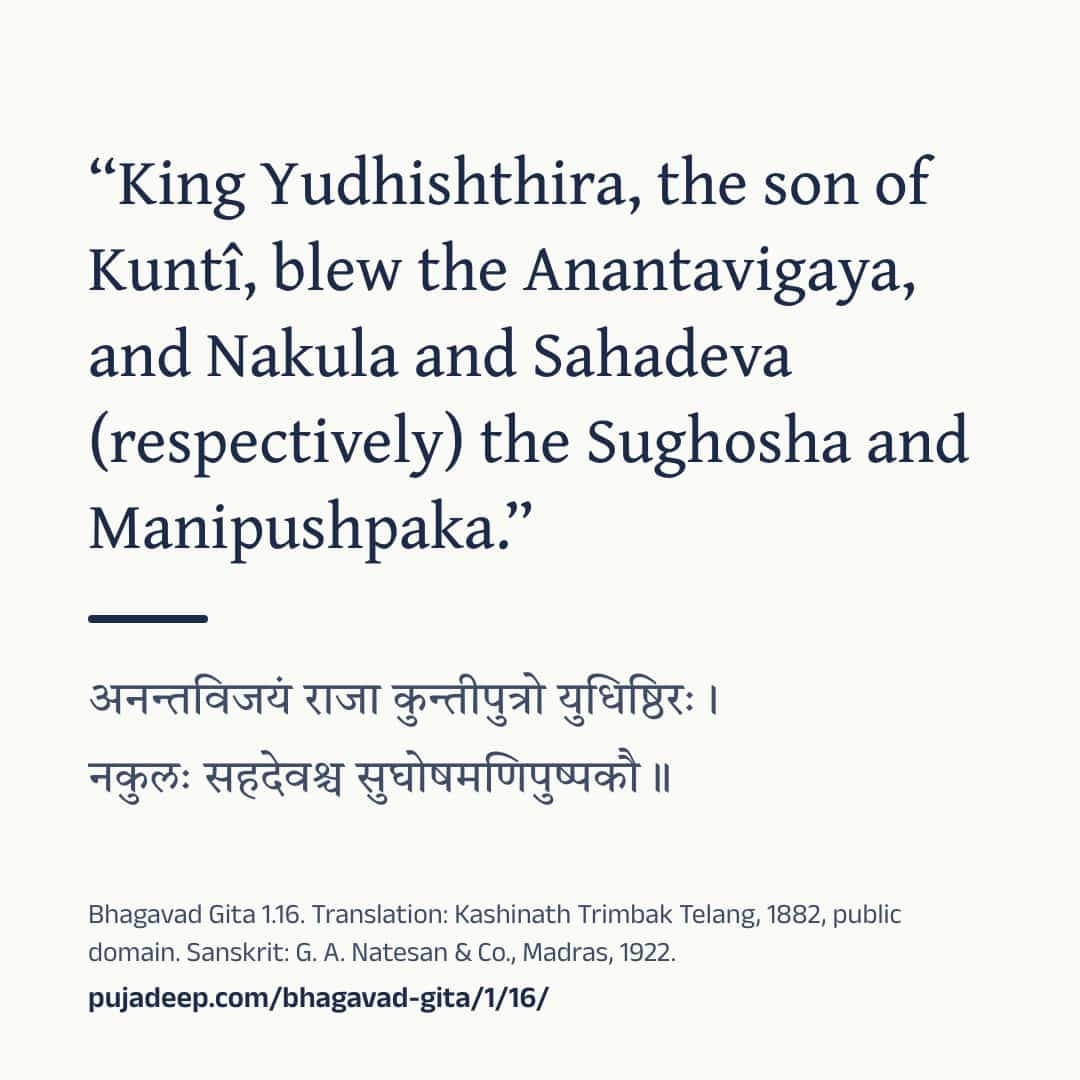
Drawing the picture
See the words
Bhagavad Gita 1.16

अनन्तविजयं राजा कुन्तीपुत्रो युधिष्ठिरः ।
नकुलः सहदेवश्च सुघोषमणिपुष्पकौ ॥

“King Yudhishthira, the son of Kuntî, blew the Anantavigaya, and Nakula and Sahadeva (respectively) the Sughosha and Manipushpaka.”
(K. T. Telang, The Bhagavadgîtâ (The Sacred Books of the East, vol. VIII, Oxford: Clarendon Press, 1882), pp. 38–39, public domain)

“The Râjâ, the son of Kuntî, Yudhishthira, [blew] Anantavïjaya; Nakula and Sahadeva Sughosha and Manipushpaka.”
(Annie Besant, The Bhagavad Gîtâ, or The Lord's Song (London: Theosophical Publishing Society, 1895), pp. 16–17, public domain)
This sentence begins in 1.14.

“King Yudhishthira, son of Kunti, blew the conch named Anantavijaya, and Nakula and Sahadeva their Sughosha and Manipushpaka.”
(Swami Swarupananda, Srimad-Bhagavad-Gita (Mayavati: Prabuddha Bharata Press, 1909; first printed in Prabuddha Bharata, 1907–1909), p. 9, public domain)

Sanskrit: G. A. Natesan & Co., Madras, 1922.
https://pujadeep.com/bhagavad-gita/1/16/ Nothing is sent from this site. Your own app sends it, to the chat you choose. The picture quotes the translation you chose on this page, with its name and year.
Sanskrit text: The Bhagavad-Gita, or The Lord's Song, with the text in Devanagari and an English translation, 1922. Meanings: written for Pujadeep and checked against the cited edition. Source and changes
Questions families ask
Who speaks Bhagavad Gita 1.16?
Sanjaya speaks this verse, in chapter 1 (Arjuna Vishada Yoga).
Where does the Sanskrit text come from?
Sanskrit text: The Bhagavad-Gita, or The Lord's Song, with the text in Devanagari and an English translation, 1922. Meanings: written for Pujadeep and checked against the cited edition. See the source
Is the meaning on this page a translation?
Explanation written for this site from the sources listed here, and checked against the cited edition. It is not a translation and not the only way to read the text. Free to quote with credit.
Source and licence
- Sanskrit text
- The Bhagavad-Gita, or The Lord's Song, with the text in Devanagari and an English translation (Annie Besant, G. A. Natesan & Co., Madras, 1922). Public domain. The Sanskrit on these pages was read from this printing’s page images.
- Translation
- The Bhagavadgîtâ with the Sanatsugâtîya and the Anugîtâ, translated by Kâshinâth Trimbak Telang (The Sacred Books of the East, vol. VIII, ed. F. Max Müller) (Kashinath Trimbak Telang, F. Max Müller, Clarendon Press, Oxford, 1882). Public domain. Shown verbatim, as printed.
- Translation
- The Bhagavad Gîtâ, or The Lord's Song, translated by Annie Besant (Annie Besant, Theosophical Publishing Society, London, 1895). Public domain. Shown verbatim, as printed.
- Translation
- Srimad-Bhagavad-Gita, with Sanskrit Text; Paraphrase with Word-by-word Literal Translation; English Rendering and Comments, Index, &c., by the Swami Swarupananda (Himalayan Series, No. XX) (Swami Swarupananda, The Editors and Publishers, Advaita Ashrama, Mayavati, Prabuddha Bharata Press, Mayavati, Almora, Himalayas, 1909). Public domain. Shown verbatim, as printed.
- Common wording
- In this text, 32 words follow today's common wording, checked against sanskritdocuments.org; Sanskrit Wikisource; Gita Press, Gorakhpur; GRETIL, Göttingen and Bhaktivedanta Book Trust.
- Our explanation
- Explanation written for this site from the sources listed here, and checked against the cited edition. It is not a translation and not the only way to read the text. Free to quote with credit.
- Checked
- Checked against the cited edition, October 15, 2026.
- Updated
- October 25, 2026