Bhagavad Gita 1.23: meaning and translation
Chapter 1: Arjuna Vishada Yoga. Arjuna says
Arjuna: He wants to see those who have gathered here to fight because they wish to please Duryodhana, the evil-minded son of Dhritarashtra.
Click or tap a word for its meaning and its dictionary page.
Text and layers
Text and layers
These choices stay in this browser.
Bhagavad Gita 1.23
योत्स्यमानानवेक्षेऽहं य एतेऽत्र समागताः ।धार्तराष्ट्रस्य दुर्बुद्धेर्युद्धे प्रियचिकीर्षवः ॥
Yotsyamananaveksheham ya etetra samagatahDhartarashtrasya durbuddheryuddhe priyachikirshavah
yotsyamānānavekṣe’haṃ ya ete’tra samāgatāḥ |dhārtarāṣṭrasya durbuddheryuddhe priyacikīrṣavaḥ ||
Our explanation He wants to see those who have gathered here to fight because they wish to please Duryodhana, the evil-minded son of Dhritarashtra.
हिंदी अर्थ वे उन लोगों को देखना चाहते हैं जो दुर्बुद्धि दुर्योधन (धृतराष्ट्र के पुत्र) को युद्ध में प्रसन्न करने की इच्छा से यहाँ लड़ने आए हैं।
Word by word
Every word, with its dictionary page
Word by word
- योत्स्यमानान् yotsyamānān · those about to fight (future participle (masculine), accusative plural) Dictionary: 1. yudh, Monier-Williams 1899, p. 854, col. 3 “to fight, wage war”
- अवेक्षे avekṣe · "I may see" (present, 1st person singular) Dictionary: avekṣ, Monier-Williams 1899, p. 111, col. 1 “have regard to, take into consideration”
- अहम् aham · "I" (pronoun, nominative singular) Dictionary: aham, Monier-Williams 1899, p. 124, col. 2 “nom. sg. ‘I,’”
- ये ye · who (pronoun (masculine), nominative plural) Dictionary: yad, Monier-Williams 1899, p. 844, col. 2 “who, which, what, whichever, whatever, that”
- एते ete · these (pronoun (masculine), nominative plural) Dictionary: etad, Monier-Williams 1899, p. 231, col. 2 “this, this here, here”
- अत्र atra · here (indeclinable) Dictionary: 1. a-tra, Monier-Williams 1899, p. 17, col. 2 “in this place, here”
- समागताः samāgatāḥ · have gathered (past participle (masculine), nominative plural) Dictionary: sam-āgata, Monier-Williams 1899, p. 1159, col. 1 “come together, met, encountered, joined, assembled”
- धार्तराष्ट्रस्य dhārtarāṣṭrasya · of the son of Dhritarashtra (Duryodhana) (noun (masculine), genitive singular) Dictionary: dhārta-rāṣṭra, Monier-Williams 1899, p. 516, col. 1 “a son of Dhṛ°, a Kuru”
- दुर्बुद्धेः durbuddheḥ · of evil mind (adjective (masculine), genitive singular) Dictionary: dur-buddhi, Monier-Williams 1899, p. 486, col. 1 “silly, foolish, ignorant, malignant”
- युद्धे yuddhe · in battle (noun (neuter), locative singular) Dictionary: yuddha, Monier-Williams 1899, p. 854, col. 3 “battle, fight, war”
- प्रियचिकीर्षवः priyacikīrṣavaḥ · wishing to please (compound (masculine), nominative plural) Dictionary: priya, Monier-Williams 1899, p. 710, col. 1 “beloved, dear to (gen., loc., dat. or comp.), liked, favourite”; cikīrṣu, Monier-Williams 1899, p. 394, col. 3 “intending to make or do or perform”
Old translations
Kashinath Trimbak Telang, 1882. Public domain. Page 39.
I will observe those who are assembled here and who are about to engage in battle, wishing to do service in battle1 to the evil-minded son of Dhritarâshtra.'
Footnotes (the translator’s own) - In the original, several derivatives from the root yudh, meaning 'to fight,' occur with the same frequency as 'battle' here. ↩
Compare 3 translations
Kashinath Trimbak Telang, 1882. Public domain. Page 39.
I will observe those who are assembled here and who are about to engage in battle, wishing to do service in battle1 to the evil-minded son of Dhritarâshtra.'
Footnotes (the translator’s own) - In the original, several derivatives from the root yudh, meaning 'to fight,' occur with the same frequency as 'battle' here. ↩
You are reading this one
Annie Besant, 1895. Public domain. Page 18.
And gaze on those here gathered together, ready to fight, desirous of pleasing the evil-minded son of Dhritarâshtra."
This sentence begins in 1.20.
You are reading this one
Swami Swarupananda, 1909 (first printed 1907). Public domain. Page 12.
For I desire to observe those who are assembled here for fight, wishing to please the evil-minded Duryodhana by taking his part on this battle-field.
You are reading this one
Cite this verse
The translation: K. T. Telang, The Bhagavadgîtâ (The Sacred Books of the East, vol. VIII, Oxford: Clarendon Press, 1882), p. 39. Bhagavad Gita 1.23.
The translation: Annie Besant, The Bhagavad Gîtâ, or The Lord's Song (London: Theosophical Publishing Society, 1895), p. 18. Bhagavad Gita 1.23.
The translation: Swami Swarupananda, Srimad-Bhagavad-Gita (Mayavati: Prabuddha Bharata Press, 1909; first printed in Prabuddha Bharata, 1907–1909), p. 12. Bhagavad Gita 1.23.
Our explanation: “Bhagavad Gita 1.23: meaning and translation.” Pujadeep. Updated October 25, 2026. https://pujadeep.com/bhagavad-gita/1/23/
Pujadeep’s explanations are free to quote with credit: name Pujadeep and link to the page. How to credit
Classical readings, by school
No readings by school on this verse yet.
Share
Show the ways to share
Send one picture or the text to one chat. The picture names its source and the address of this page.
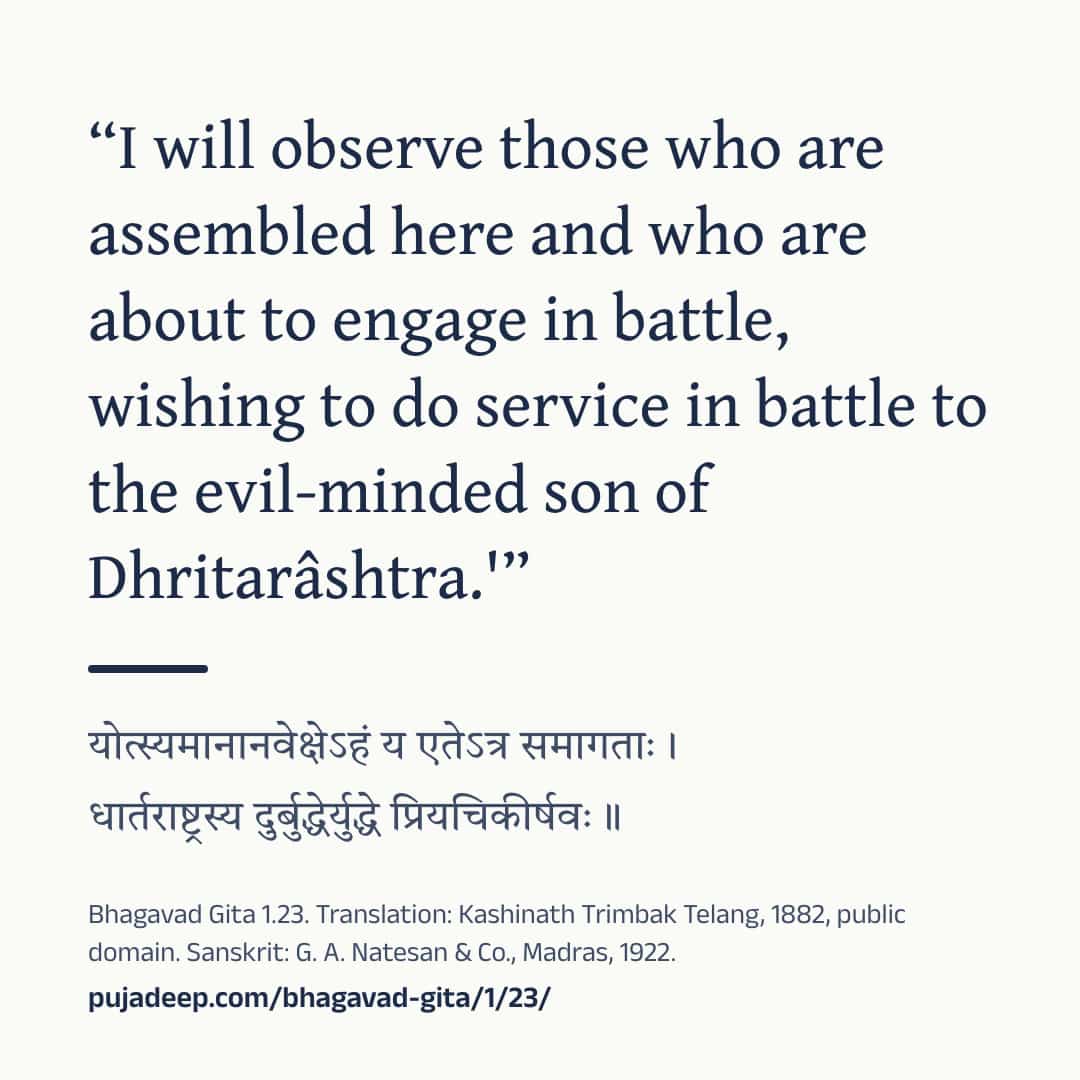
Drawing the picture
See the words
Bhagavad Gita 1.23

योत्स्यमानानवेक्षेऽहं य एतेऽत्र समागताः ।
धार्तराष्ट्रस्य दुर्बुद्धेर्युद्धे प्रियचिकीर्षवः ॥

“I will observe those who are assembled here and who are about to engage in battle, wishing to do service in battle to the evil-minded son of Dhritarâshtra.'”
(K. T. Telang, The Bhagavadgîtâ (The Sacred Books of the East, vol. VIII, Oxford: Clarendon Press, 1882), p. 39, public domain)

“And gaze on those here gathered together, ready to fight, desirous of pleasing the evil-minded son of Dhritarâshtra."”
(Annie Besant, The Bhagavad Gîtâ, or The Lord's Song (London: Theosophical Publishing Society, 1895), p. 18, public domain)
This sentence begins in 1.20.

“For I desire to observe those who are assembled here for fight, wishing to please the evil-minded Duryodhana by taking his part on this battle-field.”
(Swami Swarupananda, Srimad-Bhagavad-Gita (Mayavati: Prabuddha Bharata Press, 1909; first printed in Prabuddha Bharata, 1907–1909), p. 12, public domain)

Sanskrit: G. A. Natesan & Co., Madras, 1922.
https://pujadeep.com/bhagavad-gita/1/23/ Nothing is sent from this site. Your own app sends it, to the chat you choose. The picture quotes the translation you chose on this page, with its name and year.
Sanskrit text: The Bhagavad-Gita, or The Lord's Song, with the text in Devanagari and an English translation, 1922. Meanings: written for Pujadeep and checked against the cited edition. Source and changes
Questions families ask
Who speaks Bhagavad Gita 1.23?
Arjuna speaks this verse, in chapter 1 (Arjuna Vishada Yoga).
Where does the Sanskrit text come from?
Sanskrit text: The Bhagavad-Gita, or The Lord's Song, with the text in Devanagari and an English translation, 1922. Meanings: written for Pujadeep and checked against the cited edition. See the source
Is the meaning on this page a translation?
Explanation written for this site from the sources listed here, and checked against the cited edition. It is not a translation and not the only way to read the text. Free to quote with credit.
Source and licence
- Sanskrit text
- The Bhagavad-Gita, or The Lord's Song, with the text in Devanagari and an English translation (Annie Besant, G. A. Natesan & Co., Madras, 1922). Public domain. The Sanskrit on these pages was read from this printing’s page images.
- Translation
- The Bhagavadgîtâ with the Sanatsugâtîya and the Anugîtâ, translated by Kâshinâth Trimbak Telang (The Sacred Books of the East, vol. VIII, ed. F. Max Müller) (Kashinath Trimbak Telang, F. Max Müller, Clarendon Press, Oxford, 1882). Public domain. Shown verbatim, as printed.
- Translation
- The Bhagavad Gîtâ, or The Lord's Song, translated by Annie Besant (Annie Besant, Theosophical Publishing Society, London, 1895). Public domain. Shown verbatim, as printed.
- Translation
- Srimad-Bhagavad-Gita, with Sanskrit Text; Paraphrase with Word-by-word Literal Translation; English Rendering and Comments, Index, &c., by the Swami Swarupananda (Himalayan Series, No. XX) (Swami Swarupananda, The Editors and Publishers, Advaita Ashrama, Mayavati, Prabuddha Bharata Press, Mayavati, Almora, Himalayas, 1909). Public domain. Shown verbatim, as printed.
- Common wording
- In this text, 32 words follow today's common wording, checked against sanskritdocuments.org; Sanskrit Wikisource; Gita Press, Gorakhpur; GRETIL, Göttingen and Bhaktivedanta Book Trust.
- Our explanation
- Explanation written for this site from the sources listed here, and checked against the cited edition. It is not a translation and not the only way to read the text. Free to quote with credit.
- Checked
- Checked against the cited edition, October 15, 2026.
- Updated
- October 25, 2026