Bhagavad Gita 1.29: meaning and translation
Chapter 1: Arjuna Vishada Yoga. Arjuna says
Arjuna describes what is happening to his body: his limbs give way, his mouth is dry, his body trembles and his hair stands on end.
Click or tap a word for its meaning and its dictionary page.
Text and layers
Text and layers
These choices stay in this browser.
Bhagavad Gita 1.29
सीदन्ति मम गात्राणि मुखं च परिशुष्यति ।वेपथुश्च शरीरे मे रोमहर्षश्च जायते ॥
Sidanti mama gatrani mukham cha parishushyatiVepathushcha sharire me romaharshashcha jayate
sīdanti mama gātrāṇi mukhaṃ ca pariśuṣyati |vepathuśca śarīre me romaharṣaśca jāyate ||
Our explanation Arjuna describes what is happening to his body: his limbs give way, his mouth is dry, his body trembles and his hair stands on end. Grief is felt in the body, not only in the mind.
हिंदी अर्थ अर्जुन बताते हैं कि उनके शरीर पर क्या बीत रही है: उनके अंग शिथिल हो रहे हैं, मुँह सूख रहा है, शरीर काँप रहा है और रोंगटे खड़े हो रहे हैं। दुःख केवल मन में नहीं, शरीर में भी महसूस होता है।
Word by word
Every word, with its dictionary page
Word by word
- सीदन्ति sīdanti · give way (present, 3rd person plural) Dictionary: 2. sad, Monier-Williams 1899, p. 1138, col. 2 “to sink down, sink into despondency or distress, become faint or wearied”
- मम mama · "my" (pronoun, genitive singular) Dictionary: 1. mad, Monier-Williams 1899, p. 777, col. 2 “base of the first pers. pron. in the sg. number (esp. in comp.)”
- गात्राणि gātrāṇi · limbs (noun (neuter), nominative plural) Dictionary: gātra, Monier-Williams 1899, p. 352, col. 1 “a limb or member of the body”
- मुखम् mukham · mouth (noun (neuter), nominative singular) Dictionary: mukha, Monier-Williams 1899, p. 819, col. 3 “the mouth, face, countenance”
- च ca · and (indeclinable) Dictionary: 2. ca, Monier-Williams 1899, p. 380, col. 1 “ind. and, both, also, moreover, as well as”
- परिशुष्यति pariśuṣyati · dries up (present, 3rd person singular) Dictionary: pari-śuṣ, Monier-Williams 1899, p. 602, col. 2 “to be thoroughly dried up, to shrivel, wither”
- वेपथुः vepathuḥ · trembling (noun (masculine), nominative singular) Dictionary: vepathu, Monier-Williams 1899, p. 1018, col. 2 “quivering, trembling, tremor”
- च ca · and (indeclinable) Dictionary: 2. ca, Monier-Williams 1899, p. 380, col. 1 “ind. and, both, also, moreover, as well as”
- शरीरे śarīre · in the body (noun (neuter), locative singular) Dictionary: śarīra, Monier-Williams 1899, p. 1057, col. 3 “the body, bodily frame, solid parts of the body”
- मे me · "my" (pronoun, genitive singular) Dictionary: 1. mad, Monier-Williams 1899, p. 777, col. 2 “base of the first pers. pron. in the sg. number (esp. in comp.)”
- रोमहर्षः romaharṣaḥ · hair standing on end (compound (masculine), nominative singular) Dictionary: roma-harṣa, Monier-Williams 1899, p. 889, col. 3 “the bristling of the h° of the body”
- च ca · and (indeclinable) Dictionary: 2. ca, Monier-Williams 1899, p. 380, col. 1 “ind. and, both, also, moreover, as well as”
- जायते jāyate · arises (present, 3rd person singular) Dictionary: jan, Monier-Williams 1899, p. 410, col. 1 “to be born or produced, come into existence”
1 printing differs
Edition differences. Another printing or text reads this place differently.
- The printed edition reads: सीदन्ति मम गात्राणि मुखं च परिशुष्यति ।
वेपथुश्च शरीरे मे रोमहर्षश्च जायते । The print closes the verse with a single danda (जायते । २९ ॥); shown with the double danda that closes every other verse.
Old translations
Kashinath Trimbak Telang, 1882. Public domain. Page 40.
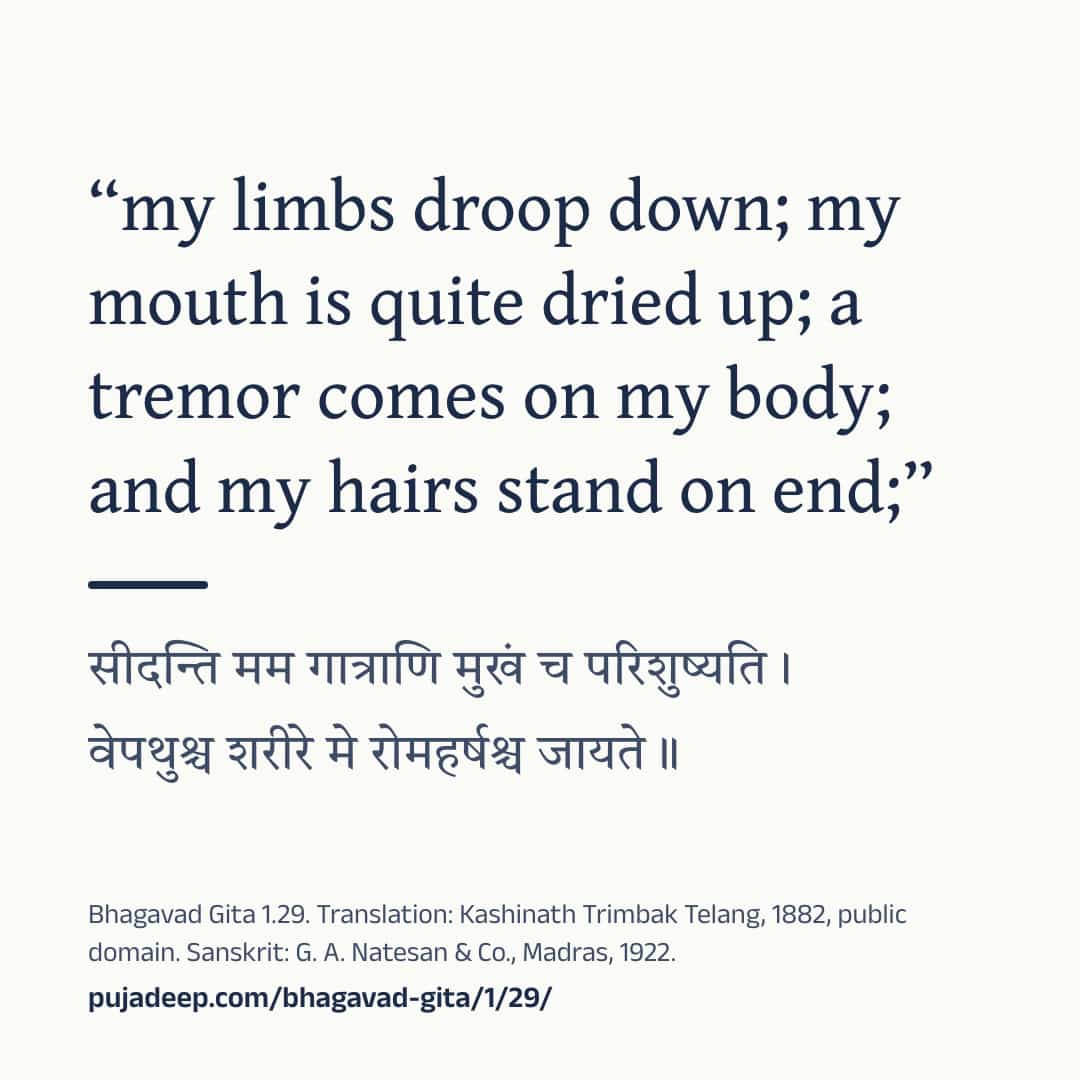
my limbs droop down; my mouth is quite dried up; a tremor comes on my body; and my hairs stand on end;
This sentence begins in 1.26. This sentence goes on in 1.30.
Compare 3 translations
Kashinath Trimbak Telang, 1882. Public domain. Page 40.
my limbs droop down; my mouth is quite dried up; a tremor comes on my body; and my hairs stand on end;
This sentence begins in 1.26. This sentence goes on in 1.30.
You are reading this one
Annie Besant, 1895. Public domain. Page 19.
My limbs fail and my mouth is parched, my body quivers and my hair stands on end,
This sentence begins in 1.26. This sentence goes on in 1.30.
You are reading this one
Swami Swarupananda, 1909 (first printed 1907). Public domain. Page 58.
my limbs fail me, and my mouth is parched up. I shiver all over, and my hair stands on end.
This sentence begins in 1.26.
You are reading this one
Cite this verse
The translation: K. T. Telang, The Bhagavadgîtâ (The Sacred Books of the East, vol. VIII, Oxford: Clarendon Press, 1882), p. 40. Bhagavad Gita 1.29.
The translation: Annie Besant, The Bhagavad Gîtâ, or The Lord's Song (London: Theosophical Publishing Society, 1895), p. 19. Bhagavad Gita 1.29.
The translation: Swami Swarupananda, Srimad-Bhagavad-Gita (Mayavati: Prabuddha Bharata Press, 1909; first printed in Prabuddha Bharata, 1907–1909), p. 58. Bhagavad Gita 1.29.
Our explanation: “Bhagavad Gita 1.29: meaning and translation.” Pujadeep. Updated October 25, 2026. https://pujadeep.com/bhagavad-gita/1/29/
Pujadeep’s explanations are free to quote with credit: name Pujadeep and link to the page. How to credit
Classical readings, by school
No readings by school on this verse yet.
Share
Show the ways to share
Send one picture or the text to one chat. The picture names its source and the address of this page.
Drawing the picture
See the words
Bhagavad Gita 1.29

सीदन्ति मम गात्राणि मुखं च परिशुष्यति ।
वेपथुश्च शरीरे मे रोमहर्षश्च जायते ॥

“my limbs droop down; my mouth is quite dried up; a tremor comes on my body; and my hairs stand on end;”
(K. T. Telang, The Bhagavadgîtâ (The Sacred Books of the East, vol. VIII, Oxford: Clarendon Press, 1882), p. 40, public domain)
This sentence begins in 1.26. This sentence goes on in 1.30.

“My limbs fail and my mouth is parched, my body quivers and my hair stands on end,”
(Annie Besant, The Bhagavad Gîtâ, or The Lord's Song (London: Theosophical Publishing Society, 1895), p. 19, public domain)
This sentence begins in 1.26. This sentence goes on in 1.30.

“my limbs fail me, and my mouth is parched up. I shiver all over, and my hair stands on end.”
(Swami Swarupananda, Srimad-Bhagavad-Gita (Mayavati: Prabuddha Bharata Press, 1909; first printed in Prabuddha Bharata, 1907–1909), p. 58, public domain)
This sentence begins in 1.26.

Sanskrit: G. A. Natesan & Co., Madras, 1922.
https://pujadeep.com/bhagavad-gita/1/29/ Nothing is sent from this site. Your own app sends it, to the chat you choose. The picture quotes the translation you chose on this page, with its name and year.
Sanskrit text: The Bhagavad-Gita, or The Lord's Song, with the text in Devanagari and an English translation, 1922. Meanings: written for Pujadeep and checked against the cited edition. Source and changes
Questions families ask
Who speaks Bhagavad Gita 1.29?
Arjuna speaks this verse, in chapter 1 (Arjuna Vishada Yoga).
Where does the Sanskrit text come from?
Sanskrit text: The Bhagavad-Gita, or The Lord's Song, with the text in Devanagari and an English translation, 1922. Meanings: written for Pujadeep and checked against the cited edition. See the source
Is the meaning on this page a translation?
Explanation written for this site from the sources listed here, and checked against the cited edition. It is not a translation and not the only way to read the text. Free to quote with credit.
Source and licence
- Sanskrit text
- The Bhagavad-Gita, or The Lord's Song, with the text in Devanagari and an English translation (Annie Besant, G. A. Natesan & Co., Madras, 1922). Public domain. The Sanskrit on these pages was read from this printing’s page images.
- Translation
- The Bhagavadgîtâ with the Sanatsugâtîya and the Anugîtâ, translated by Kâshinâth Trimbak Telang (The Sacred Books of the East, vol. VIII, ed. F. Max Müller) (Kashinath Trimbak Telang, F. Max Müller, Clarendon Press, Oxford, 1882). Public domain. Shown verbatim, as printed.
- Translation
- The Bhagavad Gîtâ, or The Lord's Song, translated by Annie Besant (Annie Besant, Theosophical Publishing Society, London, 1895). Public domain. Shown verbatim, as printed.
- Translation
- Srimad-Bhagavad-Gita, with Sanskrit Text; Paraphrase with Word-by-word Literal Translation; English Rendering and Comments, Index, &c., by the Swami Swarupananda (Himalayan Series, No. XX) (Swami Swarupananda, The Editors and Publishers, Advaita Ashrama, Mayavati, Prabuddha Bharata Press, Mayavati, Almora, Himalayas, 1909). Public domain. Shown verbatim, as printed.
- Common wording
- In this text, 32 words follow today's common wording, checked against sanskritdocuments.org; Sanskrit Wikisource; Gita Press, Gorakhpur; GRETIL, Göttingen and Bhaktivedanta Book Trust.
- Our explanation
- Explanation written for this site from the sources listed here, and checked against the cited edition. It is not a translation and not the only way to read the text. Free to quote with credit.
- Checked
- Checked against the cited edition, October 15, 2026.
- Updated
- October 25, 2026