Bhagavad Gita 1.42: meaning and translation
Chapter 1: Arjuna Vishada Yoga. Arjuna says
In Arjuna's argument, this mixing leads both the family and those who destroyed it to naraka (hell), and their ancestors fall, because no one is left to give them the offerings of rice-balls and water (piṇḍa and udaka) of the family rites.
Click or tap a word for its meaning and its dictionary page.
Text and layers
Text and layers
These choices stay in this browser.
Bhagavad Gita 1.42
सङ्करो नरकायैव कुलघ्नानां कुलस्य च ।पतन्ति पितरो ह्येषां लुप्तपिण्डोदकक्रियाः ॥
Sankaro narakayaiva kulaghnanam kulasya chaPatanti pitaro hyesham luptapindodakakriyah
saṅkaro narakāyaiva kulaghnānāṃ kulasya ca |patanti pitaro hyeṣāṃ luptapiṇḍodakakriyāḥ ||
Our explanation In Arjuna's argument, this mixing leads both the family and those who destroyed it to naraka (hell), and their ancestors fall, because no one is left to give them the offerings of rice-balls and water (piṇḍa and udaka) of the family rites.
हिंदी अर्थ अर्जुन के तर्क में यह मेल कुल को और कुल का नाश करने वालों को नरक की ओर ले जाता है, और उनके पितर गिर जाते हैं, क्योंकि उन्हें पिण्ड और जल (तर्पण) देने वाला कोई नहीं रहता।
Word by word
Every word, with its dictionary page
Word by word
- सङ्करः saṅkaraḥ · mixing (noun (masculine), nominative singular) Dictionary: saṃ-kara, Monier-Williams 1899, p. 1126, col. 2 “mixing together, commingling, intermixture, confusion”
- नरकाय narakāya · to naraka (hell) (noun (masculine), dative singular) Dictionary: naraka, Monier-Williams 1899, p. 529, col. 3 “hell, place of torment”
- एव eva · only (indeclinable) Dictionary: 1. eva, Monier-Williams 1899, p. 232, col. 2 “just, exactly, very, same, only, even, alone, merely”
- कुलघ्नानाम् kulaghnānām · of the destroyers of the family (compound (masculine), genitive plural) Dictionary: kula, Monier-Williams 1899, p. 294, col. 2 “a race, family, community”; ghna, Monier-Williams 1899, p. 379, col. 3 “killing, killer, murderer”
- कुलस्य kulasya · of the family (noun (neuter), genitive singular) Dictionary: kula, Monier-Williams 1899, p. 294, col. 2 “a race, family, community”
- च ca · and (indeclinable) Dictionary: 2. ca, Monier-Williams 1899, p. 380, col. 1 “ind. and, both, also, moreover, as well as”
- पतन्ति patanti · fall (present, 3rd person plural) Dictionary: 2. pat, Monier-Williams 1899, p. 580, col. 3 “to fall down or off, alight, descend”
- पितरः pitaraḥ · ancestors (noun (masculine), nominative plural) Dictionary: pitṛ, Monier-Williams 1899, p. 626, col. 2 “the fathers, forefathers, ancestors, (esp.) the Pitṛis or deceased ancestors”
- हि hi · for (indeclinable) Dictionary: 2. hi, Monier-Williams 1899, p. 1297, col. 3 “for, because, on account of”
- एषाम् eṣām · their (pronoun (masculine), genitive plural) Dictionary: etad, Monier-Williams 1899, p. 231, col. 2 “this, this here, here”
- लुप्तपिण्डोदकक्रियाः luptapiṇḍodakakriyāḥ · deprived of the rites of rice-balls and water (compound (masculine), nominative plural) Dictionary: lupta, Monier-Williams 1899, p. 904, col. 2 “(ifc.) deprived of”; piṇḍa, Monier-Williams 1899, p. 625, col. 2 “a ball of rice or flour &c. offered to the Pitṛis or deceased ancestors”; udaka, Monier-Williams 1899, p. 183, col. 2 “water”; kriyā, Monier-Williams 1899, p. 320, col. 3 “doing, performing, performance”
Old translations
Kashinath Trimbak Telang, 1882. Public domain. Page 41.
that intermingling necessarily leads the family and the destroyers of the family to hell; for when the ceremonies of (offering) the balls of food and water (to them) fail1, their ancestors fall down (to hell).
This sentence begins in 1.41.
Footnotes (the translator’s own) - There being no qualified person to perform them; 'their ancestors'—that is to say, of the 'destroyers of families.' ↩
Compare 3 translations
Kashinath Trimbak Telang, 1882. Public domain. Page 41.
that intermingling necessarily leads the family and the destroyers of the family to hell; for when the ceremonies of (offering) the balls of food and water (to them) fail1, their ancestors fall down (to hell).
This sentence begins in 1.41.
Footnotes (the translator’s own) - There being no qualified person to perform them; 'their ancestors'—that is to say, of the 'destroyers of families.' ↩
You are reading this one
Annie Besant, 1895. Public domain. Page 22.
This confusion draggeth to hell the family-slaughterers and the family; for their ancestors fall, deprived of rice-balls and libations.
This sentence begins in 1.40.
You are reading this one
Swami Swarupananda, 1909 (first printed 1907). Public domain. Page 60.
Admixture of family indeed,—is for the hell of the destroyers of the family; their ancestors fall, deprived of the offerings of rice-ball and water.
You are reading this one
Cite this verse
The translation: K. T. Telang, The Bhagavadgîtâ (The Sacred Books of the East, vol. VIII, Oxford: Clarendon Press, 1882), p. 41. Bhagavad Gita 1.42.
The translation: Annie Besant, The Bhagavad Gîtâ, or The Lord's Song (London: Theosophical Publishing Society, 1895), p. 22. Bhagavad Gita 1.42.
The translation: Swami Swarupananda, Srimad-Bhagavad-Gita (Mayavati: Prabuddha Bharata Press, 1909; first printed in Prabuddha Bharata, 1907–1909), p. 60. Bhagavad Gita 1.42.
Our explanation: “Bhagavad Gita 1.42: meaning and translation.” Pujadeep. Updated October 25, 2026. https://pujadeep.com/bhagavad-gita/1/42/
Pujadeep’s explanations are free to quote with credit: name Pujadeep and link to the page. How to credit
Classical readings, by school
No readings by school on this verse yet.
Share
Show the ways to share
Send one picture or the text to one chat. The picture names its source and the address of this page.
Drawing the picture
See the words
Bhagavad Gita 1.42

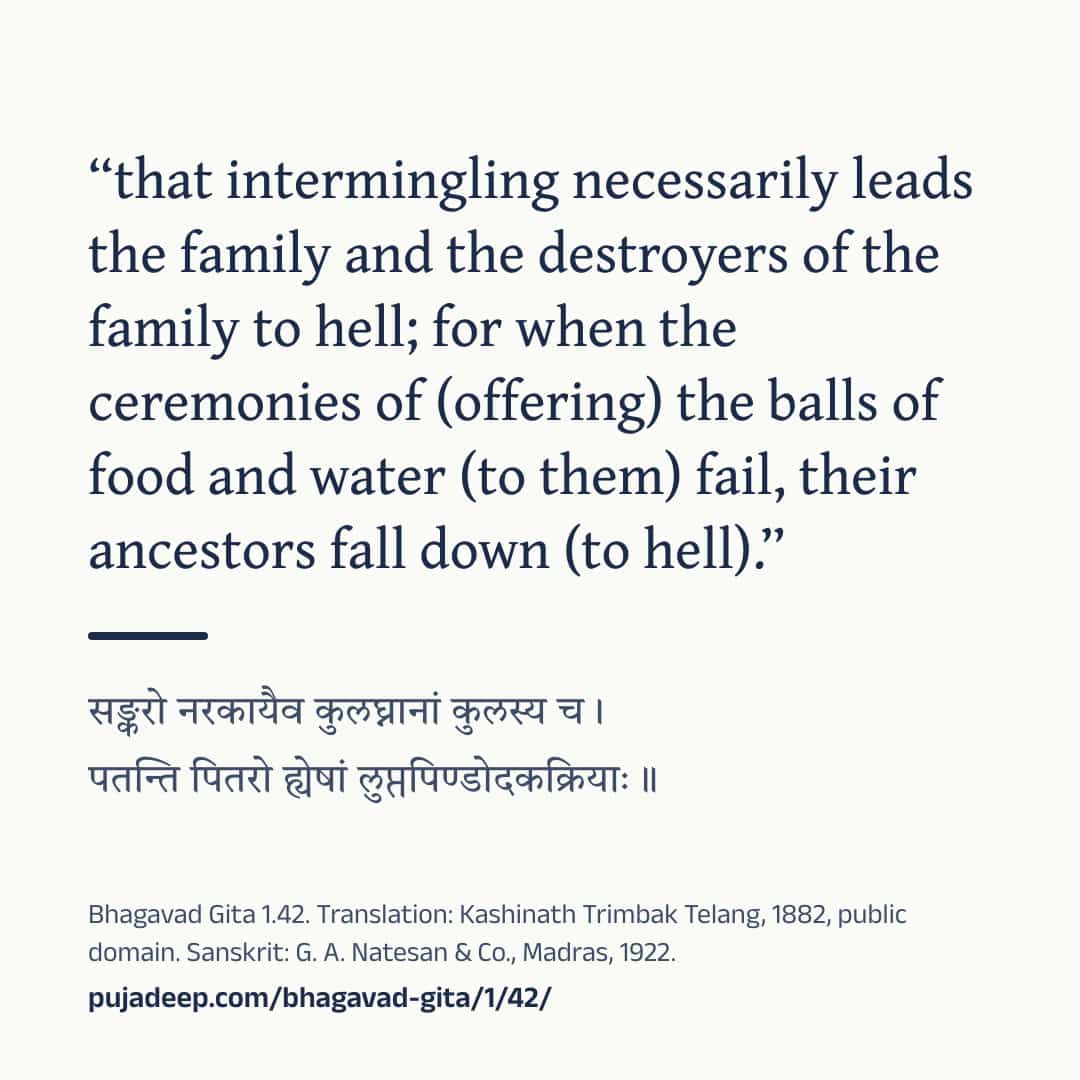
सङ्करो नरकायैव कुलघ्नानां कुलस्य च ।
पतन्ति पितरो ह्येषां लुप्तपिण्डोदकक्रियाः ॥

“that intermingling necessarily leads the family and the destroyers of the family to hell; for when the ceremonies of (offering) the balls of food and water (to them) fail, their ancestors fall down (to hell).”
(K. T. Telang, The Bhagavadgîtâ (The Sacred Books of the East, vol. VIII, Oxford: Clarendon Press, 1882), p. 41, public domain)
This sentence begins in 1.41.

“This confusion draggeth to hell the family-slaughterers and the family; for their ancestors fall, deprived of rice-balls and libations.”
(Annie Besant, The Bhagavad Gîtâ, or The Lord's Song (London: Theosophical Publishing Society, 1895), p. 22, public domain)
This sentence begins in 1.40.

“Admixture of family indeed,—is for the hell of the destroyers of the family; their ancestors fall, deprived of the offerings of rice-ball and water.”
(Swami Swarupananda, Srimad-Bhagavad-Gita (Mayavati: Prabuddha Bharata Press, 1909; first printed in Prabuddha Bharata, 1907–1909), p. 60, public domain)

Sanskrit: G. A. Natesan & Co., Madras, 1922.
https://pujadeep.com/bhagavad-gita/1/42/ Nothing is sent from this site. Your own app sends it, to the chat you choose. The picture quotes the translation you chose on this page, with its name and year.
Sanskrit text: The Bhagavad-Gita, or The Lord's Song, with the text in Devanagari and an English translation, 1922. Meanings: written for Pujadeep and checked against the cited edition. Source and changes
Questions families ask
Who speaks Bhagavad Gita 1.42?
Arjuna speaks this verse, in chapter 1 (Arjuna Vishada Yoga).
Where does the Sanskrit text come from?
Sanskrit text: The Bhagavad-Gita, or The Lord's Song, with the text in Devanagari and an English translation, 1922. Meanings: written for Pujadeep and checked against the cited edition. See the source
Is the meaning on this page a translation?
Explanation written for this site from the sources listed here, and checked against the cited edition. It is not a translation and not the only way to read the text. Free to quote with credit.
Source and licence
- Sanskrit text
- The Bhagavad-Gita, or The Lord's Song, with the text in Devanagari and an English translation (Annie Besant, G. A. Natesan & Co., Madras, 1922). Public domain. The Sanskrit on these pages was read from this printing’s page images.
- Translation
- The Bhagavadgîtâ with the Sanatsugâtîya and the Anugîtâ, translated by Kâshinâth Trimbak Telang (The Sacred Books of the East, vol. VIII, ed. F. Max Müller) (Kashinath Trimbak Telang, F. Max Müller, Clarendon Press, Oxford, 1882). Public domain. Shown verbatim, as printed.
- Translation
- The Bhagavad Gîtâ, or The Lord's Song, translated by Annie Besant (Annie Besant, Theosophical Publishing Society, London, 1895). Public domain. Shown verbatim, as printed.
- Translation
- Srimad-Bhagavad-Gita, with Sanskrit Text; Paraphrase with Word-by-word Literal Translation; English Rendering and Comments, Index, &c., by the Swami Swarupananda (Himalayan Series, No. XX) (Swami Swarupananda, The Editors and Publishers, Advaita Ashrama, Mayavati, Prabuddha Bharata Press, Mayavati, Almora, Himalayas, 1909). Public domain. Shown verbatim, as printed.
- Common wording
- In this text, 32 words follow today's common wording, checked against sanskritdocuments.org; Sanskrit Wikisource; Gita Press, Gorakhpur; GRETIL, Göttingen and Bhaktivedanta Book Trust.
- Our explanation
- Explanation written for this site from the sources listed here, and checked against the cited edition. It is not a translation and not the only way to read the text. Free to quote with credit.
- Checked
- Checked against the cited edition, October 15, 2026.
- Updated
- October 25, 2026