Bhagavad Gita 1.33: meaning and translation
Chapter 1: Arjuna Vishada Yoga. Arjuna says
Arjuna: The very people for whose sake they want a kingdom, enjoyments and pleasures are standing here in battle, ready to give up their lives and their wealth.
Click or tap a word for its meaning and its dictionary page.
Text and layers
Text and layers
These choices stay in this browser.
Bhagavad Gita 1.33
येषामर्थे काङ्क्षितं नो राज्यं भोगाः सुखानि च ।त इमेऽवस्थिता युद्धे प्राणांस्त्यक्त्वा धनानि च ॥
Yeshamarthe kankshitam no rajyam bhogah sukhani chaTa imevasthita yuddhe prananstyaktva dhanani cha
yeṣāmarthe kāṅkṣitaṃ no rājyaṃ bhogāḥ sukhāni ca |ta ime’vasthitā yuddhe prāṇāṃstyaktvā dhanāni ca ||
Our explanation The very people for whose sake they want a kingdom, enjoyments and pleasures are standing here in battle, ready to give up their lives and their wealth.
हिंदी अर्थ जिन लोगों के लिए वे राज्य, भोग और सुख चाहते हैं, वही लोग प्राण और धन की आशा छोड़कर यहाँ युद्ध में खड़े हैं।
Word by word
Every word, with its dictionary page
Word by word
- येषाम् yeṣām · for whose (pronoun (masculine), genitive plural) Dictionary: yad, Monier-Williams 1899, p. 844, col. 2 “who, which, what, whichever, whatever, that”
- अर्थे arthe · sake (noun (masculine), locative singular) Dictionary: artha, Monier-Williams 1899, p. 90, col. 3 “aim, purpose”
- काङ्क्षितम् kāṅkṣitam · desired (past participle (neuter), nominative singular) Dictionary: kāṅkṣ, Monier-Williams 1899, p. 268, col. 1 “to wish, desire, long for, hope for”
- नः naḥ · by us (pronoun, genitive plural) Dictionary: 1. nas, Monier-Williams 1899, p. 532, col. 2 “us, of us, to us”
- राज्यम् rājyam · kingdom (noun (neuter), nominative singular) Dictionary: rājya, Monier-Williams 1899, p. 875, col. 1 “kingdom, country, realm”
- भोगाः bhogāḥ · enjoyments (noun (masculine), nominative plural) Dictionary: 2. bhoga, Monier-Williams 1899, p. 767, col. 2 “enjoyment, eating, feeding on”
- सुखानि sukhāni · pleasures (noun (neuter), nominative plural) Dictionary: sukha, Monier-Williams 1899, p. 1221, col. 1 “ease, easiness, comfort, prosperity, pleasure, happiness”
- च ca · and (indeclinable) Dictionary: 2. ca, Monier-Williams 1899, p. 380, col. 1 “ind. and, both, also, moreover, as well as”
- ते te · they (pronoun (masculine), nominative plural) Dictionary: tad, Monier-Williams 1899, p. 434, col. 1 “m. he, f. she, n. it, that, this”
- इमे ime · these (pronoun (masculine), nominative plural) Dictionary: 1. idam, Monier-Williams 1899, p. 165, col. 2 “this, this here, referring to something near the speaker”
- अवस्थिताः avasthitāḥ · stand (past participle (masculine), nominative plural) Dictionary: ava-sthita, Monier-Williams 1899, p. 106, col. 1 “placed, having its place or abode”
- युद्धे yuddhe · in battle (noun (neuter), locative singular) Dictionary: yuddha, Monier-Williams 1899, p. 854, col. 3 “battle, fight, war”
- प्राणान् prāṇān · lives (noun (masculine), accusative plural) Dictionary: prāṇa, Monier-Williams 1899, p. 705, col. 1 “the breath of life, breath, respiration, spirit, vitality”
- त्यक्त्वा tyaktvā · having given up (absolutive (having done)) Dictionary: 1. tyaj, Monier-Williams 1899, p. 456, col. 3 “to leave, abandon, quit”
- धनानि dhanāni · wealth (noun (neuter), accusative plural) Dictionary: dhana, Monier-Williams 1899, p. 508, col. 2 “wealth, riches, (movable) property, money, treasure”
- च ca · and (indeclinable) Dictionary: 2. ca, Monier-Williams 1899, p. 380, col. 1 “ind. and, both, also, moreover, as well as”
Old translations
Kashinath Trimbak Telang, 1882. Public domain. Page 40.
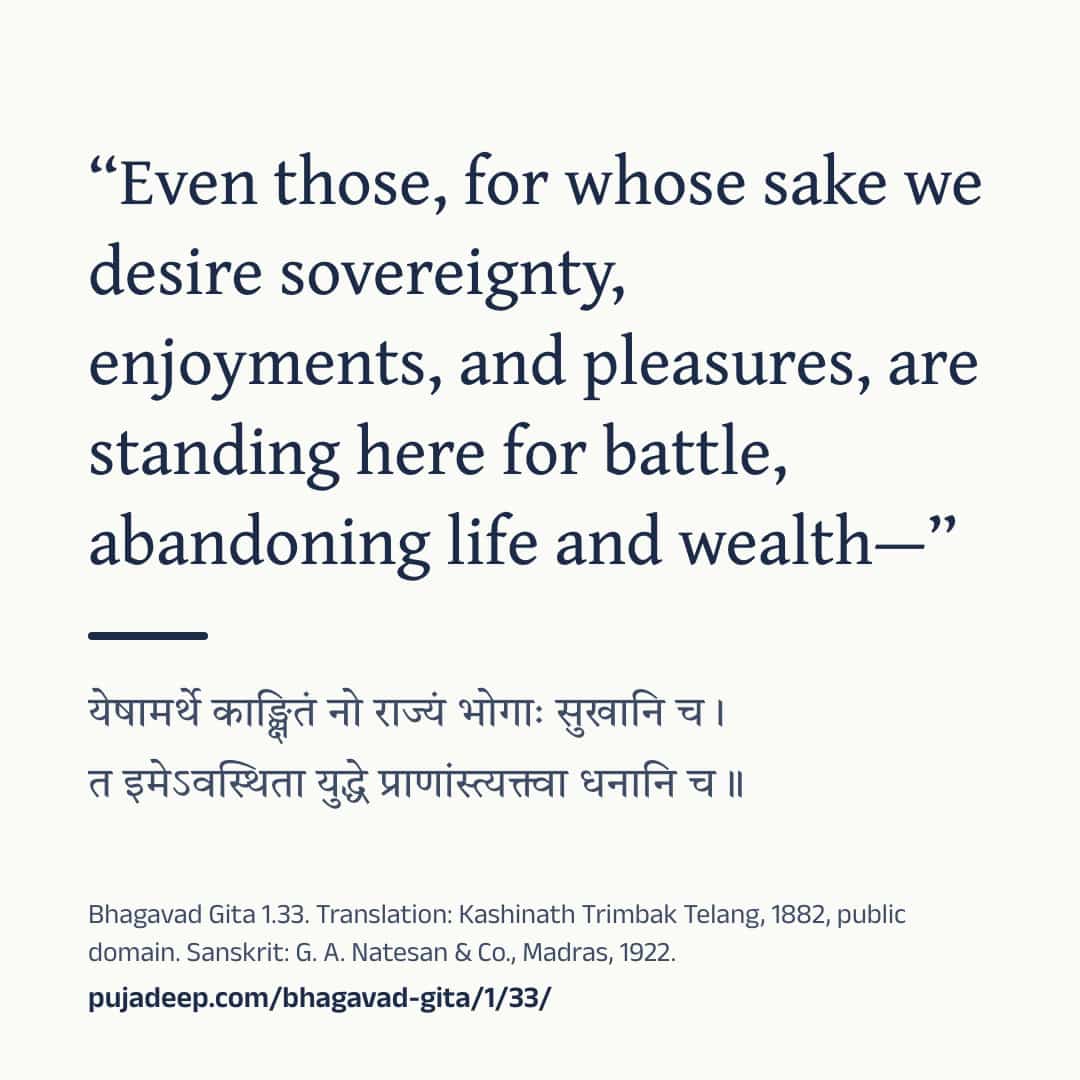
Even those, for whose sake we desire sovereignty, enjoyments, and pleasures, are standing here for battle, abandoning life and wealth—
This sentence goes on in 1.34.
Compare 3 translations
Kashinath Trimbak Telang, 1882. Public domain. Page 40.
Even those, for whose sake we desire sovereignty, enjoyments, and pleasures, are standing here for battle, abandoning life and wealth—
This sentence goes on in 1.34.
You are reading this one
Annie Besant, 1895. Public domain. Page 20.
Those for whose sake we desire kingship, enjoyments and pleasures, they stand here in battle, abandoning breath and riches—
This sentence goes on in 1.34.
You are reading this one
Swami Swarupananda, 1909 (first printed 1907). Public domain.
Swarupananda renders verses 32–34 together; see 1.32. Read it at 1.32
You are reading this one
Cite this verse
The translation: K. T. Telang, The Bhagavadgîtâ (The Sacred Books of the East, vol. VIII, Oxford: Clarendon Press, 1882), p. 40. Bhagavad Gita 1.33.
The translation: Annie Besant, The Bhagavad Gîtâ, or The Lord's Song (London: Theosophical Publishing Society, 1895), p. 20. Bhagavad Gita 1.33.
The translation: Swami Swarupananda, Srimad-Bhagavad-Gita (Mayavati: Prabuddha Bharata Press, 1909; first printed in Prabuddha Bharata, 1907–1909), p. 16; 58. Bhagavad Gita 1.32–34.
Our explanation: “Bhagavad Gita 1.33: meaning and translation.” Pujadeep. Updated October 25, 2026. https://pujadeep.com/bhagavad-gita/1/33/
Pujadeep’s explanations are free to quote with credit: name Pujadeep and link to the page. How to credit
Classical readings, by school
No readings by school on this verse yet.
Share
Show the ways to share
Send one picture or the text to one chat. The picture names its source and the address of this page.
Drawing the picture
See the words
Bhagavad Gita 1.33

येषामर्थे काङ्क्षितं नो राज्यं भोगाः सुखानि च ।
त इमेऽवस्थिता युद्धे प्राणांस्त्यक्त्वा धनानि च ॥

“Even those, for whose sake we desire sovereignty, enjoyments, and pleasures, are standing here for battle, abandoning life and wealth—”
(K. T. Telang, The Bhagavadgîtâ (The Sacred Books of the East, vol. VIII, Oxford: Clarendon Press, 1882), p. 40, public domain)
This sentence goes on in 1.34.

“Those for whose sake we desire kingship, enjoyments and pleasures, they stand here in battle, abandoning breath and riches—”
(Annie Besant, The Bhagavad Gîtâ, or The Lord's Song (London: Theosophical Publishing Society, 1895), p. 20, public domain)
This sentence goes on in 1.34.

Sanskrit: G. A. Natesan & Co., Madras, 1922.
https://pujadeep.com/bhagavad-gita/1/33/ Nothing is sent from this site. Your own app sends it, to the chat you choose. The picture quotes the translation you chose on this page, with its name and year.
Sanskrit text: The Bhagavad-Gita, or The Lord's Song, with the text in Devanagari and an English translation, 1922. Meanings: written for Pujadeep and checked against the cited edition. Source and changes
Questions families ask
Who speaks Bhagavad Gita 1.33?
Arjuna speaks this verse, in chapter 1 (Arjuna Vishada Yoga).
Where does the Sanskrit text come from?
Sanskrit text: The Bhagavad-Gita, or The Lord's Song, with the text in Devanagari and an English translation, 1922. Meanings: written for Pujadeep and checked against the cited edition. See the source
Is the meaning on this page a translation?
Explanation written for this site from the sources listed here, and checked against the cited edition. It is not a translation and not the only way to read the text. Free to quote with credit.
Source and licence
- Sanskrit text
- The Bhagavad-Gita, or The Lord's Song, with the text in Devanagari and an English translation (Annie Besant, G. A. Natesan & Co., Madras, 1922). Public domain. The Sanskrit on these pages was read from this printing’s page images.
- Translation
- The Bhagavadgîtâ with the Sanatsugâtîya and the Anugîtâ, translated by Kâshinâth Trimbak Telang (The Sacred Books of the East, vol. VIII, ed. F. Max Müller) (Kashinath Trimbak Telang, F. Max Müller, Clarendon Press, Oxford, 1882). Public domain. Shown verbatim, as printed.
- Translation
- The Bhagavad Gîtâ, or The Lord's Song, translated by Annie Besant (Annie Besant, Theosophical Publishing Society, London, 1895). Public domain. Shown verbatim, as printed.
- Translation
- Srimad-Bhagavad-Gita, with Sanskrit Text; Paraphrase with Word-by-word Literal Translation; English Rendering and Comments, Index, &c., by the Swami Swarupananda (Himalayan Series, No. XX) (Swami Swarupananda, The Editors and Publishers, Advaita Ashrama, Mayavati, Prabuddha Bharata Press, Mayavati, Almora, Himalayas, 1909). Public domain. Shown verbatim, as printed.
- Common wording
- In this text, 32 words follow today's common wording, checked against sanskritdocuments.org; Sanskrit Wikisource; Gita Press, Gorakhpur; GRETIL, Göttingen and Bhaktivedanta Book Trust.
- Our explanation
- Explanation written for this site from the sources listed here, and checked against the cited edition. It is not a translation and not the only way to read the text. Free to quote with credit.
- Checked
- Checked against the cited edition, October 15, 2026.
- Updated
- October 25, 2026