Bhagavad Gita 1.24: meaning and translation
Chapter 1: Arjuna Vishada Yoga. Sanjaya says
Sanjaya tells the king, whom he calls Bharata (descendant of Bharata), that Krishna does as Arjuna (Gudakesha, the one who has conquered sleep) asks, and stops that finest of chariots between the two armies.
Click or tap a word for its meaning and its dictionary page.
Text and layers
Text and layers
These choices stay in this browser.
Bhagavad Gita 1.24
सञ्जय उवाच ।
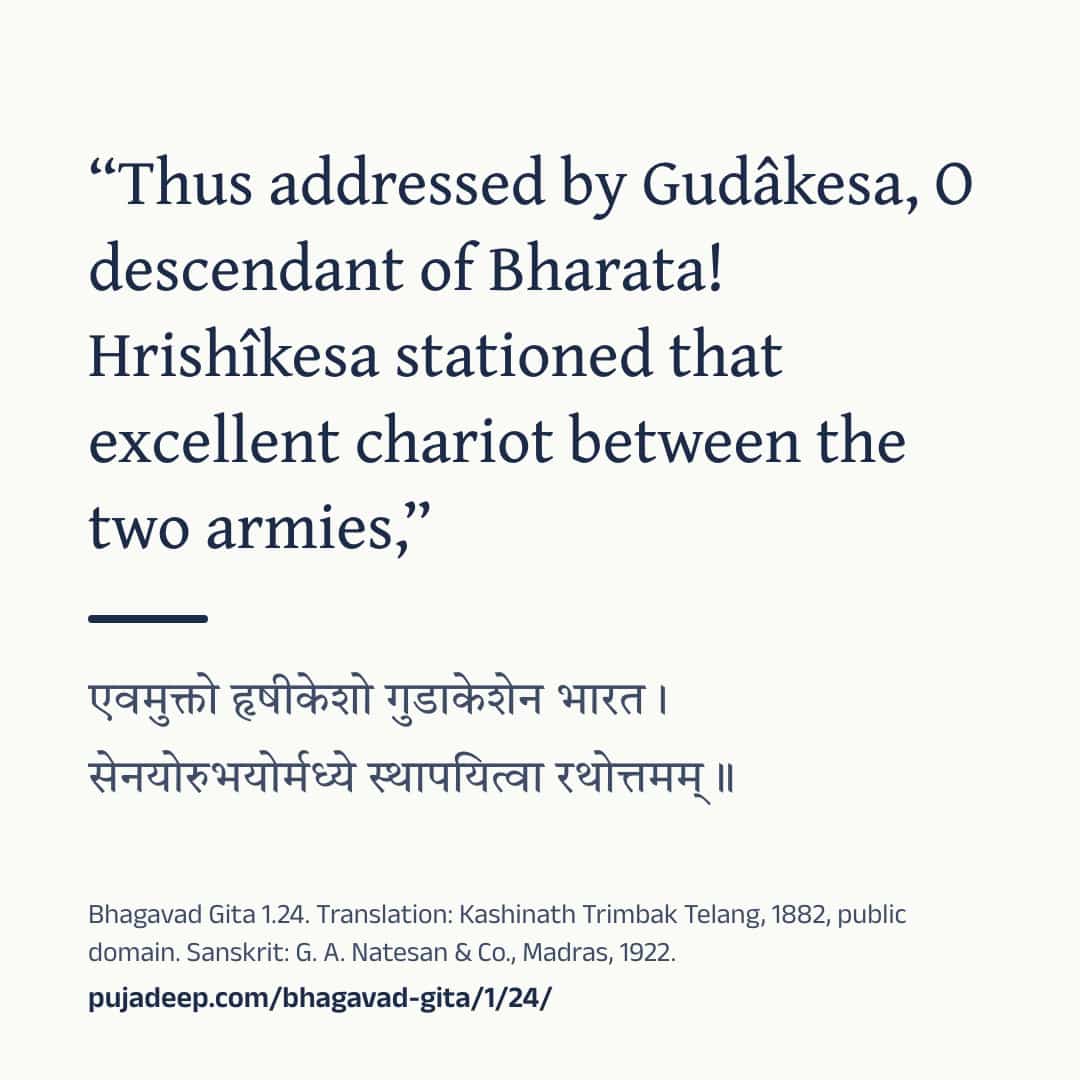
एवमुक्तो हृषीकेशो गुडाकेशेन भारत ।सेनयोरुभयोर्मध्ये स्थापयित्वा रथोत्तमम् ॥
Evamukto hrishikesho gudakeshena bharataSenayorubhayormadhye sthapayitva rathottamam
evamukto hṛṣīkeśo guḍākeśena bhārata |senayorubhayormadhye sthāpayitvā rathottamam ||
Our explanation Sanjaya tells the king, whom he calls Bharata (descendant of Bharata), that Krishna does as Arjuna (Gudakesha, the one who has conquered sleep) asks, and stops that finest of chariots between the two armies.
हिंदी अर्थ संजय राजा को भारत (भरतवंशी) कहकर बताते हैं कि गुडाकेश (नींद को जीतने वाले अर्जुन) के ऐसा कहने पर हृषीकेश कृष्ण उस श्रेष्ठ रथ को दोनों सेनाओं के बीच खड़ा कर देते हैं।
Word by word
Every word, with its dictionary page
Word by word
- एवम् evam · thus (indeclinable) Dictionary: evam, Monier-Williams 1899, p. 232, col. 2 “thus, in this way, in such a manner, such”
- उक्तः uktaḥ · addressed (past participle (masculine), nominative singular) Dictionary: vac, Monier-Williams 1899, p. 912, col. 1 “to speak, say, tell, utter, announce”
- हृषीकेशः hṛṣīkeśaḥ · Hrishikesha (Krishna) (noun (masculine), nominative singular) Dictionary: hṛṣīkeśa, Monier-Williams 1899, p. 1303, col. 2
- गुडाकेशेन guḍākeśena · by Gudakesha (Arjuna) (noun (masculine), instrumental singular) Dictionary: guḍākeśa, Monier-Williams 1899, p. 356, col. 3 “‘thick-haired,’ the hero Arjuna”
- भारत bhārata · O Bharata (the king) (noun (masculine), vocative singular) Dictionary: bhārata, Monier-Williams 1899, p. 753, col. 1 “a descendant of Bharata”
- सेनयोः senayoḥ · of the armies (noun (feminine), genitive dual) Dictionary: senā, Monier-Williams 1899, p. 1246, col. 2 “an army, armament, battle-array, armed force”
- उभयोः ubhayoḥ · of both (pronoun (feminine), genitive dual) Dictionary: ubhaya, Monier-Williams 1899, p. 216, col. 2 “both, of both kinds”
- मध्ये madhye · in the middle (noun (neuter), locative singular) Dictionary: madhya, Monier-Williams 1899, p. 781, col. 3 “middle”
- स्थापयित्वा sthāpayitvā · having placed (absolutive (having done)) Dictionary: 1. sthā, Monier-Williams 1899, p. 1262, col. 2 “to stand, stand firmly, station one's self”
- रथोत्तमम् rathottamam · the finest chariot (compound (masculine), accusative singular) Dictionary: 1. ratha, Monier-Williams 1899, p. 865, col. 2 “‘goer,’ a chariot, car, esp. a two-wheeled war-chariot”; uttama, Monier-Williams 1899, p. 177, col. 3 “best, excellent”
1 printing differs
Edition differences. Another printing or text reads this place differently.
- Omission A digital text reads Same words, without the speaker line sañjaya uvāca that the 1922 edition prints before this verse.
Old translations
Kashinath Trimbak Telang, 1882. Public domain. Page 39.
Sañgaya said:
Thus addressed by Gudâkesa1, O descendant of Bharata2! Hrishîkesa stationed that excellent chariot between the two armies,
This sentence goes on in 1.25.
Footnotes (the translator’s own) Compare 3 translations
Kashinath Trimbak Telang, 1882. Public domain. Page 39.
Sañgaya said:
Thus addressed by Gudâkesa1, O descendant of Bharata2! Hrishîkesa stationed that excellent chariot between the two armies,
This sentence goes on in 1.25.
Footnotes (the translator’s own) You are reading this one
Annie Besant, 1895. Public domain. Page 18.
Sanjaya said:
Thus addressed by Gudâkesha,1 Hrishîkesha, O Bhârata! stayed that best of chariots in the midst, between the two armies,
This sentence goes on in 1.25.
Footnotes (the translator’s own) - The lord of sleep, Arjuna. ↩
You are reading this one
Swami Swarupananda, 1909 (first printed 1907). Public domain. Page 13.
Sanjaya said:
Commanded thus by Gudàkesha, Hrishikesha, O Bhàrata, drove that grandest of chariots to a place between the two hosts, facing Bhishma, Drona and all the rulers of the earth, and then spoke thus, "Behold, O Pártha, all the Kurus gathered together!"
This sentence covers verses 1.24 to 1.25.
You are reading this one
Cite this verse
The translation: K. T. Telang, The Bhagavadgîtâ (The Sacred Books of the East, vol. VIII, Oxford: Clarendon Press, 1882), p. 39. Bhagavad Gita 1.24.
The translation: Annie Besant, The Bhagavad Gîtâ, or The Lord's Song (London: Theosophical Publishing Society, 1895), p. 18. Bhagavad Gita 1.24.
The translation: Swami Swarupananda, Srimad-Bhagavad-Gita (Mayavati: Prabuddha Bharata Press, 1909; first printed in Prabuddha Bharata, 1907–1909), p. 13. Bhagavad Gita 1.24–25.
Our explanation: “Bhagavad Gita 1.24: meaning and translation.” Pujadeep. Updated October 25, 2026. https://pujadeep.com/bhagavad-gita/1/24/
Pujadeep’s explanations are free to quote with credit: name Pujadeep and link to the page. How to credit
Classical readings, by school
No readings by school on this verse yet.
Share
Show the ways to share
Send one picture or the text to one chat. The picture names its source and the address of this page.
Drawing the picture
See the words
Bhagavad Gita 1.24

एवमुक्तो हृषीकेशो गुडाकेशेन भारत ।
सेनयोरुभयोर्मध्ये स्थापयित्वा रथोत्तमम् ॥

“Thus addressed by Gudâkesa, O descendant of Bharata! Hrishîkesa stationed that excellent chariot between the two armies,”
(K. T. Telang, The Bhagavadgîtâ (The Sacred Books of the East, vol. VIII, Oxford: Clarendon Press, 1882), p. 39, public domain)
This sentence goes on in 1.25.

“Thus addressed by Gudâkesha, Hrishîkesha, O Bhârata! stayed that best of chariots in the midst, between the two armies,”
(Annie Besant, The Bhagavad Gîtâ, or The Lord's Song (London: Theosophical Publishing Society, 1895), p. 18, public domain)
This sentence goes on in 1.25.

“Commanded thus by Gudàkesha, Hrishikesha, O Bhàrata, drove that grandest of chariots to a place between the two hosts, facing Bhishma, Drona and all the rulers of the earth, and then spoke thus, "Behold, O Pártha, all the Kurus gathered together!"”
(Swami Swarupananda, Srimad-Bhagavad-Gita (Mayavati: Prabuddha Bharata Press, 1909; first printed in Prabuddha Bharata, 1907–1909), p. 13, public domain)
This sentence covers verses 1.24 to 1.25.

Sanskrit: G. A. Natesan & Co., Madras, 1922.
https://pujadeep.com/bhagavad-gita/1/24/ Nothing is sent from this site. Your own app sends it, to the chat you choose. The picture quotes the translation you chose on this page, with its name and year.
Sanskrit text: The Bhagavad-Gita, or The Lord's Song, with the text in Devanagari and an English translation, 1922. Meanings: written for Pujadeep and checked against the cited edition. Source and changes
Questions families ask
Who speaks Bhagavad Gita 1.24?
Sanjaya speaks this verse, in chapter 1 (Arjuna Vishada Yoga).
Where does the Sanskrit text come from?
Sanskrit text: The Bhagavad-Gita, or The Lord's Song, with the text in Devanagari and an English translation, 1922. Meanings: written for Pujadeep and checked against the cited edition. See the source
Is the meaning on this page a translation?
Explanation written for this site from the sources listed here, and checked against the cited edition. It is not a translation and not the only way to read the text. Free to quote with credit.
Source and licence
- Sanskrit text
- The Bhagavad-Gita, or The Lord's Song, with the text in Devanagari and an English translation (Annie Besant, G. A. Natesan & Co., Madras, 1922). Public domain. The Sanskrit on these pages was read from this printing’s page images.
- Translation
- The Bhagavadgîtâ with the Sanatsugâtîya and the Anugîtâ, translated by Kâshinâth Trimbak Telang (The Sacred Books of the East, vol. VIII, ed. F. Max Müller) (Kashinath Trimbak Telang, F. Max Müller, Clarendon Press, Oxford, 1882). Public domain. Shown verbatim, as printed.
- Translation
- The Bhagavad Gîtâ, or The Lord's Song, translated by Annie Besant (Annie Besant, Theosophical Publishing Society, London, 1895). Public domain. Shown verbatim, as printed.
- Translation
- Srimad-Bhagavad-Gita, with Sanskrit Text; Paraphrase with Word-by-word Literal Translation; English Rendering and Comments, Index, &c., by the Swami Swarupananda (Himalayan Series, No. XX) (Swami Swarupananda, The Editors and Publishers, Advaita Ashrama, Mayavati, Prabuddha Bharata Press, Mayavati, Almora, Himalayas, 1909). Public domain. Shown verbatim, as printed.
- Common wording
- In this text, 32 words follow today's common wording, checked against sanskritdocuments.org; Sanskrit Wikisource; Gita Press, Gorakhpur; GRETIL, Göttingen and Bhaktivedanta Book Trust.
- Our explanation
- Explanation written for this site from the sources listed here, and checked against the cited edition. It is not a translation and not the only way to read the text. Free to quote with credit.
- Checked
- Checked against the cited edition, October 15, 2026.
- Updated
- October 25, 2026