Bhagavad Gita 1.20: meaning and translation
Chapter 1: Arjuna Vishada Yoga. Sanjaya says
Sanjaya: Arjuna, whose banner bears a monkey (kapidhvaja), sees Dhritarashtra's sons standing in battle order.
Click or tap a word for its meaning and its dictionary page.
Text and layers
Text and layers
These choices stay in this browser.
Bhagavad Gita 1.20
अथ व्यवस्थितान्दृष्ट्वा धार्तराष्ट्रान्कपिध्वजः ।प्रवृत्ते शस्त्रसम्पाते धनुरुद्यम्य पाण्डवः ॥
Atha vyavasthitandrishtva dhartarashtrankapidhvajahPravritte shastrasampate dhanurudyamya pandavah
atha vyavasthitāndṛṣṭvā dhārtarāṣṭrānkapidhvajaḥ |pravṛtte śastrasampāte dhanurudyamya pāṇḍavaḥ ||
Our explanation Arjuna, whose banner bears a monkey (kapidhvaja), sees Dhritarashtra's sons standing in battle order. As the clash of weapons begins, he lifts his bow.
हिंदी अर्थ जिनके ध्वज पर वानर का चिह्न है, वे अर्जुन (कपिध्वज) धृतराष्ट्र के पुत्रों को युद्ध के लिए पंक्तियों में खड़ा देखते हैं। शस्त्र चलने का समय आने पर वे अपना धनुष उठाते हैं।
Word by word
Every word, with its dictionary page
Word by word
- अथ atha · then (indeclinable) Dictionary: atha, Monier-Williams 1899, p. 17, col. 3 “now; then; moreover; rather; certainly”
- व्यवस्थितान् vyavasthitān · standing in battle order (past participle (masculine), accusative plural) Dictionary: vy-avasthita, Monier-Williams 1899, p. 1034, col. 1 “placed in order, drawn up (in battle)”
- दृष्ट्वा dṛṣṭvā · having seen (absolutive (having done)) Dictionary: 1. dṛś, Monier-Williams 1899, p. 491, col. 2 “to see, behold, look at, regard, consider”
- धार्तराष्ट्रान् dhārtarāṣṭrān · the sons of Dhritarashtra (noun (masculine), accusative plural) Dictionary: dhārta-rāṣṭra, Monier-Williams 1899, p. 516, col. 1 “a son of Dhṛ°, a Kuru”
- कपिध्वजः kapidhvajaḥ · the monkey-bannered (Arjuna) (compound (masculine), nominative singular) Dictionary: kapi-dhvaja, Monier-Williams 1899, p. 250, col. 3 “N. of Arjuna”
- प्रवृत्ते pravṛtte · having begun (past participle (masculine), locative singular) Dictionary: pra-vṛtta, Monier-Williams 1899, p. 693, col. 3 “commenced, begun”
- शस्त्रसम्पाते śastrasampāte · the clash of weapons (compound (masculine), locative singular) Dictionary: 2. śastra, Monier-Williams 1899, p. 1060, col. 3 “an instrument for cutting or wounding, knife, sword, dagger, any weapon”; sam-pāta, Monier-Williams 1899, p. 1171, col. 3 “flying or rushing together, collision, concussion”
- धनुः dhanuḥ · bow (noun (neuter), accusative singular) Dictionary: dhanus, Monier-Williams 1899, p. 509, col. 2 “a bow”
- उद्यम्य udyamya · having raised (absolutive (having done)) Dictionary: ud-yam, Monier-Williams 1899, p. 190, col. 3 “to lift up, raise”
- पाण्डवः pāṇḍavaḥ · the Pandava (Arjuna) (noun (masculine), nominative singular) Dictionary: pāṇḍava, Monier-Williams 1899, p. 616, col. 2 “a son or descendant of Pāṇḍu”
Old translations
Kashinath Trimbak Telang, 1882. Public domain. Page 39.
Then seeing (the people of) Dhritarâshtra's party regularly marshalled, the son of Pându, whose standard is the ape, raised his bow1, after the discharge of missiles had commenced,
This sentence goes on in 1.21.
Footnotes (the translator’s own) - I. e. to join in the fight. ↩
Compare 3 translations
Kashinath Trimbak Telang, 1882. Public domain. Page 39.
Then seeing (the people of) Dhritarâshtra's party regularly marshalled, the son of Pându, whose standard is the ape, raised his bow1, after the discharge of missiles had commenced,
This sentence goes on in 1.21.
Footnotes (the translator’s own) - I. e. to join in the fight. ↩
You are reading this one
Annie Besant, 1895. Public domain. Page 17.
Then beholding the sons of Dhritarâshtra standing arrayed, and the flight of missiles about to begin, he whose crest is an ape, the son of Pându, took up his bow,
This sentence goes on in 1.21.
You are reading this one
Swami Swarupananda, 1909 (first printed 1907). Public domain. Page 11.
Then, O Lord of Earth, seeing Dhritaráshtra army standing marshalled and shooting about to begin, that Pàndava whose ensign was the monkey, raising his bow,
This sentence goes on in 1.21.
You are reading this one
Cite this verse
The translation: K. T. Telang, The Bhagavadgîtâ (The Sacred Books of the East, vol. VIII, Oxford: Clarendon Press, 1882), p. 39. Bhagavad Gita 1.20.
The translation: Annie Besant, The Bhagavad Gîtâ, or The Lord's Song (London: Theosophical Publishing Society, 1895), p. 17. Bhagavad Gita 1.20.
The translation: Swami Swarupananda, Srimad-Bhagavad-Gita (Mayavati: Prabuddha Bharata Press, 1909; first printed in Prabuddha Bharata, 1907–1909), p. 11. Bhagavad Gita 1.20.
Our explanation: “Bhagavad Gita 1.20: meaning and translation.” Pujadeep. Updated October 25, 2026. https://pujadeep.com/bhagavad-gita/1/20/
Pujadeep’s explanations are free to quote with credit: name Pujadeep and link to the page. How to credit
Classical readings, by school
No readings by school on this verse yet.
Share
Show the ways to share
Send one picture or the text to one chat. The picture names its source and the address of this page.
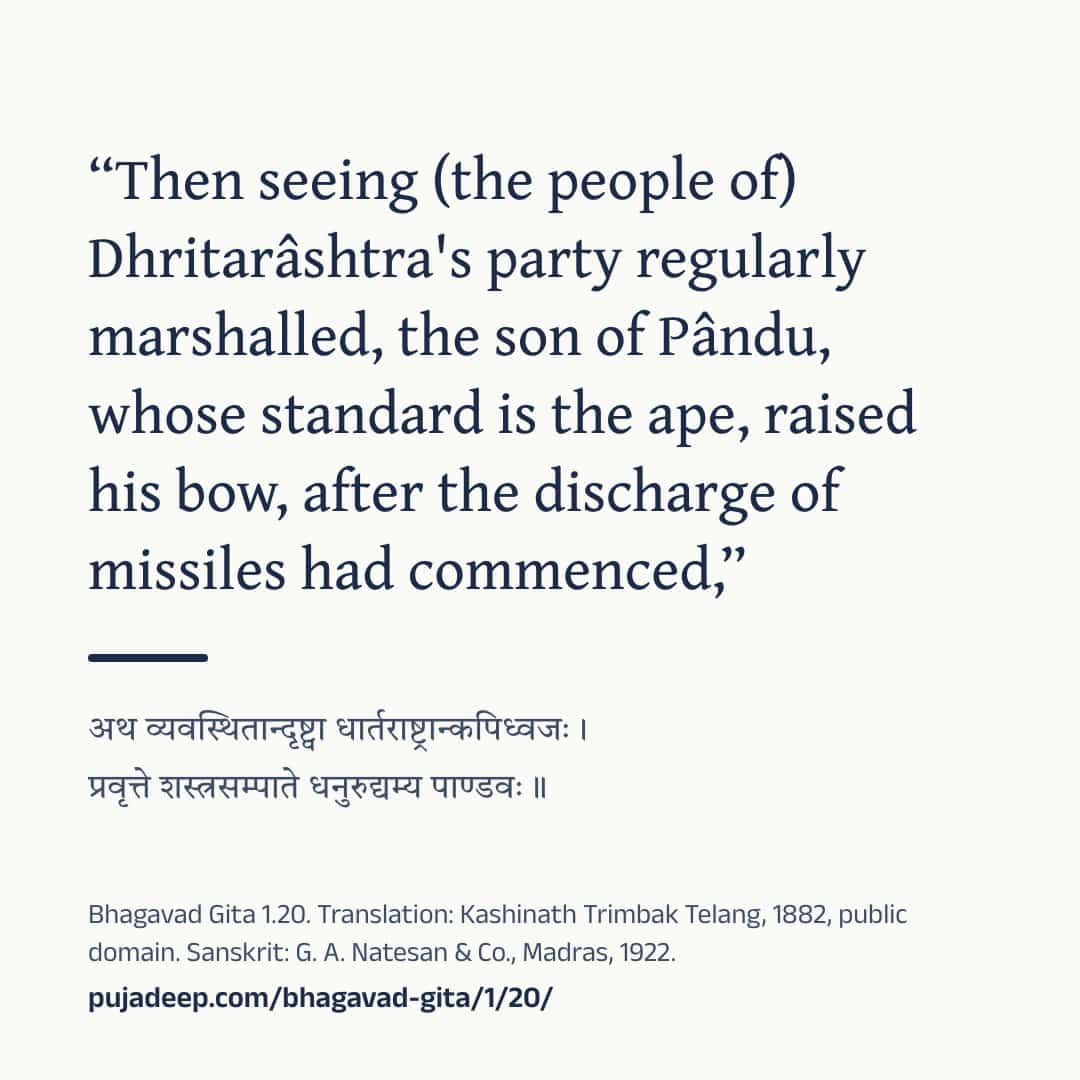
Drawing the picture
See the words
Bhagavad Gita 1.20

अथ व्यवस्थितान्दृष्ट्वा धार्तराष्ट्रान्कपिध्वजः ।
प्रवृत्ते शस्त्रसम्पाते धनुरुद्यम्य पाण्डवः ॥

“Then seeing (the people of) Dhritarâshtra's party regularly marshalled, the son of Pându, whose standard is the ape, raised his bow, after the discharge of missiles had commenced,”
(K. T. Telang, The Bhagavadgîtâ (The Sacred Books of the East, vol. VIII, Oxford: Clarendon Press, 1882), p. 39, public domain)
This sentence goes on in 1.21.

“Then beholding the sons of Dhritarâshtra standing arrayed, and the flight of missiles about to begin, he whose crest is an ape, the son of Pându, took up his bow,”
(Annie Besant, The Bhagavad Gîtâ, or The Lord's Song (London: Theosophical Publishing Society, 1895), p. 17, public domain)
This sentence goes on in 1.21.

“Then, O Lord of Earth, seeing Dhritaráshtra army standing marshalled and shooting about to begin, that Pàndava whose ensign was the monkey, raising his bow,”
(Swami Swarupananda, Srimad-Bhagavad-Gita (Mayavati: Prabuddha Bharata Press, 1909; first printed in Prabuddha Bharata, 1907–1909), p. 11, public domain)
This sentence goes on in 1.21.

Sanskrit: G. A. Natesan & Co., Madras, 1922.
https://pujadeep.com/bhagavad-gita/1/20/ Nothing is sent from this site. Your own app sends it, to the chat you choose. The picture quotes the translation you chose on this page, with its name and year.
Sanskrit text: The Bhagavad-Gita, or The Lord's Song, with the text in Devanagari and an English translation, 1922. Meanings: written for Pujadeep and checked against the cited edition. Source and changes
Questions families ask
Who speaks Bhagavad Gita 1.20?
Sanjaya speaks this verse, in chapter 1 (Arjuna Vishada Yoga).
Where does the Sanskrit text come from?
Sanskrit text: The Bhagavad-Gita, or The Lord's Song, with the text in Devanagari and an English translation, 1922. Meanings: written for Pujadeep and checked against the cited edition. See the source
Is the meaning on this page a translation?
Explanation written for this site from the sources listed here, and checked against the cited edition. It is not a translation and not the only way to read the text. Free to quote with credit.
Source and licence
- Sanskrit text
- The Bhagavad-Gita, or The Lord's Song, with the text in Devanagari and an English translation (Annie Besant, G. A. Natesan & Co., Madras, 1922). Public domain. The Sanskrit on these pages was read from this printing’s page images.
- Translation
- The Bhagavadgîtâ with the Sanatsugâtîya and the Anugîtâ, translated by Kâshinâth Trimbak Telang (The Sacred Books of the East, vol. VIII, ed. F. Max Müller) (Kashinath Trimbak Telang, F. Max Müller, Clarendon Press, Oxford, 1882). Public domain. Shown verbatim, as printed.
- Translation
- The Bhagavad Gîtâ, or The Lord's Song, translated by Annie Besant (Annie Besant, Theosophical Publishing Society, London, 1895). Public domain. Shown verbatim, as printed.
- Translation
- Srimad-Bhagavad-Gita, with Sanskrit Text; Paraphrase with Word-by-word Literal Translation; English Rendering and Comments, Index, &c., by the Swami Swarupananda (Himalayan Series, No. XX) (Swami Swarupananda, The Editors and Publishers, Advaita Ashrama, Mayavati, Prabuddha Bharata Press, Mayavati, Almora, Himalayas, 1909). Public domain. Shown verbatim, as printed.
- Common wording
- In this text, 32 words follow today's common wording, checked against sanskritdocuments.org; Sanskrit Wikisource; Gita Press, Gorakhpur; GRETIL, Göttingen and Bhaktivedanta Book Trust.
- Our explanation
- Explanation written for this site from the sources listed here, and checked against the cited edition. It is not a translation and not the only way to read the text. Free to quote with credit.
- Checked
- Checked against the cited edition, October 15, 2026.
- Updated
- October 25, 2026