Bhagavad Gita 1.18: meaning and translation
Chapter 1: Arjuna Vishada Yoga. Sanjaya says
Sanjaya: Drupada, the sons of Draupadi and the strong-armed son of Subhadra (Abhimanyu) also blow their own conches, on every side.
Click or tap a word for its meaning and its dictionary page.
Text and layers
Text and layers
These choices stay in this browser.
Bhagavad Gita 1.18
द्रुपदो द्रौपदेयाश्च सर्वशः पृथिवीपते ।सौभद्रश्च महाबाहुः शङ्खान्दध्मुः पृथक्पृथक् ॥
Drupado draupadeyashcha sarvashah prithivipateSaubhadrashcha mahabahuh shankhandadhmuh prithakprithak
drupado draupadeyāśca sarvaśaḥ pṛthivīpate |saubhadraśca mahābāhuḥ śaṅkhāndadhmuḥ pṛthakpṛthak ||
Our explanation Drupada, the sons of Draupadi and the strong-armed son of Subhadra (Abhimanyu) also blow their own conches, on every side. Sanjaya addresses King Dhritarashtra as "lord of the earth".
हिंदी अर्थ द्रुपद, द्रौपदी के पुत्र और महाबाहु अभिमन्यु (सुभद्रा के पुत्र) भी सब ओर अपने-अपने शंख बजाते हैं। संजय राजा धृतराष्ट्र को “पृथ्वीपति” कहकर संबोधित करते हैं।
Word by word
Every word, with its dictionary page
Word by word
- द्रुपदः drupadaḥ · Drupada (noun (masculine), nominative singular) Dictionary: drupada, Monier-Williams 1899, p. 502, col. 1 “N. of a king of the Pañcālas”
- द्रौपदेयाः draupadeyāḥ · the sons of Draupadi (noun (masculine), nominative plural) Dictionary: draupadeya, Monier-Williams 1899, p. 503, col. 2 “metron. of the 5 sons of Draupadī”
- च ca · and (indeclinable) Dictionary: 2. ca, Monier-Williams 1899, p. 380, col. 1 “ind. and, both, also, moreover, as well as”
- सर्वशः sarvaśaḥ · all together (indeclinable) Dictionary: sarvaśas, Monier-Williams 1899, p. 1189, col. 2 “wholly, completely, entirely, thoroughly, collectively, altogether”
- पृथिवीपते pṛthivīpate · O lord of the earth (the king) (compound (masculine), vocative singular) Dictionary: pṛthivī-pati, Monier-Williams 1899, p. 646, col. 2 “‘e°-lord,’ a prince, king”
- सौभद्रः saubhadraḥ · the son of Subhadra (Abhimanyu) (noun (masculine), nominative singular) Dictionary: saubhadra, Monier-Williams 1899, p. 1253, col. 3 “metron. of Abhimanyu”
- च ca · and (indeclinable) Dictionary: 2. ca, Monier-Williams 1899, p. 380, col. 1 “ind. and, both, also, moreover, as well as”
- महाबाहुः mahābāhuḥ · mighty-armed (compound (masculine), nominative singular) Dictionary: mahā-bāhu, Monier-Williams 1899, p. 798, col. 1 “long-armed”
- शङ्खान् śaṅkhān · conches (noun (masculine), accusative plural) Dictionary: śaṅkha, Monier-Williams 1899, p. 1047, col. 2 “a shell, (esp.) the conch-shell”
- दध्मुः dadhmuḥ · blew (perfect, 3rd person plural) Dictionary: dham, Monier-Williams 1899, p. 509, col. 3 “as to blow a conch-shell or any wind instrument”
- पृथक् pṛthak · separately (indeclinable) Dictionary: pṛthak, Monier-Williams 1899, p. 645, col. 3 “widely apart, separately, differently, singly, severally, one by one”
- पृथक् pṛthak · separately (each his own) (indeclinable) Dictionary: pṛthak, Monier-Williams 1899, p. 645, col. 3 “widely apart, separately, differently, singly, severally, one by one”
Old translations
Kashinath Trimbak Telang, 1882. Public domain. Page 39.
and Drupada, and the sons of Draupadî, and the son of Subhadrâ, of mighty arms, blew conchs severally from all sides, O king of the earth!
This sentence begins in 1.17.
Compare 3 translations
Kashinath Trimbak Telang, 1882. Public domain. Page 39.
and Drupada, and the sons of Draupadî, and the son of Subhadrâ, of mighty arms, blew conchs severally from all sides, O king of the earth!
This sentence begins in 1.17.
You are reading this one
Annie Besant, 1895. Public domain. Page 17.
Drupada and the Draupadeyas, O Lord of Earth, and Saubhadra, the great-armed, on all sides their several conches blew.
This sentence begins in 1.17.
You are reading this one
Swami Swarupananda, 1909 (first printed 1907). Public domain. Page 10.
O Lord of Earth! Drupada and the sons of Draupadi, and the mighty-armed son of Subhadrà, all also, blew each his own conch.
This sentence begins in 1.17.
You are reading this one
Cite this verse
The translation: K. T. Telang, The Bhagavadgîtâ (The Sacred Books of the East, vol. VIII, Oxford: Clarendon Press, 1882), p. 39. Bhagavad Gita 1.18.
The translation: Annie Besant, The Bhagavad Gîtâ, or The Lord's Song (London: Theosophical Publishing Society, 1895), p. 17. Bhagavad Gita 1.18.
The translation: Swami Swarupananda, Srimad-Bhagavad-Gita (Mayavati: Prabuddha Bharata Press, 1909; first printed in Prabuddha Bharata, 1907–1909), p. 10. Bhagavad Gita 1.18.
Our explanation: “Bhagavad Gita 1.18: meaning and translation.” Pujadeep. Updated October 25, 2026. https://pujadeep.com/bhagavad-gita/1/18/
Pujadeep’s explanations are free to quote with credit: name Pujadeep and link to the page. How to credit
Classical readings, by school
No readings by school on this verse yet.
Share
Show the ways to share
Send one picture or the text to one chat. The picture names its source and the address of this page.
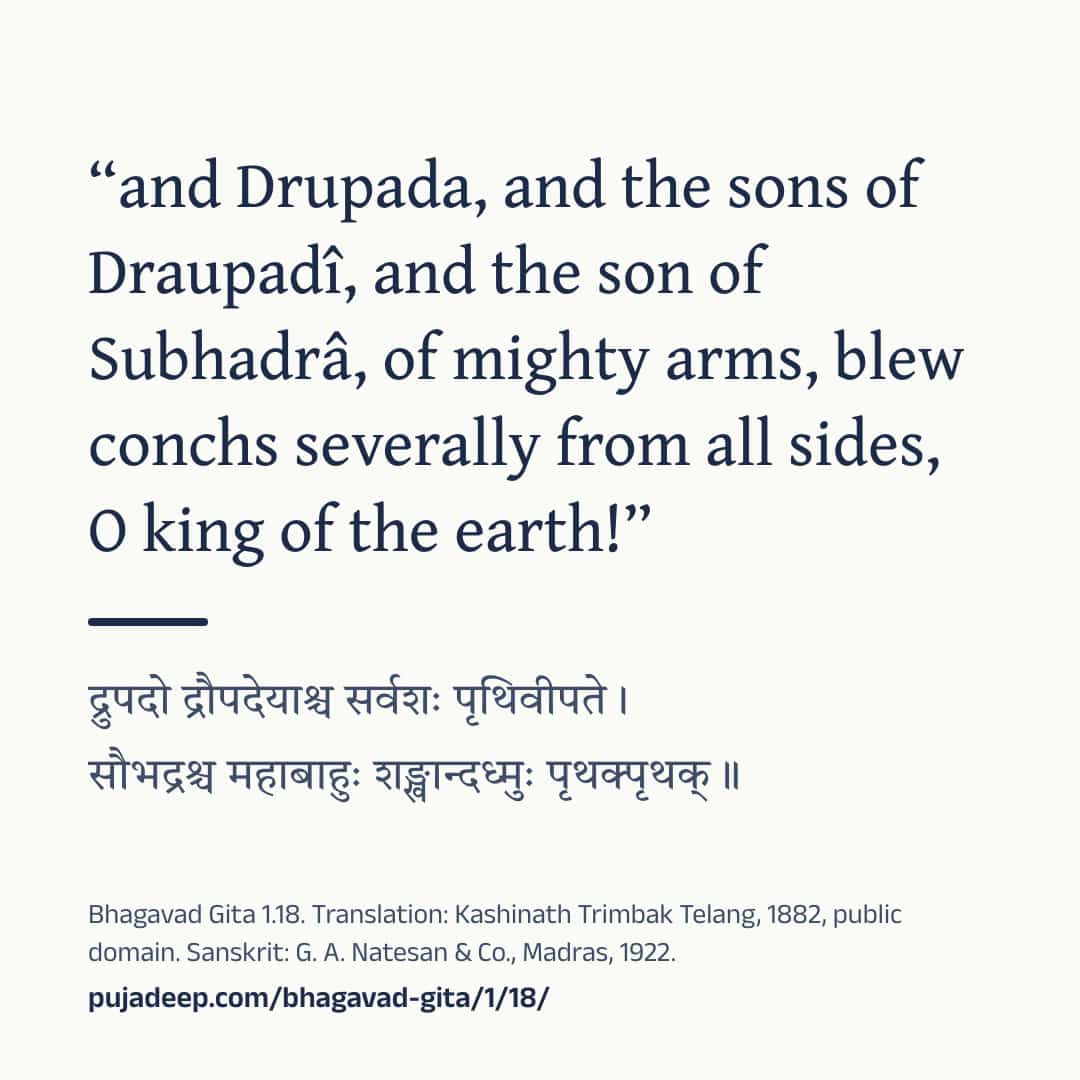
Drawing the picture
See the words
Bhagavad Gita 1.18

द्रुपदो द्रौपदेयाश्च सर्वशः पृथिवीपते ।
सौभद्रश्च महाबाहुः शङ्खान्दध्मुः पृथक्पृथक् ॥

“and Drupada, and the sons of Draupadî, and the son of Subhadrâ, of mighty arms, blew conchs severally from all sides, O king of the earth!”
(K. T. Telang, The Bhagavadgîtâ (The Sacred Books of the East, vol. VIII, Oxford: Clarendon Press, 1882), p. 39, public domain)
This sentence begins in 1.17.

“Drupada and the Draupadeyas, O Lord of Earth, and Saubhadra, the great-armed, on all sides their several conches blew.”
(Annie Besant, The Bhagavad Gîtâ, or The Lord's Song (London: Theosophical Publishing Society, 1895), p. 17, public domain)
This sentence begins in 1.17.

“O Lord of Earth! Drupada and the sons of Draupadi, and the mighty-armed son of Subhadrà, all also, blew each his own conch.”
(Swami Swarupananda, Srimad-Bhagavad-Gita (Mayavati: Prabuddha Bharata Press, 1909; first printed in Prabuddha Bharata, 1907–1909), p. 10, public domain)
This sentence begins in 1.17.

Sanskrit: G. A. Natesan & Co., Madras, 1922.
https://pujadeep.com/bhagavad-gita/1/18/ Nothing is sent from this site. Your own app sends it, to the chat you choose. The picture quotes the translation you chose on this page, with its name and year.
Sanskrit text: The Bhagavad-Gita, or The Lord's Song, with the text in Devanagari and an English translation, 1922. Meanings: written for Pujadeep and checked against the cited edition. Source and changes
Questions families ask
Who speaks Bhagavad Gita 1.18?
Sanjaya speaks this verse, in chapter 1 (Arjuna Vishada Yoga).
Where does the Sanskrit text come from?
Sanskrit text: The Bhagavad-Gita, or The Lord's Song, with the text in Devanagari and an English translation, 1922. Meanings: written for Pujadeep and checked against the cited edition. See the source
Is the meaning on this page a translation?
Explanation written for this site from the sources listed here, and checked against the cited edition. It is not a translation and not the only way to read the text. Free to quote with credit.
Source and licence
- Sanskrit text
- The Bhagavad-Gita, or The Lord's Song, with the text in Devanagari and an English translation (Annie Besant, G. A. Natesan & Co., Madras, 1922). Public domain. The Sanskrit on these pages was read from this printing’s page images.
- Translation
- The Bhagavadgîtâ with the Sanatsugâtîya and the Anugîtâ, translated by Kâshinâth Trimbak Telang (The Sacred Books of the East, vol. VIII, ed. F. Max Müller) (Kashinath Trimbak Telang, F. Max Müller, Clarendon Press, Oxford, 1882). Public domain. Shown verbatim, as printed.
- Translation
- The Bhagavad Gîtâ, or The Lord's Song, translated by Annie Besant (Annie Besant, Theosophical Publishing Society, London, 1895). Public domain. Shown verbatim, as printed.
- Translation
- Srimad-Bhagavad-Gita, with Sanskrit Text; Paraphrase with Word-by-word Literal Translation; English Rendering and Comments, Index, &c., by the Swami Swarupananda (Himalayan Series, No. XX) (Swami Swarupananda, The Editors and Publishers, Advaita Ashrama, Mayavati, Prabuddha Bharata Press, Mayavati, Almora, Himalayas, 1909). Public domain. Shown verbatim, as printed.
- Common wording
- In this text, 32 words follow today's common wording, checked against sanskritdocuments.org; Sanskrit Wikisource; Gita Press, Gorakhpur; GRETIL, Göttingen and Bhaktivedanta Book Trust.
- Our explanation
- Explanation written for this site from the sources listed here, and checked against the cited edition. It is not a translation and not the only way to read the text. Free to quote with credit.
- Checked
- Checked against the cited edition, October 15, 2026.
- Updated
- October 25, 2026