Bhagavad Gita 1.15: meaning and translation
Chapter 1: Arjuna Vishada Yoga. Sanjaya says
Sanjaya: Krishna (Hrishikesha, lord of the senses) blows Panchajanya; Arjuna (Dhananjaya, winner of wealth) blows Devadatta; and Bhima (Vrikodara, the wolf-bellied), of mighty deeds, blows the great conch Paundra.
Click or tap a word for its meaning and its dictionary page.
Text and layers
Text and layers
These choices stay in this browser.
Bhagavad Gita 1.15
पाञ्चजन्यं हृषीकेशो देवदत्तं धनञ्जयः ।पौण्ड्रं दध्मौ महाशङ्खं भीमकर्मा वृकोदरः ॥
Panchajanyam hrishikesho devadattam dhananjayahPaundram dadhmau mahashankham bhimakarma vrikodarah
pāñcajanyaṃ hṛṣīkeśo devadattaṃ dhanañjayaḥ |pauṇḍraṃ dadhmau mahāśaṅkhaṃ bhīmakarmā vṛkodaraḥ ||
Our explanation Krishna (Hrishikesha, lord of the senses) blows Panchajanya; Arjuna (Dhananjaya, winner of wealth) blows Devadatta; and Bhima (Vrikodara, the wolf-bellied), of mighty deeds, blows the great conch Paundra. Besant's footnote says Panchajanya was made from the bones of the giant Panchajana, whom Krishna slew.
हिंदी अर्थ हृषीकेश (इंद्रियों के स्वामी, कृष्ण) पाञ्चजन्य शंख बजाते हैं, धनञ्जय (धन जीतने वाले, अर्जुन) देवदत्त, और महान कर्म करने वाले वृकोदर (भीम) महाशंख पौण्ड्र बजाते हैं। बेसेंट की टिप्पणी के अनुसार पाञ्चजन्य उस पञ्चजन नाम के दैत्य की हड्डियों से बना था, जिसे कृष्ण ने मारा था।
Word by word
Every word, with its dictionary page
Word by word
- पाञ्चजन्यम् pāñcajanyam · Panchajanya (Krishna's conch) (noun (masculine), accusative singular) Dictionary: pāñca-janya, Monier-Williams 1899, p. 614, col. 2 “N. of Kṛishṇa's conch taken from the demon Pañca-jana”
- हृषीकेशः hṛṣīkeśaḥ · Hrishikesha (Krishna) (noun (masculine), nominative singular) Dictionary: hṛṣīkeśa, Monier-Williams 1899, p. 1303, col. 2
- देवदत्तम् devadattam · Devadatta (Arjuna's conch) (noun (masculine), accusative singular) Dictionary: deva-datta, Monier-Williams 1899, p. 493, col. 1 “N. of Arjuna's conch-shell”
- धनञ्जयः dhanañjayaḥ · Dhananjaya (Arjuna) (noun (masculine), nominative singular) Dictionary: dhanaṃ-jaya, Monier-Williams 1899, p. 508, col. 2 “N. of Arjuna”
- पौण्ड्रम् pauṇḍram · Paundra (Bhima's conch) (noun (masculine), accusative singular) Dictionary: 1. pauṇḍra, Monier-Williams 1899, p. 650, col. 3 “N. of the conch-shell of Bhīma”
- दध्मौ dadhmau · blew (perfect, 3rd person singular) Dictionary: dham, Monier-Williams 1899, p. 509, col. 3 “as to blow a conch-shell or any wind instrument”
- महाशङ्खम् mahāśaṅkham · the great conch (compound (masculine), accusative singular) Dictionary: mahā, Monier-Williams 1899, p. 794, col. 3 “in comp. for mahat”; śaṅkha, Monier-Williams 1899, p. 1047, col. 2 “a shell, (esp.) the conch-shell”
- भीमकर्मा bhīmakarmā · of mighty deeds (compound (masculine), nominative singular) Dictionary: bhīma, Monier-Williams 1899, p. 758, col. 1 “fearful, terrific, terrible, awful, formidable, tremendous”; karman, Monier-Williams 1899, p. 258, col. 2 “act, action, performance, business”
- वृकोदरः vṛkodaraḥ · Vrikodara (Bhima) (noun (masculine), nominative singular) Dictionary: vṛkodara, Monier-Williams 1899, p. 1008, col. 2 “‘wolf-bellied,’ N. of Bhīma”
Old translations
Kashinath Trimbak Telang, 1882. Public domain. Page 38.
Hrishîkesa1 blew the Pâñkaganya2, and Dhanañgaya the Devadatta, and Bhîma, (the doer) of fearful deeds, blew the great conch Paundra.
Footnotes (the translator’s own) Compare 3 translations
Kashinath Trimbak Telang, 1882. Public domain. Page 38.
Hrishîkesa1 blew the Pâñkaganya2, and Dhanañgaya the Devadatta, and Bhîma, (the doer) of fearful deeds, blew the great conch Paundra.
Footnotes (the translator’s own) You are reading this one
Annie Besant, 1895. Public domain. Page 16.
Pânchajanya by Hrishîkesha, and Devadatta by Dhananjaya.1 Vrikodara,2 the terrible in action, blew his mighty conch, Paundra;
This sentence begins in 1.14. This sentence goes on in 1.16.
Footnotes (the translator’s own) - Pânchajanya, Shrî Krishna's conch, was made from the bones of the giant Panchajana, slain by him; the title Hrishîkesha is "Lord of the senses." Dhananjaya, the "conqueror of wealth," is a title often given to Arjuna, whose conch is the "God-given." ↩
- Bhîma; the meaning of the name of his conch is doubtful. ↩
You are reading this one
Swami Swarupananda, 1909 (first printed 1907). Public domain. Page 8.
Hrishikesha blew the Pànchajanya, Dhananjaya, the Devadatta, and Vrikodara, the doer of terrific deeds, his large conch Paundra.
You are reading this one
Cite this verse
The translation: K. T. Telang, The Bhagavadgîtâ (The Sacred Books of the East, vol. VIII, Oxford: Clarendon Press, 1882), p. 38. Bhagavad Gita 1.15.
The translation: Annie Besant, The Bhagavad Gîtâ, or The Lord's Song (London: Theosophical Publishing Society, 1895), p. 16. Bhagavad Gita 1.15.
The translation: Swami Swarupananda, Srimad-Bhagavad-Gita (Mayavati: Prabuddha Bharata Press, 1909; first printed in Prabuddha Bharata, 1907–1909), p. 8. Bhagavad Gita 1.15.
Our explanation: “Bhagavad Gita 1.15: meaning and translation.” Pujadeep. Updated October 25, 2026. https://pujadeep.com/bhagavad-gita/1/15/
Pujadeep’s explanations are free to quote with credit: name Pujadeep and link to the page. How to credit
Classical readings, by school
No readings by school on this verse yet.
Share
Show the ways to share
Send one picture or the text to one chat. The picture names its source and the address of this page.
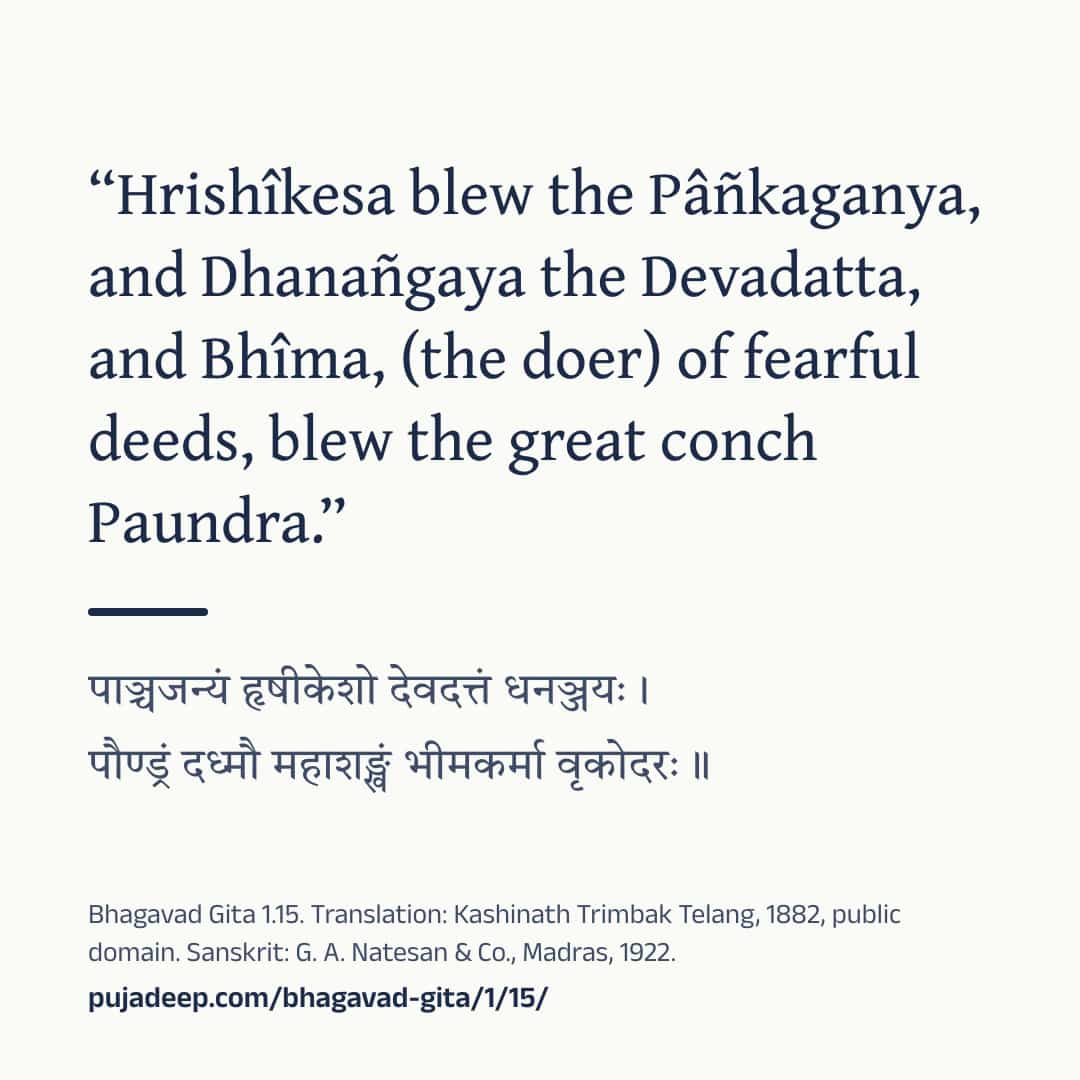
Drawing the picture
See the words
Bhagavad Gita 1.15

पाञ्चजन्यं हृषीकेशो देवदत्तं धनञ्जयः ।
पौण्ड्रं दध्मौ महाशङ्खं भीमकर्मा वृकोदरः ॥

“Hrishîkesa blew the Pâñkaganya, and Dhanañgaya the Devadatta, and Bhîma, (the doer) of fearful deeds, blew the great conch Paundra.”
(K. T. Telang, The Bhagavadgîtâ (The Sacred Books of the East, vol. VIII, Oxford: Clarendon Press, 1882), p. 38, public domain)

“Pânchajanya by Hrishîkesha, and Devadatta by Dhananjaya. Vrikodara, the terrible in action, blew his mighty conch, Paundra;”
(Annie Besant, The Bhagavad Gîtâ, or The Lord's Song (London: Theosophical Publishing Society, 1895), p. 16, public domain)
This sentence begins in 1.14. This sentence goes on in 1.16.

“Hrishikesha blew the Pànchajanya, Dhananjaya, the Devadatta, and Vrikodara, the doer of terrific deeds, his large conch Paundra.”
(Swami Swarupananda, Srimad-Bhagavad-Gita (Mayavati: Prabuddha Bharata Press, 1909; first printed in Prabuddha Bharata, 1907–1909), p. 8, public domain)

Sanskrit: G. A. Natesan & Co., Madras, 1922.
https://pujadeep.com/bhagavad-gita/1/15/ Nothing is sent from this site. Your own app sends it, to the chat you choose. The picture quotes the translation you chose on this page, with its name and year.
Sanskrit text: The Bhagavad-Gita, or The Lord's Song, with the text in Devanagari and an English translation, 1922. Meanings: written for Pujadeep and checked against the cited edition. Source and changes
Questions families ask
Who speaks Bhagavad Gita 1.15?
Sanjaya speaks this verse, in chapter 1 (Arjuna Vishada Yoga).
Where does the Sanskrit text come from?
Sanskrit text: The Bhagavad-Gita, or The Lord's Song, with the text in Devanagari and an English translation, 1922. Meanings: written for Pujadeep and checked against the cited edition. See the source
Is the meaning on this page a translation?
Explanation written for this site from the sources listed here, and checked against the cited edition. It is not a translation and not the only way to read the text. Free to quote with credit.
Source and licence
- Sanskrit text
- The Bhagavad-Gita, or The Lord's Song, with the text in Devanagari and an English translation (Annie Besant, G. A. Natesan & Co., Madras, 1922). Public domain. The Sanskrit on these pages was read from this printing’s page images.
- Translation
- The Bhagavadgîtâ with the Sanatsugâtîya and the Anugîtâ, translated by Kâshinâth Trimbak Telang (The Sacred Books of the East, vol. VIII, ed. F. Max Müller) (Kashinath Trimbak Telang, F. Max Müller, Clarendon Press, Oxford, 1882). Public domain. Shown verbatim, as printed.
- Translation
- The Bhagavad Gîtâ, or The Lord's Song, translated by Annie Besant (Annie Besant, Theosophical Publishing Society, London, 1895). Public domain. Shown verbatim, as printed.
- Translation
- Srimad-Bhagavad-Gita, with Sanskrit Text; Paraphrase with Word-by-word Literal Translation; English Rendering and Comments, Index, &c., by the Swami Swarupananda (Himalayan Series, No. XX) (Swami Swarupananda, The Editors and Publishers, Advaita Ashrama, Mayavati, Prabuddha Bharata Press, Mayavati, Almora, Himalayas, 1909). Public domain. Shown verbatim, as printed.
- Common wording
- In this text, 32 words follow today's common wording, checked against sanskritdocuments.org; Sanskrit Wikisource; Gita Press, Gorakhpur; GRETIL, Göttingen and Bhaktivedanta Book Trust.
- Our explanation
- Explanation written for this site from the sources listed here, and checked against the cited edition. It is not a translation and not the only way to read the text. Free to quote with credit.
- Checked
- Checked against the cited edition, October 15, 2026.
- Updated
- October 25, 2026