Bhagavad Gita 1.22: meaning and translation
Chapter 1: Arjuna Vishada Yoga. Arjuna says
Arjuna wants to look at the warriors who stand there eager to fight, and to see whom he must fight in this battle.
Click or tap a word for its meaning and its dictionary page.
Text and layers
Text and layers
These choices stay in this browser.
Bhagavad Gita 1.22
यावदेतान्निरीक्षेऽहं योद्धुकामानवस्थितान् ।कैर्मया सह योद्धव्यमस्मिन्रणसमुद्यमे ॥
Yavadetanniriksheham yoddhukamanavasthitanKairmaya saha yoddhavyamasminranasamudyame
yāvadetānnirīkṣe’haṃ yoddhukāmānavasthitān |kairmayā saha yoddhavyamasminraṇasamudyame ||
Our explanation Arjuna wants to look at the warriors who stand there eager to fight, and to see whom he must fight in this battle.
हिंदी अर्थ अर्जुन उन योद्धाओं को देखना चाहते हैं जो लड़ने की इच्छा से खड़े हैं, और जानना चाहते हैं कि इस युद्ध में उन्हें किन-किन से लड़ना है।
Word by word
Every word, with its dictionary page
Word by word
- यावत् yāvat · so that, while (indeclinable) Dictionary: yāvat, Monier-Williams 1899, p. 852, col. 1 “as long as, whilst; as soon as, the moment that, until”
- एतान् etān · these (pronoun (masculine), accusative plural) Dictionary: etad, Monier-Williams 1899, p. 231, col. 2 “this, this here, here”
- निरीक्षे nirīkṣe · "I may look at" (present, 1st person singular) Dictionary: nir-īkṣ, Monier-Williams 1899, p. 553, col. 3 “to look at or towards, behold, regard, observe”
- अहम् aham · "I" (pronoun, nominative singular) Dictionary: aham, Monier-Williams 1899, p. 124, col. 2 “nom. sg. ‘I,’”
- योद्धुकामान् yoddhukāmān · eager to fight (compound (masculine), accusative plural) Dictionary: 1. yudh, Monier-Williams 1899, p. 854, col. 3 “to fight, wage war”; kāma, Monier-Williams 1899, p. 271, col. 3 “wish, desire, longing”
- अवस्थितान् avasthitān · standing ready (past participle (masculine), accusative plural) Dictionary: ava-sthita, Monier-Williams 1899, p. 106, col. 1 “placed, having its place or abode”
- कैः kaiḥ · with whom (pronoun (masculine), instrumental plural) Dictionary: kim, Monier-Williams 1899, p. 282, col. 2 “what? how? whence? wherefore? why?”
- मया mayā · "by me" (pronoun, instrumental singular) Dictionary: 1. mad, Monier-Williams 1899, p. 777, col. 2 “base of the first pers. pron. in the sg. number (esp. in comp.)”
- सह saha · with (indeclinable) Dictionary: 2. saha, Monier-Williams 1899, p. 1193, col. 2 “together with, along with, with”
- योद्धव्यम् yoddhavyam · must be fought (gerundive (to be done) (neuter), nominative singular) Dictionary: 1. yudh, Monier-Williams 1899, p. 854, col. 3 “to fight, wage war”
- अस्मिन् asmin · in this (pronoun (masculine), locative singular) Dictionary: 1. idam, Monier-Williams 1899, p. 165, col. 2 “this, this here, referring to something near the speaker”
- रणसमुद्यमे raṇasamudyame · in this outbreak of war (compound (masculine), locative singular) Dictionary: 1. raṇa, Monier-Williams 1899, p. 863, col. 3 “war, combat, fight, conflict”; sam-udyama, Monier-Williams 1899, p. 1168, col. 2 “great effort or exertion, setting about, readiness”
Old translations
Kashinath Trimbak Telang, 1882. Public domain. Page 39.
while I observe those, who stand here desirous to engage in battle, and with whom, in the labours of this struggle, I must do battle.
This sentence begins in 1.20.
Compare 3 translations
Kashinath Trimbak Telang, 1882. Public domain. Page 39.
while I observe those, who stand here desirous to engage in battle, and with whom, in the labours of this struggle, I must do battle.
This sentence begins in 1.20.
You are reading this one
Annie Besant, 1895. Public domain. Page 18.
While I behold these standing, longing for battle, with whom I must strive in this tremendous war,
This sentence begins in 1.20. This sentence goes on in 1.23.
You are reading this one
Swami Swarupananda, 1909 (first printed 1907). Public domain.
Swarupananda renders the second half of verse 21 and verse 22 together; see 1.21. Read it at 1.21
You are reading this one
Cite this verse
The translation: K. T. Telang, The Bhagavadgîtâ (The Sacred Books of the East, vol. VIII, Oxford: Clarendon Press, 1882), p. 39. Bhagavad Gita 1.22.
The translation: Annie Besant, The Bhagavad Gîtâ, or The Lord's Song (London: Theosophical Publishing Society, 1895), p. 18. Bhagavad Gita 1.22.
The translation: Swami Swarupananda, Srimad-Bhagavad-Gita (Mayavati: Prabuddha Bharata Press, 1909; first printed in Prabuddha Bharata, 1907–1909), pp. 11–12. Bhagavad Gita 1.21–22.
Our explanation: “Bhagavad Gita 1.22: meaning and translation.” Pujadeep. Updated October 25, 2026. https://pujadeep.com/bhagavad-gita/1/22/
Pujadeep’s explanations are free to quote with credit: name Pujadeep and link to the page. How to credit
Classical readings, by school
No readings by school on this verse yet.
Share
Show the ways to share
Send one picture or the text to one chat. The picture names its source and the address of this page.
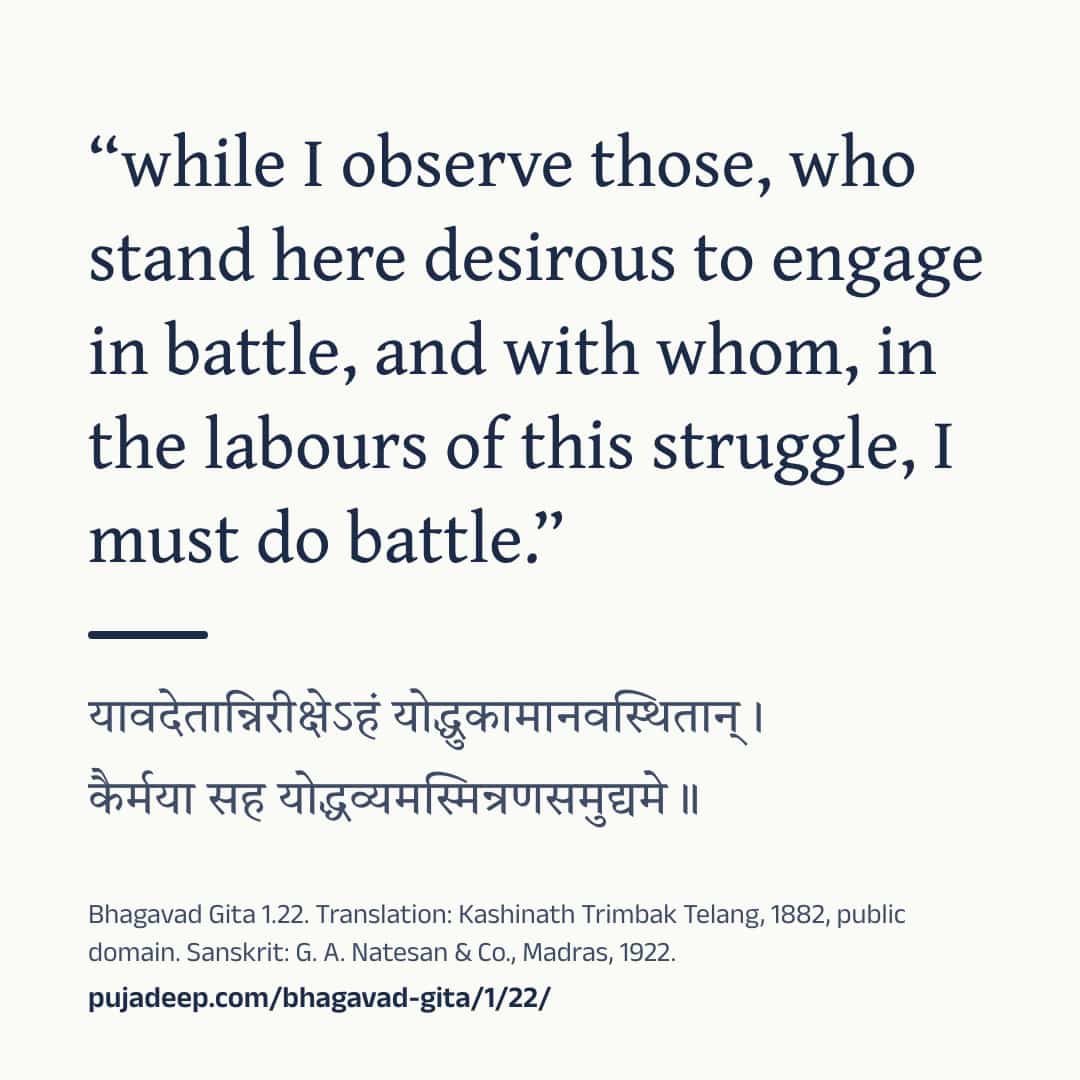
Drawing the picture
See the words
Bhagavad Gita 1.22

यावदेतान्निरीक्षेऽहं योद्धुकामानवस्थितान् ।
कैर्मया सह योद्धव्यमस्मिन्रणसमुद्यमे ॥

“while I observe those, who stand here desirous to engage in battle, and with whom, in the labours of this struggle, I must do battle.”
(K. T. Telang, The Bhagavadgîtâ (The Sacred Books of the East, vol. VIII, Oxford: Clarendon Press, 1882), p. 39, public domain)
This sentence begins in 1.20.

“While I behold these standing, longing for battle, with whom I must strive in this tremendous war,”
(Annie Besant, The Bhagavad Gîtâ, or The Lord's Song (London: Theosophical Publishing Society, 1895), p. 18, public domain)
This sentence begins in 1.20. This sentence goes on in 1.23.

Sanskrit: G. A. Natesan & Co., Madras, 1922.
https://pujadeep.com/bhagavad-gita/1/22/ Nothing is sent from this site. Your own app sends it, to the chat you choose. The picture quotes the translation you chose on this page, with its name and year.
Sanskrit text: The Bhagavad-Gita, or The Lord's Song, with the text in Devanagari and an English translation, 1922. Meanings: written for Pujadeep and checked against the cited edition. Source and changes
Questions families ask
Who speaks Bhagavad Gita 1.22?
Arjuna speaks this verse, in chapter 1 (Arjuna Vishada Yoga).
Where does the Sanskrit text come from?
Sanskrit text: The Bhagavad-Gita, or The Lord's Song, with the text in Devanagari and an English translation, 1922. Meanings: written for Pujadeep and checked against the cited edition. See the source
Is the meaning on this page a translation?
Explanation written for this site from the sources listed here, and checked against the cited edition. It is not a translation and not the only way to read the text. Free to quote with credit.
Source and licence
- Sanskrit text
- The Bhagavad-Gita, or The Lord's Song, with the text in Devanagari and an English translation (Annie Besant, G. A. Natesan & Co., Madras, 1922). Public domain. The Sanskrit on these pages was read from this printing’s page images.
- Translation
- The Bhagavadgîtâ with the Sanatsugâtîya and the Anugîtâ, translated by Kâshinâth Trimbak Telang (The Sacred Books of the East, vol. VIII, ed. F. Max Müller) (Kashinath Trimbak Telang, F. Max Müller, Clarendon Press, Oxford, 1882). Public domain. Shown verbatim, as printed.
- Translation
- The Bhagavad Gîtâ, or The Lord's Song, translated by Annie Besant (Annie Besant, Theosophical Publishing Society, London, 1895). Public domain. Shown verbatim, as printed.
- Translation
- Srimad-Bhagavad-Gita, with Sanskrit Text; Paraphrase with Word-by-word Literal Translation; English Rendering and Comments, Index, &c., by the Swami Swarupananda (Himalayan Series, No. XX) (Swami Swarupananda, The Editors and Publishers, Advaita Ashrama, Mayavati, Prabuddha Bharata Press, Mayavati, Almora, Himalayas, 1909). Public domain. Shown verbatim, as printed.
- Common wording
- In this text, 32 words follow today's common wording, checked against sanskritdocuments.org; Sanskrit Wikisource; Gita Press, Gorakhpur; GRETIL, Göttingen and Bhaktivedanta Book Trust.
- Our explanation
- Explanation written for this site from the sources listed here, and checked against the cited edition. It is not a translation and not the only way to read the text. Free to quote with credit.
- Checked
- Checked against the cited edition, October 15, 2026.
- Updated
- October 25, 2026