Bhagavad Gita 1.13: meaning and translation
Chapter 1: Arjuna Vishada Yoga. Sanjaya says
Sanjaya: Then conches, kettledrums, drums and horns all sound at once, and the noise is tremendous.
Click or tap a word for its meaning and its dictionary page.
Text and layers
Text and layers
These choices stay in this browser.
Bhagavad Gita 1.13
ततः शङ्खाश्च भेर्यश्च पणवानकगोमुखाः ।सहसैवाभ्यहन्यन्त स शब्दस्तुमुलोऽभवत् ॥
Tatah shankhashcha bheryashcha panavanakagomukhahSahasaivabhyahanyanta sa shabdastumulobhavat
tataḥ śaṅkhāśca bheryaśca paṇavānakagomukhāḥ |sahasaivābhyahanyanta sa śabdastumulo’bhavat ||
Our explanation Then conches, kettledrums, drums and horns all sound at once, and the noise is tremendous.
हिंदी अर्थ फिर एक साथ शंख, नगाड़े, ढोल और नरसिंघे बज उठते हैं, और भारी कोलाहल होता है।
Word by word
Every word, with its dictionary page
Word by word
- ततः tataḥ · then (indeclinable) Dictionary: tatas, Monier-Williams 1899, p. 432, col. 2 “thereupon, then, after that”
- शङ्खाः śaṅkhāḥ · conches (noun (masculine), nominative plural) Dictionary: śaṅkha, Monier-Williams 1899, p. 1047, col. 2 “a shell, (esp.) the conch-shell”
- च ca · and (indeclinable) Dictionary: 2. ca, Monier-Williams 1899, p. 380, col. 1 “ind. and, both, also, moreover, as well as”
- भेर्यः bheryaḥ · kettledrums (noun (feminine), nominative plural) Dictionary: bherī, Monier-Williams 1899, p. 766, col. 3 “a kettle-drum”
- च ca · and (indeclinable) Dictionary: 2. ca, Monier-Williams 1899, p. 380, col. 1 “ind. and, both, also, moreover, as well as”
- पणवानकगोमुखाः paṇavānakagomukhāḥ · tabors, drums and horns (compound (masculine), nominative plural) Dictionary: paṇava, Monier-Williams 1899, p. 580, col. 2 “a small drum or a kind of cymbal”; ānaka, Monier-Williams 1899, p. 139, col. 3 “a large military drum beaten at one end; a double drum; a small drum or tabor”; go-mukha, Monier-Williams 1899, p. 366, col. 1 “a kind of musical instrument (sort of horn or trumpet?)”
- सहसा sahasā · all at once (indeclinable) Dictionary: sahasā, Monier-Williams 1899, p. 1193, col. 1 “suddenly, quickly, precipitately, immediately, at once”
- एव eva · just (indeclinable) Dictionary: 1. eva, Monier-Williams 1899, p. 232, col. 2 “just, exactly, very, same, only, even, alone, merely”
- अभ्यहन्यन्त abhyahanyanta · were sounded (imperfect passive, 3rd person plural) Dictionary: abhi-han, Monier-Williams 1899, p. 74, col. 1 “to beat (as a drum, &c.)”
- सः saḥ · that (pronoun (masculine), nominative singular) Dictionary: tad, Monier-Williams 1899, p. 434, col. 1 “m. he, f. she, n. it, that, this”
- शब्दः śabdaḥ · sound (noun (masculine), nominative singular) Dictionary: śabda, Monier-Williams 1899, p. 1052, col. 2 “sound, noise, voice, tone, note”
- तुमुलः tumulaḥ · tumultuous (adjective (masculine), nominative singular) Dictionary: tumula, Monier-Williams 1899, p. 450, col. 3 “tumultuous, noisy”
- अभवत् abhavat · became, was (imperfect, 3rd person singular) Dictionary: 1. bhū, Monier-Williams 1899, p. 760, col. 2 “arise, come into being, exist”
Old translations
Kashinath Trimbak Telang, 1882. Public domain. Page 38.
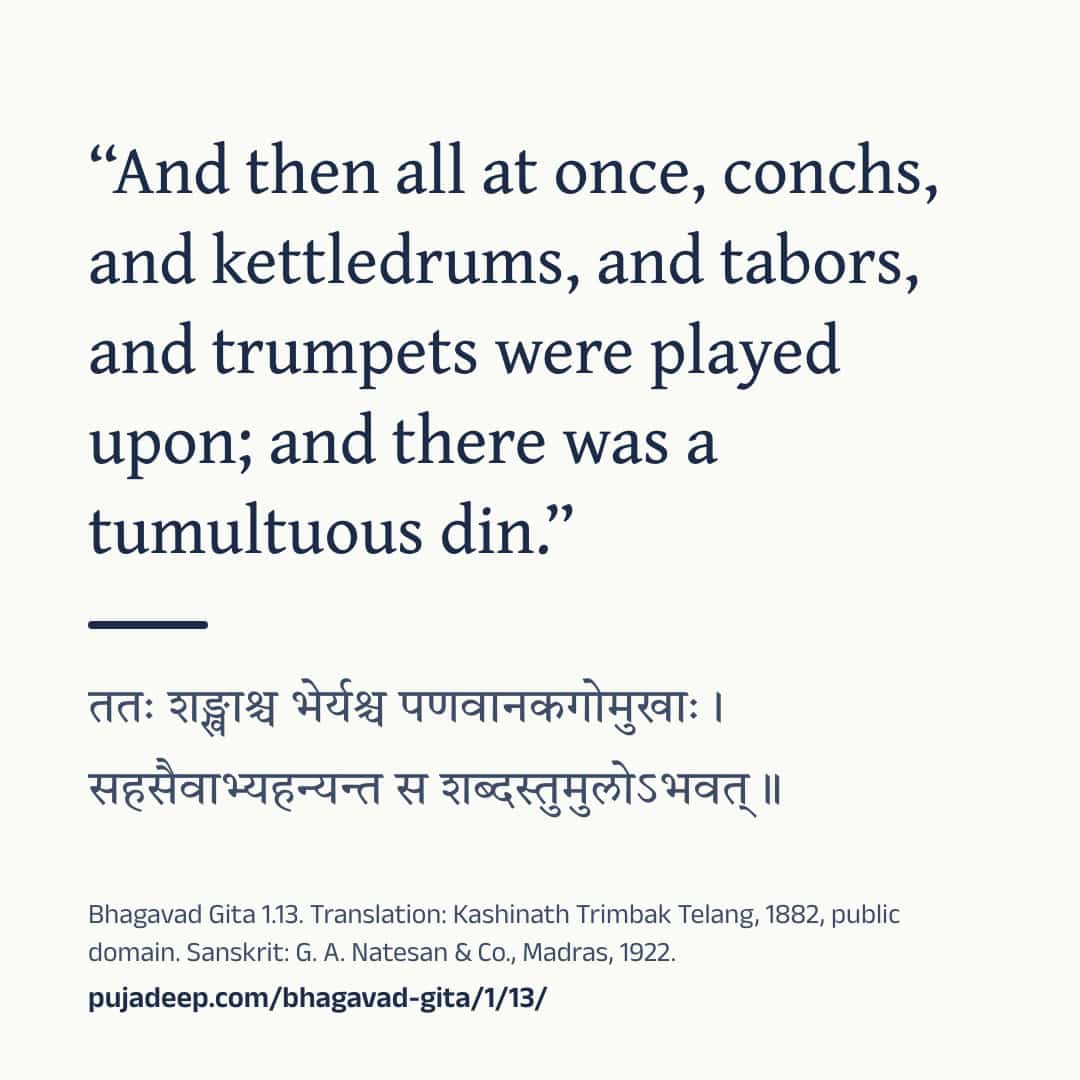
And then all at once, conchs, and kettledrums, and tabors, and trumpets were played upon; and there was a tumultuous din.
Compare 3 translations
Kashinath Trimbak Telang, 1882. Public domain. Page 38.
And then all at once, conchs, and kettledrums, and tabors, and trumpets were played upon; and there was a tumultuous din.
You are reading this one
Annie Besant, 1895. Public domain. Page 16.
Then conches and kettledrums, tabors and trumpets and cowhorns, suddenly blared forth, and the sound was an uproar.
You are reading this one
Swami Swarupananda, 1909 (first printed 1907). Public domain. Page 7.
Then following Bhishma, conches and kettledrums, tabors, trumpets and cowhorns blared forth suddenly from the Kaurava side and the noise was tremendous.
You are reading this one
Cite this verse
The translation: K. T. Telang, The Bhagavadgîtâ (The Sacred Books of the East, vol. VIII, Oxford: Clarendon Press, 1882), p. 38. Bhagavad Gita 1.13.
The translation: Annie Besant, The Bhagavad Gîtâ, or The Lord's Song (London: Theosophical Publishing Society, 1895), p. 16. Bhagavad Gita 1.13.
The translation: Swami Swarupananda, Srimad-Bhagavad-Gita (Mayavati: Prabuddha Bharata Press, 1909; first printed in Prabuddha Bharata, 1907–1909), p. 7. Bhagavad Gita 1.13.
Our explanation: “Bhagavad Gita 1.13: meaning and translation.” Pujadeep. Updated October 25, 2026. https://pujadeep.com/bhagavad-gita/1/13/
Pujadeep’s explanations are free to quote with credit: name Pujadeep and link to the page. How to credit
Classical readings, by school
No readings by school on this verse yet.
Share
Show the ways to share
Send one picture or the text to one chat. The picture names its source and the address of this page.
Drawing the picture
See the words
Bhagavad Gita 1.13

ततः शङ्खाश्च भेर्यश्च पणवानकगोमुखाः ।
सहसैवाभ्यहन्यन्त स शब्दस्तुमुलोऽभवत् ॥

“And then all at once, conchs, and kettledrums, and tabors, and trumpets were played upon; and there was a tumultuous din.”
(K. T. Telang, The Bhagavadgîtâ (The Sacred Books of the East, vol. VIII, Oxford: Clarendon Press, 1882), p. 38, public domain)

“Then conches and kettledrums, tabors and trumpets and cowhorns, suddenly blared forth, and the sound was an uproar.”
(Annie Besant, The Bhagavad Gîtâ, or The Lord's Song (London: Theosophical Publishing Society, 1895), p. 16, public domain)

“Then following Bhishma, conches and kettledrums, tabors, trumpets and cowhorns blared forth suddenly from the Kaurava side and the noise was tremendous.”
(Swami Swarupananda, Srimad-Bhagavad-Gita (Mayavati: Prabuddha Bharata Press, 1909; first printed in Prabuddha Bharata, 1907–1909), p. 7, public domain)

Sanskrit: G. A. Natesan & Co., Madras, 1922.
https://pujadeep.com/bhagavad-gita/1/13/ Nothing is sent from this site. Your own app sends it, to the chat you choose. The picture quotes the translation you chose on this page, with its name and year.
Sanskrit text: The Bhagavad-Gita, or The Lord's Song, with the text in Devanagari and an English translation, 1922. Meanings: written for Pujadeep and checked against the cited edition. Source and changes
Questions families ask
Who speaks Bhagavad Gita 1.13?
Sanjaya speaks this verse, in chapter 1 (Arjuna Vishada Yoga).
Where does the Sanskrit text come from?
Sanskrit text: The Bhagavad-Gita, or The Lord's Song, with the text in Devanagari and an English translation, 1922. Meanings: written for Pujadeep and checked against the cited edition. See the source
Is the meaning on this page a translation?
Explanation written for this site from the sources listed here, and checked against the cited edition. It is not a translation and not the only way to read the text. Free to quote with credit.
Source and licence
- Sanskrit text
- The Bhagavad-Gita, or The Lord's Song, with the text in Devanagari and an English translation (Annie Besant, G. A. Natesan & Co., Madras, 1922). Public domain. The Sanskrit on these pages was read from this printing’s page images.
- Translation
- The Bhagavadgîtâ with the Sanatsugâtîya and the Anugîtâ, translated by Kâshinâth Trimbak Telang (The Sacred Books of the East, vol. VIII, ed. F. Max Müller) (Kashinath Trimbak Telang, F. Max Müller, Clarendon Press, Oxford, 1882). Public domain. Shown verbatim, as printed.
- Translation
- The Bhagavad Gîtâ, or The Lord's Song, translated by Annie Besant (Annie Besant, Theosophical Publishing Society, London, 1895). Public domain. Shown verbatim, as printed.
- Translation
- Srimad-Bhagavad-Gita, with Sanskrit Text; Paraphrase with Word-by-word Literal Translation; English Rendering and Comments, Index, &c., by the Swami Swarupananda (Himalayan Series, No. XX) (Swami Swarupananda, The Editors and Publishers, Advaita Ashrama, Mayavati, Prabuddha Bharata Press, Mayavati, Almora, Himalayas, 1909). Public domain. Shown verbatim, as printed.
- Common wording
- In this text, 32 words follow today's common wording, checked against sanskritdocuments.org; Sanskrit Wikisource; Gita Press, Gorakhpur; GRETIL, Göttingen and Bhaktivedanta Book Trust.
- Our explanation
- Explanation written for this site from the sources listed here, and checked against the cited edition. It is not a translation and not the only way to read the text. Free to quote with credit.
- Checked
- Checked against the cited edition, October 15, 2026.
- Updated
- October 25, 2026