Bhagavad Gita 1.4: meaning and translation
Chapter 1: Arjuna Vishada Yoga. Duryodhana says
Duryodhana: He names the heroes on the Pandava side, great archers equal in battle to Bhima and Arjuna: Yuyudhana (also called Satyaki, a kinsman of Krishna), Virata (the king at whose court the Pandavas lived in disguise), and Drupada (king of the Panchalas and father of Draupadi), a great chariot-warrior (mahāratha).
Click or tap a word for its meaning and its dictionary page.
Text and layers
Text and layers
These choices stay in this browser.
Bhagavad Gita 1.4
अत्र शूरा महेष्वासा भीमार्जुनसमा युधि ।युयुधानो विराटश्च द्रुपदश्च महारथः ॥
Atra shura maheshvasa bhimarjunasama yudhiYuyudhano viratashcha drupadashcha maharathah
atra śūrā maheṣvāsā bhīmārjunasamā yudhi |yuyudhāno virāṭaśca drupadaśca mahārathaḥ ||
Our explanation He names the heroes on the Pandava side, great archers equal in battle to Bhima and Arjuna: Yuyudhana (also called Satyaki, a kinsman of Krishna), Virata (the king at whose court the Pandavas lived in disguise), and Drupada (king of the Panchalas and father of Draupadi), a great chariot-warrior (mahāratha).
हिंदी अर्थ वे पाण्डवों की ओर के वीरों के नाम लेते हैं, जो बड़े धनुर्धर हैं और युद्ध में भीम और अर्जुन के समान हैं: युयुधान (सात्यकि, कृष्ण के संबंधी), विराट (वह राजा जिनके दरबार में पाण्डव वेश बदलकर रहे थे) और महारथी (महान रथ-योद्धा) द्रुपद (पांचाल देश के राजा, द्रौपदी के पिता)।
Word by word
Every word, with its dictionary page
Word by word
- अत्र atra · here (indeclinable) Dictionary: 1. a-tra, Monier-Williams 1899, p. 17, col. 2 “in this place, here”
- शूराः śūrāḥ · heroes (noun (masculine), nominative plural) Dictionary: śūra, Monier-Williams 1899, p. 1086, col. 1 “strong, powerful, valiant, heroic, brave”
- महेष्वासाः maheṣvāsāḥ · great archers (compound (masculine), nominative plural) Dictionary: maheṣv-āsa, Monier-Williams 1899, p. 802, col. 2 “a gr° archer”
- भीमार्जुनसमाः bhīmārjunasamāḥ · equal to Bhima and Arjuna (compound (masculine), nominative plural) Dictionary: bhīma, Monier-Williams 1899, p. 758, col. 1 “fearful, terrific, terrible, awful, formidable, tremendous”; arjuna, Monier-Williams 1899, p. 90, col. 1; 2. sama, Monier-Williams 1899, p. 1152, col. 1 “same, equal, similar, like, equivalent”
- युधि yudhi · in battle (noun (feminine), locative singular) Dictionary: 2. yudh, Monier-Williams 1899, p. 855, col. 1 “f. war, fight, combat, struggle, contest”
- युयुधानः yuyudhānaḥ · Yuyudhana (Satyaki) (noun (masculine), nominative singular) Dictionary: yuyudhāna, Monier-Williams 1899, p. 855, col. 2 “N. of a son of Satyaka (one of the allies of the Pāṇḍavas)”
- विराटः virāṭaḥ · Virata (noun (masculine), nominative singular) Dictionary: virāṭa, Monier-Williams 1899, p. 983, col. 1 “N. of an ancient king of a particular district in India”
- च ca · and (indeclinable) Dictionary: 2. ca, Monier-Williams 1899, p. 380, col. 1 “ind. and, both, also, moreover, as well as”
- द्रुपदः drupadaḥ · Drupada (noun (masculine), nominative singular) Dictionary: drupada, Monier-Williams 1899, p. 502, col. 1 “N. of a king of the Pañcālas”
- च ca · and (indeclinable) Dictionary: 2. ca, Monier-Williams 1899, p. 380, col. 1 “ind. and, both, also, moreover, as well as”
- महारथः mahārathaḥ · a great chariot-warrior (compound (masculine), nominative singular) Dictionary: mahā-ratha, Monier-Williams 1899, p. 799, col. 2 “a gr° warrior”
2 printings differ
Edition differences. Another printing or text reads this place differently.
- The printed edition reads: अत्र शूरा महेष्वासा भीमार्जुनसमा युधि ।
युयुंधानो विराटश्च द्रुपदश्च महारथः ॥ The print shows a dot like an anusvara over the second यु (युयुंधानो); read as a printing flaw and not shown, because the name Yuyudhāna has no nasal and both proofreading references read युयुधानो. - Word The 1922 Madras printing reads: युयुंधानो विराटश्च द्रुपदश्च महारथः The 1922 base printing (leaf n11) shows a stray dot like an anusvara over the second यु (युयुंधानो), a printing flaw; see normalisations.
Old translations
Kashinath Trimbak Telang, 1882. Public domain. Page 37.
In it are heroes (bearing) large bows, the equals of Bhîma and Arguna in battle—(namely), Yuyudhâna, Virâta, and Drupada, the master of a great car1,
This sentence goes on in 1.5.
Footnotes (the translator’s own) - This is a literal rendering; the technical meaning is 'a warrior proficient in military science, who can fight single-handed a thousand archers.' ↩
Compare 3 translations
Kashinath Trimbak Telang, 1882. Public domain. Page 37.
In it are heroes (bearing) large bows, the equals of Bhîma and Arguna in battle—(namely), Yuyudhâna, Virâta, and Drupada, the master of a great car1,
This sentence goes on in 1.5.
Footnotes (the translator’s own) - This is a literal rendering; the technical meaning is 'a warrior proficient in military science, who can fight single-handed a thousand archers.' ↩
You are reading this one
Annie Besant, 1895. Public domain. Page 14.
Heroes are these, mighty bowmen, to Bhîma and Arjuna equal in battle; Yuyudhâna, Virâta, and Drupada of the great car:
This sentence goes on in 1.5.
You are reading this one
Swami Swarupananda, 1909 (first printed 1907). Public domain. Page 4.
"Here (are) heroes, mighty archers, the equals in battle of Bhima and Arjuna—the great warriors Yuyudhâna, Virâta, Drupada; the valiant Dhrishtaketu, Chekitâna and the king of Kàshi, the best of men Purujit, Kunti-Bhoja and Shaibya; the powerful Yudhámanyu and the brave Uttamaujas; the son of Subhadrà, and the sons of Draupadi,—lords of great chariots.
This sentence covers verses 1.4 to 1.6.
You are reading this one
Cite this verse
The translation: K. T. Telang, The Bhagavadgîtâ (The Sacred Books of the East, vol. VIII, Oxford: Clarendon Press, 1882), p. 37. Bhagavad Gita 1.4.
The translation: Annie Besant, The Bhagavad Gîtâ, or The Lord's Song (London: Theosophical Publishing Society, 1895), p. 14. Bhagavad Gita 1.4.
The translation: Swami Swarupananda, Srimad-Bhagavad-Gita (Mayavati: Prabuddha Bharata Press, 1909; first printed in Prabuddha Bharata, 1907–1909), p. 4. Bhagavad Gita 1.4–6.
Our explanation: “Bhagavad Gita 1.4: meaning and translation.” Pujadeep. Updated October 25, 2026. https://pujadeep.com/bhagavad-gita/1/4/
Pujadeep’s explanations are free to quote with credit: name Pujadeep and link to the page. How to credit
Classical readings, by school
No readings by school on this verse yet.
Share
Show the ways to share
Send one picture or the text to one chat. The picture names its source and the address of this page.
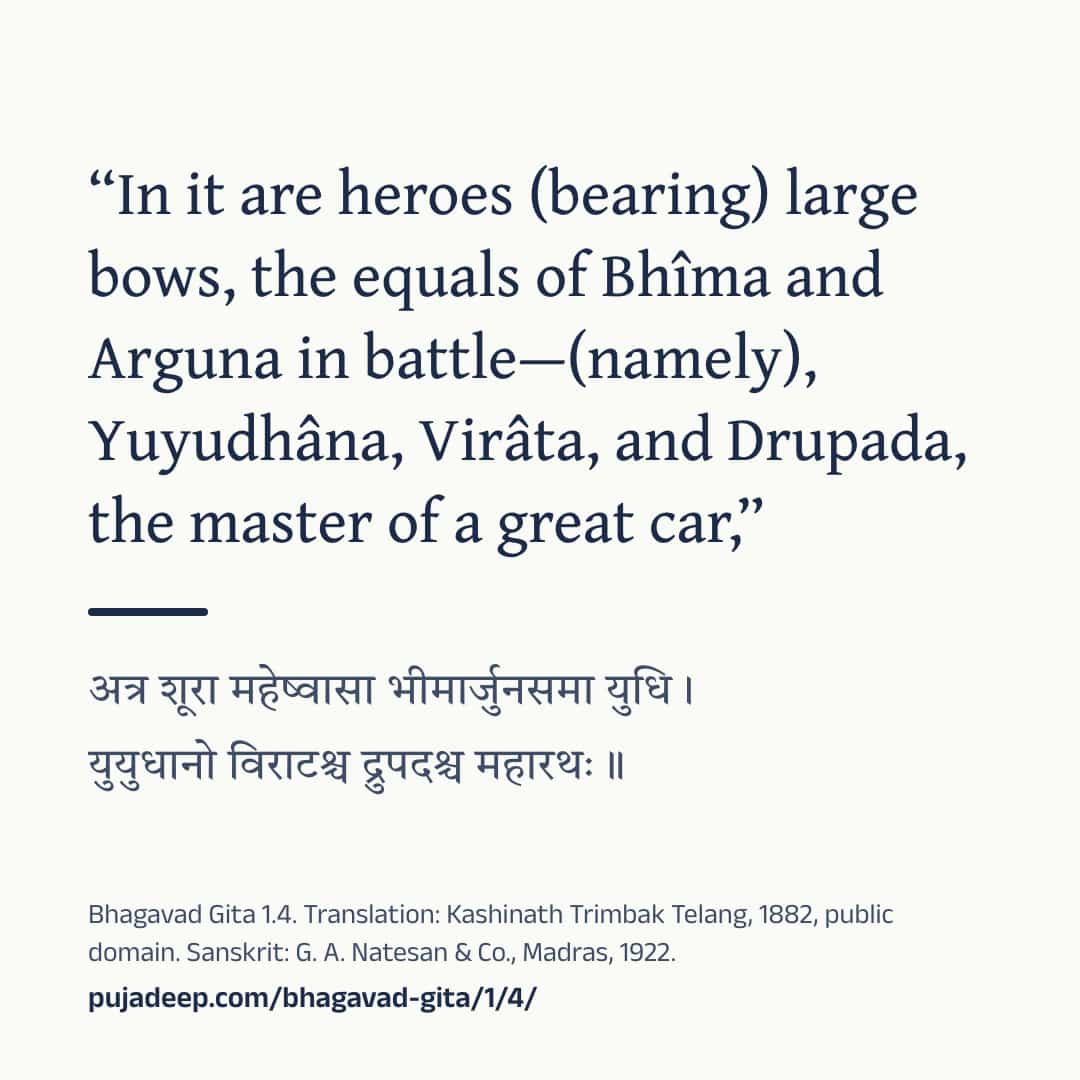
Drawing the picture
See the words
Bhagavad Gita 1.4

अत्र शूरा महेष्वासा भीमार्जुनसमा युधि ।
युयुधानो विराटश्च द्रुपदश्च महारथः ॥

“In it are heroes (bearing) large bows, the equals of Bhîma and Arguna in battle—(namely), Yuyudhâna, Virâta, and Drupada, the master of a great car,”
(K. T. Telang, The Bhagavadgîtâ (The Sacred Books of the East, vol. VIII, Oxford: Clarendon Press, 1882), p. 37, public domain)
This sentence goes on in 1.5.

“Heroes are these, mighty bowmen, to Bhîma and Arjuna equal in battle; Yuyudhâna, Virâta, and Drupada of the great car:”
(Annie Besant, The Bhagavad Gîtâ, or The Lord's Song (London: Theosophical Publishing Society, 1895), p. 14, public domain)
This sentence goes on in 1.5.

“"Here (are) heroes, mighty archers, the equals in battle of Bhima and Arjuna—the great warriors Yuyudhâna, Virâta, Drupada; the valiant Dhrishtaketu, Chekitâna and the king of Kàshi, the best of men Purujit, Kunti-Bhoja and Shaibya; the powerful Yudhámanyu and the brave Uttamaujas; the son of Subhadrà, and the sons of Draupadi,—lords of great chariots.”
(Swami Swarupananda, Srimad-Bhagavad-Gita (Mayavati: Prabuddha Bharata Press, 1909; first printed in Prabuddha Bharata, 1907–1909), p. 4, public domain)
This sentence covers verses 1.4 to 1.6.

Sanskrit: G. A. Natesan & Co., Madras, 1922.
https://pujadeep.com/bhagavad-gita/1/4/ Nothing is sent from this site. Your own app sends it, to the chat you choose. The picture quotes the translation you chose on this page, with its name and year.
Sanskrit text: The Bhagavad-Gita, or The Lord's Song, with the text in Devanagari and an English translation, 1922. Meanings: written for Pujadeep and checked against the cited edition. Source and changes
Questions families ask
Who speaks Bhagavad Gita 1.4?
Duryodhana speaks this verse, in chapter 1 (Arjuna Vishada Yoga).
Where does the Sanskrit text come from?
Sanskrit text: The Bhagavad-Gita, or The Lord's Song, with the text in Devanagari and an English translation, 1922. Meanings: written for Pujadeep and checked against the cited edition. See the source
Is the meaning on this page a translation?
Explanation written for this site from the sources listed here, and checked against the cited edition. It is not a translation and not the only way to read the text. Free to quote with credit.
Source and licence
- Sanskrit text
- The Bhagavad-Gita, or The Lord's Song, with the text in Devanagari and an English translation (Annie Besant, G. A. Natesan & Co., Madras, 1922). Public domain. The Sanskrit on these pages was read from this printing’s page images.
- Translation
- The Bhagavadgîtâ with the Sanatsugâtîya and the Anugîtâ, translated by Kâshinâth Trimbak Telang (The Sacred Books of the East, vol. VIII, ed. F. Max Müller) (Kashinath Trimbak Telang, F. Max Müller, Clarendon Press, Oxford, 1882). Public domain. Shown verbatim, as printed.
- Translation
- The Bhagavad Gîtâ, or The Lord's Song, translated by Annie Besant (Annie Besant, Theosophical Publishing Society, London, 1895). Public domain. Shown verbatim, as printed.
- Translation
- Srimad-Bhagavad-Gita, with Sanskrit Text; Paraphrase with Word-by-word Literal Translation; English Rendering and Comments, Index, &c., by the Swami Swarupananda (Himalayan Series, No. XX) (Swami Swarupananda, The Editors and Publishers, Advaita Ashrama, Mayavati, Prabuddha Bharata Press, Mayavati, Almora, Himalayas, 1909). Public domain. Shown verbatim, as printed.
- Common wording
- In this text, 32 words follow today's common wording, checked against sanskritdocuments.org; Sanskrit Wikisource; Gita Press, Gorakhpur; GRETIL, Göttingen and Bhaktivedanta Book Trust.
- Our explanation
- Explanation written for this site from the sources listed here, and checked against the cited edition. It is not a translation and not the only way to read the text. Free to quote with credit.
- Checked
- Checked against the cited edition, October 15, 2026.
- Updated
- October 25, 2026