Bhagavad Gita 1.3: meaning and translation
Chapter 1: Arjuna Vishada Yoga. Duryodhana says
Duryodhana asks his teacher Drona to look at the great army of the Pandavas.
Click or tap a word for its meaning and its dictionary page.
Text and layers
Text and layers
These choices stay in this browser.
Bhagavad Gita 1.3
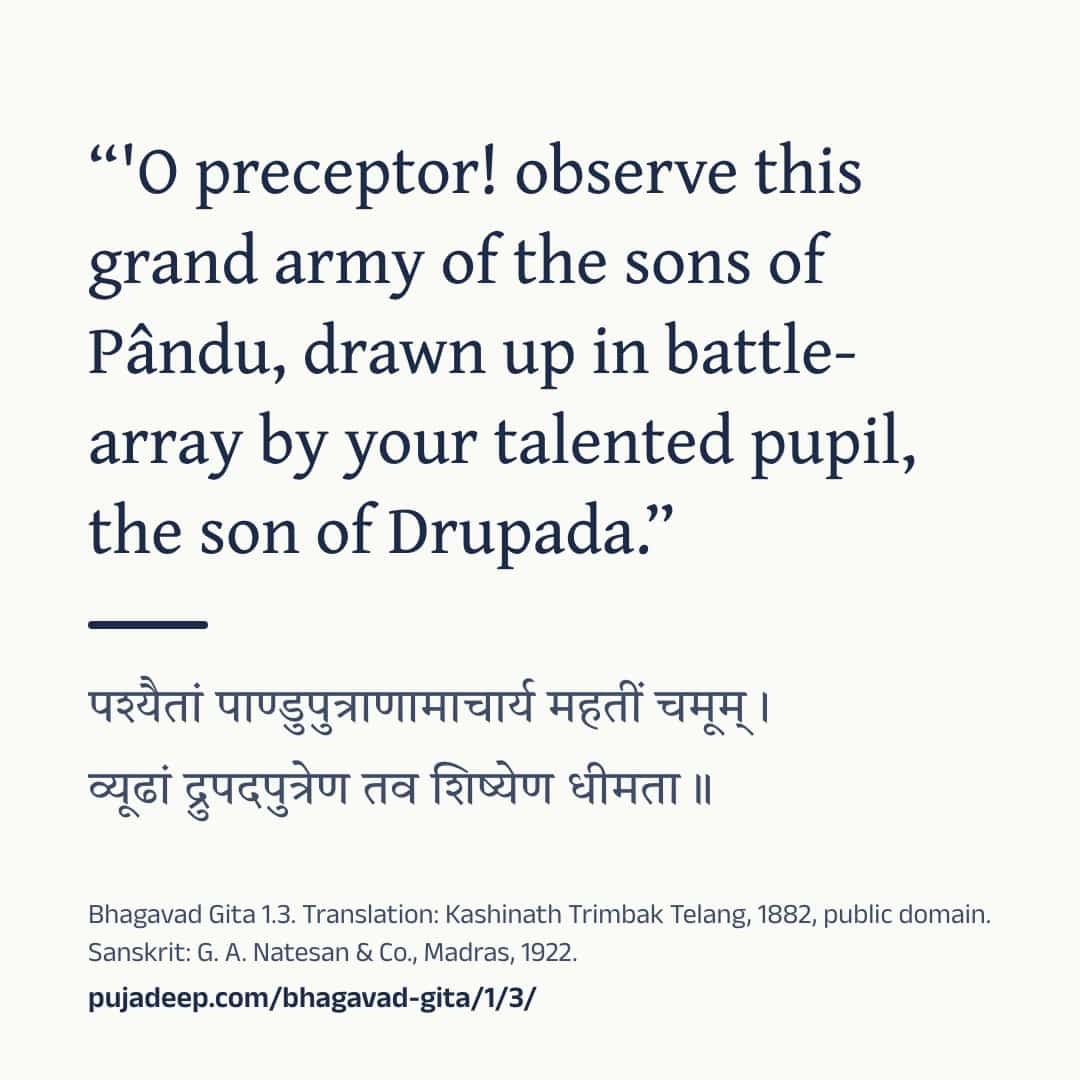
पश्यैतां पाण्डुपुत्राणामाचार्य महतीं चमूम् ।व्यूढां द्रुपदपुत्रेण तव शिष्येण धीमता ॥
Pashyaitam panduputranamacharya mahatim chamumVyudham drupadaputrena tava shishyena dhimata
paśyaitāṃ pāṇḍuputrāṇāmācārya mahatīṃ camūm |vyūḍhāṃ drupadaputreṇa tava śiṣyeṇa dhīmatā ||
Our explanation Duryodhana asks his teacher Drona to look at the great army of the Pandavas. It has been drawn up by the son of Drupada (Dhrishtadyumna), Drona's own clever pupil, who now leads the other side.
हिंदी अर्थ दुर्योधन अपने गुरु द्रोणाचार्य से कहते हैं कि पाण्डवों की इस विशाल सेना को देखिए। इसे द्रुपद के पुत्र धृष्टद्युम्न ने व्यूह में खड़ा किया है, जो द्रोणाचार्य के ही बुद्धिमान शिष्य हैं और अब दूसरे पक्ष की सेना के नायक हैं।
Word by word
Every word, with its dictionary page
Word by word
- पश्य paśya · look at (imperative, 2nd person singular) Dictionary: 1. paś, Monier-Williams 1899, p. 611, col. 2 “behold, look at, observe, perceive, notice”
- एताम् etām · this (pronoun (feminine), accusative singular) Dictionary: etad, Monier-Williams 1899, p. 231, col. 2 “this, this here, here”
- पाण्डुपुत्राणाम् pāṇḍuputrāṇām · of the sons of Pandu (compound (masculine), genitive plural) Dictionary: pāṇḍu, Monier-Williams 1899, p. 616, col. 1 “N. of a son of Vyāsa”; putra, Monier-Williams 1899, p. 632, col. 3 “a son, child”
- आचार्य ācārya · O teacher (noun (masculine), vocative singular) Dictionary: ācārya, Monier-Williams 1899, p. 131, col. 3
- महतीम् mahatīm · great, vast (adjective (feminine), accusative singular) Dictionary: mahat, Monier-Williams 1899, p. 794, col. 2 “great (in space, time, quantity or degree)”
- चमूम् camūm · army (noun (feminine), accusative singular) Dictionary: camū, Monier-Williams 1899, p. 388, col. 3 “an army or division of an army”
- व्यूढाम् vyūḍhām · drawn up in battle order (past participle (feminine), accusative singular) Dictionary: 2. vy-ūḍha, Monier-Williams 1899, p. 1041, col. 1 “pushed or moved apart, divided, distributed, arranged”
- द्रुपदपुत्रेण drupadaputreṇa · by the son of Drupada (compound (masculine), instrumental singular) Dictionary: drupada, Monier-Williams 1899, p. 502, col. 1 “N. of a king of the Pañcālas”; putra, Monier-Williams 1899, p. 632, col. 3 “a son, child”
- तव tava · your (pronoun, genitive singular) Dictionary: 2. tva, Monier-Williams 1899, p. 463, col. 2 “base of the 2nd personal pron.”
- शिष्येण śiṣyeṇa · by the pupil (noun (masculine), instrumental singular) Dictionary: śiṣya, Monier-Williams 1899, p. 1077, col. 1 “a pupil, scholar, disciple”
- धीमता dhīmatā · wise, clever (adjective (masculine), instrumental singular) Dictionary: dhī-mat, Monier-Williams 1899, p. 516, col. 3 “intelligent, wise, learned, sensible”
Old translations
Kashinath Trimbak Telang, 1882. Public domain. Page 37.
'O preceptor! observe this grand army of the sons of Pându, drawn up in battle-array by your talented pupil, the son of Drupada.
This sentence begins in 1.2.
Compare 3 translations
Kashinath Trimbak Telang, 1882. Public domain. Page 37.
'O preceptor! observe this grand army of the sons of Pându, drawn up in battle-array by your talented pupil, the son of Drupada.
This sentence begins in 1.2.
You are reading this one
Annie Besant, 1895. Public domain. Page 14.
"Behold this mighty host of the sons of Pându, O Teacher, arrayed by the son of Drupada, thy wise disciple.
This sentence begins in 1.2.
You are reading this one
Swami Swarupananda, 1909 (first printed 1907). Public domain. Page 3.
"Behold, O Teacher! this mighty army of the sons of Pându, arrayed by the son of Drupada, thy gifted pupil.
This sentence begins in 1.2.
You are reading this one
Cite this verse
The translation: K. T. Telang, The Bhagavadgîtâ (The Sacred Books of the East, vol. VIII, Oxford: Clarendon Press, 1882), p. 37. Bhagavad Gita 1.3.
The translation: Annie Besant, The Bhagavad Gîtâ, or The Lord's Song (London: Theosophical Publishing Society, 1895), p. 14. Bhagavad Gita 1.3.
The translation: Swami Swarupananda, Srimad-Bhagavad-Gita (Mayavati: Prabuddha Bharata Press, 1909; first printed in Prabuddha Bharata, 1907–1909), p. 3. Bhagavad Gita 1.3.
Our explanation: “Bhagavad Gita 1.3: meaning and translation.” Pujadeep. Updated October 25, 2026. https://pujadeep.com/bhagavad-gita/1/3/
Pujadeep’s explanations are free to quote with credit: name Pujadeep and link to the page. How to credit
Classical readings, by school
No readings by school on this verse yet.
Share
Show the ways to share
Send one picture or the text to one chat. The picture names its source and the address of this page.
Drawing the picture
See the words
Bhagavad Gita 1.3

पश्यैतां पाण्डुपुत्राणामाचार्य महतीं चमूम् ।
व्यूढां द्रुपदपुत्रेण तव शिष्येण धीमता ॥

“'O preceptor! observe this grand army of the sons of Pându, drawn up in battle-array by your talented pupil, the son of Drupada.”
(K. T. Telang, The Bhagavadgîtâ (The Sacred Books of the East, vol. VIII, Oxford: Clarendon Press, 1882), p. 37, public domain)
This sentence begins in 1.2.

“"Behold this mighty host of the sons of Pându, O Teacher, arrayed by the son of Drupada, thy wise disciple.”
(Annie Besant, The Bhagavad Gîtâ, or The Lord's Song (London: Theosophical Publishing Society, 1895), p. 14, public domain)
This sentence begins in 1.2.

“"Behold, O Teacher! this mighty army of the sons of Pându, arrayed by the son of Drupada, thy gifted pupil.”
(Swami Swarupananda, Srimad-Bhagavad-Gita (Mayavati: Prabuddha Bharata Press, 1909; first printed in Prabuddha Bharata, 1907–1909), p. 3, public domain)
This sentence begins in 1.2.

Sanskrit: G. A. Natesan & Co., Madras, 1922.
https://pujadeep.com/bhagavad-gita/1/3/ Nothing is sent from this site. Your own app sends it, to the chat you choose. The picture quotes the translation you chose on this page, with its name and year.
Sanskrit text: The Bhagavad-Gita, or The Lord's Song, with the text in Devanagari and an English translation, 1922. Meanings: written for Pujadeep and checked against the cited edition. Source and changes
Questions families ask
Who speaks Bhagavad Gita 1.3?
Duryodhana speaks this verse, in chapter 1 (Arjuna Vishada Yoga).
Where does the Sanskrit text come from?
Sanskrit text: The Bhagavad-Gita, or The Lord's Song, with the text in Devanagari and an English translation, 1922. Meanings: written for Pujadeep and checked against the cited edition. See the source
Is the meaning on this page a translation?
Explanation written for this site from the sources listed here, and checked against the cited edition. It is not a translation and not the only way to read the text. Free to quote with credit.
Source and licence
- Sanskrit text
- The Bhagavad-Gita, or The Lord's Song, with the text in Devanagari and an English translation (Annie Besant, G. A. Natesan & Co., Madras, 1922). Public domain. The Sanskrit on these pages was read from this printing’s page images.
- Translation
- The Bhagavadgîtâ with the Sanatsugâtîya and the Anugîtâ, translated by Kâshinâth Trimbak Telang (The Sacred Books of the East, vol. VIII, ed. F. Max Müller) (Kashinath Trimbak Telang, F. Max Müller, Clarendon Press, Oxford, 1882). Public domain. Shown verbatim, as printed.
- Translation
- The Bhagavad Gîtâ, or The Lord's Song, translated by Annie Besant (Annie Besant, Theosophical Publishing Society, London, 1895). Public domain. Shown verbatim, as printed.
- Translation
- Srimad-Bhagavad-Gita, with Sanskrit Text; Paraphrase with Word-by-word Literal Translation; English Rendering and Comments, Index, &c., by the Swami Swarupananda (Himalayan Series, No. XX) (Swami Swarupananda, The Editors and Publishers, Advaita Ashrama, Mayavati, Prabuddha Bharata Press, Mayavati, Almora, Himalayas, 1909). Public domain. Shown verbatim, as printed.
- Common wording
- In this text, 32 words follow today's common wording, checked against sanskritdocuments.org; Sanskrit Wikisource; Gita Press, Gorakhpur; GRETIL, Göttingen and Bhaktivedanta Book Trust.
- Our explanation
- Explanation written for this site from the sources listed here, and checked against the cited edition. It is not a translation and not the only way to read the text. Free to quote with credit.
- Checked
- Checked against the cited edition, October 15, 2026.
- Updated
- October 25, 2026