Bhagavad Gita 1.7: meaning and translation
Chapter 1: Arjuna Vishada Yoga. Duryodhana says
Then Duryodhana turns to his own side.
Click or tap a word for its meaning and its dictionary page.
Text and layers
Text and layers
These choices stay in this browser.
Bhagavad Gita 1.7
अस्माकं तु विशिष्टा ये तान्निबोध द्विजोत्तम ।नायका मम सैन्यस्य संज्ञार्थं तान्ब्रवीमि ते ॥
Asmakam tu vishishta ye tannibodha dvijottamaNayaka mama sainyasya sanjnartham tanbravimi te
asmākaṃ tu viśiṣṭā ye tānnibodha dvijottama |nāyakā mama sainyasya saṃjñārthaṃ tānbravīmi te ||
Our explanation Then Duryodhana turns to his own side. He addresses Drona as the best of the twice-born (Drona is a Brahmin), and offers to name the chief commanders of their army.
हिंदी अर्थ फिर दुर्योधन अपनी ओर के योद्धाओं की बात करते हैं। वे द्रोणाचार्य को द्विजोत्तम (ब्राह्मणों में श्रेष्ठ) कहकर संबोधित करते हैं और अपनी सेना के मुख्य सेनापतियों के नाम बताने की बात कहते हैं।
Word by word
Every word, with its dictionary page
Word by word
- अस्माकम् asmākam · our (pronoun, genitive plural) Dictionary: asmad, Monier-Williams 1899, p. 123, col. 2 “base of the first person plur., as used in comp.”
- तु tu · but, now (indeclinable) Dictionary: 2. tu, Monier-Williams 1899, p. 449, col. 3 “but”
- विशिष्टाः viśiṣṭāḥ · most distinguished (past participle (masculine), nominative plural) Dictionary: vi-śiṣṭa, Monier-Williams 1899, p. 990, col. 2 “distinguished, distinct, particular, peculiar”
- ये ye · who (pronoun (masculine), nominative plural) Dictionary: yad, Monier-Williams 1899, p. 844, col. 2 “who, which, what, whichever, whatever, that”
- तान् tān · them (pronoun (masculine), accusative plural) Dictionary: tad, Monier-Williams 1899, p. 434, col. 1 “m. he, f. she, n. it, that, this”
- निबोध nibodha · know, take note (imperative, 2nd person singular) Dictionary: ni-budh, Monier-Williams 1899, p. 550, col. 2 “to know, understand, consider”
- द्विजोत्तम dvijottama · O best of the twice-born (compound (masculine), vocative singular) Dictionary: dvijottama, Monier-Williams 1899, p. 506, col. 2
- नायकाः nāyakāḥ · the leaders (noun (masculine), nominative plural) Dictionary: nāyaka, Monier-Williams 1899, p. 536, col. 3 “a guide, leader, chief, lord, principal”
- मम mama · "my" (pronoun, genitive singular) Dictionary: 1. mad, Monier-Williams 1899, p. 777, col. 2 “base of the first pers. pron. in the sg. number (esp. in comp.)”
- सैन्यस्य sainyasya · of the army (noun (neuter), genitive singular) Dictionary: sainya, Monier-Williams 1899, p. 1248, col. 1 “an army”
- संज्ञार्थम् saṃjñārtham · for your information (compound, accusative used as an adverb (for the sake of)) Dictionary: saṃ-jñā, Monier-Williams 1899, p. 1133, col. 3 “a sign, token, signal”; artha, Monier-Williams 1899, p. 90, col. 3 “aim, purpose”
- तान् tān · them (pronoun (masculine), accusative plural) Dictionary: tad, Monier-Williams 1899, p. 434, col. 1 “m. he, f. she, n. it, that, this”
- ब्रवीमि bravīmi · "I tell" (present, 1st person singular) Dictionary: brū, Monier-Williams 1899, p. 742, col. 1 “to speak, say, tell”
- ते te · to you (pronoun, dative singular) Dictionary: 2. tva, Monier-Williams 1899, p. 463, col. 2 “base of the 2nd personal pron.”
Old translations
Kashinath Trimbak Telang, 1882. Public domain. Page 37–38.
And now, O best of Brâhmanas! learn who are most distinguished among us, and are leaders of my army. I will name them to you, in order that you may know them well.
Compare 3 translations
Kashinath Trimbak Telang, 1882. Public domain. Page 37–38.
And now, O best of Brâhmanas! learn who are most distinguished among us, and are leaders of my army. I will name them to you, in order that you may know them well.
You are reading this one
Annie Besant, 1895. Public domain. Page 14.
Know also those who are the chief of ours, O best of the Twice-born, the leaders of my army; these I name to thee for thy information:
This sentence goes on in 1.8.
You are reading this one
Swami Swarupananda, 1909 (first printed 1907). Public domain. Page 4.
Hear also, O Best of the twice-born! the names of those who (are) distinguished amongst ourselves, the leaders of my army. These I relate (to you) for your information.
You are reading this one
Cite this verse
The translation: K. T. Telang, The Bhagavadgîtâ (The Sacred Books of the East, vol. VIII, Oxford: Clarendon Press, 1882), pp. 37–38. Bhagavad Gita 1.7.
The translation: Annie Besant, The Bhagavad Gîtâ, or The Lord's Song (London: Theosophical Publishing Society, 1895), p. 14. Bhagavad Gita 1.7.
The translation: Swami Swarupananda, Srimad-Bhagavad-Gita (Mayavati: Prabuddha Bharata Press, 1909; first printed in Prabuddha Bharata, 1907–1909), p. 4. Bhagavad Gita 1.7.
Our explanation: “Bhagavad Gita 1.7: meaning and translation.” Pujadeep. Updated October 25, 2026. https://pujadeep.com/bhagavad-gita/1/7/
Pujadeep’s explanations are free to quote with credit: name Pujadeep and link to the page. How to credit
Classical readings, by school
No readings by school on this verse yet.
Share
Show the ways to share
Send one picture or the text to one chat. The picture names its source and the address of this page.
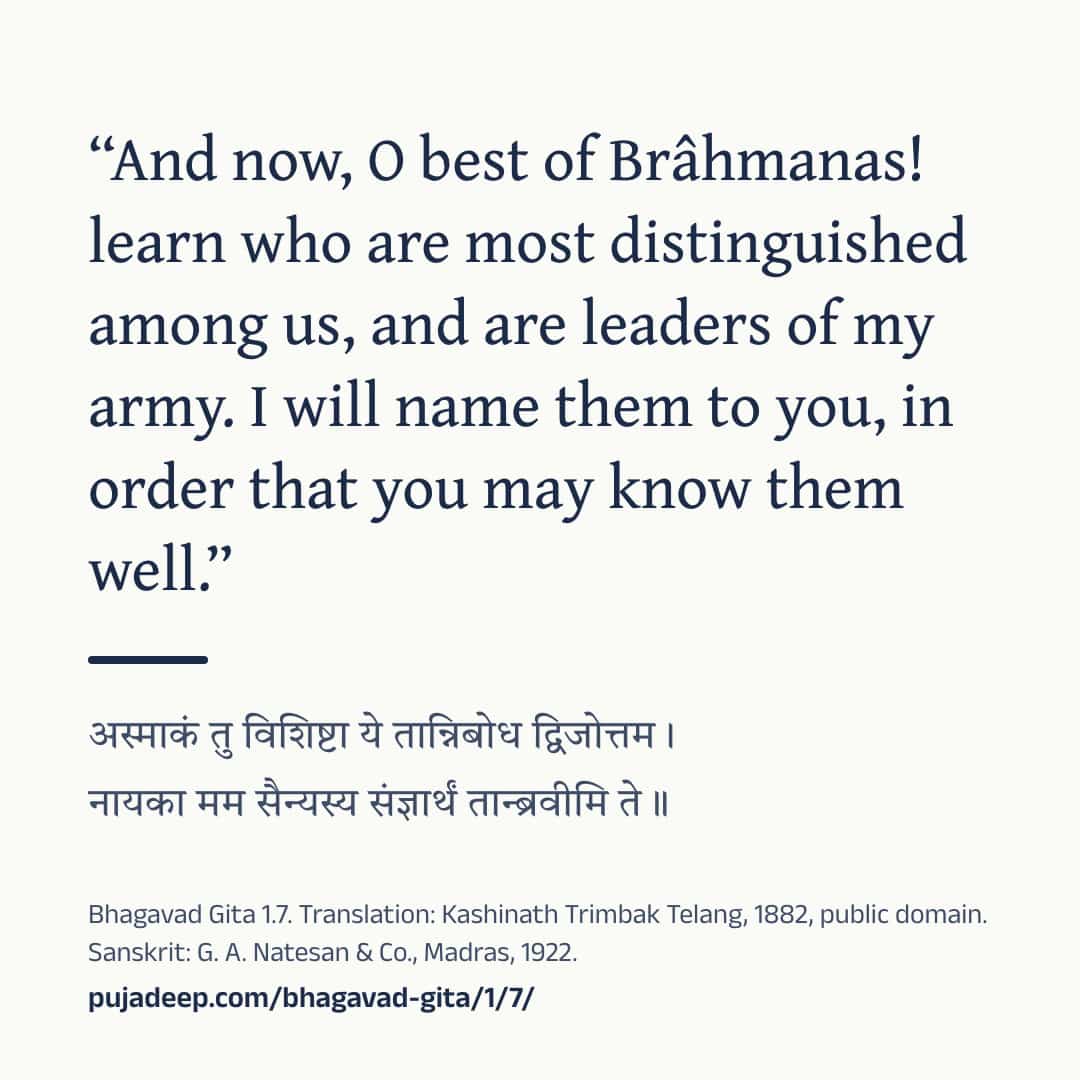
Drawing the picture
See the words
Bhagavad Gita 1.7

अस्माकं तु विशिष्टा ये तान्निबोध द्विजोत्तम ।
नायका मम सैन्यस्य संज्ञार्थं तान्ब्रवीमि ते ॥

“And now, O best of Brâhmanas! learn who are most distinguished among us, and are leaders of my army. I will name them to you, in order that you may know them well.”
(K. T. Telang, The Bhagavadgîtâ (The Sacred Books of the East, vol. VIII, Oxford: Clarendon Press, 1882), pp. 37–38, public domain)

“Know also those who are the chief of ours, O best of the Twice-born, the leaders of my army; these I name to thee for thy information:”
(Annie Besant, The Bhagavad Gîtâ, or The Lord's Song (London: Theosophical Publishing Society, 1895), p. 14, public domain)
This sentence goes on in 1.8.

“Hear also, O Best of the twice-born! the names of those who (are) distinguished amongst ourselves, the leaders of my army. These I relate (to you) for your information.”
(Swami Swarupananda, Srimad-Bhagavad-Gita (Mayavati: Prabuddha Bharata Press, 1909; first printed in Prabuddha Bharata, 1907–1909), p. 4, public domain)

Sanskrit: G. A. Natesan & Co., Madras, 1922.
https://pujadeep.com/bhagavad-gita/1/7/ Nothing is sent from this site. Your own app sends it, to the chat you choose. The picture quotes the translation you chose on this page, with its name and year.
Sanskrit text: The Bhagavad-Gita, or The Lord's Song, with the text in Devanagari and an English translation, 1922. Meanings: written for Pujadeep and checked against the cited edition. Source and changes
Questions families ask
Who speaks Bhagavad Gita 1.7?
Duryodhana speaks this verse, in chapter 1 (Arjuna Vishada Yoga).
Where does the Sanskrit text come from?
Sanskrit text: The Bhagavad-Gita, or The Lord's Song, with the text in Devanagari and an English translation, 1922. Meanings: written for Pujadeep and checked against the cited edition. See the source
Is the meaning on this page a translation?
Explanation written for this site from the sources listed here, and checked against the cited edition. It is not a translation and not the only way to read the text. Free to quote with credit.
Source and licence
- Sanskrit text
- The Bhagavad-Gita, or The Lord's Song, with the text in Devanagari and an English translation (Annie Besant, G. A. Natesan & Co., Madras, 1922). Public domain. The Sanskrit on these pages was read from this printing’s page images.
- Translation
- The Bhagavadgîtâ with the Sanatsugâtîya and the Anugîtâ, translated by Kâshinâth Trimbak Telang (The Sacred Books of the East, vol. VIII, ed. F. Max Müller) (Kashinath Trimbak Telang, F. Max Müller, Clarendon Press, Oxford, 1882). Public domain. Shown verbatim, as printed.
- Translation
- The Bhagavad Gîtâ, or The Lord's Song, translated by Annie Besant (Annie Besant, Theosophical Publishing Society, London, 1895). Public domain. Shown verbatim, as printed.
- Translation
- Srimad-Bhagavad-Gita, with Sanskrit Text; Paraphrase with Word-by-word Literal Translation; English Rendering and Comments, Index, &c., by the Swami Swarupananda (Himalayan Series, No. XX) (Swami Swarupananda, The Editors and Publishers, Advaita Ashrama, Mayavati, Prabuddha Bharata Press, Mayavati, Almora, Himalayas, 1909). Public domain. Shown verbatim, as printed.
- Common wording
- In this text, 32 words follow today's common wording, checked against sanskritdocuments.org; Sanskrit Wikisource; Gita Press, Gorakhpur; GRETIL, Göttingen and Bhaktivedanta Book Trust.
- Our explanation
- Explanation written for this site from the sources listed here, and checked against the cited edition. It is not a translation and not the only way to read the text. Free to quote with credit.
- Checked
- Checked against the cited edition, October 15, 2026.
- Updated
- October 25, 2026