Bhagavad Gita 1.21: meaning and translation
Chapter 1: Arjuna Vishada Yoga. Sanjaya says
Sanjaya tells the king that Arjuna then speaks to Krishna (Hrishikesha).
Click or tap a word for its meaning and its dictionary page.
Text and layers
Text and layers
These choices stay in this browser.
Bhagavad Gita 1.21
हृषीकेशं तदा वाक्यमिदमाह महीपते ।अर्जुन उवाच ।सेनयोरुभयोर्मध्ये रथं स्थापय मेऽच्युत ॥
Hrishikesham tada vakyamidamaha mahipateArjuna uvachaSenayorubhayormadhye ratham sthapaya mechyuta
hṛṣīkeśaṃ tadā vākyamidamāha mahīpate |arjuna uvāca |senayorubhayormadhye rathaṃ sthāpaya me’cyuta ||
Our explanation Sanjaya tells the king that Arjuna then speaks to Krishna (Hrishikesha). Arjuna asks him to place the chariot between the two armies, and calls him Achyuta, "the one who does not fall". The edition prints "Arjuna said" in the middle of this verse, where Arjuna's own words begin.
हिंदी अर्थ संजय राजा से कहते हैं कि तब अर्जुन हृषीकेश (कृष्ण) से बात करते हैं। अर्जुन उनसे रथ को दोनों सेनाओं के बीच खड़ा करने को कहते हैं, और उन्हें अच्युत (जो कभी अपने स्थान से न डिगे) कहकर पुकारते हैं। संस्करण में “अर्जुन उवाच” इस श्लोक के बीच में छपा है, जहाँ से अर्जुन के अपने शब्द शुरू होते हैं।
Word by word
Every word, with its dictionary page
Word by word
- हृषीकेशम् hṛṣīkeśam · to Hrishikesha (Krishna) (noun (masculine), accusative singular) Dictionary: hṛṣīkeśa, Monier-Williams 1899, p. 1303, col. 2
- तदा tadā · then (indeclinable) Dictionary: tadā, Monier-Williams 1899, p. 434, col. 3 “at that time, then, in that case”
- वाक्यम् vākyam · words (noun (neuter), accusative singular) Dictionary: vākya, Monier-Williams 1899, p. 936, col. 2 “speech, saying, assertion, statement, command, words”
- इदम् idam · these (pronoun (neuter), accusative singular) Dictionary: 1. idam, Monier-Williams 1899, p. 165, col. 2 “this, this here, referring to something near the speaker”
- आह āha · said (perfect, 3rd person singular) Dictionary: 1. ah, Monier-Williams 1899, p. 124, col. 1 “to say, speak”
- महीपते mahīpate · O lord of the earth (the king) (compound (masculine), vocative singular) Dictionary: 1. mahī, Monier-Williams 1899, p. 803, col. 2 “the earth”; pati, Monier-Williams 1899, p. 582, col. 1 “a master, owner, possessor, lord, ruler, sovereign”
- सेनयोः senayoḥ · of the armies (noun (feminine), genitive dual) Dictionary: senā, Monier-Williams 1899, p. 1246, col. 2 “an army, armament, battle-array, armed force”
- उभयोः ubhayoḥ · of both (pronoun (feminine), genitive dual) Dictionary: ubhaya, Monier-Williams 1899, p. 216, col. 2 “both, of both kinds”
- मध्ये madhye · in the middle (noun (neuter), locative singular) Dictionary: madhya, Monier-Williams 1899, p. 781, col. 3 “middle”
- रथम् ratham · chariot (noun (masculine), accusative singular) Dictionary: 1. ratha, Monier-Williams 1899, p. 865, col. 2 “‘goer,’ a chariot, car, esp. a two-wheeled war-chariot”
- स्थापय sthāpaya · place, halt (causative imperative, 2nd person singular) Dictionary: 1. sthā, Monier-Williams 1899, p. 1262, col. 2 “to stand, stand firmly, station one's self”
- मे me · "my" (pronoun, genitive singular) Dictionary: 1. mad, Monier-Williams 1899, p. 777, col. 2 “base of the first pers. pron. in the sg. number (esp. in comp.)”
- अच्युत acyuta · O Achyuta (Krishna) (noun (masculine), vocative singular) Dictionary: a-cyuta, Monier-Williams 1899, p. 9, col. 2 “not fallen; firm, solid; imperishable, permanent”
1 printing differs
Edition differences. Another printing or text reads this place differently.
- Omission A digital text reads Same words, without the speaker line arjuna uvāca that the 1922 edition prints between the two halves of the verse.
Old translations
Kashinath Trimbak Telang, 1882. Public domain. Page 39.
and O king of the earth! spake these words to Hrishîkesa: 'O undegraded one! station my chariot between the two armies,
This sentence begins in 1.20. This sentence goes on in 1.22.
Compare 3 translations
Kashinath Trimbak Telang, 1882. Public domain. Page 39.
and O king of the earth! spake these words to Hrishîkesa: 'O undegraded one! station my chariot between the two armies,
This sentence begins in 1.20. This sentence goes on in 1.22.
You are reading this one
Annie Besant, 1895. Public domain. Page 18.
And spake this word to Hrishîkesha, O Lord of Earth.
(Arjuna said:)
"In the midst, between the two armies, my chariot stay, O Achyuta,1
This sentence begins in 1.20. This sentence goes on in 1.22.
Footnotes (the translator’s own) - The changeless, the immovable. ↩
You are reading this one
Swami Swarupananda, 1909 (first printed 1907). Public domain. Page 11–12.
said the following words to Krishna:
Arjuna said:
Place my chariot, O Achyuta! between the two armies that I may see those who stand here prepared for war. On this the eve of battle (let me know) with whom I have to fight.
This sentence covers verses 1.21 to 1.22.
This sentence begins in 1.20.
You are reading this one
Cite this verse
The translation: K. T. Telang, The Bhagavadgîtâ (The Sacred Books of the East, vol. VIII, Oxford: Clarendon Press, 1882), p. 39. Bhagavad Gita 1.21.
The translation: Annie Besant, The Bhagavad Gîtâ, or The Lord's Song (London: Theosophical Publishing Society, 1895), p. 18. Bhagavad Gita 1.21.
The translation: Swami Swarupananda, Srimad-Bhagavad-Gita (Mayavati: Prabuddha Bharata Press, 1909; first printed in Prabuddha Bharata, 1907–1909), pp. 11–12. Bhagavad Gita 1.21–22.
Our explanation: “Bhagavad Gita 1.21: meaning and translation.” Pujadeep. Updated October 25, 2026. https://pujadeep.com/bhagavad-gita/1/21/
Pujadeep’s explanations are free to quote with credit: name Pujadeep and link to the page. How to credit
Classical readings, by school
No readings by school on this verse yet.
Share
Show the ways to share
Send one picture or the text to one chat. The picture names its source and the address of this page.
Drawing the picture
See the words
Bhagavad Gita 1.21

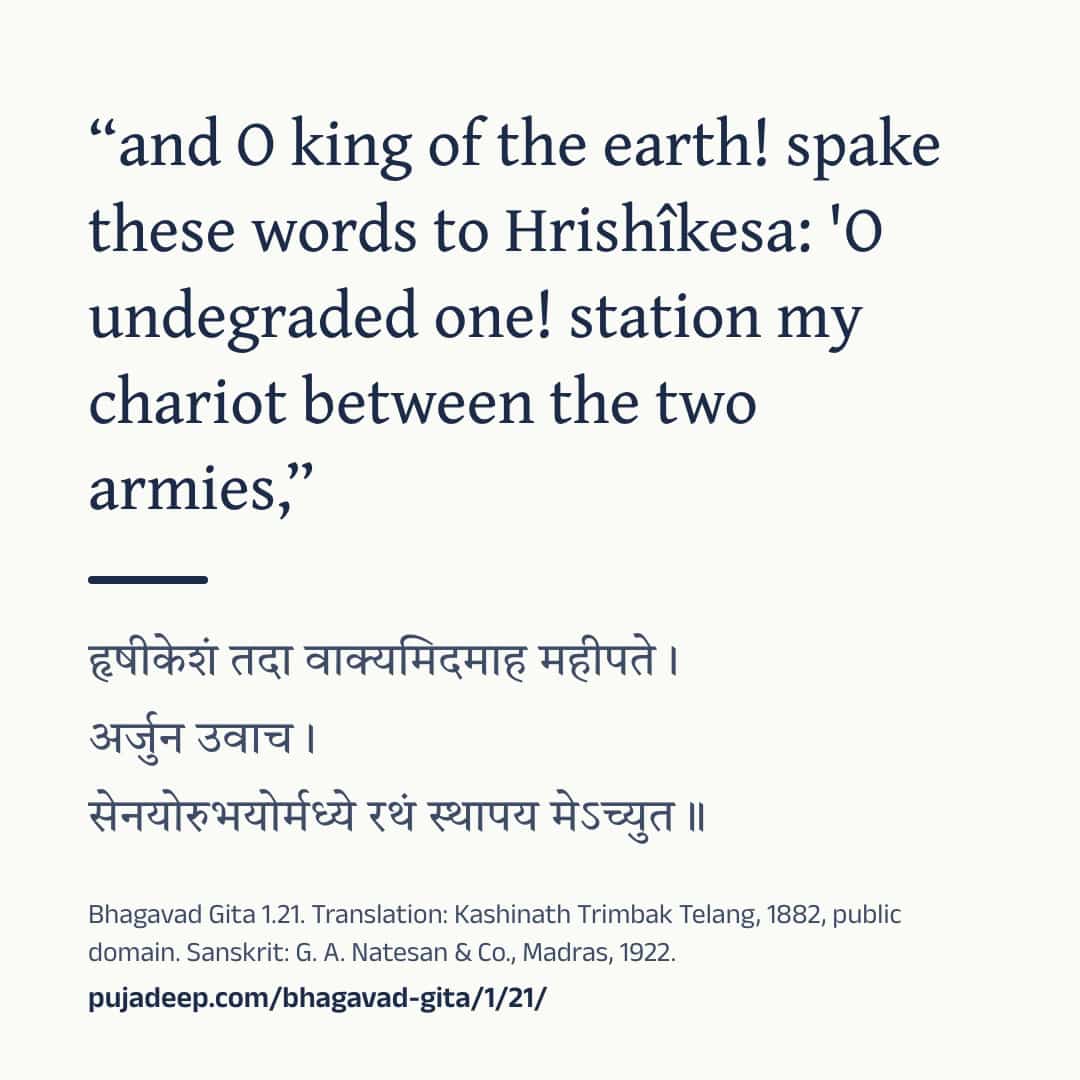
हृषीकेशं तदा वाक्यमिदमाह महीपते ।
अर्जुन उवाच ।
सेनयोरुभयोर्मध्ये रथं स्थापय मेऽच्युत ॥

“and O king of the earth! spake these words to Hrishîkesa: 'O undegraded one! station my chariot between the two armies,”
(K. T. Telang, The Bhagavadgîtâ (The Sacred Books of the East, vol. VIII, Oxford: Clarendon Press, 1882), p. 39, public domain)
This sentence begins in 1.20. This sentence goes on in 1.22.

“And spake this word to Hrishîkesha, O Lord of Earth. (Arjuna said:) "In the midst, between the two armies, my chariot stay, O Achyuta,”
(Annie Besant, The Bhagavad Gîtâ, or The Lord's Song (London: Theosophical Publishing Society, 1895), p. 18, public domain)
This sentence begins in 1.20. This sentence goes on in 1.22.

“said the following words to Krishna: Arjuna said: Place my chariot, O Achyuta! between the two armies that I may see those who stand here prepared for war. On this the eve of battle (let me know) with whom I have to fight.”
(Swami Swarupananda, Srimad-Bhagavad-Gita (Mayavati: Prabuddha Bharata Press, 1909; first printed in Prabuddha Bharata, 1907–1909), pp. 11–12, public domain)
This sentence covers verses 1.21 to 1.22. This sentence begins in 1.20.

Sanskrit: G. A. Natesan & Co., Madras, 1922.
https://pujadeep.com/bhagavad-gita/1/21/ Nothing is sent from this site. Your own app sends it, to the chat you choose. The picture quotes the translation you chose on this page, with its name and year.
Sanskrit text: The Bhagavad-Gita, or The Lord's Song, with the text in Devanagari and an English translation, 1922. Meanings: written for Pujadeep and checked against the cited edition. Source and changes
Questions families ask
Who speaks Bhagavad Gita 1.21?
Sanjaya speaks this verse, in chapter 1 (Arjuna Vishada Yoga).
Where does the Sanskrit text come from?
Sanskrit text: The Bhagavad-Gita, or The Lord's Song, with the text in Devanagari and an English translation, 1922. Meanings: written for Pujadeep and checked against the cited edition. See the source
Is the meaning on this page a translation?
Explanation written for this site from the sources listed here, and checked against the cited edition. It is not a translation and not the only way to read the text. Free to quote with credit.
Source and licence
- Sanskrit text
- The Bhagavad-Gita, or The Lord's Song, with the text in Devanagari and an English translation (Annie Besant, G. A. Natesan & Co., Madras, 1922). Public domain. The Sanskrit on these pages was read from this printing’s page images.
- Translation
- The Bhagavadgîtâ with the Sanatsugâtîya and the Anugîtâ, translated by Kâshinâth Trimbak Telang (The Sacred Books of the East, vol. VIII, ed. F. Max Müller) (Kashinath Trimbak Telang, F. Max Müller, Clarendon Press, Oxford, 1882). Public domain. Shown verbatim, as printed.
- Translation
- The Bhagavad Gîtâ, or The Lord's Song, translated by Annie Besant (Annie Besant, Theosophical Publishing Society, London, 1895). Public domain. Shown verbatim, as printed.
- Translation
- Srimad-Bhagavad-Gita, with Sanskrit Text; Paraphrase with Word-by-word Literal Translation; English Rendering and Comments, Index, &c., by the Swami Swarupananda (Himalayan Series, No. XX) (Swami Swarupananda, The Editors and Publishers, Advaita Ashrama, Mayavati, Prabuddha Bharata Press, Mayavati, Almora, Himalayas, 1909). Public domain. Shown verbatim, as printed.
- Common wording
- In this text, 32 words follow today's common wording, checked against sanskritdocuments.org; Sanskrit Wikisource; Gita Press, Gorakhpur; GRETIL, Göttingen and Bhaktivedanta Book Trust.
- Our explanation
- Explanation written for this site from the sources listed here, and checked against the cited edition. It is not a translation and not the only way to read the text. Free to quote with credit.
- Checked
- Checked against the cited edition, October 15, 2026.
- Updated
- October 25, 2026