Bhagavad Gita 1.34: meaning and translation
Chapter 1: Arjuna Vishada Yoga. Arjuna says
Arjuna: He names them: teachers, fathers, sons and grandfathers, maternal uncles, fathers-in-law, grandsons, brothers-in-law and other relatives.
Click or tap a word for its meaning and its dictionary page.
Text and layers
Text and layers
These choices stay in this browser.
Bhagavad Gita 1.34
आचार्याः पितरः पुत्रास्तथैव च पितामहाः ।मातुलाः श्वशुराः पौत्राः श्यालाः सम्बन्धिनस्तथा ॥
Acharyah pitarah putrastathaiva cha pitamahahMatulah shvashurah pautrah shyalah sambandhinastatha
ācāryāḥ pitaraḥ putrāstathaiva ca pitāmahāḥ |mātulāḥ śvaśurāḥ pautrāḥ śyālāḥ sambandhinastathā ||
Our explanation He names them: teachers, fathers, sons and grandfathers, maternal uncles, fathers-in-law, grandsons, brothers-in-law and other relatives.
हिंदी अर्थ वे उन्हें गिनाते हैं: गुरु, पिता, पुत्र, पितामह, मामा, ससुर, पौत्र, साले और दूसरे संबंधी।
Word by word
Every word, with its dictionary page
Word by word
- आचार्याः ācāryāḥ · teachers (noun (masculine), nominative plural) Dictionary: ācārya, Monier-Williams 1899, p. 131, col. 3
- पितरः pitaraḥ · fathers (noun (masculine), nominative plural) Dictionary: pitṛ, Monier-Williams 1899, p. 626, col. 2 “the fathers, forefathers, ancestors, (esp.) the Pitṛis or deceased ancestors”
- पुत्राः putrāḥ · sons (noun (masculine), nominative plural) Dictionary: putra, Monier-Williams 1899, p. 632, col. 3 “a son, child”
- तथा tathā · likewise (indeclinable) Dictionary: tathā, Monier-Williams 1899, p. 433, col. 3 “in that manner, so, thus”
- एव eva · also (indeclinable) Dictionary: 1. eva, Monier-Williams 1899, p. 232, col. 2 “just, exactly, very, same, only, even, alone, merely”
- च ca · and (indeclinable) Dictionary: 2. ca, Monier-Williams 1899, p. 380, col. 1 “ind. and, both, also, moreover, as well as”
- पितामहाः pitāmahāḥ · grandfathers (noun (masculine), nominative plural) Dictionary: pitā-maha, Monier-Williams 1899, p. 627, col. 1 “a paternal grandfather”
- मातुलाः mātulāḥ · maternal uncles (noun (masculine), nominative plural) Dictionary: mātula, Monier-Williams 1899, p. 807, col. 3 “a maternal uncle”
- श्वशुराः śvaśurāḥ · fathers-in-law (noun (masculine), nominative plural) Dictionary: śvaśura, Monier-Williams 1899, p. 1105, col. 3 “a father-in-law, husband's or wife's father”
- पौत्राः pautrāḥ · grandsons (noun (masculine), nominative plural) Dictionary: 1. pautra, Monier-Williams 1899, p. 651, col. 1 “a son's son, grandson”
- श्यालाः śyālāḥ · brothers-in-law (noun (masculine), nominative plural) Dictionary: syāla, Monier-Williams 1899, p. 1273, col. 2 “the brother of a bride, a wife's brother”
- सम्बन्धिनः sambandhinaḥ · relatives by marriage (noun (masculine), nominative plural) Dictionary: sam-bandhin, Monier-Williams 1899, p. 1178, col. 1 “related, connected by marriage, a relative”
- तथा tathā · also (indeclinable) Dictionary: tathā, Monier-Williams 1899, p. 433, col. 3 “in that manner, so, thus”
Old translations
Kashinath Trimbak Telang, 1882. Public domain. Page 40.
preceptors, fathers, sons as well as grandfathers, maternal uncles, fathers-in-law, grandsons, brothers-in-law, as also (other) relatives.
This sentence begins in 1.33.
Compare 3 translations
Kashinath Trimbak Telang, 1882. Public domain. Page 40.
preceptors, fathers, sons as well as grandfathers, maternal uncles, fathers-in-law, grandsons, brothers-in-law, as also (other) relatives.
This sentence begins in 1.33.
You are reading this one
Annie Besant, 1895. Public domain. Page 20.
Teachers, fathers, sons, as well as grandfathers, mother's brothers, fathers-in-law, grandsons, brothers-in-law, and other relatives.
This sentence begins in 1.33.
You are reading this one
Swami Swarupananda, 1909 (first printed 1907). Public domain.
Swarupananda renders verses 32–34 together; see 1.32. Read it at 1.32
You are reading this one
Cite this verse
The translation: K. T. Telang, The Bhagavadgîtâ (The Sacred Books of the East, vol. VIII, Oxford: Clarendon Press, 1882), p. 40. Bhagavad Gita 1.34.
The translation: Annie Besant, The Bhagavad Gîtâ, or The Lord's Song (London: Theosophical Publishing Society, 1895), p. 20. Bhagavad Gita 1.34.
The translation: Swami Swarupananda, Srimad-Bhagavad-Gita (Mayavati: Prabuddha Bharata Press, 1909; first printed in Prabuddha Bharata, 1907–1909), p. 16; 58. Bhagavad Gita 1.32–34.
Our explanation: “Bhagavad Gita 1.34: meaning and translation.” Pujadeep. Updated October 25, 2026. https://pujadeep.com/bhagavad-gita/1/34/
Pujadeep’s explanations are free to quote with credit: name Pujadeep and link to the page. How to credit
Classical readings, by school
No readings by school on this verse yet.
Share
Show the ways to share
Send one picture or the text to one chat. The picture names its source and the address of this page.
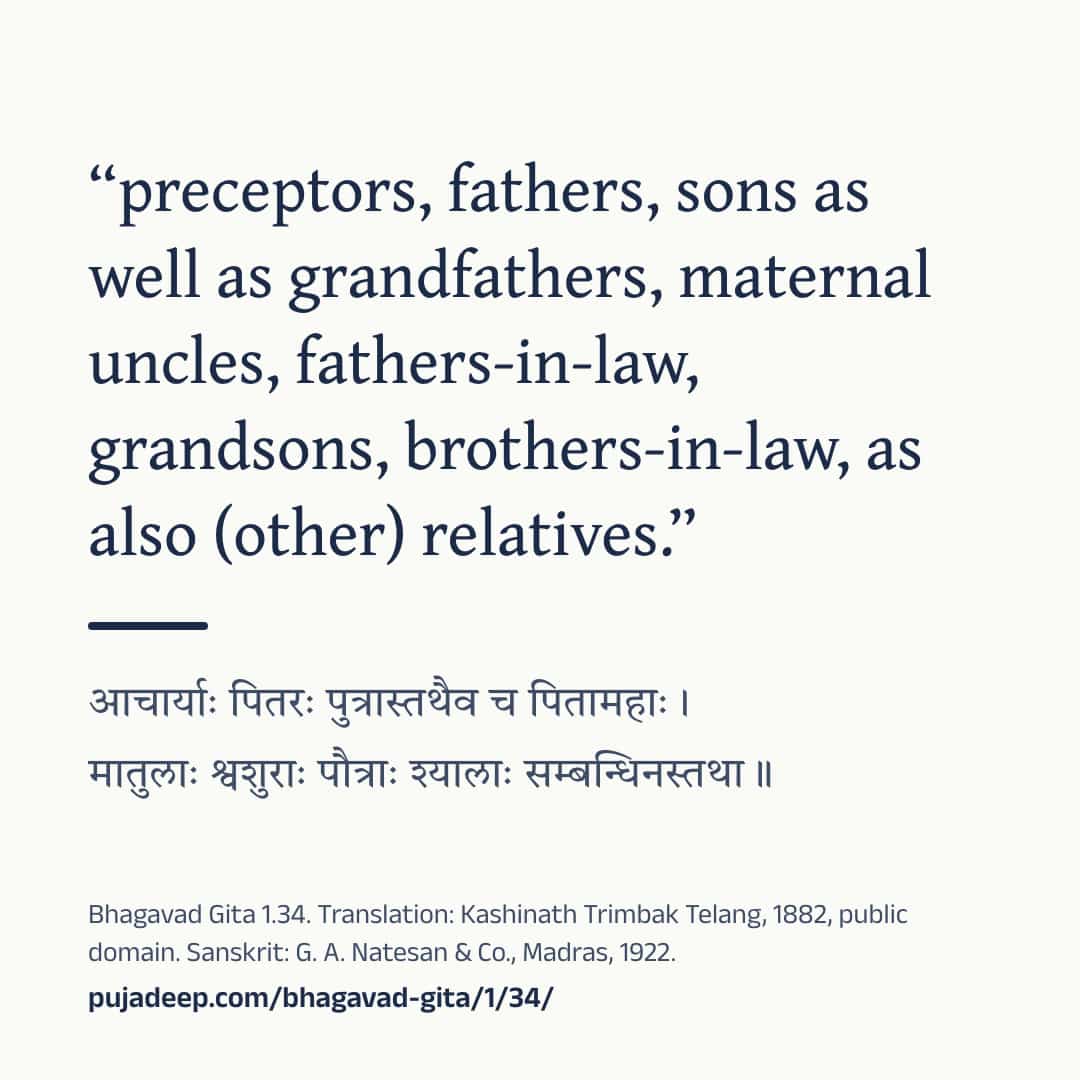
Drawing the picture
See the words
Bhagavad Gita 1.34

आचार्याः पितरः पुत्रास्तथैव च पितामहाः ।
मातुलाः श्वशुराः पौत्राः श्यालाः सम्बन्धिनस्तथा ॥

“preceptors, fathers, sons as well as grandfathers, maternal uncles, fathers-in-law, grandsons, brothers-in-law, as also (other) relatives.”
(K. T. Telang, The Bhagavadgîtâ (The Sacred Books of the East, vol. VIII, Oxford: Clarendon Press, 1882), p. 40, public domain)
This sentence begins in 1.33.

“Teachers, fathers, sons, as well as grandfathers, mother's brothers, fathers-in-law, grandsons, brothers-in-law, and other relatives.”
(Annie Besant, The Bhagavad Gîtâ, or The Lord's Song (London: Theosophical Publishing Society, 1895), p. 20, public domain)
This sentence begins in 1.33.

Sanskrit: G. A. Natesan & Co., Madras, 1922.
https://pujadeep.com/bhagavad-gita/1/34/ Nothing is sent from this site. Your own app sends it, to the chat you choose. The picture quotes the translation you chose on this page, with its name and year.
Sanskrit text: The Bhagavad-Gita, or The Lord's Song, with the text in Devanagari and an English translation, 1922. Meanings: written for Pujadeep and checked against the cited edition. Source and changes
Questions families ask
Who speaks Bhagavad Gita 1.34?
Arjuna speaks this verse, in chapter 1 (Arjuna Vishada Yoga).
Where does the Sanskrit text come from?
Sanskrit text: The Bhagavad-Gita, or The Lord's Song, with the text in Devanagari and an English translation, 1922. Meanings: written for Pujadeep and checked against the cited edition. See the source
Is the meaning on this page a translation?
Explanation written for this site from the sources listed here, and checked against the cited edition. It is not a translation and not the only way to read the text. Free to quote with credit.
Source and licence
- Sanskrit text
- The Bhagavad-Gita, or The Lord's Song, with the text in Devanagari and an English translation (Annie Besant, G. A. Natesan & Co., Madras, 1922). Public domain. The Sanskrit on these pages was read from this printing’s page images.
- Translation
- The Bhagavadgîtâ with the Sanatsugâtîya and the Anugîtâ, translated by Kâshinâth Trimbak Telang (The Sacred Books of the East, vol. VIII, ed. F. Max Müller) (Kashinath Trimbak Telang, F. Max Müller, Clarendon Press, Oxford, 1882). Public domain. Shown verbatim, as printed.
- Translation
- The Bhagavad Gîtâ, or The Lord's Song, translated by Annie Besant (Annie Besant, Theosophical Publishing Society, London, 1895). Public domain. Shown verbatim, as printed.
- Translation
- Srimad-Bhagavad-Gita, with Sanskrit Text; Paraphrase with Word-by-word Literal Translation; English Rendering and Comments, Index, &c., by the Swami Swarupananda (Himalayan Series, No. XX) (Swami Swarupananda, The Editors and Publishers, Advaita Ashrama, Mayavati, Prabuddha Bharata Press, Mayavati, Almora, Himalayas, 1909). Public domain. Shown verbatim, as printed.
- Common wording
- In this text, 32 words follow today's common wording, checked against sanskritdocuments.org; Sanskrit Wikisource; Gita Press, Gorakhpur; GRETIL, Göttingen and Bhaktivedanta Book Trust.
- Our explanation
- Explanation written for this site from the sources listed here, and checked against the cited edition. It is not a translation and not the only way to read the text. Free to quote with credit.
- Checked
- Checked against the cited edition, October 15, 2026.
- Updated
- October 25, 2026