Bhagavad Gita 1.38: meaning and translation
Chapter 1: Arjuna Vishada Yoga. Arjuna says
Arjuna grants that the other side, their minds clouded by greed, see no wrong in destroying a family and no sin in betraying friends.
Click or tap a word for its meaning and its dictionary page.
Text and layers
Text and layers
These choices stay in this browser.
Bhagavad Gita 1.38
यद्यप्येते न पश्यन्ति लोभोपहतचेतसः ।कुलक्षयकृतं दोषं मित्रद्रोहे च पातकम् ॥
Yadyapyete na pashyanti lobhopahatachetasahKulakshayakritam dosham mitradrohe cha patakam
yadyapyete na paśyanti lobhopahatacetasaḥ |kulakṣayakṛtaṃ doṣaṃ mitradrohe ca pātakam ||
Our explanation Arjuna grants that the other side, their minds clouded by greed, see no wrong in destroying a family and no sin in betraying friends.
हिंदी अर्थ अर्जुन मानते हैं कि दूसरे पक्ष के लोग लोभ से अंधे होकर कुल के नाश में कोई दोष और मित्रों से द्रोह में कोई पाप नहीं देखते।
Word by word
Every word, with its dictionary page
Word by word
- यदि yadi · if (indeclinable) Dictionary: yadi, Monier-Williams 1899, p. 844, col. 3 “if, in case that”
- अपि api · even (even though) (indeclinable) Dictionary: api, Monier-Williams 1899, p. 55, col. 1 “in the sense of even, also, very”
- एते ete · these (pronoun (masculine), nominative plural) Dictionary: etad, Monier-Williams 1899, p. 231, col. 2 “this, this here, here”
- न na · not (indeclinable) Dictionary: 2. na, Monier-Williams 1899, p. 523, col. 1 “ind. not, no, nor, neither”
- पश्यन्ति paśyanti · see (present, 3rd person plural) Dictionary: 1. paś, Monier-Williams 1899, p. 611, col. 2 “behold, look at, observe, perceive, notice”
- लोभोपहतचेतसः lobhopahatacetasaḥ · their minds struck by greed (compound (masculine), nominative plural) Dictionary: lobha, Monier-Williams 1899, p. 905, col. 1 “covetousness, cupidity, avarice”; upa-hata, Monier-Williams 1899, p. 211, col. 3 “hit, hurt, damaged, injured, visited, afflicted”; cetas, Monier-Williams 1899, p. 398, col. 1 “consciousness, intelligence, thinking soul, heart, mind”
- कुलक्षयकृतम् kulakṣayakṛtam · caused by destroying a family (compound (masculine), accusative singular) Dictionary: kula-kṣaya, Monier-Williams 1899, p. 294, col. 3 “decay of a race or family”; 1. kṛta, Monier-Williams 1899, p. 301, col. 3 “done, made, accomplished, performed”
- दोषम् doṣam · wrong, fault (noun (masculine), accusative singular) Dictionary: 2. doṣa, Monier-Williams 1899, p. 498, col. 2 “fault, vice, deficiency, want”
- मित्रद्रोहे mitradrohe · in betraying friends (compound (masculine), locative singular) Dictionary: mitra-droha, Monier-Williams 1899, p. 816, col. 2 “injury or betrayal of a fr°”
- च ca · and (indeclinable) Dictionary: 2. ca, Monier-Williams 1899, p. 380, col. 1 “ind. and, both, also, moreover, as well as”
- पातकम् pātakam · sin (noun (neuter), accusative singular) Dictionary: pātaka, Monier-Williams 1899, p. 616, col. 3 “‘that which causes to fall or sink,’ sin, crime”
Old translations
Kashinath Trimbak Telang, 1882. Public domain. Page 41.
Although having their consciences corrupted by avarice, they do not see the evils flowing from the extinction of a family, and the sin in treachery to friends,
This sentence goes on in 1.39.
Compare 3 translations
Kashinath Trimbak Telang, 1882. Public domain. Page 41.
Although having their consciences corrupted by avarice, they do not see the evils flowing from the extinction of a family, and the sin in treachery to friends,
This sentence goes on in 1.39.
You are reading this one
Annie Besant, 1895. Public domain. Page 21.
Although these, with intelligence overpowered by greed, see no guilt in the destruction of a family, no crime in hostility to friends,
This sentence goes on in 1.39.
You are reading this one
Swami Swarupananda, 1909 (first printed 1907). Public domain. Page 19.
Though these, with understanding overpowered by greed, see no evil due to decay of of families, and no sin in hostility to friends, why should we, O Janàrdana, who see clearly the evil due to the decay of families, not turn away from this sin?
This sentence covers verses 1.38 to 1.39.
You are reading this one
Cite this verse
The translation: K. T. Telang, The Bhagavadgîtâ (The Sacred Books of the East, vol. VIII, Oxford: Clarendon Press, 1882), p. 41. Bhagavad Gita 1.38.
The translation: Annie Besant, The Bhagavad Gîtâ, or The Lord's Song (London: Theosophical Publishing Society, 1895), p. 21. Bhagavad Gita 1.38.
The translation: Swami Swarupananda, Srimad-Bhagavad-Gita (Mayavati: Prabuddha Bharata Press, 1909; first printed in Prabuddha Bharata, 1907–1909), p. 19. Bhagavad Gita 1.38–39.
Our explanation: “Bhagavad Gita 1.38: meaning and translation.” Pujadeep. Updated October 25, 2026. https://pujadeep.com/bhagavad-gita/1/38/
Pujadeep’s explanations are free to quote with credit: name Pujadeep and link to the page. How to credit
Classical readings, by school
No readings by school on this verse yet.
Share
Show the ways to share
Send one picture or the text to one chat. The picture names its source and the address of this page.
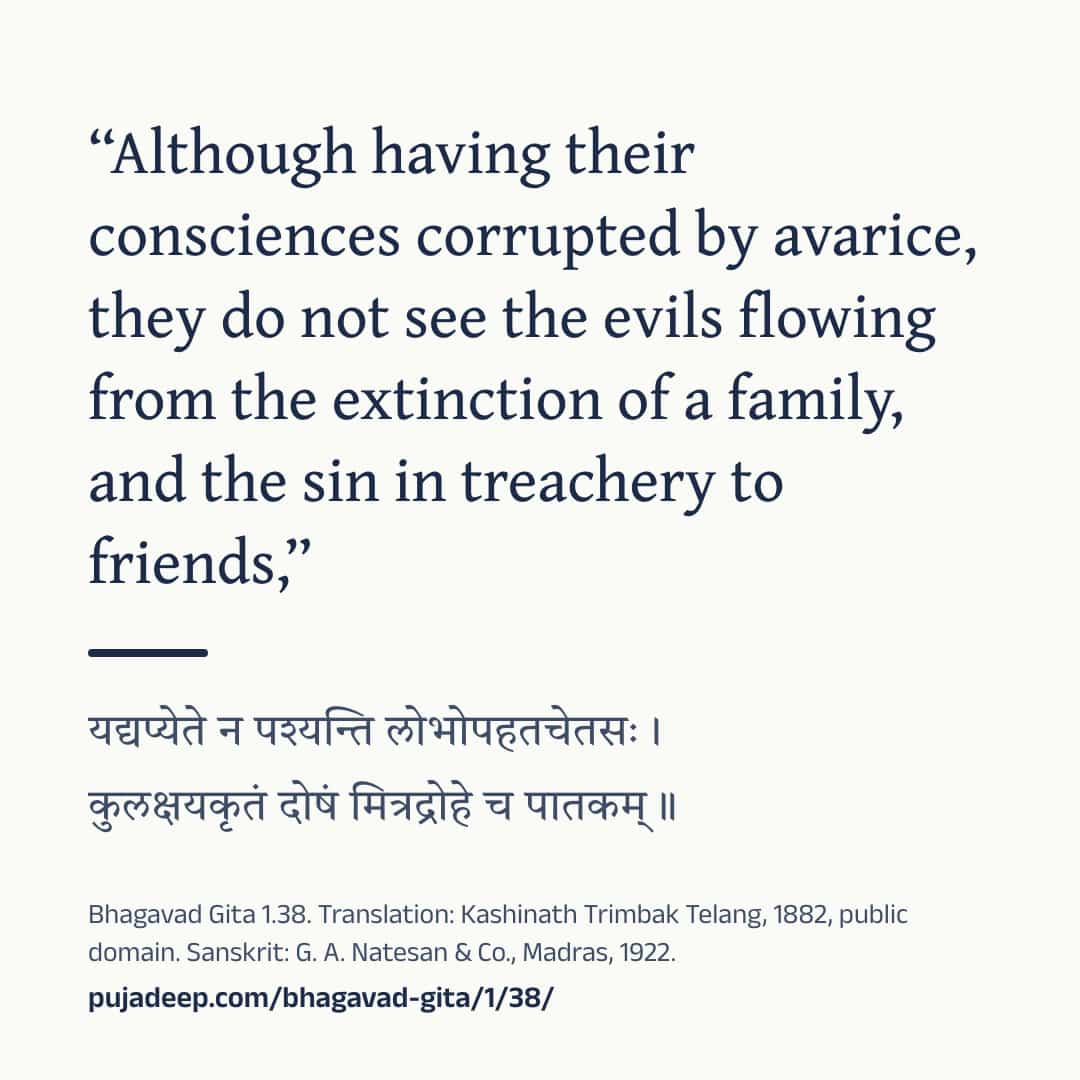
Drawing the picture
See the words
Bhagavad Gita 1.38

यद्यप्येते न पश्यन्ति लोभोपहतचेतसः ।
कुलक्षयकृतं दोषं मित्रद्रोहे च पातकम् ॥

“Although having their consciences corrupted by avarice, they do not see the evils flowing from the extinction of a family, and the sin in treachery to friends,”
(K. T. Telang, The Bhagavadgîtâ (The Sacred Books of the East, vol. VIII, Oxford: Clarendon Press, 1882), p. 41, public domain)
This sentence goes on in 1.39.

“Although these, with intelligence overpowered by greed, see no guilt in the destruction of a family, no crime in hostility to friends,”
(Annie Besant, The Bhagavad Gîtâ, or The Lord's Song (London: Theosophical Publishing Society, 1895), p. 21, public domain)
This sentence goes on in 1.39.

“Though these, with understanding overpowered by greed, see no evil due to decay of of families, and no sin in hostility to friends, why should we, O Janàrdana, who see clearly the evil due to the decay of families, not turn away from this sin?”
(Swami Swarupananda, Srimad-Bhagavad-Gita (Mayavati: Prabuddha Bharata Press, 1909; first printed in Prabuddha Bharata, 1907–1909), p. 19, public domain)
This sentence covers verses 1.38 to 1.39.

Sanskrit: G. A. Natesan & Co., Madras, 1922.
https://pujadeep.com/bhagavad-gita/1/38/ Nothing is sent from this site. Your own app sends it, to the chat you choose. The picture quotes the translation you chose on this page, with its name and year.
Sanskrit text: The Bhagavad-Gita, or The Lord's Song, with the text in Devanagari and an English translation, 1922. Meanings: written for Pujadeep and checked against the cited edition. Source and changes
Questions families ask
Who speaks Bhagavad Gita 1.38?
Arjuna speaks this verse, in chapter 1 (Arjuna Vishada Yoga).
Where does the Sanskrit text come from?
Sanskrit text: The Bhagavad-Gita, or The Lord's Song, with the text in Devanagari and an English translation, 1922. Meanings: written for Pujadeep and checked against the cited edition. See the source
Is the meaning on this page a translation?
Explanation written for this site from the sources listed here, and checked against the cited edition. It is not a translation and not the only way to read the text. Free to quote with credit.
Source and licence
- Sanskrit text
- The Bhagavad-Gita, or The Lord's Song, with the text in Devanagari and an English translation (Annie Besant, G. A. Natesan & Co., Madras, 1922). Public domain. The Sanskrit on these pages was read from this printing’s page images.
- Translation
- The Bhagavadgîtâ with the Sanatsugâtîya and the Anugîtâ, translated by Kâshinâth Trimbak Telang (The Sacred Books of the East, vol. VIII, ed. F. Max Müller) (Kashinath Trimbak Telang, F. Max Müller, Clarendon Press, Oxford, 1882). Public domain. Shown verbatim, as printed.
- Translation
- The Bhagavad Gîtâ, or The Lord's Song, translated by Annie Besant (Annie Besant, Theosophical Publishing Society, London, 1895). Public domain. Shown verbatim, as printed.
- Translation
- Srimad-Bhagavad-Gita, with Sanskrit Text; Paraphrase with Word-by-word Literal Translation; English Rendering and Comments, Index, &c., by the Swami Swarupananda (Himalayan Series, No. XX) (Swami Swarupananda, The Editors and Publishers, Advaita Ashrama, Mayavati, Prabuddha Bharata Press, Mayavati, Almora, Himalayas, 1909). Public domain. Shown verbatim, as printed.
- Common wording
- In this text, 32 words follow today's common wording, checked against sanskritdocuments.org; Sanskrit Wikisource; Gita Press, Gorakhpur; GRETIL, Göttingen and Bhaktivedanta Book Trust.
- Our explanation
- Explanation written for this site from the sources listed here, and checked against the cited edition. It is not a translation and not the only way to read the text. Free to quote with credit.
- Checked
- Checked against the cited edition, October 15, 2026.
- Updated
- October 25, 2026