Bhagavad Gita 1.37: meaning and translation
Chapter 1: Arjuna Vishada Yoga. Arjuna says
So, Arjuna says, it is not right for them to kill the sons of Dhritarashtra, their own kinsmen.
Click or tap a word for its meaning and its dictionary page.
Text and layers
Text and layers
These choices stay in this browser.
Bhagavad Gita 1.37
तस्मान्नार्हा वयं हन्तुं धार्तराष्ट्रान्स्वबान्धवान् ।स्वजनं हि कथं हत्वा सुखिनः स्याम माधव ॥
Tasmannarha vayam hantum dhartarashtransvabandhavanSvajanam hi katham hatva sukhinah syama madhava
tasmānnārhā vayaṃ hantuṃ dhārtarāṣṭrānsvabāndhavān |svajanaṃ hi kathaṃ hatvā sukhinaḥ syāma mādhava ||
Our explanation So, Arjuna says, it is not right for them to kill the sons of Dhritarashtra, their own kinsmen. He asks Krishna (Madhava) how they could be happy after killing their own people.
हिंदी अर्थ इसलिए अर्जुन कहते हैं कि अपने ही बंधु धृतराष्ट्र के पुत्रों को मारना उनके लिए उचित नहीं। वे माधव (कृष्ण) से पूछते हैं कि अपने ही लोगों को मारकर वे सुखी कैसे रह सकते हैं।
Word by word
Every word, with its dictionary page
Word by word
- तस्मात् tasmāt · therefore (indeclinable) Dictionary: tasmāt, Monier-Williams 1899, p. 441, col. 2 “from that, on that account, therefore”
- न na · not (indeclinable) Dictionary: 2. na, Monier-Williams 1899, p. 523, col. 1 “ind. not, no, nor, neither”
- अर्हाः arhāḥ · right, fit (adjective (masculine), nominative plural) Dictionary: arha, Monier-Williams 1899, p. 93, col. 3 “meriting, deserving (praise or blame, cf. pūjârha, nindârha), worthy of, having a claim”
- वयम् vayam · we (pronoun, nominative plural) Dictionary: vayam, Monier-Williams 1899, p. 920, col. 2 “nom. pl. of 1. pers. pron., we”
- हन्तुम् hantum · to kill (infinitive (to do)) Dictionary: 1. han, Monier-Williams 1899, p. 1287, col. 2 “to smite, slay, hit, kill, mar, destroy”
- धार्तराष्ट्रान् dhārtarāṣṭrān · the sons of Dhritarashtra (noun (masculine), accusative plural) Dictionary: dhārta-rāṣṭra, Monier-Williams 1899, p. 516, col. 1 “a son of Dhṛ°, a Kuru”
- स्वबान्धवान् svabāndhavān · our own kinsmen (compound (masculine), accusative plural) Dictionary: 1. sva, Monier-Williams 1899, p. 1275, col. 1 “own, one's own, my own, thy own, his own, her own, our own, their own &c.”; bāndhava, Monier-Williams 1899, p. 728, col. 2 “a kinsman, relation”
- स्वजनम् svajanam · own people (compound (masculine), accusative singular) Dictionary: 1. sva, Monier-Williams 1899, p. 1275, col. 1 “own, one's own, my own, thy own, his own, her own, our own, their own &c.”; jana, Monier-Williams 1899, p. 410, col. 1 “creature, living being, man, person, race”
- हि hi · for (indeclinable) Dictionary: 2. hi, Monier-Williams 1899, p. 1297, col. 3 “for, because, on account of”
- कथम् katham · how (indeclinable) Dictionary: katham, Monier-Williams 1899, p. 247, col. 2 “how? in what manner?”
- हत्वा hatvā · having killed (absolutive (having done)) Dictionary: 1. han, Monier-Williams 1899, p. 1287, col. 2 “to smite, slay, hit, kill, mar, destroy”
- सुखिनः sukhinaḥ · happy (adjective (masculine), nominative plural) Dictionary: sukhin, Monier-Williams 1899, p. 1222, col. 1 “possessing or causing happiness or pleasure, happy, joyful”
- स्याम syāma · could we be (optative, 1st person plural) Dictionary: 1. as, Monier-Williams 1899, p. 117, col. 2 “to be, live, exist, be present”
- माधव mādhava · O Madhava (Krishna) (noun (masculine), vocative singular) Dictionary: mādhava, Monier-Williams 1899, p. 808, col. 2 “a son or descendant of Madhu, a man of the race of Yadu”
Old translations
Kashinath Trimbak Telang, 1882. Public domain. Page 41.
Therefore it is not proper for us to kill our own kinsmen, the sons of Dhritarâshtra. For how, O Mâdhava! shall we be happy after killing our own relatives?
Compare 3 translations
Kashinath Trimbak Telang, 1882. Public domain. Page 41.
Therefore it is not proper for us to kill our own kinsmen, the sons of Dhritarâshtra. For how, O Mâdhava! shall we be happy after killing our own relatives?
You are reading this one
Annie Besant, 1895. Public domain. Page 21.
It is not proper to kill the sons of Dhritarâshtra, our relatives; for how, killing our kinsmen, may we be happy, O Mâdhava?
You are reading this one
Swami Swarupananda, 1909 (first printed 1907). Public domain. Page 59.
Therefore ought we not to kill our kindred, the sons of Dhritaràshtra. For how could we, O Màdhava, gain happiness by the slaying of our own kinsmen?
You are reading this one
Cite this verse
The translation: K. T. Telang, The Bhagavadgîtâ (The Sacred Books of the East, vol. VIII, Oxford: Clarendon Press, 1882), p. 41. Bhagavad Gita 1.37.
The translation: Annie Besant, The Bhagavad Gîtâ, or The Lord's Song (London: Theosophical Publishing Society, 1895), p. 21. Bhagavad Gita 1.37.
The translation: Swami Swarupananda, Srimad-Bhagavad-Gita (Mayavati: Prabuddha Bharata Press, 1909; first printed in Prabuddha Bharata, 1907–1909), p. 59. Bhagavad Gita 1.37.
Our explanation: “Bhagavad Gita 1.37: meaning and translation.” Pujadeep. Updated October 25, 2026. https://pujadeep.com/bhagavad-gita/1/37/
Pujadeep’s explanations are free to quote with credit: name Pujadeep and link to the page. How to credit
Classical readings, by school
No readings by school on this verse yet.
Share
Show the ways to share
Send one picture or the text to one chat. The picture names its source and the address of this page.
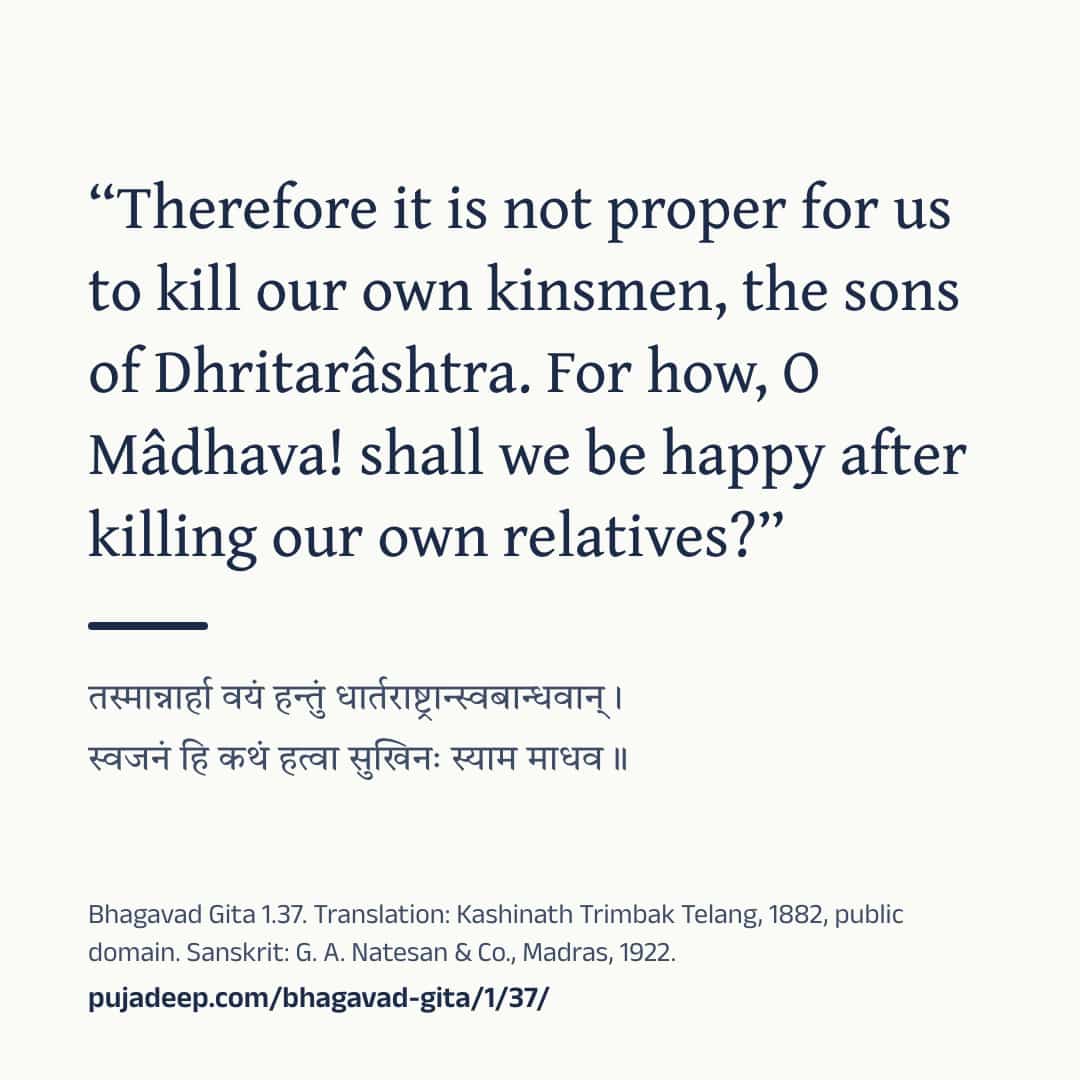
Drawing the picture
See the words
Bhagavad Gita 1.37

तस्मान्नार्हा वयं हन्तुं धार्तराष्ट्रान्स्वबान्धवान् ।
स्वजनं हि कथं हत्वा सुखिनः स्याम माधव ॥

“Therefore it is not proper for us to kill our own kinsmen, the sons of Dhritarâshtra. For how, O Mâdhava! shall we be happy after killing our own relatives?”
(K. T. Telang, The Bhagavadgîtâ (The Sacred Books of the East, vol. VIII, Oxford: Clarendon Press, 1882), p. 41, public domain)

“It is not proper to kill the sons of Dhritarâshtra, our relatives; for how, killing our kinsmen, may we be happy, O Mâdhava?”
(Annie Besant, The Bhagavad Gîtâ, or The Lord's Song (London: Theosophical Publishing Society, 1895), p. 21, public domain)

“Therefore ought we not to kill our kindred, the sons of Dhritaràshtra. For how could we, O Màdhava, gain happiness by the slaying of our own kinsmen?”
(Swami Swarupananda, Srimad-Bhagavad-Gita (Mayavati: Prabuddha Bharata Press, 1909; first printed in Prabuddha Bharata, 1907–1909), p. 59, public domain)

Sanskrit: G. A. Natesan & Co., Madras, 1922.
https://pujadeep.com/bhagavad-gita/1/37/ Nothing is sent from this site. Your own app sends it, to the chat you choose. The picture quotes the translation you chose on this page, with its name and year.
Sanskrit text: The Bhagavad-Gita, or The Lord's Song, with the text in Devanagari and an English translation, 1922. Meanings: written for Pujadeep and checked against the cited edition. Source and changes
Questions families ask
Who speaks Bhagavad Gita 1.37?
Arjuna speaks this verse, in chapter 1 (Arjuna Vishada Yoga).
Where does the Sanskrit text come from?
Sanskrit text: The Bhagavad-Gita, or The Lord's Song, with the text in Devanagari and an English translation, 1922. Meanings: written for Pujadeep and checked against the cited edition. See the source
Is the meaning on this page a translation?
Explanation written for this site from the sources listed here, and checked against the cited edition. It is not a translation and not the only way to read the text. Free to quote with credit.
Source and licence
- Sanskrit text
- The Bhagavad-Gita, or The Lord's Song, with the text in Devanagari and an English translation (Annie Besant, G. A. Natesan & Co., Madras, 1922). Public domain. The Sanskrit on these pages was read from this printing’s page images.
- Translation
- The Bhagavadgîtâ with the Sanatsugâtîya and the Anugîtâ, translated by Kâshinâth Trimbak Telang (The Sacred Books of the East, vol. VIII, ed. F. Max Müller) (Kashinath Trimbak Telang, F. Max Müller, Clarendon Press, Oxford, 1882). Public domain. Shown verbatim, as printed.
- Translation
- The Bhagavad Gîtâ, or The Lord's Song, translated by Annie Besant (Annie Besant, Theosophical Publishing Society, London, 1895). Public domain. Shown verbatim, as printed.
- Translation
- Srimad-Bhagavad-Gita, with Sanskrit Text; Paraphrase with Word-by-word Literal Translation; English Rendering and Comments, Index, &c., by the Swami Swarupananda (Himalayan Series, No. XX) (Swami Swarupananda, The Editors and Publishers, Advaita Ashrama, Mayavati, Prabuddha Bharata Press, Mayavati, Almora, Himalayas, 1909). Public domain. Shown verbatim, as printed.
- Common wording
- In this text, 32 words follow today's common wording, checked against sanskritdocuments.org; Sanskrit Wikisource; Gita Press, Gorakhpur; GRETIL, Göttingen and Bhaktivedanta Book Trust.
- Our explanation
- Explanation written for this site from the sources listed here, and checked against the cited edition. It is not a translation and not the only way to read the text. Free to quote with credit.
- Checked
- Checked against the cited edition, October 15, 2026.
- Updated
- October 25, 2026