Bhagavad Gita 1.28: meaning and translation
Chapter 1: Arjuna Vishada Yoga. Sanjaya says
Sanjaya: Arjuna is filled with deep compassion, and in sorrow he speaks.
Click or tap a word for its meaning and its dictionary page.
Text and layers
Text and layers
These choices stay in this browser.
Bhagavad Gita 1.28
कृपया परयाऽऽविष्टो विषीदन्निदमब्रवीत् ।अर्जुन उवाच ।दृष्ट्वेमं स्वजनं कृष्ण युयुत्सुं समुपस्थितम् ॥
Kripaya parayavishto vishidannidamabravitArjuna uvachaDrishtvemam svajanam krishna yuyutsum samupasthitam
kṛpayā parayā’’viṣṭo viṣīdannidamabravīt |arjuna uvāca |dṛṣṭvemaṃ svajanaṃ kṛṣṇa yuyutsuṃ samupasthitam ||
Our explanation Arjuna is filled with deep compassion, and in sorrow he speaks. He tells Krishna what happens to him when he sees his own people gathered, eager to fight. His grief is the grief of anyone who loves his family: the people he must face are the people he grew up with. The edition prints "Arjuna said" in the middle of this verse, where his own words begin.
हिंदी अर्थ अर्जुन गहरी करुणा से भर जाते हैं और दुःखी होकर बोलते हैं। वे कृष्ण से कहते हैं कि युद्ध की इच्छा से सामने खड़े अपने ही लोगों को देखकर उनकी क्या दशा हो रही है। उनका दुःख वैसा ही है जैसा अपने परिवार से प्रेम करने वाले किसी भी व्यक्ति का होगा: जिनसे उन्हें लड़ना है, वे वही लोग हैं जिनके साथ वे बड़े हुए। संस्करण में “अर्जुन उवाच” इस श्लोक के बीच में छपा है, जहाँ से अर्जुन के अपने शब्द शुरू होते हैं।
Word by word
Every word, with its dictionary page
Word by word
- कृपया kṛpayā · by pity (noun (feminine), instrumental singular) Dictionary: kṛpā, Monier-Williams 1899, p. 305, col. 1 “pity, tenderness, compassion”
- परया parayā · deep (adjective (feminine), instrumental singular) Dictionary: 1. para, Monier-Williams 1899, p. 586, col. 1 “highest, supreme, chief”
- आविष्टः āviṣṭaḥ · overcome (past participle (masculine), nominative singular) Dictionary: ā-viṣṭa, Monier-Williams 1899, p. 155, col. 3 “filled (by any sentiment or feeling)”
- विषीदन् viṣīdan · sinking in sorrow (present participle (masculine), nominative singular) Dictionary: vi-ṣad, Monier-Williams 1899, p. 996, col. 2 “to be exhausted or dejected, despond, despair”
- इदम् idam · this (pronoun (neuter), accusative singular) Dictionary: 1. idam, Monier-Williams 1899, p. 165, col. 2 “this, this here, referring to something near the speaker”
- अब्रवीत् abravīt · said (imperfect, 3rd person singular) Dictionary: brū, Monier-Williams 1899, p. 742, col. 1 “to speak, say, tell”
- दृष्ट्वा dṛṣṭvā · having seen (absolutive (having done)) Dictionary: 1. dṛś, Monier-Williams 1899, p. 491, col. 2 “to see, behold, look at, regard, consider”
- इमम् imam · these (pronoun (masculine), accusative singular) Dictionary: 1. idam, Monier-Williams 1899, p. 165, col. 2 “this, this here, referring to something near the speaker”
- स्वजनम् svajanam · own people, kinsmen (compound (masculine), accusative singular) Dictionary: 1. sva, Monier-Williams 1899, p. 1275, col. 1 “own, one's own, my own, thy own, his own, her own, our own, their own &c.”; jana, Monier-Williams 1899, p. 410, col. 1 “creature, living being, man, person, race”
- कृष्ण kṛṣṇa · O Krishna (noun (masculine), vocative singular) Dictionary: kṛṣṇa, Monier-Williams 1899, p. 306, col. 2 “N. of a celebrated Avatār of the god Vishṇu, or sometimes identified with Vishṇu himself”
- युयुत्सुम् yuyutsum · eager to fight (adjective (masculine), accusative singular) Dictionary: yuyutsu, Monier-Williams 1899, p. 855, col. 2 “wishing to fight”
- समुपस्थितम् samupasthitam · standing near (past participle (masculine), accusative singular) Dictionary: sam-upasthita, Monier-Williams 1899, p. 1169, col. 3 “approached, come to”
2 printings differ
Edition differences. Another printing or text reads this place differently.
- Spelling A digital text reads Same words. The 1922 edition marks the merged vowel with an avagraha (ऽ); this e-text does not. Edition: परयाऽऽविष्टो.
- Omission A digital text reads Same words, without the speaker line arjuna uvāca that the 1922 edition prints between the two halves of the verse.
Old translations
Kashinath Trimbak Telang, 1882. Public domain. Page 40.
was overcome by excessive pity, and spake thus despondingly.
Arguna said:
Seeing these kinsmen, O Krishna! standing (here) desirous to engage in battle,
This sentence begins in 1.26. This sentence goes on in 1.29.
Compare 3 translations
Kashinath Trimbak Telang, 1882. Public domain. Page 40.
was overcome by excessive pity, and spake thus despondingly.
Arguna said:
Seeing these kinsmen, O Krishna! standing (here) desirous to engage in battle,
This sentence begins in 1.26. This sentence goes on in 1.29.
You are reading this one
Cite this verse
The translation: K. T. Telang, The Bhagavadgîtâ (The Sacred Books of the East, vol. VIII, Oxford: Clarendon Press, 1882), p. 40. Bhagavad Gita 1.28.
The translation: Annie Besant, The Bhagavad Gîtâ, or The Lord's Song (London: Theosophical Publishing Society, 1895), p. 19. Bhagavad Gita 1.28.
The translation: Swami Swarupananda, Srimad-Bhagavad-Gita (Mayavati: Prabuddha Bharata Press, 1909; first printed in Prabuddha Bharata, 1907–1909), pp. 57–58. Bhagavad Gita 1.28.
Our explanation: “Bhagavad Gita 1.28: meaning and translation.” Pujadeep. Updated October 25, 2026. https://pujadeep.com/bhagavad-gita/1/28/
Pujadeep’s explanations are free to quote with credit: name Pujadeep and link to the page. How to credit
Classical readings, by school
No readings by school on this verse yet.
Share
Show the ways to share
Send one picture or the text to one chat. The picture names its source and the address of this page.
Drawing the picture
See the words
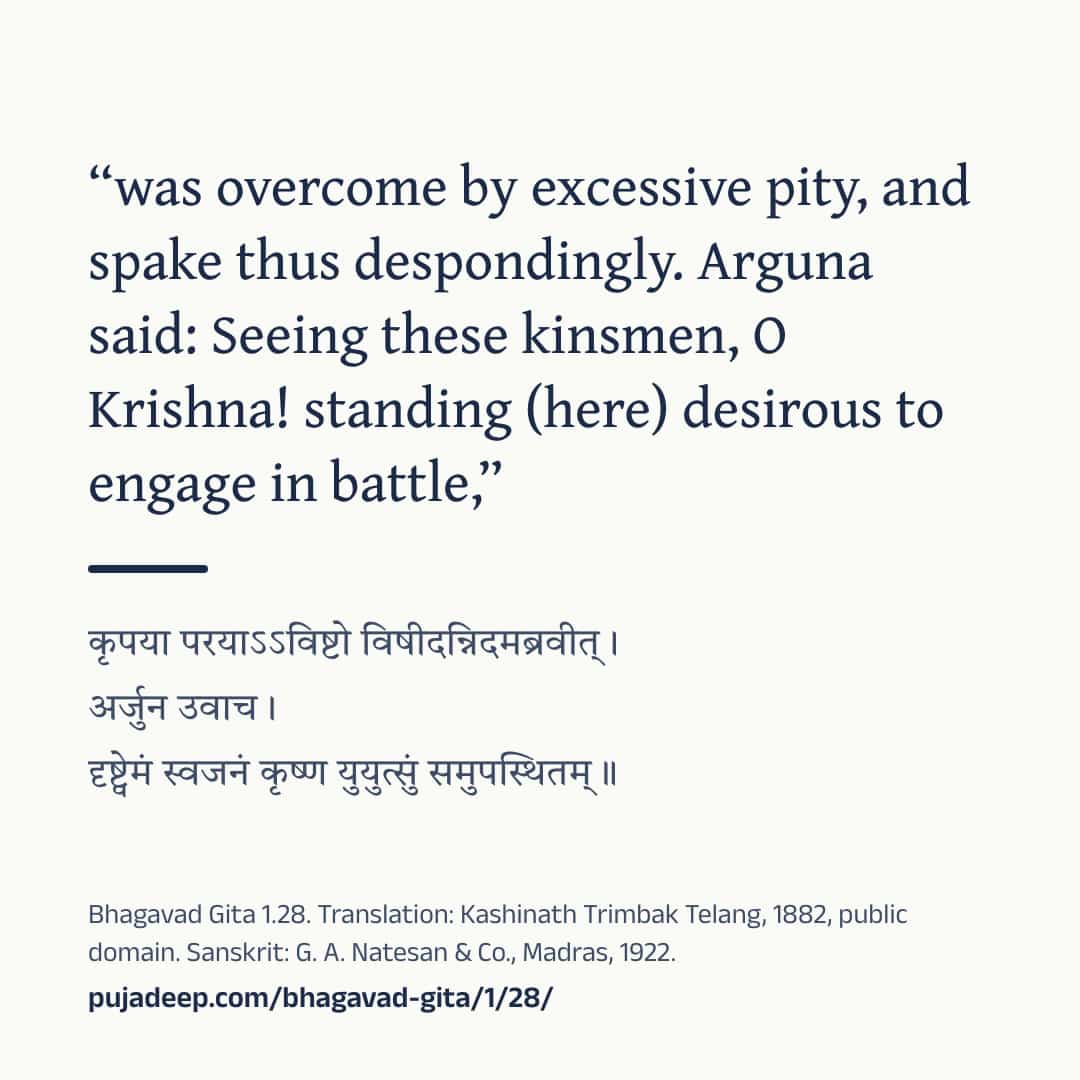
Bhagavad Gita 1.28

कृपया परयाऽऽविष्टो विषीदन्निदमब्रवीत् ।
अर्जुन उवाच ।
दृष्ट्वेमं स्वजनं कृष्ण युयुत्सुं समुपस्थितम् ॥

“was overcome by excessive pity, and spake thus despondingly. Arguna said: Seeing these kinsmen, O Krishna! standing (here) desirous to engage in battle,”
(K. T. Telang, The Bhagavadgîtâ (The Sacred Books of the East, vol. VIII, Oxford: Clarendon Press, 1882), p. 40, public domain)
This sentence begins in 1.26. This sentence goes on in 1.29.

“Deeply moved to pity, this uttered in sadness: Arjuna said: Seeing these my kinsmen arrayed, O Krishna, eager to fight,”
(Annie Besant, The Bhagavad Gîtâ, or The Lord's Song (London: Theosophical Publishing Society, 1895), p. 19, public domain)
This sentence begins in 1.26. This sentence goes on in 1.29.

“spoke thus sorrowfully, filled with deep compassion. Arjuna Said: Seeing, O Krishna, these my kinsmen gathered here, eager for fight,”
(Swami Swarupananda, Srimad-Bhagavad-Gita (Mayavati: Prabuddha Bharata Press, 1909; first printed in Prabuddha Bharata, 1907–1909), pp. 57–58, public domain)
This sentence begins in 1.26. This sentence goes on in 1.29.

Sanskrit: G. A. Natesan & Co., Madras, 1922.
https://pujadeep.com/bhagavad-gita/1/28/ Nothing is sent from this site. Your own app sends it, to the chat you choose. The picture quotes the translation you chose on this page, with its name and year.
Sanskrit text: The Bhagavad-Gita, or The Lord's Song, with the text in Devanagari and an English translation, 1922. Meanings: written for Pujadeep and checked against the cited edition. Source and changes
Questions families ask
Who speaks Bhagavad Gita 1.28?
Sanjaya speaks this verse, in chapter 1 (Arjuna Vishada Yoga).
Where does the Sanskrit text come from?
Sanskrit text: The Bhagavad-Gita, or The Lord's Song, with the text in Devanagari and an English translation, 1922. Meanings: written for Pujadeep and checked against the cited edition. See the source
Is the meaning on this page a translation?
Explanation written for this site from the sources listed here, and checked against the cited edition. It is not a translation and not the only way to read the text. Free to quote with credit.
Source and licence
- Sanskrit text
- The Bhagavad-Gita, or The Lord's Song, with the text in Devanagari and an English translation (Annie Besant, G. A. Natesan & Co., Madras, 1922). Public domain. The Sanskrit on these pages was read from this printing’s page images.
- Translation
- The Bhagavadgîtâ with the Sanatsugâtîya and the Anugîtâ, translated by Kâshinâth Trimbak Telang (The Sacred Books of the East, vol. VIII, ed. F. Max Müller) (Kashinath Trimbak Telang, F. Max Müller, Clarendon Press, Oxford, 1882). Public domain. Shown verbatim, as printed.
- Translation
- The Bhagavad Gîtâ, or The Lord's Song, translated by Annie Besant (Annie Besant, Theosophical Publishing Society, London, 1895). Public domain. Shown verbatim, as printed.
- Translation
- Srimad-Bhagavad-Gita, with Sanskrit Text; Paraphrase with Word-by-word Literal Translation; English Rendering and Comments, Index, &c., by the Swami Swarupananda (Himalayan Series, No. XX) (Swami Swarupananda, The Editors and Publishers, Advaita Ashrama, Mayavati, Prabuddha Bharata Press, Mayavati, Almora, Himalayas, 1909). Public domain. Shown verbatim, as printed.
- Common wording
- In this text, 32 words follow today's common wording, checked against sanskritdocuments.org; Sanskrit Wikisource; Gita Press, Gorakhpur; GRETIL, Göttingen and Bhaktivedanta Book Trust.
- Our explanation
- Explanation written for this site from the sources listed here, and checked against the cited edition. It is not a translation and not the only way to read the text. Free to quote with credit.
- Checked
- Checked against the cited edition, October 15, 2026.
- Updated
- October 25, 2026