Bhagavad Gita 1.19: meaning and translation
Chapter 1: Arjuna Vishada Yoga. Sanjaya says
Sanjaya: The tremendous sound echoes through sky and earth and tears at the hearts of Dhritarashtra's sons.
Click or tap a word for its meaning and its dictionary page.
Text and layers
Text and layers
These choices stay in this browser.
Bhagavad Gita 1.19
स घोषो धार्तराष्ट्राणां हृदयानि व्यदारयत् ।नभश्च पृथिवीं चैव तुमुलो व्यनुनादयन् ॥
Sa ghosho dhartarashtranam hridayani vyadarayatNabhashcha prithivim chaiva tumulo vyanunadayan
sa ghoṣo dhārtarāṣṭrāṇāṃ hṛdayāni vyadārayat |nabhaśca pṛthivīṃ caiva tumulo vyanunādayan ||
Our explanation The tremendous sound echoes through sky and earth and tears at the hearts of Dhritarashtra's sons.
हिंदी अर्थ वह भारी नाद आकाश और धरती में गूँजता हुआ धृतराष्ट्र के पुत्रों के हृदय विदीर्ण कर देता है।
Word by word
Every word, with its dictionary page
Word by word
- सः saḥ · that (pronoun (masculine), nominative singular) Dictionary: tad, Monier-Williams 1899, p. 434, col. 1 “m. he, f. she, n. it, that, this”
- घोषः ghoṣaḥ · roar, sound (noun (masculine), nominative singular) Dictionary: ghoṣa, Monier-Williams 1899, p. 378, col. 1 “indistinct noise, tumult, confused cries of a multitude, battle-cry”
- धार्तराष्ट्राणाम् dhārtarāṣṭrāṇām · of the sons of Dhritarashtra (noun (masculine), genitive plural) Dictionary: dhārta-rāṣṭra, Monier-Williams 1899, p. 516, col. 1 “a son of Dhṛ°, a Kuru”
- हृदयानि hṛdayāni · hearts (noun (neuter), accusative plural) Dictionary: hṛdaya, Monier-Williams 1899, p. 1302, col. 3 “the heart”
- व्यदारयत् vyadārayat · tore apart (imperfect, 3rd person singular) Dictionary: vi-dṝ, Monier-Williams 1899, p. 966, col. 1 “to tear asunder or to pieces, lacerate”
- नभः nabhaḥ · the sky (noun (neuter), accusative singular) Dictionary: nabhas, Monier-Williams 1899, p. 527, col. 3 “the sky or atmosphere”
- च ca · and (indeclinable) Dictionary: 2. ca, Monier-Williams 1899, p. 380, col. 1 “ind. and, both, also, moreover, as well as”
- पृथिवीम् pṛthivīm · the earth (noun (feminine), accusative singular) Dictionary: pṛthivī, Monier-Williams 1899, p. 646, col. 1 “the earth”
- च ca · and (indeclinable) Dictionary: 2. ca, Monier-Williams 1899, p. 380, col. 1 “ind. and, both, also, moreover, as well as”
- एव eva · also (indeclinable) Dictionary: 1. eva, Monier-Williams 1899, p. 232, col. 2 “just, exactly, very, same, only, even, alone, merely”
- तुमुलः tumulaḥ · tumultuous (adjective (masculine), nominative singular) Dictionary: tumula, Monier-Williams 1899, p. 450, col. 3 “tumultuous, noisy”
- व्यनुनादयन् vyanunādayan · making resound (present participle (masculine), nominative singular) Dictionary: vy-anu-nad, Monier-Williams 1899, p. 1031, col. 2 “to cause to resound, fill with noise or cries”
2 printings differ
Edition differences. Another printing or text reads this place differently.
- Word A digital text reads Reads अभ्यनुनादयन् and gives the edition's व्यनुनादयन् in brackets as an alternative (तुमुलो व्यनुनादयन्). Both verbs mean 'making (sky and earth) resound'; the translations do not decide between them.
- Word A digital text reads Reads abhyanunādayan, like another digital text (another digital text prints tumulobhyanunādayan without the avagraha).
Old translations
Kashinath Trimbak Telang, 1882. Public domain. Page 39.
That tumultuous din rent the hearts of all (the people) of Dhritarâshtra's (party), causing reverberations throughout heaven and earth.
Compare 3 translations
Kashinath Trimbak Telang, 1882. Public domain. Page 39.
That tumultuous din rent the hearts of all (the people) of Dhritarâshtra's (party), causing reverberations throughout heaven and earth.
You are reading this one
Annie Besant, 1895. Public domain. Page 17.
That tumult pierced the hearts of the sons of Dhritarâshtra, for truly the uproar re-echoed from earth and sky.
You are reading this one
Swami Swarupananda, 1909 (first printed 1907). Public domain. Page 10.
And the terrific noise resounding throughout heaven and earth rent the hearts of the Dhritaràshtra's party.
You are reading this one
Cite this verse
The translation: K. T. Telang, The Bhagavadgîtâ (The Sacred Books of the East, vol. VIII, Oxford: Clarendon Press, 1882), p. 39. Bhagavad Gita 1.19.
The translation: Annie Besant, The Bhagavad Gîtâ, or The Lord's Song (London: Theosophical Publishing Society, 1895), p. 17. Bhagavad Gita 1.19.
The translation: Swami Swarupananda, Srimad-Bhagavad-Gita (Mayavati: Prabuddha Bharata Press, 1909; first printed in Prabuddha Bharata, 1907–1909), p. 10. Bhagavad Gita 1.19.
Our explanation: “Bhagavad Gita 1.19: meaning and translation.” Pujadeep. Updated October 25, 2026. https://pujadeep.com/bhagavad-gita/1/19/
Pujadeep’s explanations are free to quote with credit: name Pujadeep and link to the page. How to credit
Classical readings, by school
No readings by school on this verse yet.
Share
Show the ways to share
Send one picture or the text to one chat. The picture names its source and the address of this page.
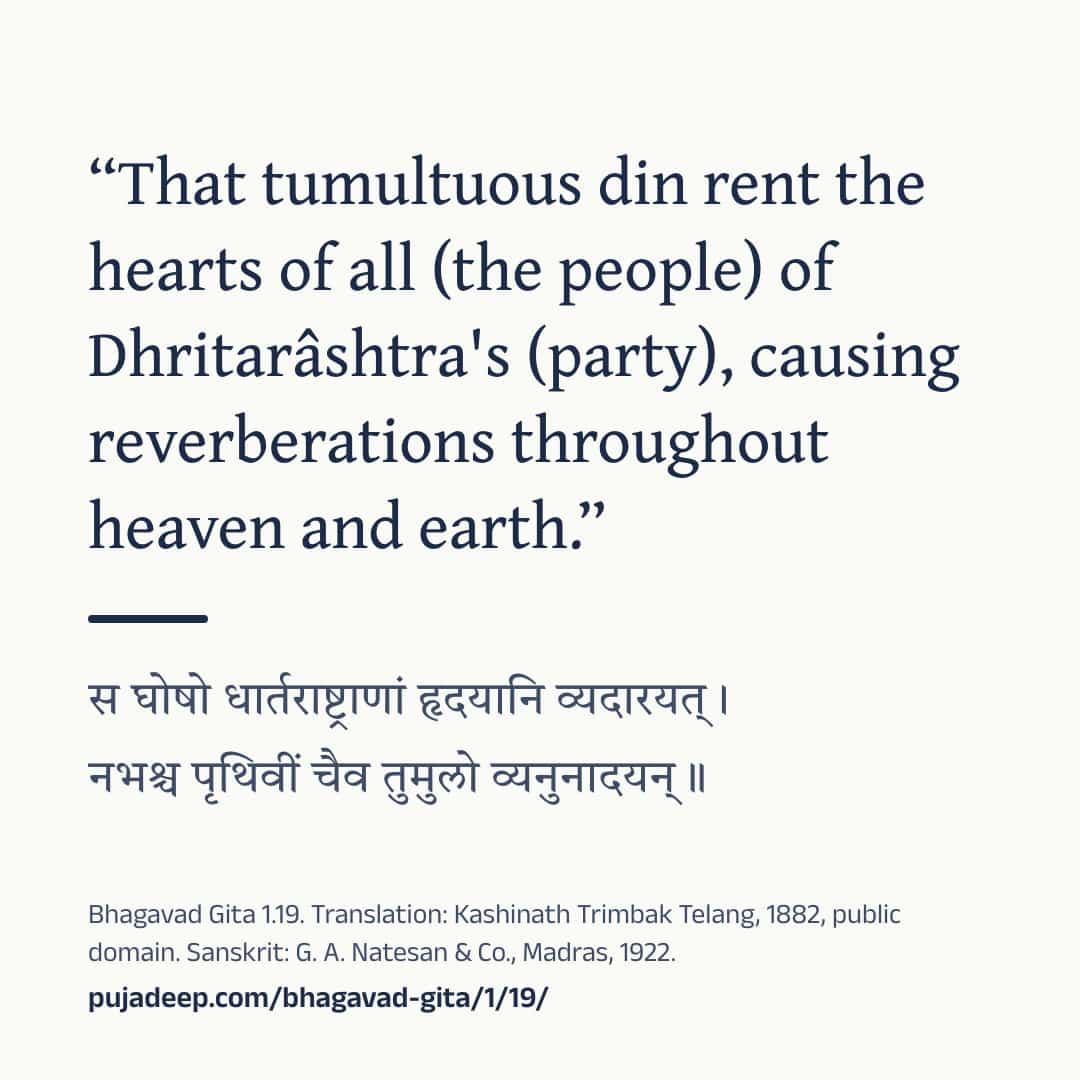
Drawing the picture
See the words
Bhagavad Gita 1.19

स घोषो धार्तराष्ट्राणां हृदयानि व्यदारयत् ।
नभश्च पृथिवीं चैव तुमुलो व्यनुनादयन् ॥

“That tumultuous din rent the hearts of all (the people) of Dhritarâshtra's (party), causing reverberations throughout heaven and earth.”
(K. T. Telang, The Bhagavadgîtâ (The Sacred Books of the East, vol. VIII, Oxford: Clarendon Press, 1882), p. 39, public domain)

“That tumult pierced the hearts of the sons of Dhritarâshtra, for truly the uproar re-echoed from earth and sky.”
(Annie Besant, The Bhagavad Gîtâ, or The Lord's Song (London: Theosophical Publishing Society, 1895), p. 17, public domain)

“And the terrific noise resounding throughout heaven and earth rent the hearts of the Dhritaràshtra's party.”
(Swami Swarupananda, Srimad-Bhagavad-Gita (Mayavati: Prabuddha Bharata Press, 1909; first printed in Prabuddha Bharata, 1907–1909), p. 10, public domain)

Sanskrit: G. A. Natesan & Co., Madras, 1922.
https://pujadeep.com/bhagavad-gita/1/19/ Nothing is sent from this site. Your own app sends it, to the chat you choose. The picture quotes the translation you chose on this page, with its name and year.
Sanskrit text: The Bhagavad-Gita, or The Lord's Song, with the text in Devanagari and an English translation, 1922. Meanings: written for Pujadeep and checked against the cited edition. Source and changes
Questions families ask
Who speaks Bhagavad Gita 1.19?
Sanjaya speaks this verse, in chapter 1 (Arjuna Vishada Yoga).
Where does the Sanskrit text come from?
Sanskrit text: The Bhagavad-Gita, or The Lord's Song, with the text in Devanagari and an English translation, 1922. Meanings: written for Pujadeep and checked against the cited edition. See the source
Is the meaning on this page a translation?
Explanation written for this site from the sources listed here, and checked against the cited edition. It is not a translation and not the only way to read the text. Free to quote with credit.
Source and licence
- Sanskrit text
- The Bhagavad-Gita, or The Lord's Song, with the text in Devanagari and an English translation (Annie Besant, G. A. Natesan & Co., Madras, 1922). Public domain. The Sanskrit on these pages was read from this printing’s page images.
- Translation
- The Bhagavadgîtâ with the Sanatsugâtîya and the Anugîtâ, translated by Kâshinâth Trimbak Telang (The Sacred Books of the East, vol. VIII, ed. F. Max Müller) (Kashinath Trimbak Telang, F. Max Müller, Clarendon Press, Oxford, 1882). Public domain. Shown verbatim, as printed.
- Translation
- The Bhagavad Gîtâ, or The Lord's Song, translated by Annie Besant (Annie Besant, Theosophical Publishing Society, London, 1895). Public domain. Shown verbatim, as printed.
- Translation
- Srimad-Bhagavad-Gita, with Sanskrit Text; Paraphrase with Word-by-word Literal Translation; English Rendering and Comments, Index, &c., by the Swami Swarupananda (Himalayan Series, No. XX) (Swami Swarupananda, The Editors and Publishers, Advaita Ashrama, Mayavati, Prabuddha Bharata Press, Mayavati, Almora, Himalayas, 1909). Public domain. Shown verbatim, as printed.
- Common wording
- In this text, 32 words follow today's common wording, checked against sanskritdocuments.org; Sanskrit Wikisource; Gita Press, Gorakhpur; GRETIL, Göttingen and Bhaktivedanta Book Trust.
- Our explanation
- Explanation written for this site from the sources listed here, and checked against the cited edition. It is not a translation and not the only way to read the text. Free to quote with credit.
- Checked
- Checked against the cited edition, October 15, 2026.
- Updated
- October 25, 2026