Bhagavad Gita 1.10: meaning and translation
Chapter 1: Arjuna Vishada Yoga. Duryodhana says
Duryodhana compares the two armies: his own, protected by Bhishma, and the Pandava army, protected by Bhima.
Click or tap a word for its meaning and its dictionary page.
Text and layers
Text and layers
These choices stay in this browser.
Bhagavad Gita 1.10
अपर्याप्तं तदस्माकं बलं भीष्माभिरक्षितम् ।पर्याप्तं त्विदमेतेषां बलं भीमाभिरक्षितम् ॥
Aparyaptam tadasmakam balam bhishmabhirakshitamParyaptam tvidametesham balam bhimabhirakshitam
aparyāptaṃ tadasmākaṃ balaṃ bhīṣmābhirakṣitam |paryāptaṃ tvidameteṣāṃ balaṃ bhīmābhirakṣitam ||
Our explanation Duryodhana compares the two armies: his own, protected by Bhishma, and the Pandava army, protected by Bhima. The word aparyāpta can mean "not enough" or "beyond measure", so the verse is read in two ways. In Telang's translation his army is unlimited and the other is limited; in Besant's, his army seems not enough and the other seems enough. Besant's footnote says the commentators differ.
हिंदी अर्थ दुर्योधन दोनों सेनाओं की तुलना करते हैं: भीष्म द्वारा रक्षित अपनी सेना, और भीम द्वारा रक्षित पाण्डवों की सेना। “अपर्याप्त” शब्द के दो अर्थ हो सकते हैं, “कम” या “असीम”, इसलिए इस श्लोक को दो तरह से समझा जाता है। तेलंग के अनुवाद में उनकी सेना असीम है और दूसरी सीमित; बेसेंट के अनुवाद में उनकी सेना कम लगती है और दूसरी पर्याप्त। बेसेंट की टिप्पणी बताती है कि टीकाकारों के मत अलग हैं।
Word by word
Every word, with its dictionary page
Word by word
- अपर्याप्तम् aparyāptam · unlimited, or not enough (adjective (neuter), nominative singular) Dictionary: a-paryāpta, Monier-Williams 1899, p. 51, col. 3 “incomplete; unable, incompetent, insufficient; not enough; unlimited, unbounded”
- तत् tat · that (pronoun (neuter), nominative singular) Dictionary: tad, Monier-Williams 1899, p. 434, col. 1 “m. he, f. she, n. it, that, this”
- अस्माकम् asmākam · our (pronoun, genitive plural) Dictionary: asmad, Monier-Williams 1899, p. 123, col. 2 “base of the first person plur., as used in comp.”
- बलम् balam · army, force (noun (neuter), nominative singular) Dictionary: bala, Monier-Williams 1899, p. 722, col. 3 “power, strength, might, vigour, force”
- भीष्माभिरक्षितम् bhīṣmābhirakṣitam · guarded by Bhishma (compound (neuter), nominative singular) Dictionary: bhīṣma, Monier-Williams 1899, p. 758, col. 3 “N. of a son of Śāṃtanu and Gaṅgā”; abhi-rakṣita, Monier-Williams 1899, p. 68, col. 1 “protected, preserved, guarded”
- पर्याप्तम् paryāptam · limited, or enough (adjective (neuter), nominative singular) Dictionary: pary-āpta, Monier-Williams 1899, p. 608, col. 1 “sufficient for (dat. or gen.) … limited in number”
- तु tu · but (indeclinable) Dictionary: 2. tu, Monier-Williams 1899, p. 449, col. 3 “but”
- इदम् idam · this (pronoun (neuter), nominative singular) Dictionary: 1. idam, Monier-Williams 1899, p. 165, col. 2 “this, this here, referring to something near the speaker”
- एतेषाम् eteṣām · of these (men) (pronoun (masculine), genitive plural) Dictionary: etad, Monier-Williams 1899, p. 231, col. 2 “this, this here, here”
- बलम् balam · army, force (noun (neuter), nominative singular) Dictionary: bala, Monier-Williams 1899, p. 722, col. 3 “power, strength, might, vigour, force”
- भीमाभिरक्षितम् bhīmābhirakṣitam · guarded by Bhima (compound (neuter), nominative singular) Dictionary: bhīma, Monier-Williams 1899, p. 758, col. 1 “fearful, terrific, terrible, awful, formidable, tremendous”; abhi-rakṣita, Monier-Williams 1899, p. 68, col. 1 “protected, preserved, guarded”
Old translations
Kashinath Trimbak Telang, 1882. Public domain. Page 38.
Thus our army which is protected by Bhîshma is unlimited; while this army of theirs which is protected by Bhîma is very limited.
Compare 3 translations
Kashinath Trimbak Telang, 1882. Public domain. Page 38.
Thus our army which is protected by Bhîshma is unlimited; while this army of theirs which is protected by Bhîma is very limited.
You are reading this one
Annie Besant, 1895. Public domain. Page 15.
Yet insufficient seems this army of ours, though commanded by Bhîshma, while sufficient seems that army of theirs, commanded even by Bhîma1;
This sentence goes on in 1.11.
Footnotes (the translator’s own) - The commentators differ in their interpretation of this verse; Anandagiri takes it to mean just the reverse of Dridhau Svâmi, and connects "Aparyâptam" with the army of the Pândavas. ↩
You are reading this one
Swami Swarupananda, 1909 (first printed 1907). Public domain. Page 6.
"This our army commanded by Bhishma (is) impossible to be counted, but that army of theirs, commanded by Bhima (is) easy to number.
You are reading this one
Cite this verse
The translation: K. T. Telang, The Bhagavadgîtâ (The Sacred Books of the East, vol. VIII, Oxford: Clarendon Press, 1882), p. 38. Bhagavad Gita 1.10.
The translation: Annie Besant, The Bhagavad Gîtâ, or The Lord's Song (London: Theosophical Publishing Society, 1895), p. 15. Bhagavad Gita 1.10.
The translation: Swami Swarupananda, Srimad-Bhagavad-Gita (Mayavati: Prabuddha Bharata Press, 1909; first printed in Prabuddha Bharata, 1907–1909), p. 6. Bhagavad Gita 1.10.
Our explanation: “Bhagavad Gita 1.10: meaning and translation.” Pujadeep. Updated October 25, 2026. https://pujadeep.com/bhagavad-gita/1/10/
Pujadeep’s explanations are free to quote with credit: name Pujadeep and link to the page. How to credit
Classical readings, by school
No readings by school on this verse yet.
Share
Show the ways to share
Send one picture or the text to one chat. The picture names its source and the address of this page.
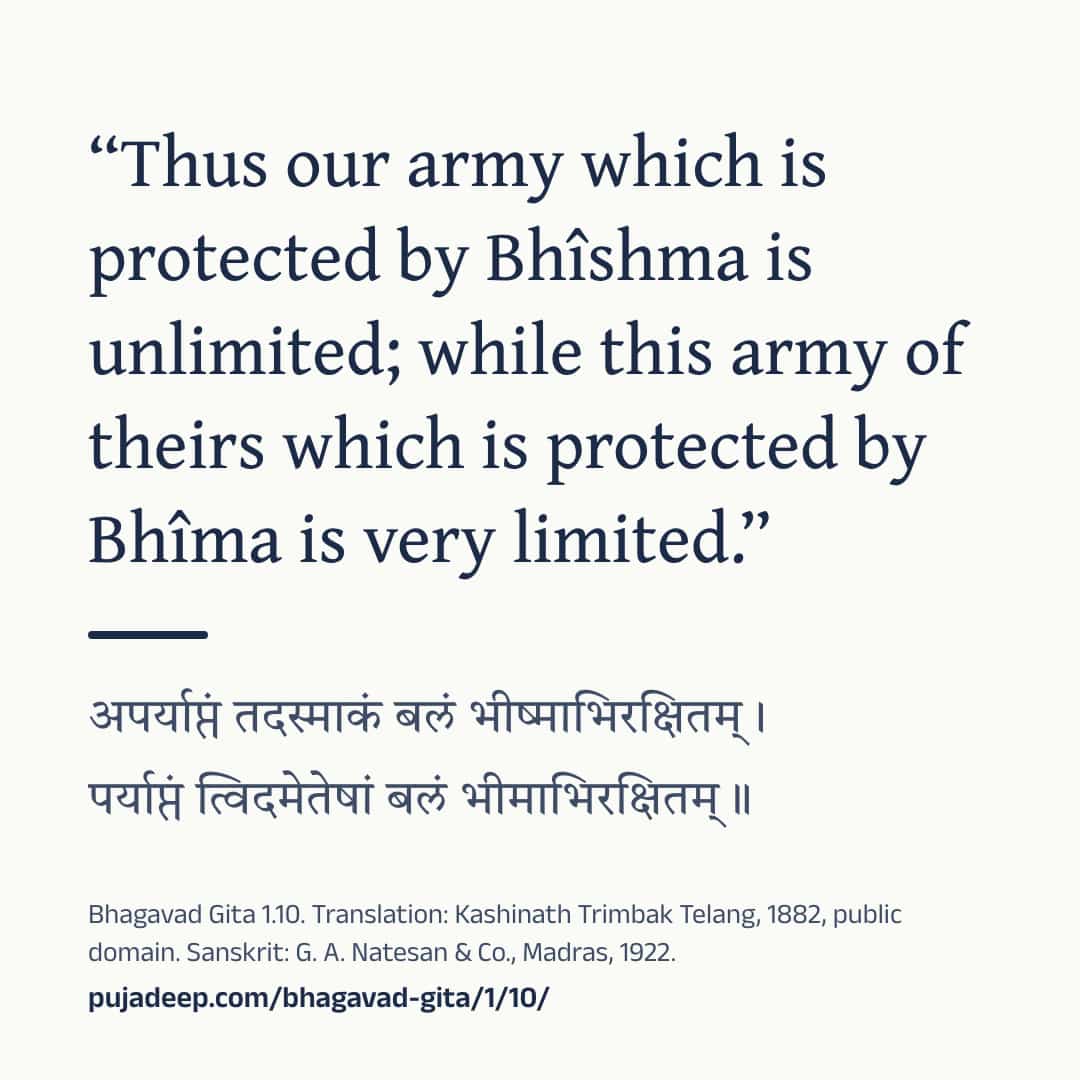
Drawing the picture
See the words
Bhagavad Gita 1.10

अपर्याप्तं तदस्माकं बलं भीष्माभिरक्षितम् ।
पर्याप्तं त्विदमेतेषां बलं भीमाभिरक्षितम् ॥

“Thus our army which is protected by Bhîshma is unlimited; while this army of theirs which is protected by Bhîma is very limited.”
(K. T. Telang, The Bhagavadgîtâ (The Sacred Books of the East, vol. VIII, Oxford: Clarendon Press, 1882), p. 38, public domain)

“Yet insufficient seems this army of ours, though commanded by Bhîshma, while sufficient seems that army of theirs, commanded even by Bhîma;”
(Annie Besant, The Bhagavad Gîtâ, or The Lord's Song (London: Theosophical Publishing Society, 1895), p. 15, public domain)
This sentence goes on in 1.11.

“"This our army commanded by Bhishma (is) impossible to be counted, but that army of theirs, commanded by Bhima (is) easy to number.”
(Swami Swarupananda, Srimad-Bhagavad-Gita (Mayavati: Prabuddha Bharata Press, 1909; first printed in Prabuddha Bharata, 1907–1909), p. 6, public domain)

Sanskrit: G. A. Natesan & Co., Madras, 1922.
https://pujadeep.com/bhagavad-gita/1/10/ Nothing is sent from this site. Your own app sends it, to the chat you choose. The picture quotes the translation you chose on this page, with its name and year.
Sanskrit text: The Bhagavad-Gita, or The Lord's Song, with the text in Devanagari and an English translation, 1922. Meanings: written for Pujadeep and checked against the cited edition. Source and changes
Questions families ask
Who speaks Bhagavad Gita 1.10?
Duryodhana speaks this verse, in chapter 1 (Arjuna Vishada Yoga).
Where does the Sanskrit text come from?
Sanskrit text: The Bhagavad-Gita, or The Lord's Song, with the text in Devanagari and an English translation, 1922. Meanings: written for Pujadeep and checked against the cited edition. See the source
Is the meaning on this page a translation?
Explanation written for this site from the sources listed here, and checked against the cited edition. It is not a translation and not the only way to read the text. Free to quote with credit.
Source and licence
- Sanskrit text
- The Bhagavad-Gita, or The Lord's Song, with the text in Devanagari and an English translation (Annie Besant, G. A. Natesan & Co., Madras, 1922). Public domain. The Sanskrit on these pages was read from this printing’s page images.
- Translation
- The Bhagavadgîtâ with the Sanatsugâtîya and the Anugîtâ, translated by Kâshinâth Trimbak Telang (The Sacred Books of the East, vol. VIII, ed. F. Max Müller) (Kashinath Trimbak Telang, F. Max Müller, Clarendon Press, Oxford, 1882). Public domain. Shown verbatim, as printed.
- Translation
- The Bhagavad Gîtâ, or The Lord's Song, translated by Annie Besant (Annie Besant, Theosophical Publishing Society, London, 1895). Public domain. Shown verbatim, as printed.
- Translation
- Srimad-Bhagavad-Gita, with Sanskrit Text; Paraphrase with Word-by-word Literal Translation; English Rendering and Comments, Index, &c., by the Swami Swarupananda (Himalayan Series, No. XX) (Swami Swarupananda, The Editors and Publishers, Advaita Ashrama, Mayavati, Prabuddha Bharata Press, Mayavati, Almora, Himalayas, 1909). Public domain. Shown verbatim, as printed.
- Common wording
- In this text, 32 words follow today's common wording, checked against sanskritdocuments.org; Sanskrit Wikisource; Gita Press, Gorakhpur; GRETIL, Göttingen and Bhaktivedanta Book Trust.
- Our explanation
- Explanation written for this site from the sources listed here, and checked against the cited edition. It is not a translation and not the only way to read the text. Free to quote with credit.
- Checked
- Checked against the cited edition, October 15, 2026.
- Updated
- October 25, 2026