Bhagavad Gita 1.8: meaning and translation
Chapter 1: Arjuna Vishada Yoga. Duryodhana says
He names them: Drona himself; Bhishma (the grand elder of both families); Karna (Duryodhana's close friend); Kripa (a teacher of the princes), who wins his battles; Ashvatthama (Drona's son); Vikarna (one of Duryodhana's brothers); and the son of Somadatta (Bhurishravas).
Click or tap a word for its meaning and its dictionary page.
Text and layers
Text and layers
These choices stay in this browser.
Bhagavad Gita 1.8
भवान्भीष्मश्च कर्णश्च कृपश्च समितिञ्जयः ।अश्वत्थामा विकर्णश्च सौमदत्तिस्तथैव च ॥
Bhavanbhishmashcha karnashcha kripashcha samitinjayahAshvatthama vikarnashcha saumadattistathaiva cha
bhavānbhīṣmaśca karṇaśca kṛpaśca samitiñjayaḥ |aśvatthāmā vikarṇaśca saumadattistathaiva ca ||
Our explanation He names them: Drona himself; Bhishma (the grand elder of both families); Karna (Duryodhana's close friend); Kripa (a teacher of the princes), who wins his battles; Ashvatthama (Drona's son); Vikarna (one of Duryodhana's brothers); and the son of Somadatta (Bhurishravas).
हिंदी अर्थ वे नाम गिनाते हैं: स्वयं द्रोणाचार्य, भीष्म (दोनों परिवारों के पितामह), कर्ण (दुर्योधन के घनिष्ठ मित्र), युद्ध जीतने वाले कृपाचार्य (राजकुमारों के एक गुरु), अश्वत्थामा (द्रोण के पुत्र), विकर्ण (दुर्योधन के एक भाई) और सोमदत्त के पुत्र भूरिश्रवा।
Word by word
Every word, with its dictionary page
Word by word
- भवान् bhavān · you (sir) (pronoun (masculine), nominative singular) Dictionary: bhavat, Monier-Williams 1899, p. 749, col. 2 “your honour, your worship, your lordship or ladyship, you”
- भीष्मः bhīṣmaḥ · Bhishma (noun (masculine), nominative singular) Dictionary: bhīṣma, Monier-Williams 1899, p. 758, col. 3 “N. of a son of Śāṃtanu and Gaṅgā”
- च ca · and (indeclinable) Dictionary: 2. ca, Monier-Williams 1899, p. 380, col. 1 “ind. and, both, also, moreover, as well as”
- कर्णः karṇaḥ · Karna (noun (masculine), nominative singular) Dictionary: karṇa, Monier-Williams 1899, p. 256, col. 2 “N. of a king of Aṅga”
- च ca · and (indeclinable) Dictionary: 2. ca, Monier-Williams 1899, p. 380, col. 1 “ind. and, both, also, moreover, as well as”
- कृपः kṛpaḥ · Kripa (noun (masculine), nominative singular) Dictionary: kṛpa, Monier-Williams 1899, p. 305, col. 1 “N. of the son and daughter of the sage Śaradvat”
- च ca · and (indeclinable) Dictionary: 2. ca, Monier-Williams 1899, p. 380, col. 1 “ind. and, both, also, moreover, as well as”
- समितिञ्जयः samitiñjayaḥ · victorious in battle (compound (masculine), nominative singular) Dictionary: samitiṃ-jaya, Monier-Williams 1899, p. 1164, col. 2 “‘victorious in battle’ or ‘eminent in an assembly’ (also N. of Yama and Vishṇu)”
- अश्वत्थामा aśvatthāmā · Ashvatthama (noun (masculine), nominative singular) Dictionary: aśvatthāman, Monier-Williams 1899, p. 116, col. 1 “N. of a son of Droṇa”
- विकर्णः vikarṇaḥ · Vikarna (noun (masculine), nominative singular) Dictionary: vi-karṇa, Monier-Williams 1899, p. 950, col. 1 “of a son of Dhṛita-rāshṭra”
- च ca · and (indeclinable) Dictionary: 2. ca, Monier-Williams 1899, p. 380, col. 1 “ind. and, both, also, moreover, as well as”
- सौमदत्तिः saumadattiḥ · the son of Somadatta (Bhurishravas) (noun (masculine), nominative singular) Dictionary: sauma-datti, Monier-Williams 1899, p. 1253, col. 3 “patr. fr. soma-datta”
- तथा tathā · so, likewise (indeclinable) Dictionary: tathā, Monier-Williams 1899, p. 433, col. 3 “in that manner, so, thus”
- एव eva · also (indeclinable) Dictionary: 1. eva, Monier-Williams 1899, p. 232, col. 2 “just, exactly, very, same, only, even, alone, merely”
- च ca · and (indeclinable) Dictionary: 2. ca, Monier-Williams 1899, p. 380, col. 1 “ind. and, both, also, moreover, as well as”
1 printing differs
Edition differences. Another printing or text reads this place differently.
- Word A digital text reads Reads like the edition (सौमदत्तिस्तथैव च, 'and the son of Somadatta too') and gives सौमदत्तिर्जयद्रथः ('the son of Somadatta and Jayadratha') in brackets as an alternative. Neither translation follows the alternative.
Old translations
Kashinath Trimbak Telang, 1882. Public domain. Page 38.
Yourself, and Bhîshma, and Karna, and Kripa the victor of (many) battles; Asvatthâman, and Vikarna, and also the son of Somadatta,
This sentence goes on in 1.9.
Compare 3 translations
Kashinath Trimbak Telang, 1882. Public domain. Page 38.
Yourself, and Bhîshma, and Karna, and Kripa the victor of (many) battles; Asvatthâman, and Vikarna, and also the son of Somadatta,
This sentence goes on in 1.9.
You are reading this one
Annie Besant, 1895. Public domain. Page 15.
Thou, Lord, and Bhîshma, and Karna and Kripa, conquering in battle; Ashvatthâma, Vikarna, and Saumadatta1 also;
This sentence begins in 1.7. This sentence goes on in 1.9.
Footnotes (the translator’s own) - The son of Somadatta. ↩
You are reading this one
Swami Swarupananda, 1909 (first printed 1907). Public domain. Page 5.
"Thyself and Bhishma and Karna and Kripa, the victorious in war, Asvatthàma and Vikarna and Jayadratha, the son of Somadatta.
You are reading this one
Cite this verse
The translation: K. T. Telang, The Bhagavadgîtâ (The Sacred Books of the East, vol. VIII, Oxford: Clarendon Press, 1882), p. 38. Bhagavad Gita 1.8.
The translation: Annie Besant, The Bhagavad Gîtâ, or The Lord's Song (London: Theosophical Publishing Society, 1895), p. 15. Bhagavad Gita 1.8.
The translation: Swami Swarupananda, Srimad-Bhagavad-Gita (Mayavati: Prabuddha Bharata Press, 1909; first printed in Prabuddha Bharata, 1907–1909), p. 5. Bhagavad Gita 1.8.
Our explanation: “Bhagavad Gita 1.8: meaning and translation.” Pujadeep. Updated October 25, 2026. https://pujadeep.com/bhagavad-gita/1/8/
Pujadeep’s explanations are free to quote with credit: name Pujadeep and link to the page. How to credit
Classical readings, by school
No readings by school on this verse yet.
Share
Show the ways to share
Send one picture or the text to one chat. The picture names its source and the address of this page.
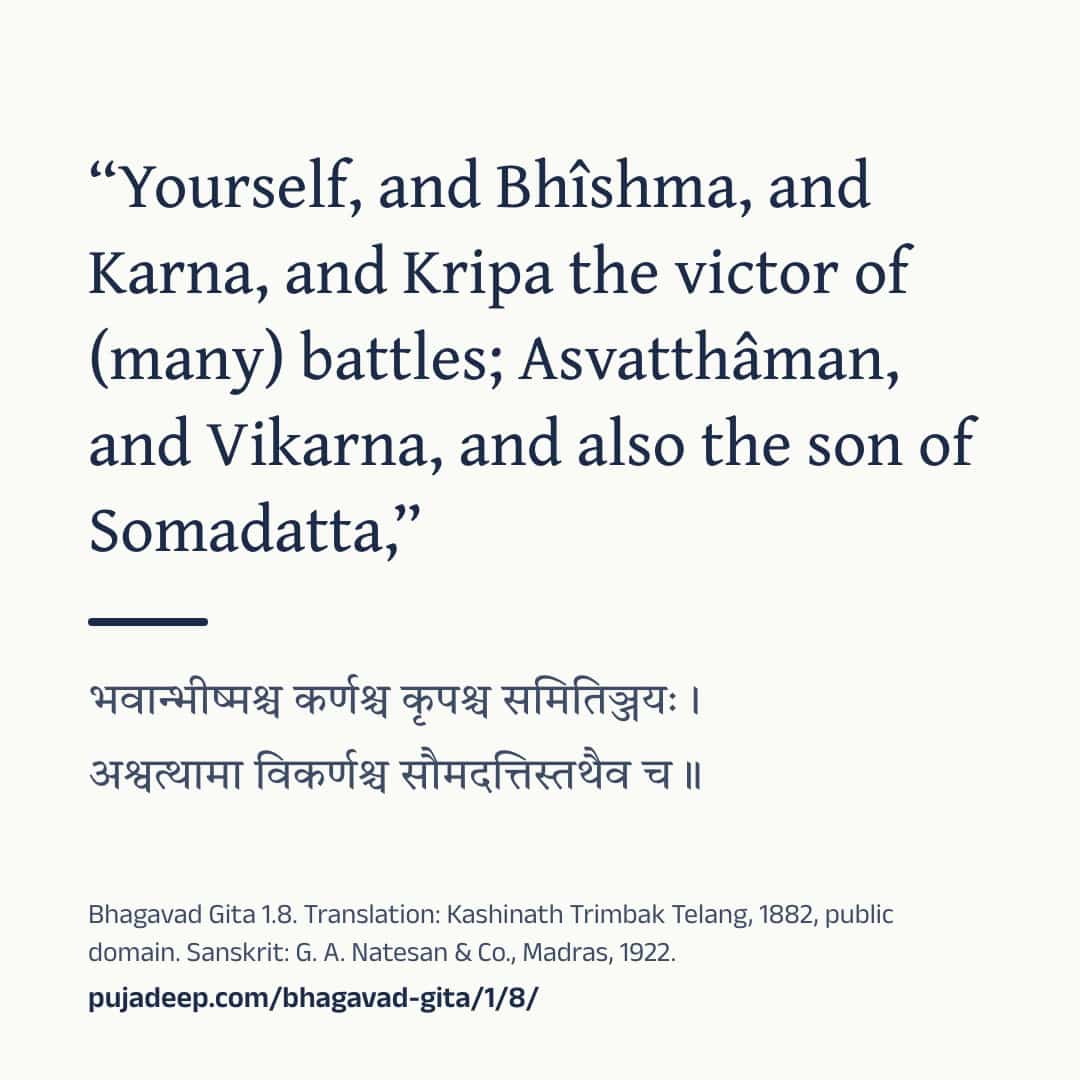
Drawing the picture
See the words
Bhagavad Gita 1.8

भवान्भीष्मश्च कर्णश्च कृपश्च समितिञ्जयः ।
अश्वत्थामा विकर्णश्च सौमदत्तिस्तथैव च ॥

“Yourself, and Bhîshma, and Karna, and Kripa the victor of (many) battles; Asvatthâman, and Vikarna, and also the son of Somadatta,”
(K. T. Telang, The Bhagavadgîtâ (The Sacred Books of the East, vol. VIII, Oxford: Clarendon Press, 1882), p. 38, public domain)
This sentence goes on in 1.9.

“Thou, Lord, and Bhîshma, and Karna and Kripa, conquering in battle; Ashvatthâma, Vikarna, and Saumadatta also;”
(Annie Besant, The Bhagavad Gîtâ, or The Lord's Song (London: Theosophical Publishing Society, 1895), p. 15, public domain)
This sentence begins in 1.7. This sentence goes on in 1.9.

“"Thyself and Bhishma and Karna and Kripa, the victorious in war, Asvatthàma and Vikarna and Jayadratha, the son of Somadatta.”
(Swami Swarupananda, Srimad-Bhagavad-Gita (Mayavati: Prabuddha Bharata Press, 1909; first printed in Prabuddha Bharata, 1907–1909), p. 5, public domain)

Sanskrit: G. A. Natesan & Co., Madras, 1922.
https://pujadeep.com/bhagavad-gita/1/8/ Nothing is sent from this site. Your own app sends it, to the chat you choose. The picture quotes the translation you chose on this page, with its name and year.
Sanskrit text: The Bhagavad-Gita, or The Lord's Song, with the text in Devanagari and an English translation, 1922. Meanings: written for Pujadeep and checked against the cited edition. Source and changes
Questions families ask
Who speaks Bhagavad Gita 1.8?
Duryodhana speaks this verse, in chapter 1 (Arjuna Vishada Yoga).
Where does the Sanskrit text come from?
Sanskrit text: The Bhagavad-Gita, or The Lord's Song, with the text in Devanagari and an English translation, 1922. Meanings: written for Pujadeep and checked against the cited edition. See the source
Is the meaning on this page a translation?
Explanation written for this site from the sources listed here, and checked against the cited edition. It is not a translation and not the only way to read the text. Free to quote with credit.
Source and licence
- Sanskrit text
- The Bhagavad-Gita, or The Lord's Song, with the text in Devanagari and an English translation (Annie Besant, G. A. Natesan & Co., Madras, 1922). Public domain. The Sanskrit on these pages was read from this printing’s page images.
- Translation
- The Bhagavadgîtâ with the Sanatsugâtîya and the Anugîtâ, translated by Kâshinâth Trimbak Telang (The Sacred Books of the East, vol. VIII, ed. F. Max Müller) (Kashinath Trimbak Telang, F. Max Müller, Clarendon Press, Oxford, 1882). Public domain. Shown verbatim, as printed.
- Translation
- The Bhagavad Gîtâ, or The Lord's Song, translated by Annie Besant (Annie Besant, Theosophical Publishing Society, London, 1895). Public domain. Shown verbatim, as printed.
- Translation
- Srimad-Bhagavad-Gita, with Sanskrit Text; Paraphrase with Word-by-word Literal Translation; English Rendering and Comments, Index, &c., by the Swami Swarupananda (Himalayan Series, No. XX) (Swami Swarupananda, The Editors and Publishers, Advaita Ashrama, Mayavati, Prabuddha Bharata Press, Mayavati, Almora, Himalayas, 1909). Public domain. Shown verbatim, as printed.
- Common wording
- In this text, 32 words follow today's common wording, checked against sanskritdocuments.org; Sanskrit Wikisource; Gita Press, Gorakhpur; GRETIL, Göttingen and Bhaktivedanta Book Trust.
- Our explanation
- Explanation written for this site from the sources listed here, and checked against the cited edition. It is not a translation and not the only way to read the text. Free to quote with credit.
- Checked
- Checked against the cited edition, October 15, 2026.
- Updated
- October 25, 2026