Bhagavad Gita 1.14: meaning and translation
Chapter 1: Arjuna Vishada Yoga. Sanjaya says
Sanjaya: Then, standing in their great chariot drawn by white horses, Krishna (called here Madhava) and Arjuna (the son of Pandu) blow their divine conches.
Click or tap a word for its meaning and its dictionary page.
Text and layers
Text and layers
These choices stay in this browser.
Bhagavad Gita 1.14
ततः श्वेतैर्हयैर्युक्ते महति स्यन्दने स्थितौ ।माधवः पाण्डवश्चैव दिव्यौ शङ्खौ प्रदध्मतुः ॥
Tatah shvetairhayairyukte mahati syandane sthitauMadhavah pandavashchaiva divyau shankhau pradadhmatuh
tataḥ śvetairhayairyukte mahati syandane sthitau |mādhavaḥ pāṇḍavaścaiva divyau śaṅkhau pradadhmatuḥ ||
Our explanation Then, standing in their great chariot drawn by white horses, Krishna (called here Madhava) and Arjuna (the son of Pandu) blow their divine conches.
हिंदी अर्थ तब सफ़ेद घोड़ों वाले विशाल रथ पर खड़े माधव (कृष्ण) और पाण्डुपुत्र अर्जुन अपने दिव्य शंख बजाते हैं।
Word by word
Every word, with its dictionary page
Word by word
- ततः tataḥ · then (indeclinable) Dictionary: tatas, Monier-Williams 1899, p. 432, col. 2 “thereupon, then, after that”
- श्वेतैः śvetaiḥ · white (adjective (masculine), instrumental plural) Dictionary: śveta, Monier-Williams 1899, p. 1106, col. 2 “white, dressed in white”
- हयैः hayaiḥ · with horses (noun (masculine), instrumental plural) Dictionary: haya, Monier-Williams 1899, p. 1288, col. 2 “a horse”
- युक्ते yukte · yoked (past participle (masculine), locative singular) Dictionary: yukta, Monier-Williams 1899, p. 853, col. 2 “yoked or joined or fastened or attached or harnessed”
- महति mahati · great (adjective (masculine), locative singular) Dictionary: mahat, Monier-Williams 1899, p. 794, col. 2 “great (in space, time, quantity or degree)”
- स्यन्दने syandane · in the chariot (noun (masculine), locative singular) Dictionary: syandana, Monier-Williams 1899, p. 1273, col. 1 “a war-chariot, chariot, car”
- स्थितौ sthitau · standing (both) (past participle (masculine), nominative dual) Dictionary: sthita, Monier-Williams 1899, p. 1264, col. 1 “standing, staying, situated, resting or abiding or remaining in”
- माधवः mādhavaḥ · Madhava (Krishna) (noun (masculine), nominative singular) Dictionary: mādhava, Monier-Williams 1899, p. 808, col. 2 “a son or descendant of Madhu, a man of the race of Yadu”
- पाण्डवः pāṇḍavaḥ · the Pandava (Arjuna) (noun (masculine), nominative singular) Dictionary: pāṇḍava, Monier-Williams 1899, p. 616, col. 2 “a son or descendant of Pāṇḍu”
- च ca · and (indeclinable) Dictionary: 2. ca, Monier-Williams 1899, p. 380, col. 1 “ind. and, both, also, moreover, as well as”
- एव eva · also (indeclinable) Dictionary: 1. eva, Monier-Williams 1899, p. 232, col. 2 “just, exactly, very, same, only, even, alone, merely”
- दिव्यौ divyau · divine (adjective (masculine), accusative dual) Dictionary: 2. divya, Monier-Williams 1899, p. 479, col. 2 “divine, heavenly, celestial”
- शङ्खौ śaṅkhau · two conches (noun (masculine), accusative dual) Dictionary: śaṅkha, Monier-Williams 1899, p. 1047, col. 2 “a shell, (esp.) the conch-shell”
- प्रदध्मतुः pradadhmatuḥ · blew (both) (perfect, 3rd person dual) Dictionary: pra-dhmā, Monier-Williams 1899, p. 681, col. 2 “to blow into (esp. into a conch shell, acc.)”
Old translations
Kashinath Trimbak Telang, 1882. Public domain. Page 38.
Then, too, Mâdhava and the son of Pându (Arguna), seated in a grand chariot to which white steeds were yoked, blew their heavenly conchs.
Compare 3 translations
Kashinath Trimbak Telang, 1882. Public domain. Page 38.
Then, too, Mâdhava and the son of Pându (Arguna), seated in a grand chariot to which white steeds were yoked, blew their heavenly conchs.
You are reading this one
Annie Besant, 1895. Public domain. Page 16.
Then stationed in their great war-chariot, yoked to white horses, Mâdhava1 and the son of Pându2 blew their divine conches,
This sentence goes on in 1.15.
Footnotes (the translator’s own) You are reading this one
Swami Swarupananda, 1909 (first printed 1907). Public domain. Page 8.
Then, also, Màdhava and Pàndava, stationed in their magnificent chariot yoked to white horses, blew their divine conches with a furious noise.
You are reading this one
Cite this verse
The translation: K. T. Telang, The Bhagavadgîtâ (The Sacred Books of the East, vol. VIII, Oxford: Clarendon Press, 1882), p. 38. Bhagavad Gita 1.14.
The translation: Annie Besant, The Bhagavad Gîtâ, or The Lord's Song (London: Theosophical Publishing Society, 1895), p. 16. Bhagavad Gita 1.14.
The translation: Swami Swarupananda, Srimad-Bhagavad-Gita (Mayavati: Prabuddha Bharata Press, 1909; first printed in Prabuddha Bharata, 1907–1909), p. 8. Bhagavad Gita 1.14.
Our explanation: “Bhagavad Gita 1.14: meaning and translation.” Pujadeep. Updated October 25, 2026. https://pujadeep.com/bhagavad-gita/1/14/
Pujadeep’s explanations are free to quote with credit: name Pujadeep and link to the page. How to credit
Classical readings, by school
No readings by school on this verse yet.
Share
Show the ways to share
Send one picture or the text to one chat. The picture names its source and the address of this page.
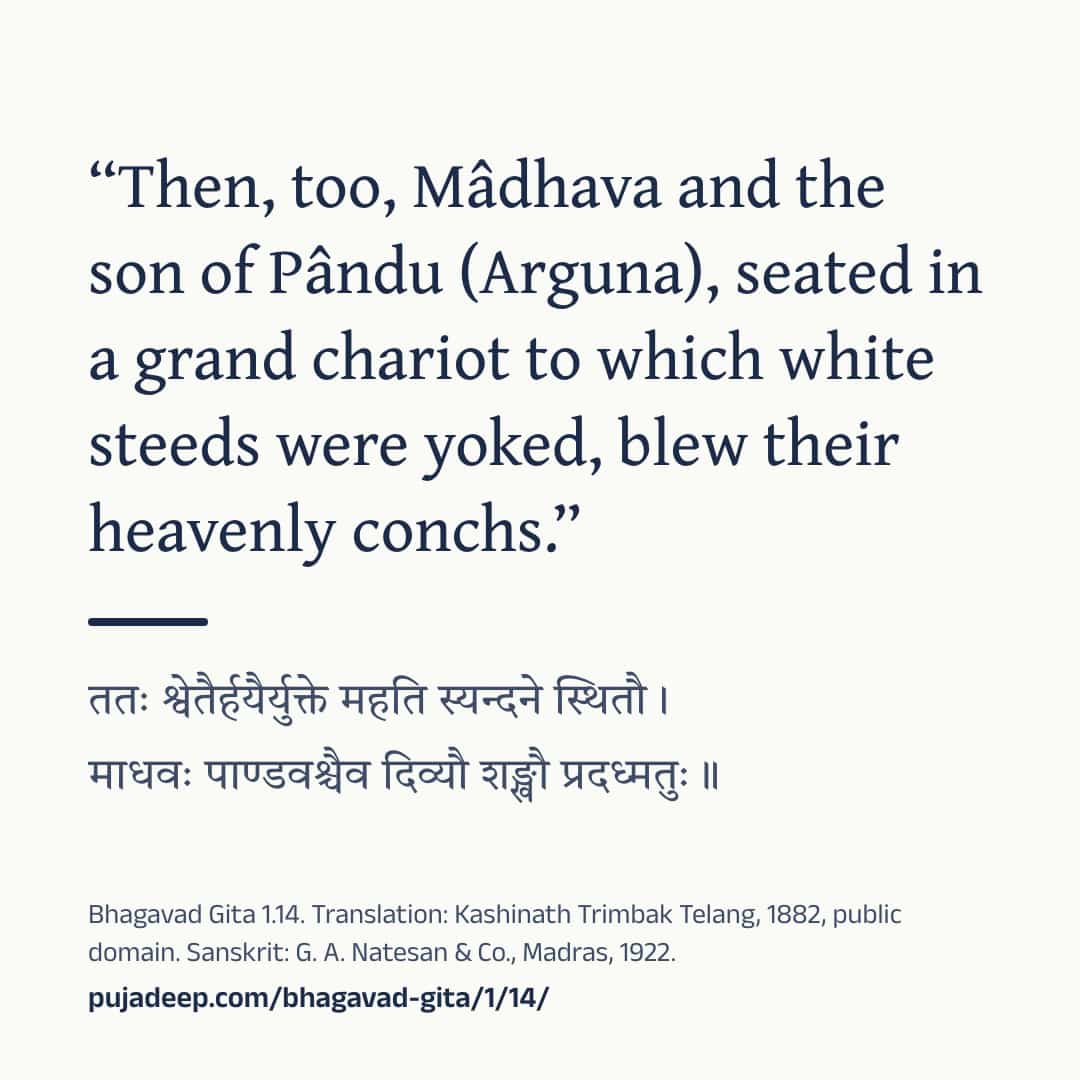
Drawing the picture
See the words
Bhagavad Gita 1.14

ततः श्वेतैर्हयैर्युक्ते महति स्यन्दने स्थितौ ।
माधवः पाण्डवश्चैव दिव्यौ शङ्खौ प्रदध्मतुः ॥

“Then, too, Mâdhava and the son of Pându (Arguna), seated in a grand chariot to which white steeds were yoked, blew their heavenly conchs.”
(K. T. Telang, The Bhagavadgîtâ (The Sacred Books of the East, vol. VIII, Oxford: Clarendon Press, 1882), p. 38, public domain)

“Then stationed in their great war-chariot, yoked to white horses, Mâdhava and the son of Pându blew their divine conches,”
(Annie Besant, The Bhagavad Gîtâ, or The Lord's Song (London: Theosophical Publishing Society, 1895), p. 16, public domain)
This sentence goes on in 1.15.

“Then, also, Màdhava and Pàndava, stationed in their magnificent chariot yoked to white horses, blew their divine conches with a furious noise.”
(Swami Swarupananda, Srimad-Bhagavad-Gita (Mayavati: Prabuddha Bharata Press, 1909; first printed in Prabuddha Bharata, 1907–1909), p. 8, public domain)

Sanskrit: G. A. Natesan & Co., Madras, 1922.
https://pujadeep.com/bhagavad-gita/1/14/ Nothing is sent from this site. Your own app sends it, to the chat you choose. The picture quotes the translation you chose on this page, with its name and year.
Sanskrit text: The Bhagavad-Gita, or The Lord's Song, with the text in Devanagari and an English translation, 1922. Meanings: written for Pujadeep and checked against the cited edition. Source and changes
Questions families ask
Who speaks Bhagavad Gita 1.14?
Sanjaya speaks this verse, in chapter 1 (Arjuna Vishada Yoga).
Where does the Sanskrit text come from?
Sanskrit text: The Bhagavad-Gita, or The Lord's Song, with the text in Devanagari and an English translation, 1922. Meanings: written for Pujadeep and checked against the cited edition. See the source
Is the meaning on this page a translation?
Explanation written for this site from the sources listed here, and checked against the cited edition. It is not a translation and not the only way to read the text. Free to quote with credit.
Source and licence
- Sanskrit text
- The Bhagavad-Gita, or The Lord's Song, with the text in Devanagari and an English translation (Annie Besant, G. A. Natesan & Co., Madras, 1922). Public domain. The Sanskrit on these pages was read from this printing’s page images.
- Translation
- The Bhagavadgîtâ with the Sanatsugâtîya and the Anugîtâ, translated by Kâshinâth Trimbak Telang (The Sacred Books of the East, vol. VIII, ed. F. Max Müller) (Kashinath Trimbak Telang, F. Max Müller, Clarendon Press, Oxford, 1882). Public domain. Shown verbatim, as printed.
- Translation
- The Bhagavad Gîtâ, or The Lord's Song, translated by Annie Besant (Annie Besant, Theosophical Publishing Society, London, 1895). Public domain. Shown verbatim, as printed.
- Translation
- Srimad-Bhagavad-Gita, with Sanskrit Text; Paraphrase with Word-by-word Literal Translation; English Rendering and Comments, Index, &c., by the Swami Swarupananda (Himalayan Series, No. XX) (Swami Swarupananda, The Editors and Publishers, Advaita Ashrama, Mayavati, Prabuddha Bharata Press, Mayavati, Almora, Himalayas, 1909). Public domain. Shown verbatim, as printed.
- Common wording
- In this text, 32 words follow today's common wording, checked against sanskritdocuments.org; Sanskrit Wikisource; Gita Press, Gorakhpur; GRETIL, Göttingen and Bhaktivedanta Book Trust.
- Our explanation
- Explanation written for this site from the sources listed here, and checked against the cited edition. It is not a translation and not the only way to read the text. Free to quote with credit.
- Checked
- Checked against the cited edition, October 15, 2026.
- Updated
- October 25, 2026