Bhagavad Gita 1.12: meaning and translation
Chapter 1: Arjuna Vishada Yoga. Sanjaya says
Sanjaya goes on.
Click or tap a word for its meaning and its dictionary page.
Text and layers
Text and layers
These choices stay in this browser.
Bhagavad Gita 1.12
तस्य सञ्जनयन्हर्षं कुरुवृद्धः पितामहः ।सिंहनादं विनद्योच्चैः शङ्खं दध्मौ प्रतापवान् ॥
Tasya sanjanayanharsham kuruvriddhah pitamahahSinhanadam vinadyochchaih shankham dadhmau pratapavan
tasya sañjanayanharṣaṃ kuruvṛddhaḥ pitāmahaḥ |siṃhanādaṃ vinadyoccaiḥ śaṅkhaṃ dadhmau pratāpavān ||
Our explanation Sanjaya goes on. To cheer Duryodhana, the mighty Bhishma, eldest of the Kurus and grandsire of the princes, gives a loud lion's roar and blows his conch.
हिंदी अर्थ संजय आगे बताते हैं। दुर्योधन का उत्साह बढ़ाने के लिए कुरुवंश के सबसे वृद्ध, प्रतापी पितामह भीष्म सिंह की तरह ऊँची गर्जना करके अपना शंख बजाते हैं।
Word by word
Every word, with its dictionary page
Word by word
- तस्य tasya · his (Duryodhana's) (pronoun (masculine), genitive singular) Dictionary: tad, Monier-Williams 1899, p. 434, col. 1 “m. he, f. she, n. it, that, this”
- सञ्जनयन् sañjanayan · giving rise to (present participle (masculine), nominative singular) Dictionary: saṃ-jan, Monier-Williams 1899, p. 1133, col. 1 “arise or come forth from (abl.), come into existence”
- हर्षम् harṣam · joy, cheer (noun (masculine), accusative singular) Dictionary: harṣa, Monier-Williams 1899, p. 1292, col. 2 “joy, pleasure, happiness”
- कुरुवृद्धः kuruvṛddhaḥ · the eldest of the Kurus (compound (masculine), nominative singular) Dictionary: kuru-vṛddha, Monier-Williams 1899, p. 294, col. 1 “N. of Bhīshma”
- पितामहः pitāmahaḥ · the grandsire (Bhishma) (noun (masculine), nominative singular) Dictionary: pitā-maha, Monier-Williams 1899, p. 627, col. 1 “a paternal grandfather”
- सिंहनादम् siṃhanādam · a lion's roar (compound (masculine), accusative singular) Dictionary: siṃha, Monier-Williams 1899, p. 1213, col. 1 “‘the powerful one,’ a lion (also identified with ātman)”; nāda, Monier-Williams 1899, p. 534, col. 3 “a loud sound, roaring, bellowing, crying … any sound or tone”
- विनद्य vinadya · having roared (absolutive (having done)) Dictionary: vi-nad, Monier-Williams 1899, p. 969, col. 1 “to sound forth, cry out, roar, bellow, thunder”
- उच्चैः uccaiḥ · loudly (indeclinable) Dictionary: uccais, Monier-Williams 1899, p. 173, col. 1 “loud, accentuated”
- शङ्खम् śaṅkham · conch (noun (masculine), accusative singular) Dictionary: śaṅkha, Monier-Williams 1899, p. 1047, col. 2 “a shell, (esp.) the conch-shell”
- दध्मौ dadhmau · blew (perfect, 3rd person singular) Dictionary: dham, Monier-Williams 1899, p. 509, col. 3 “as to blow a conch-shell or any wind instrument”
- प्रतापवान् pratāpavān · mighty (adjective (masculine), nominative singular) Dictionary: pratāpa-vat, Monier-Williams 1899, p. 661, col. 2 “full of splendour, majestic, glorious, powerful”
Old translations
Kashinath Trimbak Telang, 1882. Public domain. Page 38.
Then his powerful grandsire, Bhîshma, the oldest of the Kauravas, roaring aloud like a lion, blew his conch, (thereby) affording delight to Duryodhana.
Compare 3 translations
Kashinath Trimbak Telang, 1882. Public domain. Page 38.
Then his powerful grandsire, Bhîshma, the oldest of the Kauravas, roaring aloud like a lion, blew his conch, (thereby) affording delight to Duryodhana.
You are reading this one
Annie Besant, 1895. Public domain. Page 15–16.
To enhearten him, the Ancient of the Kurus, the Grandsire1, the glorious, blew his conch, sounding on high a lion's roar.
Footnotes (the translator’s own) - Bhîshma. ↩
You are reading this one
Swami Swarupananda, 1909 (first printed 1907). Public domain. Page 7.
That powerful, eldest of the Kurus, Bhishma the grandsire, in order to cheer Duryodhana, now sounded aloud a lion-roar and blew his conch.
You are reading this one
Cite this verse
The translation: K. T. Telang, The Bhagavadgîtâ (The Sacred Books of the East, vol. VIII, Oxford: Clarendon Press, 1882), p. 38. Bhagavad Gita 1.12.
The translation: Annie Besant, The Bhagavad Gîtâ, or The Lord's Song (London: Theosophical Publishing Society, 1895), pp. 15–16. Bhagavad Gita 1.12.
The translation: Swami Swarupananda, Srimad-Bhagavad-Gita (Mayavati: Prabuddha Bharata Press, 1909; first printed in Prabuddha Bharata, 1907–1909), p. 7. Bhagavad Gita 1.12.
Our explanation: “Bhagavad Gita 1.12: meaning and translation.” Pujadeep. Updated October 25, 2026. https://pujadeep.com/bhagavad-gita/1/12/
Pujadeep’s explanations are free to quote with credit: name Pujadeep and link to the page. How to credit
Classical readings, by school
No readings by school on this verse yet.
Share
Show the ways to share
Send one picture or the text to one chat. The picture names its source and the address of this page.
Drawing the picture
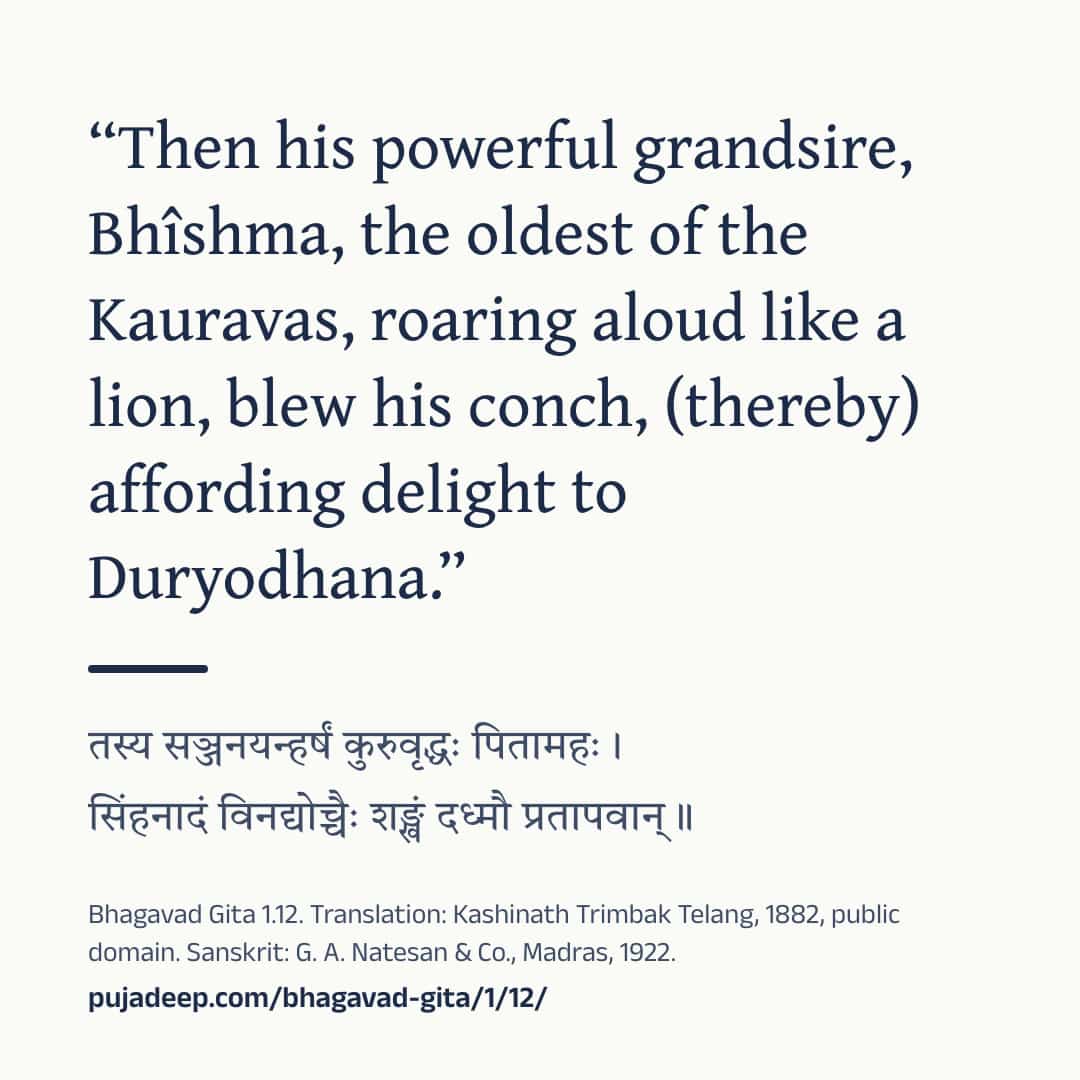
See the words
Bhagavad Gita 1.12

तस्य सञ्जनयन्हर्षं कुरुवृद्धः पितामहः ।
सिंहनादं विनद्योच्चैः शङ्खं दध्मौ प्रतापवान् ॥

“Then his powerful grandsire, Bhîshma, the oldest of the Kauravas, roaring aloud like a lion, blew his conch, (thereby) affording delight to Duryodhana.”
(K. T. Telang, The Bhagavadgîtâ (The Sacred Books of the East, vol. VIII, Oxford: Clarendon Press, 1882), p. 38, public domain)

“To enhearten him, the Ancient of the Kurus, the Grandsire, the glorious, blew his conch, sounding on high a lion's roar.”
(Annie Besant, The Bhagavad Gîtâ, or The Lord's Song (London: Theosophical Publishing Society, 1895), pp. 15–16, public domain)

“That powerful, eldest of the Kurus, Bhishma the grandsire, in order to cheer Duryodhana, now sounded aloud a lion-roar and blew his conch.”
(Swami Swarupananda, Srimad-Bhagavad-Gita (Mayavati: Prabuddha Bharata Press, 1909; first printed in Prabuddha Bharata, 1907–1909), p. 7, public domain)

Sanskrit: G. A. Natesan & Co., Madras, 1922.
https://pujadeep.com/bhagavad-gita/1/12/ Nothing is sent from this site. Your own app sends it, to the chat you choose. The picture quotes the translation you chose on this page, with its name and year.
Sanskrit text: The Bhagavad-Gita, or The Lord's Song, with the text in Devanagari and an English translation, 1922. Meanings: written for Pujadeep and checked against the cited edition. Source and changes
Questions families ask
Who speaks Bhagavad Gita 1.12?
Sanjaya speaks this verse, in chapter 1 (Arjuna Vishada Yoga).
Where does the Sanskrit text come from?
Sanskrit text: The Bhagavad-Gita, or The Lord's Song, with the text in Devanagari and an English translation, 1922. Meanings: written for Pujadeep and checked against the cited edition. See the source
Is the meaning on this page a translation?
Explanation written for this site from the sources listed here, and checked against the cited edition. It is not a translation and not the only way to read the text. Free to quote with credit.
Source and licence
- Sanskrit text
- The Bhagavad-Gita, or The Lord's Song, with the text in Devanagari and an English translation (Annie Besant, G. A. Natesan & Co., Madras, 1922). Public domain. The Sanskrit on these pages was read from this printing’s page images.
- Translation
- The Bhagavadgîtâ with the Sanatsugâtîya and the Anugîtâ, translated by Kâshinâth Trimbak Telang (The Sacred Books of the East, vol. VIII, ed. F. Max Müller) (Kashinath Trimbak Telang, F. Max Müller, Clarendon Press, Oxford, 1882). Public domain. Shown verbatim, as printed.
- Translation
- The Bhagavad Gîtâ, or The Lord's Song, translated by Annie Besant (Annie Besant, Theosophical Publishing Society, London, 1895). Public domain. Shown verbatim, as printed.
- Translation
- Srimad-Bhagavad-Gita, with Sanskrit Text; Paraphrase with Word-by-word Literal Translation; English Rendering and Comments, Index, &c., by the Swami Swarupananda (Himalayan Series, No. XX) (Swami Swarupananda, The Editors and Publishers, Advaita Ashrama, Mayavati, Prabuddha Bharata Press, Mayavati, Almora, Himalayas, 1909). Public domain. Shown verbatim, as printed.
- Common wording
- In this text, 32 words follow today's common wording, checked against sanskritdocuments.org; Sanskrit Wikisource; Gita Press, Gorakhpur; GRETIL, Göttingen and Bhaktivedanta Book Trust.
- Our explanation
- Explanation written for this site from the sources listed here, and checked against the cited edition. It is not a translation and not the only way to read the text. Free to quote with credit.
- Checked
- Checked against the cited edition, October 15, 2026.
- Updated
- October 25, 2026