Bhagavad Gita 1.9: meaning and translation
Chapter 1: Arjuna Vishada Yoga. Duryodhana says
Duryodhana: Many other heroes, he says, are ready to give their lives for his sake.
Click or tap a word for its meaning and its dictionary page.
Text and layers
Text and layers
These choices stay in this browser.
Bhagavad Gita 1.9
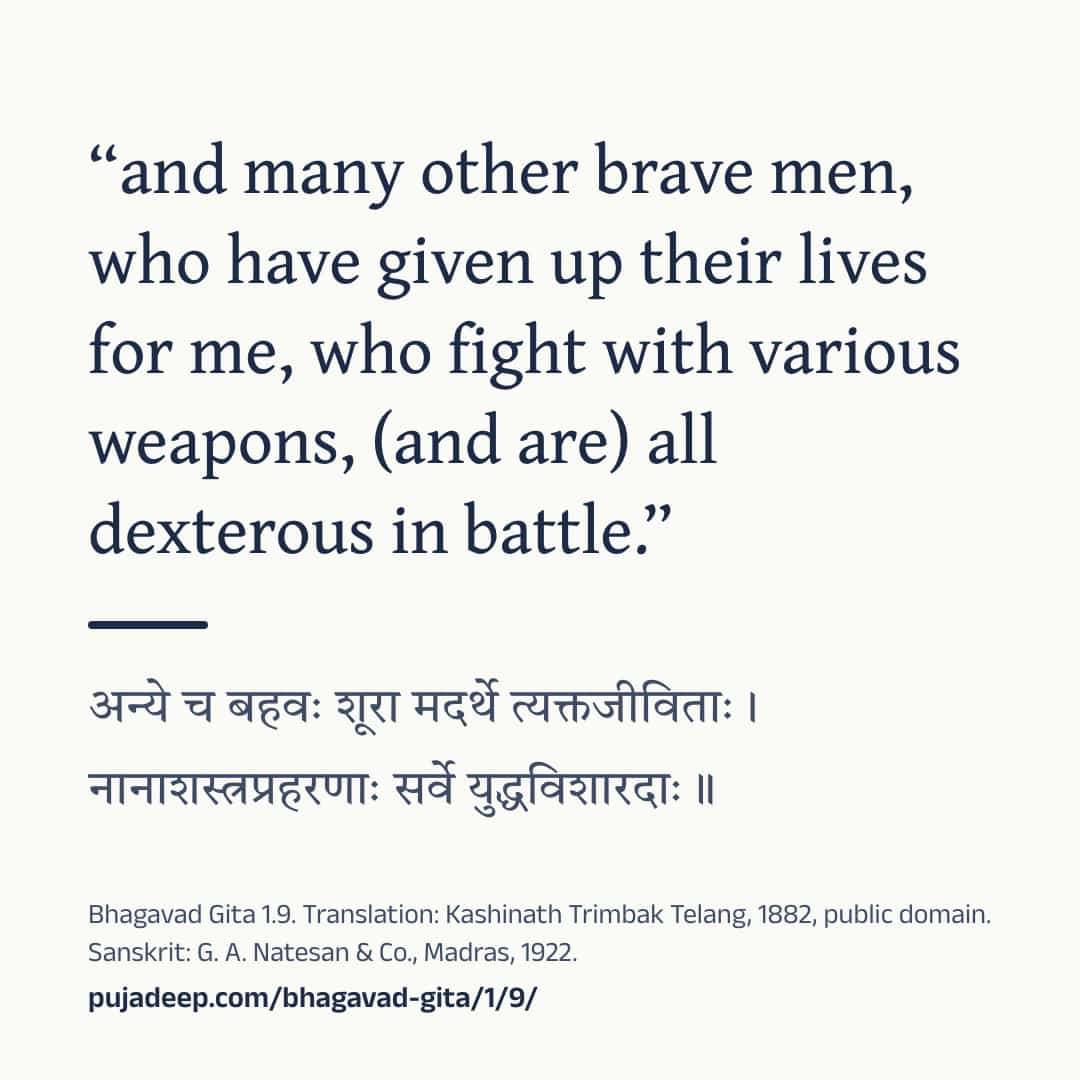
अन्ये च बहवः शूरा मदर्थे त्यक्तजीविताः ।नानाशस्त्रप्रहरणाः सर्वे युद्धविशारदाः ॥
Anye cha bahavah shura madarthe tyaktajivitahNanashastrapraharanah sarve yuddhavisharadah
anye ca bahavaḥ śūrā madarthe tyaktajīvitāḥ |nānāśastrapraharaṇāḥ sarve yuddhaviśāradāḥ ||
Our explanation Many other heroes, he says, are ready to give their lives for his sake. They carry many kinds of weapons, and all are skilled in war.
हिंदी अर्थ वे कहते हैं कि और भी बहुत-से वीर उनके लिए अपने प्राण देने को तैयार हैं। उनके पास तरह-तरह के अस्त्र-शस्त्र हैं, और सब युद्ध में कुशल हैं।
Word by word
Every word, with its dictionary page
Word by word
- अन्ये anye · others (pronoun (masculine), nominative plural) Dictionary: 2. anya, Monier-Williams 1899, p. 45, col. 2 “other, different”
- च ca · and (indeclinable) Dictionary: 2. ca, Monier-Williams 1899, p. 380, col. 1 “ind. and, both, also, moreover, as well as”
- बहवः bahavaḥ · many (adjective (masculine), nominative plural) Dictionary: bahu, Monier-Williams 1899, p. 724, col. 2 “much, many, frequent, abundant, numerous”
- शूराः śūrāḥ · heroes (noun (masculine), nominative plural) Dictionary: śūra, Monier-Williams 1899, p. 1086, col. 1 “strong, powerful, valiant, heroic, brave”
- मदर्थे madarthe · "for my sake" (compound (masculine), locative singular) Dictionary: mad-artha, Monier-Williams 1899, p. 777, col. 2 “for the sake of me”
- त्यक्तजीविताः tyaktajīvitāḥ · ready to give up their lives (compound (masculine), nominative plural) Dictionary: tyakta-jīvita, Monier-Williams 1899, p. 456, col. 3 “one who has given up all expectation of life, ready to abandon life”
- नानाशस्त्रप्रहरणाः nānāśastrapraharaṇāḥ · armed with many weapons (compound (masculine), nominative plural) Dictionary: 1. nānā, Monier-Williams 1899, p. 535, col. 1 “various, different”; 2. śastra, Monier-Williams 1899, p. 1060, col. 3 “an instrument for cutting or wounding, knife, sword, dagger, any weapon”; pra-haraṇa, Monier-Williams 1899, p. 701, col. 1 “a weapon”
- सर्वे sarve · all (pronoun (masculine), nominative plural) Dictionary: sarva, Monier-Williams 1899, p. 1184, col. 3 “whole, entire, all, every”
- युद्धविशारदाः yuddhaviśāradāḥ · skilled in war (compound (masculine), nominative plural) Dictionary: yuddha, Monier-Williams 1899, p. 854, col. 3 “battle, fight, war”; vi-śārada, Monier-Williams 1899, p. 952, col. 3 “skilled or proficient in, conversant with”
Old translations
Kashinath Trimbak Telang, 1882. Public domain. Page 38.
and many other brave men, who have given up their lives for me, who fight with various weapons, (and are) all dexterous in battle.
This sentence begins in 1.8.
Compare 3 translations
Kashinath Trimbak Telang, 1882. Public domain. Page 38.
and many other brave men, who have given up their lives for me, who fight with various weapons, (and are) all dexterous in battle.
This sentence begins in 1.8.
You are reading this one
Annie Besant, 1895. Public domain. Page 15.
And many others, heroes, ready for my sake to give up their lives, trained in divers weapons and missiles and all well-skilled in war.
This sentence begins in 1.7.
You are reading this one
Swami Swarupananda, 1909 (first printed 1907). Public domain. Page 5.
"And many other heroes also, well-skilled in fight, and armed with many kinds of weapons, are here determined to lay down their lives for my sake.
You are reading this one
Cite this verse
The translation: K. T. Telang, The Bhagavadgîtâ (The Sacred Books of the East, vol. VIII, Oxford: Clarendon Press, 1882), p. 38. Bhagavad Gita 1.9.
The translation: Annie Besant, The Bhagavad Gîtâ, or The Lord's Song (London: Theosophical Publishing Society, 1895), p. 15. Bhagavad Gita 1.9.
The translation: Swami Swarupananda, Srimad-Bhagavad-Gita (Mayavati: Prabuddha Bharata Press, 1909; first printed in Prabuddha Bharata, 1907–1909), p. 5. Bhagavad Gita 1.9.
Our explanation: “Bhagavad Gita 1.9: meaning and translation.” Pujadeep. Updated October 25, 2026. https://pujadeep.com/bhagavad-gita/1/9/
Pujadeep’s explanations are free to quote with credit: name Pujadeep and link to the page. How to credit
Classical readings, by school
No readings by school on this verse yet.
Share
Show the ways to share
Send one picture or the text to one chat. The picture names its source and the address of this page.
Drawing the picture
See the words
Bhagavad Gita 1.9

अन्ये च बहवः शूरा मदर्थे त्यक्तजीविताः ।
नानाशस्त्रप्रहरणाः सर्वे युद्धविशारदाः ॥

“and many other brave men, who have given up their lives for me, who fight with various weapons, (and are) all dexterous in battle.”
(K. T. Telang, The Bhagavadgîtâ (The Sacred Books of the East, vol. VIII, Oxford: Clarendon Press, 1882), p. 38, public domain)
This sentence begins in 1.8.

“And many others, heroes, ready for my sake to give up their lives, trained in divers weapons and missiles and all well-skilled in war.”
(Annie Besant, The Bhagavad Gîtâ, or The Lord's Song (London: Theosophical Publishing Society, 1895), p. 15, public domain)
This sentence begins in 1.7.

“"And many other heroes also, well-skilled in fight, and armed with many kinds of weapons, are here determined to lay down their lives for my sake.”
(Swami Swarupananda, Srimad-Bhagavad-Gita (Mayavati: Prabuddha Bharata Press, 1909; first printed in Prabuddha Bharata, 1907–1909), p. 5, public domain)

Sanskrit: G. A. Natesan & Co., Madras, 1922.
https://pujadeep.com/bhagavad-gita/1/9/ Nothing is sent from this site. Your own app sends it, to the chat you choose. The picture quotes the translation you chose on this page, with its name and year.
Sanskrit text: The Bhagavad-Gita, or The Lord's Song, with the text in Devanagari and an English translation, 1922. Meanings: written for Pujadeep and checked against the cited edition. Source and changes
Questions families ask
Who speaks Bhagavad Gita 1.9?
Duryodhana speaks this verse, in chapter 1 (Arjuna Vishada Yoga).
Where does the Sanskrit text come from?
Sanskrit text: The Bhagavad-Gita, or The Lord's Song, with the text in Devanagari and an English translation, 1922. Meanings: written for Pujadeep and checked against the cited edition. See the source
Is the meaning on this page a translation?
Explanation written for this site from the sources listed here, and checked against the cited edition. It is not a translation and not the only way to read the text. Free to quote with credit.
Source and licence
- Sanskrit text
- The Bhagavad-Gita, or The Lord's Song, with the text in Devanagari and an English translation (Annie Besant, G. A. Natesan & Co., Madras, 1922). Public domain. The Sanskrit on these pages was read from this printing’s page images.
- Translation
- The Bhagavadgîtâ with the Sanatsugâtîya and the Anugîtâ, translated by Kâshinâth Trimbak Telang (The Sacred Books of the East, vol. VIII, ed. F. Max Müller) (Kashinath Trimbak Telang, F. Max Müller, Clarendon Press, Oxford, 1882). Public domain. Shown verbatim, as printed.
- Translation
- The Bhagavad Gîtâ, or The Lord's Song, translated by Annie Besant (Annie Besant, Theosophical Publishing Society, London, 1895). Public domain. Shown verbatim, as printed.
- Translation
- Srimad-Bhagavad-Gita, with Sanskrit Text; Paraphrase with Word-by-word Literal Translation; English Rendering and Comments, Index, &c., by the Swami Swarupananda (Himalayan Series, No. XX) (Swami Swarupananda, The Editors and Publishers, Advaita Ashrama, Mayavati, Prabuddha Bharata Press, Mayavati, Almora, Himalayas, 1909). Public domain. Shown verbatim, as printed.
- Common wording
- In this text, 32 words follow today's common wording, checked against sanskritdocuments.org; Sanskrit Wikisource; Gita Press, Gorakhpur; GRETIL, Göttingen and Bhaktivedanta Book Trust.
- Our explanation
- Explanation written for this site from the sources listed here, and checked against the cited edition. It is not a translation and not the only way to read the text. Free to quote with credit.
- Checked
- Checked against the cited edition, October 15, 2026.
- Updated
- October 25, 2026