Bhagavad Gita 1.11: meaning and translation
Chapter 1: Arjuna Vishada Yoga. Duryodhana says
Duryodhana: He tells all his commanders to hold their places at every point of the army and, above all, to protect Bhishma.
Click or tap a word for its meaning and its dictionary page.
Text and layers
Text and layers
These choices stay in this browser.
Bhagavad Gita 1.11
अयनेषु च सर्वेषु यथाभागमवस्थिताः ।भीष्ममेवाभिरक्षन्तु भवन्तः सर्व एव हि ॥
Ayaneshu cha sarveshu yathabhagamavasthitahBhishmamevabhirakshantu bhavantah sarva eva hi
ayaneṣu ca sarveṣu yathābhāgamavasthitāḥ |bhīṣmamevābhirakṣantu bhavantaḥ sarva eva hi ||
Our explanation He tells all his commanders to hold their places at every point of the army and, above all, to protect Bhishma.
हिंदी अर्थ वे अपने सभी सेनापतियों से कहते हैं कि सेना के हर मोर्चे पर अपनी-अपनी जगह डटे रहें और सब मिलकर भीष्म की ही रक्षा करें।
Word by word
Every word, with its dictionary page
Word by word
- अयनेषु ayaneṣu · at the posts, in the lines (noun (neuter), locative plural) Dictionary: ayana, Monier-Williams 1899, p. 84, col. 2 “walking, a road, a path”
- च ca · and (indeclinable) Dictionary: 2. ca, Monier-Williams 1899, p. 380, col. 1 “ind. and, both, also, moreover, as well as”
- सर्वेषु sarveṣu · all (pronoun (neuter), locative plural) Dictionary: sarva, Monier-Williams 1899, p. 1184, col. 3 “whole, entire, all, every”
- यथाभागम् yathābhāgam · each in his own place (indeclinable) Dictionary: yathā-bhāgam, Monier-Williams 1899, p. 842, col. 3 “acc° to shares or portions, each acc° to his share”
- अवस्थिताः avasthitāḥ · posted, standing firm (past participle (masculine), nominative plural) Dictionary: ava-sthita, Monier-Williams 1899, p. 106, col. 1 “placed, having its place or abode”
- भीष्मम् bhīṣmam · Bhishma (noun (masculine), accusative singular) Dictionary: bhīṣma, Monier-Williams 1899, p. 758, col. 3 “N. of a son of Śāṃtanu and Gaṅgā”
- एव eva · above all (indeclinable) Dictionary: 1. eva, Monier-Williams 1899, p. 232, col. 2 “just, exactly, very, same, only, even, alone, merely”
- अभिरक्षन्तु abhirakṣantu · should guard (imperative, 3rd person plural) Dictionary: abhi-rakṣ, Monier-Williams 1899, p. 68, col. 1 “to guard, protect, preserve”
- भवन्तः bhavantaḥ · you (sirs) (pronoun (masculine), nominative plural) Dictionary: bhavat, Monier-Williams 1899, p. 749, col. 2 “your honour, your worship, your lordship or ladyship, you”
- सर्वे sarve · all (pronoun (masculine), nominative plural) Dictionary: sarva, Monier-Williams 1899, p. 1184, col. 3 “whole, entire, all, every”
- एव eva · indeed (indeclinable) Dictionary: 1. eva, Monier-Williams 1899, p. 232, col. 2 “just, exactly, very, same, only, even, alone, merely”
- हि hi · surely (indeclinable) Dictionary: 2. hi, Monier-Williams 1899, p. 1297, col. 3 “for, because, on account of”
Old translations
Kashinath Trimbak Telang, 1882. Public domain. Page 38.
And therefore do ye all, occupying respectively the positions1 assigned to you, protect Bhîshma2 only.'
Footnotes (the translator’s own) Compare 3 translations
Kashinath Trimbak Telang, 1882. Public domain. Page 38.
And therefore do ye all, occupying respectively the positions1 assigned to you, protect Bhîshma2 only.'
Footnotes (the translator’s own) You are reading this one
Annie Besant, 1895. Public domain. Page 15.
Therefore in the rank and file let all stand firmly in their respective divisions, supporting Bhîshma, even all ye Generals."
This sentence begins in 1.10.
You are reading this one
Swami Swarupananda, 1909 (first printed 1907). Public domain. Page 6.
"(Now) Do, being stationed in your proper places in the divisions of the army, support Bhishma alone."
You are reading this one
Cite this verse
The translation: K. T. Telang, The Bhagavadgîtâ (The Sacred Books of the East, vol. VIII, Oxford: Clarendon Press, 1882), p. 38. Bhagavad Gita 1.11.
The translation: Annie Besant, The Bhagavad Gîtâ, or The Lord's Song (London: Theosophical Publishing Society, 1895), p. 15. Bhagavad Gita 1.11.
The translation: Swami Swarupananda, Srimad-Bhagavad-Gita (Mayavati: Prabuddha Bharata Press, 1909; first printed in Prabuddha Bharata, 1907–1909), p. 6. Bhagavad Gita 1.11.
Our explanation: “Bhagavad Gita 1.11: meaning and translation.” Pujadeep. Updated October 25, 2026. https://pujadeep.com/bhagavad-gita/1/11/
Pujadeep’s explanations are free to quote with credit: name Pujadeep and link to the page. How to credit
Classical readings, by school
No readings by school on this verse yet.
Share
Show the ways to share
Send one picture or the text to one chat. The picture names its source and the address of this page.
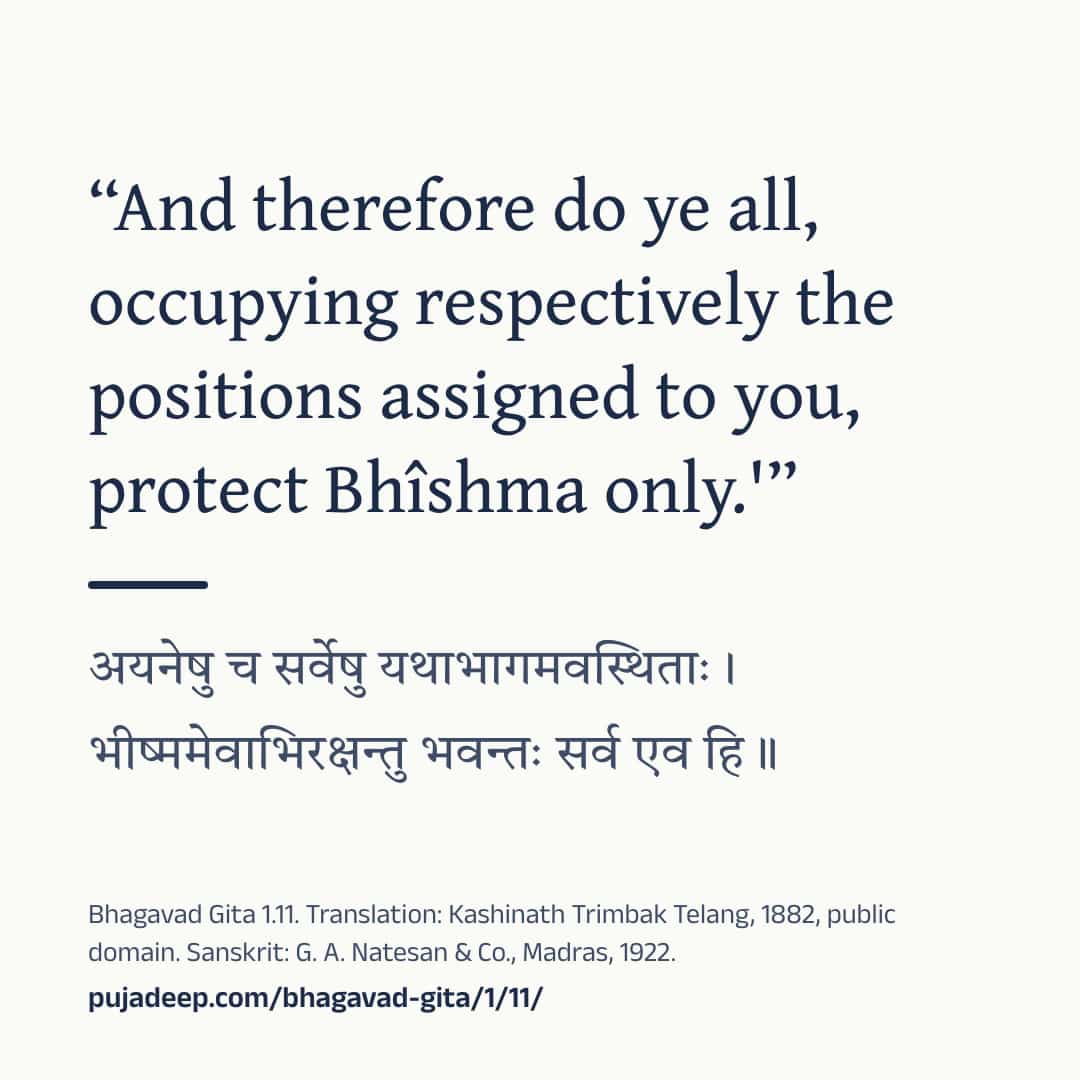
Drawing the picture
See the words
Bhagavad Gita 1.11

अयनेषु च सर्वेषु यथाभागमवस्थिताः ।
भीष्ममेवाभिरक्षन्तु भवन्तः सर्व एव हि ॥

“And therefore do ye all, occupying respectively the positions assigned to you, protect Bhîshma only.'”
(K. T. Telang, The Bhagavadgîtâ (The Sacred Books of the East, vol. VIII, Oxford: Clarendon Press, 1882), p. 38, public domain)

“Therefore in the rank and file let all stand firmly in their respective divisions, supporting Bhîshma, even all ye Generals."”
(Annie Besant, The Bhagavad Gîtâ, or The Lord's Song (London: Theosophical Publishing Society, 1895), p. 15, public domain)
This sentence begins in 1.10.

“"(Now) Do, being stationed in your proper places in the divisions of the army, support Bhishma alone."”
(Swami Swarupananda, Srimad-Bhagavad-Gita (Mayavati: Prabuddha Bharata Press, 1909; first printed in Prabuddha Bharata, 1907–1909), p. 6, public domain)

Sanskrit: G. A. Natesan & Co., Madras, 1922.
https://pujadeep.com/bhagavad-gita/1/11/ Nothing is sent from this site. Your own app sends it, to the chat you choose. The picture quotes the translation you chose on this page, with its name and year.
Sanskrit text: The Bhagavad-Gita, or The Lord's Song, with the text in Devanagari and an English translation, 1922. Meanings: written for Pujadeep and checked against the cited edition. Source and changes
Questions families ask
Who speaks Bhagavad Gita 1.11?
Duryodhana speaks this verse, in chapter 1 (Arjuna Vishada Yoga).
Where does the Sanskrit text come from?
Sanskrit text: The Bhagavad-Gita, or The Lord's Song, with the text in Devanagari and an English translation, 1922. Meanings: written for Pujadeep and checked against the cited edition. See the source
Is the meaning on this page a translation?
Explanation written for this site from the sources listed here, and checked against the cited edition. It is not a translation and not the only way to read the text. Free to quote with credit.
Source and licence
- Sanskrit text
- The Bhagavad-Gita, or The Lord's Song, with the text in Devanagari and an English translation (Annie Besant, G. A. Natesan & Co., Madras, 1922). Public domain. The Sanskrit on these pages was read from this printing’s page images.
- Translation
- The Bhagavadgîtâ with the Sanatsugâtîya and the Anugîtâ, translated by Kâshinâth Trimbak Telang (The Sacred Books of the East, vol. VIII, ed. F. Max Müller) (Kashinath Trimbak Telang, F. Max Müller, Clarendon Press, Oxford, 1882). Public domain. Shown verbatim, as printed.
- Translation
- The Bhagavad Gîtâ, or The Lord's Song, translated by Annie Besant (Annie Besant, Theosophical Publishing Society, London, 1895). Public domain. Shown verbatim, as printed.
- Translation
- Srimad-Bhagavad-Gita, with Sanskrit Text; Paraphrase with Word-by-word Literal Translation; English Rendering and Comments, Index, &c., by the Swami Swarupananda (Himalayan Series, No. XX) (Swami Swarupananda, The Editors and Publishers, Advaita Ashrama, Mayavati, Prabuddha Bharata Press, Mayavati, Almora, Himalayas, 1909). Public domain. Shown verbatim, as printed.
- Common wording
- In this text, 32 words follow today's common wording, checked against sanskritdocuments.org; Sanskrit Wikisource; Gita Press, Gorakhpur; GRETIL, Göttingen and Bhaktivedanta Book Trust.
- Our explanation
- Explanation written for this site from the sources listed here, and checked against the cited edition. It is not a translation and not the only way to read the text. Free to quote with credit.
- Checked
- Checked against the cited edition, October 15, 2026.
- Updated
- October 25, 2026