Bhagavad Gita 1.30: meaning and translation
Chapter 1: Arjuna Vishada Yoga. Arjuna says
Arjuna: His bow, Gandiva, slips from his hand, and his skin burns.
Click or tap a word for its meaning and its dictionary page.
Text and layers
Text and layers
These choices stay in this browser.
Bhagavad Gita 1.30
गाण्डीवं स्रंसते हस्तात्त्वक्चैव परिदह्यते ।न च शक्नोम्यवस्थातुं भ्रमतीव च मे मनः ॥
Gandivam sransate hastattvakchaiva paridahyateNa cha shaknomyavasthatum bhramativa cha me manah
gāṇḍīvaṃ sraṃsate hastāttvakcaiva paridahyate |na ca śaknomyavasthātuṃ bhramatīva ca me manaḥ ||
Our explanation His bow, Gandiva, slips from his hand, and his skin burns. He cannot stand steady, and his mind seems to spin.
हिंदी अर्थ उनका गाण्डीव धनुष हाथ से फिसल रहा है और त्वचा जल रही है। वे स्थिर खड़े नहीं रह पा रहे, और उनका मन जैसे चक्कर खा रहा है।
Word by word
Every word, with its dictionary page
Word by word
- गाण्डीवम् gāṇḍīvam · Gandiva (Arjuna's bow) (noun (neuter), nominative singular) Dictionary: gāṇḍīva, Monier-Williams 1899, p. 353, col. 2 “Arjuna's bow”
- स्रंसते sraṃsate · slips (present, 3rd person singular) Dictionary: 1. sraṃs, Monier-Williams 1899, p. 1273, col. 3 “to fall, drop, fall down, slip off”
- हस्तात् hastāt · from the hand (noun (masculine), ablative singular) Dictionary: hasta, Monier-Williams 1899, p. 1294, col. 3 “the hand”
- त्वक् tvak · skin (noun (feminine), nominative singular) Dictionary: 2. tvac, Monier-Williams 1899, p. 463, col. 3 “skin (of men, serpents &c.), hide (of goats, cows &c.)”
- च ca · and (indeclinable) Dictionary: 2. ca, Monier-Williams 1899, p. 380, col. 1 “ind. and, both, also, moreover, as well as”
- एव eva · also (indeclinable) Dictionary: 1. eva, Monier-Williams 1899, p. 232, col. 2 “just, exactly, very, same, only, even, alone, merely”
- परिदह्यते paridahyate · burns all over (present passive, 3rd person singular) Dictionary: pari-dah, Monier-Williams 1899, p. 595, col. 3 “to burn round or through or entirely”
- न na · not (indeclinable) Dictionary: 2. na, Monier-Williams 1899, p. 523, col. 1 “ind. not, no, nor, neither”
- च ca · and (indeclinable) Dictionary: 2. ca, Monier-Williams 1899, p. 380, col. 1 “ind. and, both, also, moreover, as well as”
- शक्नोमि śaknomi · "I am able" (present, 1st person singular) Dictionary: śak, Monier-Williams 1899, p. 1044, col. 2 “to be strong or powerful, be able to or capable of or competent for”
- अवस्थातुम् avasthātum · to stand (infinitive (to do)) Dictionary: ava-sthā, Monier-Williams 1899, p. 105, col. 3 “to take one's stand, remain standing”
- भ्रमति bhramati · whirls (present, 3rd person singular) Dictionary: bhram, Monier-Williams 1899, p. 769, col. 2 “to move to and fro or unsteadily, flicker”
- इव iva · as if (indeclinable) Dictionary: iva, Monier-Williams 1899, p. 168, col. 3 “like, in the same manner as”
- च ca · and (indeclinable) Dictionary: 2. ca, Monier-Williams 1899, p. 380, col. 1 “ind. and, both, also, moreover, as well as”
- मे me · "my" (pronoun, genitive singular) Dictionary: 1. mad, Monier-Williams 1899, p. 777, col. 2 “base of the first pers. pron. in the sg. number (esp. in comp.)”
- मनः manaḥ · mind (noun (neuter), nominative singular) Dictionary: manas, Monier-Williams 1899, p. 783, col. 3 “mind (in its widest sense as applied to all the mental powers)”
Old translations
Kashinath Trimbak Telang, 1882. Public domain. Page 40.
the Gândîva (bow) slips from my hand; my skin burns intensely. I am unable, too, to stand up; my mind whirls round, as it were;
This sentence begins in 1.26. This sentence goes on in 1.31.
Compare 3 translations
Kashinath Trimbak Telang, 1882. Public domain. Page 40.
the Gândîva (bow) slips from my hand; my skin burns intensely. I am unable, too, to stand up; my mind whirls round, as it were;
This sentence begins in 1.26. This sentence goes on in 1.31.
You are reading this one
Annie Besant, 1895. Public domain. Page 19.
Gândîva slips from my hand, and my skin burns all over, I am not able to stand, and my mind is whirling,
This sentence begins in 1.26. This sentence goes on in 1.31.
You are reading this one
Swami Swarupananda, 1909 (first printed 1907). Public domain. Page 58.
The bow Gàndiva slips from my hand, and my skin burns. Neither, Oh Keshava, can I stand upright. My mind is in a whirl.
You are reading this one
Cite this verse
The translation: K. T. Telang, The Bhagavadgîtâ (The Sacred Books of the East, vol. VIII, Oxford: Clarendon Press, 1882), p. 40. Bhagavad Gita 1.30.
The translation: Annie Besant, The Bhagavad Gîtâ, or The Lord's Song (London: Theosophical Publishing Society, 1895), p. 19. Bhagavad Gita 1.30.
The translation: Swami Swarupananda, Srimad-Bhagavad-Gita (Mayavati: Prabuddha Bharata Press, 1909; first printed in Prabuddha Bharata, 1907–1909), p. 58. Bhagavad Gita 1.30.
Our explanation: “Bhagavad Gita 1.30: meaning and translation.” Pujadeep. Updated October 25, 2026. https://pujadeep.com/bhagavad-gita/1/30/
Pujadeep’s explanations are free to quote with credit: name Pujadeep and link to the page. How to credit
Classical readings, by school
No readings by school on this verse yet.
Share
Show the ways to share
Send one picture or the text to one chat. The picture names its source and the address of this page.
Drawing the picture
See the words
Bhagavad Gita 1.30

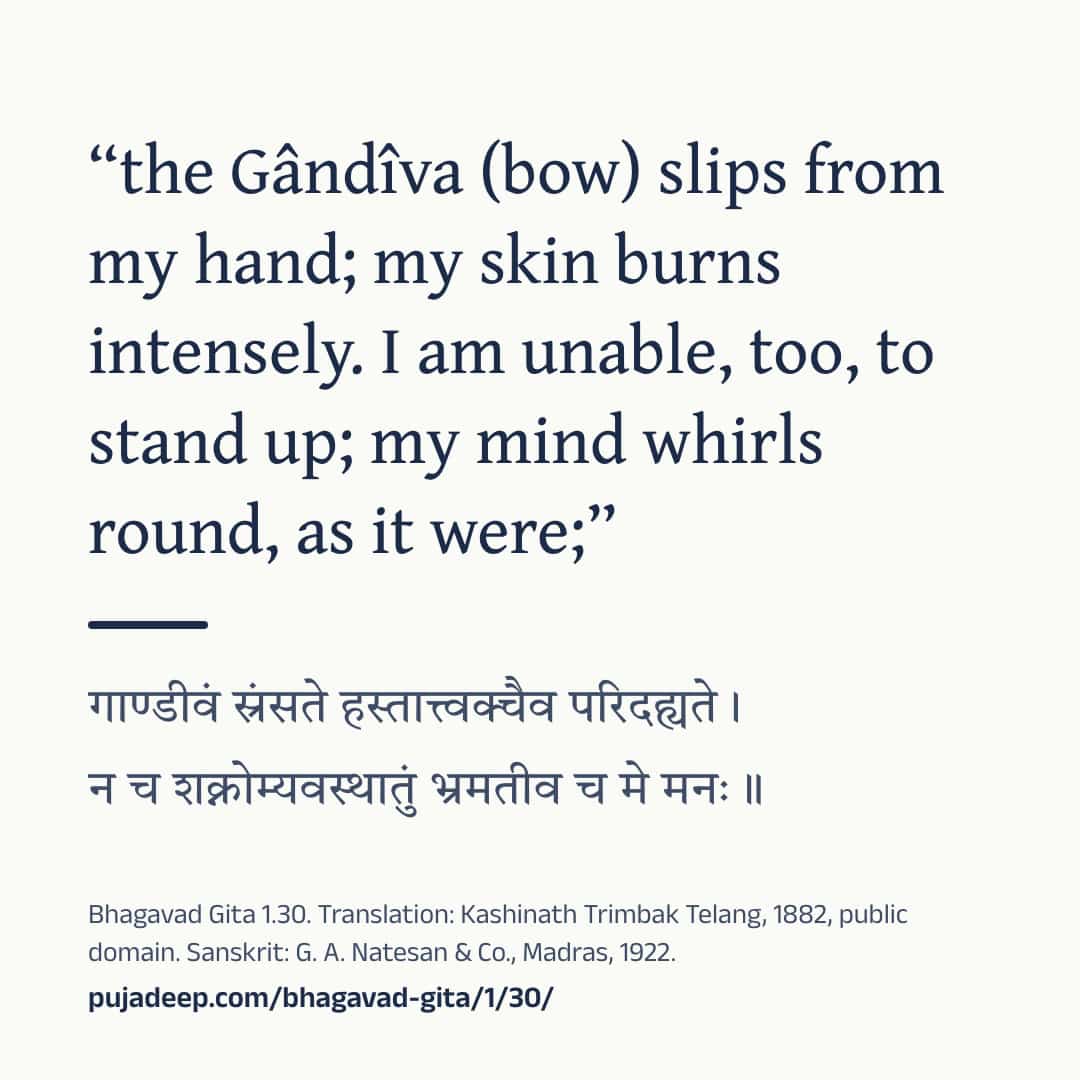
गाण्डीवं स्रंसते हस्तात्त्वक्चैव परिदह्यते ।
न च शक्नोम्यवस्थातुं भ्रमतीव च मे मनः ॥

“the Gândîva (bow) slips from my hand; my skin burns intensely. I am unable, too, to stand up; my mind whirls round, as it were;”
(K. T. Telang, The Bhagavadgîtâ (The Sacred Books of the East, vol. VIII, Oxford: Clarendon Press, 1882), p. 40, public domain)
This sentence begins in 1.26. This sentence goes on in 1.31.

“Gândîva slips from my hand, and my skin burns all over, I am not able to stand, and my mind is whirling,”
(Annie Besant, The Bhagavad Gîtâ, or The Lord's Song (London: Theosophical Publishing Society, 1895), p. 19, public domain)
This sentence begins in 1.26. This sentence goes on in 1.31.

“The bow Gàndiva slips from my hand, and my skin burns. Neither, Oh Keshava, can I stand upright. My mind is in a whirl.”
(Swami Swarupananda, Srimad-Bhagavad-Gita (Mayavati: Prabuddha Bharata Press, 1909; first printed in Prabuddha Bharata, 1907–1909), p. 58, public domain)

Sanskrit: G. A. Natesan & Co., Madras, 1922.
https://pujadeep.com/bhagavad-gita/1/30/ Nothing is sent from this site. Your own app sends it, to the chat you choose. The picture quotes the translation you chose on this page, with its name and year.
Sanskrit text: The Bhagavad-Gita, or The Lord's Song, with the text in Devanagari and an English translation, 1922. Meanings: written for Pujadeep and checked against the cited edition. Source and changes
Questions families ask
Who speaks Bhagavad Gita 1.30?
Arjuna speaks this verse, in chapter 1 (Arjuna Vishada Yoga).
Where does the Sanskrit text come from?
Sanskrit text: The Bhagavad-Gita, or The Lord's Song, with the text in Devanagari and an English translation, 1922. Meanings: written for Pujadeep and checked against the cited edition. See the source
Is the meaning on this page a translation?
Explanation written for this site from the sources listed here, and checked against the cited edition. It is not a translation and not the only way to read the text. Free to quote with credit.
Source and licence
- Sanskrit text
- The Bhagavad-Gita, or The Lord's Song, with the text in Devanagari and an English translation (Annie Besant, G. A. Natesan & Co., Madras, 1922). Public domain. The Sanskrit on these pages was read from this printing’s page images.
- Translation
- The Bhagavadgîtâ with the Sanatsugâtîya and the Anugîtâ, translated by Kâshinâth Trimbak Telang (The Sacred Books of the East, vol. VIII, ed. F. Max Müller) (Kashinath Trimbak Telang, F. Max Müller, Clarendon Press, Oxford, 1882). Public domain. Shown verbatim, as printed.
- Translation
- The Bhagavad Gîtâ, or The Lord's Song, translated by Annie Besant (Annie Besant, Theosophical Publishing Society, London, 1895). Public domain. Shown verbatim, as printed.
- Translation
- Srimad-Bhagavad-Gita, with Sanskrit Text; Paraphrase with Word-by-word Literal Translation; English Rendering and Comments, Index, &c., by the Swami Swarupananda (Himalayan Series, No. XX) (Swami Swarupananda, The Editors and Publishers, Advaita Ashrama, Mayavati, Prabuddha Bharata Press, Mayavati, Almora, Himalayas, 1909). Public domain. Shown verbatim, as printed.
- Common wording
- In this text, 32 words follow today's common wording, checked against sanskritdocuments.org; Sanskrit Wikisource; Gita Press, Gorakhpur; GRETIL, Göttingen and Bhaktivedanta Book Trust.
- Our explanation
- Explanation written for this site from the sources listed here, and checked against the cited edition. It is not a translation and not the only way to read the text. Free to quote with credit.
- Checked
- Checked against the cited edition, October 15, 2026.
- Updated
- October 25, 2026