Bhagavad Gita 1.41: meaning and translation
Chapter 1: Arjuna Vishada Yoga. Arjuna says
Arjuna: He goes on: when adharma prevails, the women of the family are led astray, and then the varṇas become mixed (varṇa-saṅkara).
Click or tap a word for its meaning and its dictionary page.
Text and layers
Text and layers
These choices stay in this browser.
Bhagavad Gita 1.41
अधर्माभिभवात्कृष्ण प्रदुष्यन्ति कुलस्त्रियः ।स्त्रीषु दुष्टासु वार्ष्णेय जायते वर्णसङ्करः ॥
Adharmabhibhavatkrishna pradushyanti kulastriyahStrishu dushtasu varshneya jayate varnasankarah
adharmābhibhavātkṛṣṇa praduṣyanti kulastriyaḥ |strīṣu duṣṭāsu vārṣṇeya jāyate varṇasaṅkaraḥ ||
Our explanation He goes on: when adharma prevails, the women of the family are led astray, and then the varṇas become mixed (varṇa-saṅkara). He calls Krishna Varshneya (of the Vrishni clan). These are Arjuna's own worries, spoken in grief; Krishna answers him from chapter 2 on.
हिंदी अर्थ वे आगे कहते हैं कि अधर्म बढ़ने पर कुल की स्त्रियाँ भटक जाती हैं, और तब वर्णों का मेल (वर्णसंकर) होता है। वे कृष्ण को वार्ष्णेय (वृष्णि वंश वाले) कहते हैं। ये शोक में डूबे अर्जुन की अपनी चिंताएँ हैं; कृष्ण अध्याय 2 से इनका उत्तर देते हैं।
Word by word
Every word, with its dictionary page
Word by word
- अधर्माभिभवात् adharmābhibhavāt · when adharma prevails (compound (masculine), ablative singular) Dictionary: a-dharma, Monier-Williams 1899, p. 20, col. 1 “unrighteousness, injustice, irreligion, wickedness”; abhi-bhava, Monier-Williams 1899, p. 67, col. 1 “prevailing, overpowering, predominance”
- कृष्ण kṛṣṇa · O Krishna (noun (masculine), vocative singular) Dictionary: kṛṣṇa, Monier-Williams 1899, p. 306, col. 2 “N. of a celebrated Avatār of the god Vishṇu, or sometimes identified with Vishṇu himself”
- प्रदुष्यन्ति praduṣyanti · go astray (present, 3rd person plural) Dictionary: pra-duṣ, Monier-Williams 1899, p. 680, col. 1 “to be defiled or polluted, fall (morally)”
- कुलस्त्रियः kulastriyaḥ · women of the family (compound (feminine), nominative plural) Dictionary: kula-strī, Monier-Williams 1899, p. 295, col. 2 “a woman of good family, respectable or virtuous woman”
- स्त्रीषु strīṣu · women (noun (feminine), locative plural) Dictionary: strī, Monier-Williams 1899, p. 1260, col. 3 “a woman, female, wife”
- दुष्टासु duṣṭāsu · led astray (past participle (feminine), locative plural) Dictionary: duṣṭa, Monier-Williams 1899, p. 488, col. 3 “spoilt, corrupted”
- वार्ष्णेय vārṣṇeya · O Varshneya (Krishna) (noun (masculine), vocative singular) Dictionary: vārṣṇeya, Monier-Williams 1899, p. 946, col. 1 “of Kṛishṇa”
- जायते jāyate · arises (present, 3rd person singular) Dictionary: jan, Monier-Williams 1899, p. 410, col. 1 “to be born or produced, come into existence”
- वर्णसङ्करः varṇasaṅkaraḥ · mixing of varṇas (compound (masculine), nominative singular) Dictionary: varṇa-saṃkara, Monier-Williams 1899, p. 925, col. 1 “mixture or confusion of castes through intermarriage”
Old translations
Kashinath Trimbak Telang, 1882. Public domain. Page 41.
In consequence of the predominance of impiety, O Krishna! the women of the family become corrupt1; and the women becoming corrupt, O descendant of Vrishni! intermingling of castes results;
This sentence goes on in 1.42.
Footnotes (the translator’s own) - I. e. either by the mere fact of relationship to such men, or by following their bad example. ↩
Compare 3 translations
Kashinath Trimbak Telang, 1882. Public domain. Page 41.
In consequence of the predominance of impiety, O Krishna! the women of the family become corrupt1; and the women becoming corrupt, O descendant of Vrishni! intermingling of castes results;
This sentence goes on in 1.42.
Footnotes (the translator’s own) - I. e. either by the mere fact of relationship to such men, or by following their bad example. ↩
You are reading this one
Annie Besant, 1895. Public domain. Page 22.
Owing to predominance of lawlessness, O Krishna, the women of the family become corrupt; women corrupted, O Vârshneya,1 there ariseth caste-confusion;
This sentence begins in 1.40. This sentence goes on in 1.42.
Footnotes (the translator’s own) - Belonging to the family of Vrishni. ↩
You are reading this one
Swami Swarupananda, 1909 (first printed 1907). Public domain. Page 59.
On the prevalence of impiety, O Krishna, the women of the family become corrupt; and women being corrupted, there arises, O Vàrshneya, intermingling of castes.
You are reading this one
Cite this verse
The translation: K. T. Telang, The Bhagavadgîtâ (The Sacred Books of the East, vol. VIII, Oxford: Clarendon Press, 1882), p. 41. Bhagavad Gita 1.41.
The translation: Annie Besant, The Bhagavad Gîtâ, or The Lord's Song (London: Theosophical Publishing Society, 1895), p. 22. Bhagavad Gita 1.41.
The translation: Swami Swarupananda, Srimad-Bhagavad-Gita (Mayavati: Prabuddha Bharata Press, 1909; first printed in Prabuddha Bharata, 1907–1909), p. 59. Bhagavad Gita 1.41.
Our explanation: “Bhagavad Gita 1.41: meaning and translation.” Pujadeep. Updated October 25, 2026. https://pujadeep.com/bhagavad-gita/1/41/
Pujadeep’s explanations are free to quote with credit: name Pujadeep and link to the page. How to credit
Classical readings, by school
No readings by school on this verse yet.
Share
Show the ways to share
Send one picture or the text to one chat. The picture names its source and the address of this page.
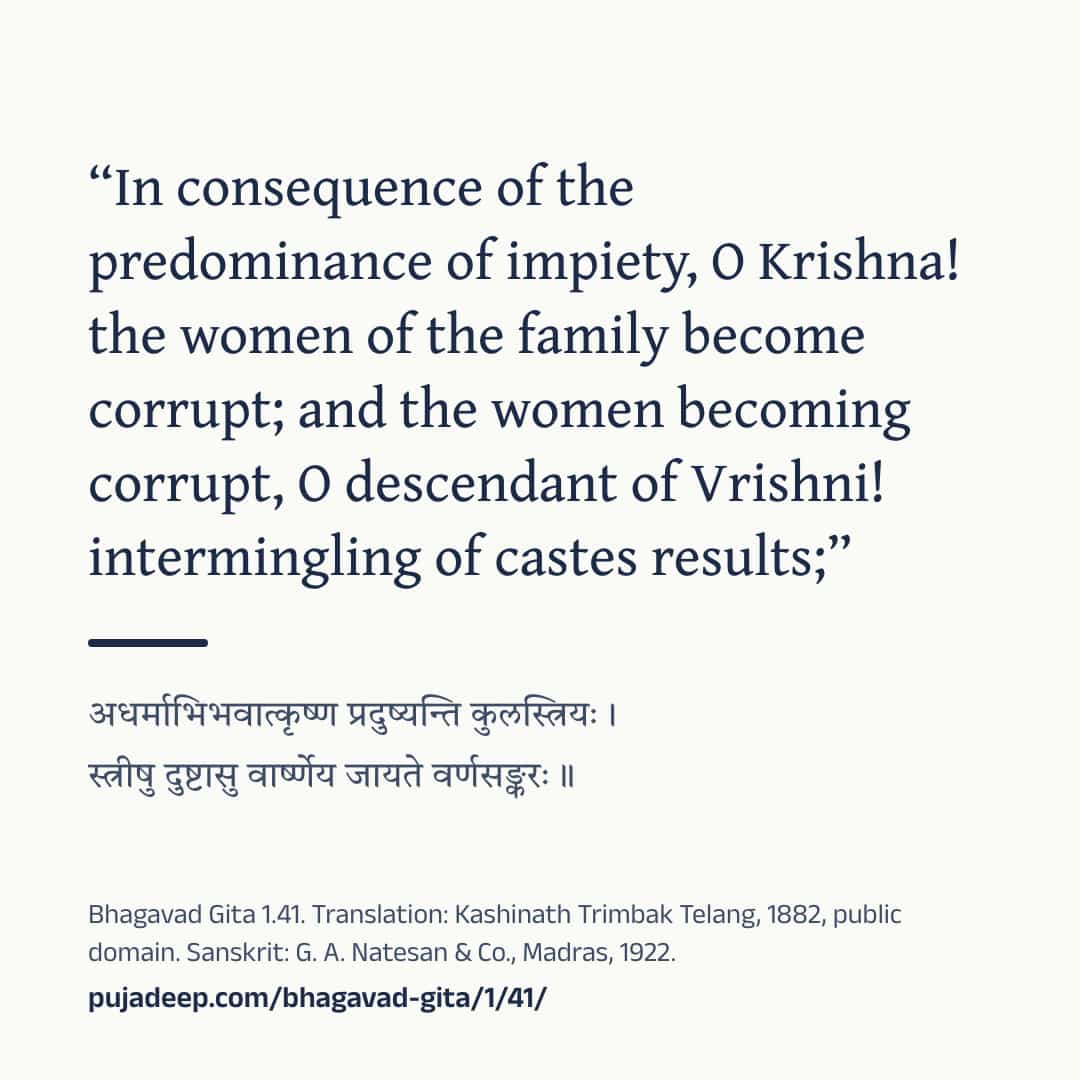
Drawing the picture
See the words
Bhagavad Gita 1.41

अधर्माभिभवात्कृष्ण प्रदुष्यन्ति कुलस्त्रियः ।
स्त्रीषु दुष्टासु वार्ष्णेय जायते वर्णसङ्करः ॥

“In consequence of the predominance of impiety, O Krishna! the women of the family become corrupt; and the women becoming corrupt, O descendant of Vrishni! intermingling of castes results;”
(K. T. Telang, The Bhagavadgîtâ (The Sacred Books of the East, vol. VIII, Oxford: Clarendon Press, 1882), p. 41, public domain)
This sentence goes on in 1.42.

“Owing to predominance of lawlessness, O Krishna, the women of the family become corrupt; women corrupted, O Vârshneya, there ariseth caste-confusion;”
(Annie Besant, The Bhagavad Gîtâ, or The Lord's Song (London: Theosophical Publishing Society, 1895), p. 22, public domain)
This sentence begins in 1.40. This sentence goes on in 1.42.

“On the prevalence of impiety, O Krishna, the women of the family become corrupt; and women being corrupted, there arises, O Vàrshneya, intermingling of castes.”
(Swami Swarupananda, Srimad-Bhagavad-Gita (Mayavati: Prabuddha Bharata Press, 1909; first printed in Prabuddha Bharata, 1907–1909), p. 59, public domain)

Sanskrit: G. A. Natesan & Co., Madras, 1922.
https://pujadeep.com/bhagavad-gita/1/41/ Nothing is sent from this site. Your own app sends it, to the chat you choose. The picture quotes the translation you chose on this page, with its name and year.
Sanskrit text: The Bhagavad-Gita, or The Lord's Song, with the text in Devanagari and an English translation, 1922. Meanings: written for Pujadeep and checked against the cited edition. Source and changes
Questions families ask
Who speaks Bhagavad Gita 1.41?
Arjuna speaks this verse, in chapter 1 (Arjuna Vishada Yoga).
Where does the Sanskrit text come from?
Sanskrit text: The Bhagavad-Gita, or The Lord's Song, with the text in Devanagari and an English translation, 1922. Meanings: written for Pujadeep and checked against the cited edition. See the source
Is the meaning on this page a translation?
Explanation written for this site from the sources listed here, and checked against the cited edition. It is not a translation and not the only way to read the text. Free to quote with credit.
Source and licence
- Sanskrit text
- The Bhagavad-Gita, or The Lord's Song, with the text in Devanagari and an English translation (Annie Besant, G. A. Natesan & Co., Madras, 1922). Public domain. The Sanskrit on these pages was read from this printing’s page images.
- Translation
- The Bhagavadgîtâ with the Sanatsugâtîya and the Anugîtâ, translated by Kâshinâth Trimbak Telang (The Sacred Books of the East, vol. VIII, ed. F. Max Müller) (Kashinath Trimbak Telang, F. Max Müller, Clarendon Press, Oxford, 1882). Public domain. Shown verbatim, as printed.
- Translation
- The Bhagavad Gîtâ, or The Lord's Song, translated by Annie Besant (Annie Besant, Theosophical Publishing Society, London, 1895). Public domain. Shown verbatim, as printed.
- Translation
- Srimad-Bhagavad-Gita, with Sanskrit Text; Paraphrase with Word-by-word Literal Translation; English Rendering and Comments, Index, &c., by the Swami Swarupananda (Himalayan Series, No. XX) (Swami Swarupananda, The Editors and Publishers, Advaita Ashrama, Mayavati, Prabuddha Bharata Press, Mayavati, Almora, Himalayas, 1909). Public domain. Shown verbatim, as printed.
- Common wording
- In this text, 32 words follow today's common wording, checked against sanskritdocuments.org; Sanskrit Wikisource; Gita Press, Gorakhpur; GRETIL, Göttingen and Bhaktivedanta Book Trust.
- Our explanation
- Explanation written for this site from the sources listed here, and checked against the cited edition. It is not a translation and not the only way to read the text. Free to quote with credit.
- Checked
- Checked against the cited edition, October 15, 2026.
- Updated
- October 25, 2026