Bhagavad Gita 1.36: meaning and translation
Chapter 1: Arjuna Vishada Yoga. Arjuna says
Arjuna: He asks Krishna (Janardana) what joy could come from killing the sons of Dhritarashtra.
Click or tap a word for its meaning and its dictionary page.
Text and layers
Text and layers
These choices stay in this browser.
Bhagavad Gita 1.36
निहत्य धार्तराष्ट्रान्नः का प्रीतिः स्याज्जनार्दन ।पापमेवाश्रयेदस्मान्हत्वैतानाततायिनः ॥
Nihatya dhartarashtrannah ka pritih syajjanardanaPapamevashrayedasmanhatvaitanatatayinah
nihatya dhārtarāṣṭrānnaḥ kā prītiḥ syājjanārdana |pāpamevāśrayedasmānhatvaitānātatāyinaḥ ||
Our explanation He asks Krishna (Janardana) what joy could come from killing the sons of Dhritarashtra. They are aggressors (ātatāyin), he says, yet killing them would bring only sin. Telang's footnote lists the six kinds of aggressor: one who sets fire, one who poisons, one who attacks with a weapon in hand, one who destroys property, and one who takes away another's wife or fields.
हिंदी अर्थ वे जनार्दन (कृष्ण) से पूछते हैं कि धृतराष्ट्र के पुत्रों को मारकर उन्हें क्या प्रसन्नता मिलेगी। वे कहते हैं कि ये आततायी (अत्याचारी) हैं, फिर भी इन्हें मारकर उन्हें पाप ही लगेगा। तेलंग की टिप्पणी आततायी के छह प्रकार बताती है: आग लगाने वाला, विष देने वाला, हाथ में शस्त्र लेकर हमला करने वाला, संपत्ति नष्ट करने वाला, और दूसरे की पत्नी या खेत छीनने वाला।
Word by word
Every word, with its dictionary page
Word by word
- निहत्य nihatya · having killed (absolutive (having done)) Dictionary: ni-han, Monier-Williams 1899, p. 564, col. 2 “kill, overwhelm, destroy”
- धार्तराष्ट्रान् dhārtarāṣṭrān · the sons of Dhritarashtra (noun (masculine), accusative plural) Dictionary: dhārta-rāṣṭra, Monier-Williams 1899, p. 516, col. 1 “a son of Dhṛ°, a Kuru”
- नः naḥ · to us (pronoun, dative plural) Dictionary: 1. nas, Monier-Williams 1899, p. 532, col. 2 “us, of us, to us”
- का kā · what (pronoun (feminine), nominative singular) Dictionary: kim, Monier-Williams 1899, p. 282, col. 2 “what? how? whence? wherefore? why?”
- प्रीतिः prītiḥ · joy (noun (feminine), nominative singular) Dictionary: prīti, Monier-Williams 1899, p. 711, col. 1 “any pleasurable sensation, pleasure, joy, gladness, satisfaction”
- स्यात् syāt · would be (optative, 3rd person singular) Dictionary: 1. as, Monier-Williams 1899, p. 117, col. 2 “to be, live, exist, be present”
- जनार्दन janārdana · O Janardana (Krishna) (noun (masculine), vocative singular) Dictionary: janārdana, Monier-Williams 1899, p. 410, col. 3 “‘exciting or agitating men,’ Vishṇu or Kṛishṇa”
- पापम् pāpam · sin (noun (neuter), nominative singular) Dictionary: pāpa, Monier-Williams 1899, p. 618, col. 2 “sin, vice, crime, guilt”
- एव eva · only (indeclinable) Dictionary: 1. eva, Monier-Williams 1899, p. 232, col. 2 “just, exactly, very, same, only, even, alone, merely”
- आश्रयेत् āśrayet · would cling to (optative, 3rd person singular) Dictionary: 1. ā-śri, Monier-Williams 1899, p. 158, col. 2 “to adhere, rest on”
- अस्मान् asmān · us (pronoun, accusative plural) Dictionary: asmad, Monier-Williams 1899, p. 123, col. 2 “base of the first person plur., as used in comp.”
- हत्वा hatvā · having killed (absolutive (having done)) Dictionary: 1. han, Monier-Williams 1899, p. 1287, col. 2 “to smite, slay, hit, kill, mar, destroy”
- एतान् etān · these (pronoun (masculine), accusative plural) Dictionary: etad, Monier-Williams 1899, p. 231, col. 2 “this, this here, here”
- आततायिनः ātatāyinaḥ · aggressors (noun (masculine), accusative plural) Dictionary: ātatāyin, Monier-Williams 1899, p. 134, col. 2 “‘one whose bow is drawn to take another's life,’ endeavouring to kill some one, a murderer”
Old translations
Kashinath Trimbak Telang, 1882. Public domain. Page 41.
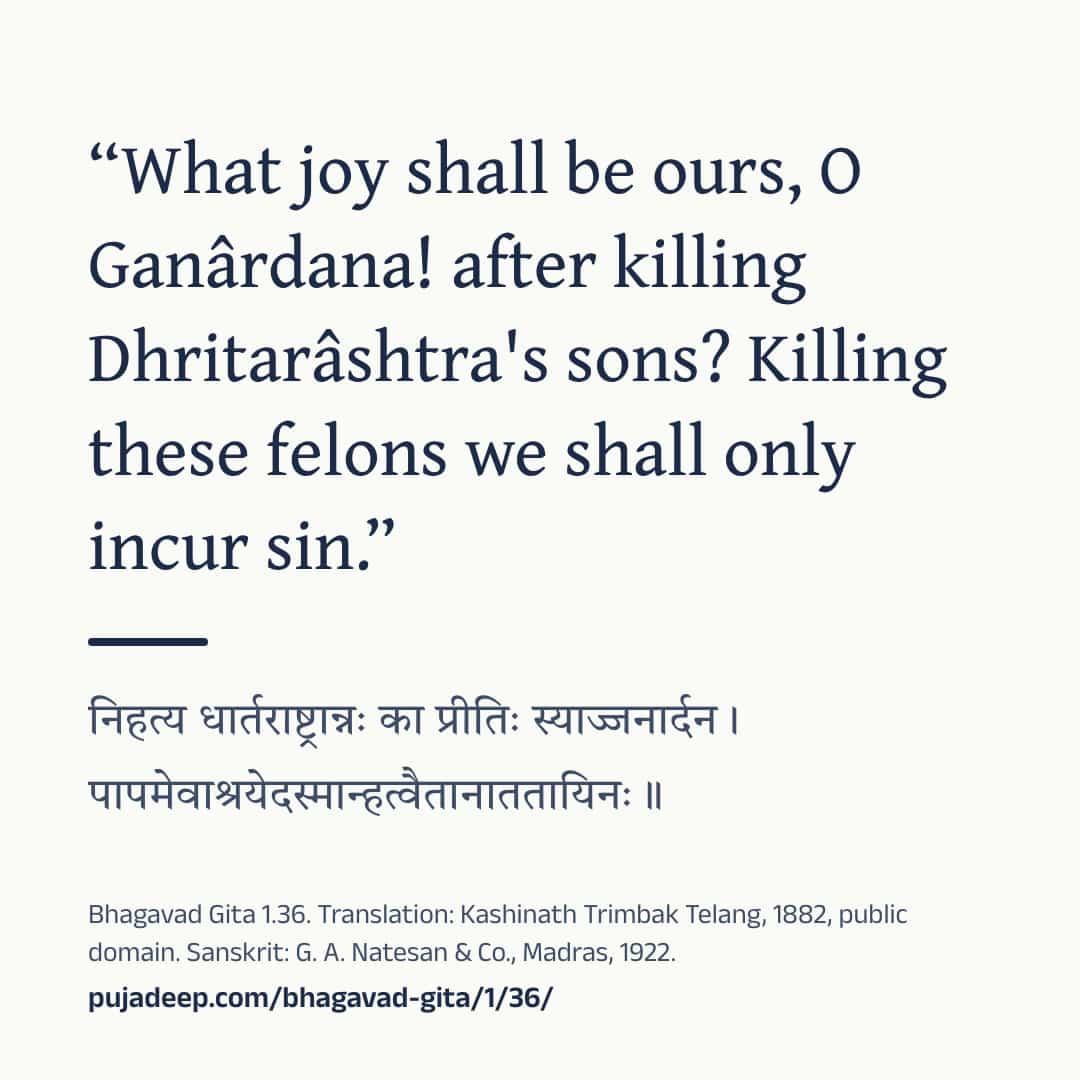
What joy shall be ours, O Ganârdana! after killing Dhritarâshtra's sons? Killing these felons1 we shall only incur sin.
Footnotes (the translator’s own) - Six classes are mentioned: an incendiary; one who administers poison; one who assaults another—weapon in hand; one who destroys property; one who robs another of his wife; or his fields. ↩
Compare 3 translations
Kashinath Trimbak Telang, 1882. Public domain. Page 41.
What joy shall be ours, O Ganârdana! after killing Dhritarâshtra's sons? Killing these felons1 we shall only incur sin.
Footnotes (the translator’s own) - Six classes are mentioned: an incendiary; one who administers poison; one who assaults another—weapon in hand; one who destroys property; one who robs another of his wife; or his fields. ↩
You are reading this one
Annie Besant, 1895. Public domain. Page 20–21.
Slaying these sons of Dhritarâshtra, what pleasure may be ours, O Janârdana?1 killing these felons, sin will but take hold of us.
Footnotes (the translator’s own) - "Destroyer of the people." Shrî Krishna as the conquering warrior against all forms of evil. ↩
You are reading this one
Swami Swarupananda, 1909 (first printed 1907). Public domain. Page 59.
What pleasure indeed could be ours, O Janàrdana, from killing these sons of Dhritaràshtra? Sin only could take hold on us by the slaying of these felons.
You are reading this one
Cite this verse
The translation: K. T. Telang, The Bhagavadgîtâ (The Sacred Books of the East, vol. VIII, Oxford: Clarendon Press, 1882), p. 41. Bhagavad Gita 1.36.
The translation: Annie Besant, The Bhagavad Gîtâ, or The Lord's Song (London: Theosophical Publishing Society, 1895), pp. 20–21. Bhagavad Gita 1.36.
The translation: Swami Swarupananda, Srimad-Bhagavad-Gita (Mayavati: Prabuddha Bharata Press, 1909; first printed in Prabuddha Bharata, 1907–1909), p. 59. Bhagavad Gita 1.36.
Our explanation: “Bhagavad Gita 1.36: meaning and translation.” Pujadeep. Updated October 25, 2026. https://pujadeep.com/bhagavad-gita/1/36/
Pujadeep’s explanations are free to quote with credit: name Pujadeep and link to the page. How to credit
Classical readings, by school
No readings by school on this verse yet.
Share
Show the ways to share
Send one picture or the text to one chat. The picture names its source and the address of this page.
Drawing the picture
See the words
Bhagavad Gita 1.36

निहत्य धार्तराष्ट्रान्नः का प्रीतिः स्याज्जनार्दन ।
पापमेवाश्रयेदस्मान्हत्वैतानाततायिनः ॥

“What joy shall be ours, O Ganârdana! after killing Dhritarâshtra's sons? Killing these felons we shall only incur sin.”
(K. T. Telang, The Bhagavadgîtâ (The Sacred Books of the East, vol. VIII, Oxford: Clarendon Press, 1882), p. 41, public domain)

“Slaying these sons of Dhritarâshtra, what pleasure may be ours, O Janârdana? killing these felons, sin will but take hold of us.”
(Annie Besant, The Bhagavad Gîtâ, or The Lord's Song (London: Theosophical Publishing Society, 1895), pp. 20–21, public domain)

“What pleasure indeed could be ours, O Janàrdana, from killing these sons of Dhritaràshtra? Sin only could take hold on us by the slaying of these felons.”
(Swami Swarupananda, Srimad-Bhagavad-Gita (Mayavati: Prabuddha Bharata Press, 1909; first printed in Prabuddha Bharata, 1907–1909), p. 59, public domain)

Sanskrit: G. A. Natesan & Co., Madras, 1922.
https://pujadeep.com/bhagavad-gita/1/36/ Nothing is sent from this site. Your own app sends it, to the chat you choose. The picture quotes the translation you chose on this page, with its name and year.
Sanskrit text: The Bhagavad-Gita, or The Lord's Song, with the text in Devanagari and an English translation, 1922. Meanings: written for Pujadeep and checked against the cited edition. Source and changes
Questions families ask
Who speaks Bhagavad Gita 1.36?
Arjuna speaks this verse, in chapter 1 (Arjuna Vishada Yoga).
Where does the Sanskrit text come from?
Sanskrit text: The Bhagavad-Gita, or The Lord's Song, with the text in Devanagari and an English translation, 1922. Meanings: written for Pujadeep and checked against the cited edition. See the source
Is the meaning on this page a translation?
Explanation written for this site from the sources listed here, and checked against the cited edition. It is not a translation and not the only way to read the text. Free to quote with credit.
Source and licence
- Sanskrit text
- The Bhagavad-Gita, or The Lord's Song, with the text in Devanagari and an English translation (Annie Besant, G. A. Natesan & Co., Madras, 1922). Public domain. The Sanskrit on these pages was read from this printing’s page images.
- Translation
- The Bhagavadgîtâ with the Sanatsugâtîya and the Anugîtâ, translated by Kâshinâth Trimbak Telang (The Sacred Books of the East, vol. VIII, ed. F. Max Müller) (Kashinath Trimbak Telang, F. Max Müller, Clarendon Press, Oxford, 1882). Public domain. Shown verbatim, as printed.
- Translation
- The Bhagavad Gîtâ, or The Lord's Song, translated by Annie Besant (Annie Besant, Theosophical Publishing Society, London, 1895). Public domain. Shown verbatim, as printed.
- Translation
- Srimad-Bhagavad-Gita, with Sanskrit Text; Paraphrase with Word-by-word Literal Translation; English Rendering and Comments, Index, &c., by the Swami Swarupananda (Himalayan Series, No. XX) (Swami Swarupananda, The Editors and Publishers, Advaita Ashrama, Mayavati, Prabuddha Bharata Press, Mayavati, Almora, Himalayas, 1909). Public domain. Shown verbatim, as printed.
- Common wording
- In this text, 32 words follow today's common wording, checked against sanskritdocuments.org; Sanskrit Wikisource; Gita Press, Gorakhpur; GRETIL, Göttingen and Bhaktivedanta Book Trust.
- Our explanation
- Explanation written for this site from the sources listed here, and checked against the cited edition. It is not a translation and not the only way to read the text. Free to quote with credit.
- Checked
- Checked against the cited edition, October 15, 2026.
- Updated
- October 25, 2026