Bhagavad Gita 18.2: meaning and translation
Chapter 18: Moksha Sannyasa Yoga. Krishna says
Krishna answers.
Click or tap a word for its meaning and its dictionary page.
Text and layers
Text and layers
These choices stay in this browser.
Bhagavad Gita 18.2
श्रीभगवानुवाच ।
काम्यानां कर्मणां न्यासं संन्यासं कवयो विदुः ।सर्वकर्मफलत्यागं प्राहुस्त्यागं विचक्षणाः ॥
Kamyanam karmanam nyasam sannyasam kavayo viduhSarvakarmaphalatyagam prahustyagam vichakshanah
kāmyānāṃ karmaṇāṃ nyāsaṃ saṃnyāsaṃ kavayo viduḥ |sarvakarmaphalatyāgaṃ prāhustyāgaṃ vicakṣaṇāḥ ||
Our explanation Krishna answers. He says the wise call it sannyāsa when a person gives up works done from desire (kāmya karma), and the discerning call it tyāga when a person gives up the fruit of all works.
हिंदी अर्थ कृष्ण उत्तर देते हैं। वे कहते हैं कि ज्ञानी कामना से किए जाने वाले कर्मों (काम्य कर्म) के त्याग को संन्यास कहते हैं, और विचारशील लोग सब कर्मों के फल के त्याग को त्याग कहते हैं।
Word by word
Every word, with its dictionary page
Word by word
- काम्यानाम् kāmyānām · done from desire (adjective (neuter), genitive plural) Dictionary: 2. kāmya, Monier-Williams 1899, p. 273, col. 3 “done from desire of benefit or from interested motives”
- कर्मणाम् karmaṇām · of actions (noun (neuter), genitive plural) Dictionary: karman, Monier-Williams 1899, p. 258, col. 2 “act, action, performance, business”
- न्यासम् nyāsam · the laying aside (noun (masculine), accusative singular) Dictionary: ny-āsa, Monier-Williams 1899, p. 572, col. 1 “putting away, taking off, laying aside”
- संन्यासम् saṃnyāsam · renunciation (sannyāsa) (noun (masculine), accusative singular) Dictionary: saṃ-nyāsa, Monier-Williams 1899, p. 1148, col. 1 “renunciation of the world, profession of asceticism”
- कवयः kavayaḥ · the wise (noun (masculine), nominative plural) Dictionary: kavi, Monier-Williams 1899, p. 264, col. 2 “gifted with insight, intelligent, knowing, enlightened, wise”
- विदुः viduḥ · know (it as) (perfect form, present sense, 3rd person plural) Dictionary: 1. vid, Monier-Williams 1899, p. 963, col. 2 “to know, understand, perceive, learn, become or be acquainted with”
- सर्वकर्मफलत्यागम् sarvakarmaphalatyāgam · giving up the fruit of all actions (compound (masculine), accusative singular) Dictionary: sarva, Monier-Williams 1899, p. 1184, col. 3 “whole, entire, all, every”; karma-phala, Monier-Williams 1899, p. 259, col. 1 “the fruit or recompense of actions”; tyāga, Monier-Williams 1899, p. 456, col. 3 “leaving, abandoning, forsaking”
- प्राहुः prāhuḥ · call (perfect form, present sense, 3rd person plural) Dictionary: 1. ah, Monier-Williams 1899, p. 124, col. 1 “to say, speak”
- त्यागम् tyāgam · giving up (tyāga) (noun (masculine), accusative singular) Dictionary: tyāga, Monier-Williams 1899, p. 456, col. 3 “leaving, abandoning, forsaking”
- विचक्षणाः vicakṣaṇāḥ · the discerning (noun (masculine), nominative plural) Dictionary: vi-cakṣaṇa, Monier-Williams 1899, p. 958, col. 2 “clear-sighted (lit. and fig.), sagacious, clever, wise, experienced or versed in”
Old translations
Kashinath Trimbak Telang, 1882. Public domain. Page 121.
The Deity said:
By renunciation the sages understand the rejection of actions done with desires. The wise call the abandonment of the fruit of all actions (by the name) abandonment.
Compare 3 translations
Kashinath Trimbak Telang, 1882. Public domain. Page 121.
The Deity said:
By renunciation the sages understand the rejection of actions done with desires. The wise call the abandonment of the fruit of all actions (by the name) abandonment.
You are reading this one
Annie Besant, 1895. Public domain. Page 152.
The Blessed Lord said:
Sages know as Renunciation the relinquishment of works with desire; the abandonment of the fruit of all actions is called Abandonment by the wise.
You are reading this one
Swami Swarupananda, 1909 (first printed 1907). Public domain. Page 320.
The Blessed Lord said:
The renunciation of Kâmya actions, the sages understand as Sannyása; the wise declare the abandonment of the fruits of all works as Tyâga.
You are reading this one
Cite this verse
The translation: K. T. Telang, The Bhagavadgîtâ (The Sacred Books of the East, vol. VIII, Oxford: Clarendon Press, 1882), p. 121. Bhagavad Gita 18.2.
The translation: Annie Besant, The Bhagavad Gîtâ, or The Lord's Song (London: Theosophical Publishing Society, 1895), p. 152. Bhagavad Gita 18.2.
The translation: Swami Swarupananda, Srimad-Bhagavad-Gita (Mayavati: Prabuddha Bharata Press, 1909; first printed in Prabuddha Bharata, 1907–1909), p. 320. Bhagavad Gita 18.2.
Our explanation: “Bhagavad Gita 18.2: meaning and translation.” Pujadeep. Updated October 25, 2026. https://pujadeep.com/bhagavad-gita/18/2/
Pujadeep’s explanations are free to quote with credit: name Pujadeep and link to the page. How to credit
Classical readings, by school
No readings by school on this verse yet.
Share
Show the ways to share
Send one picture or the text to one chat. The picture names its source and the address of this page.
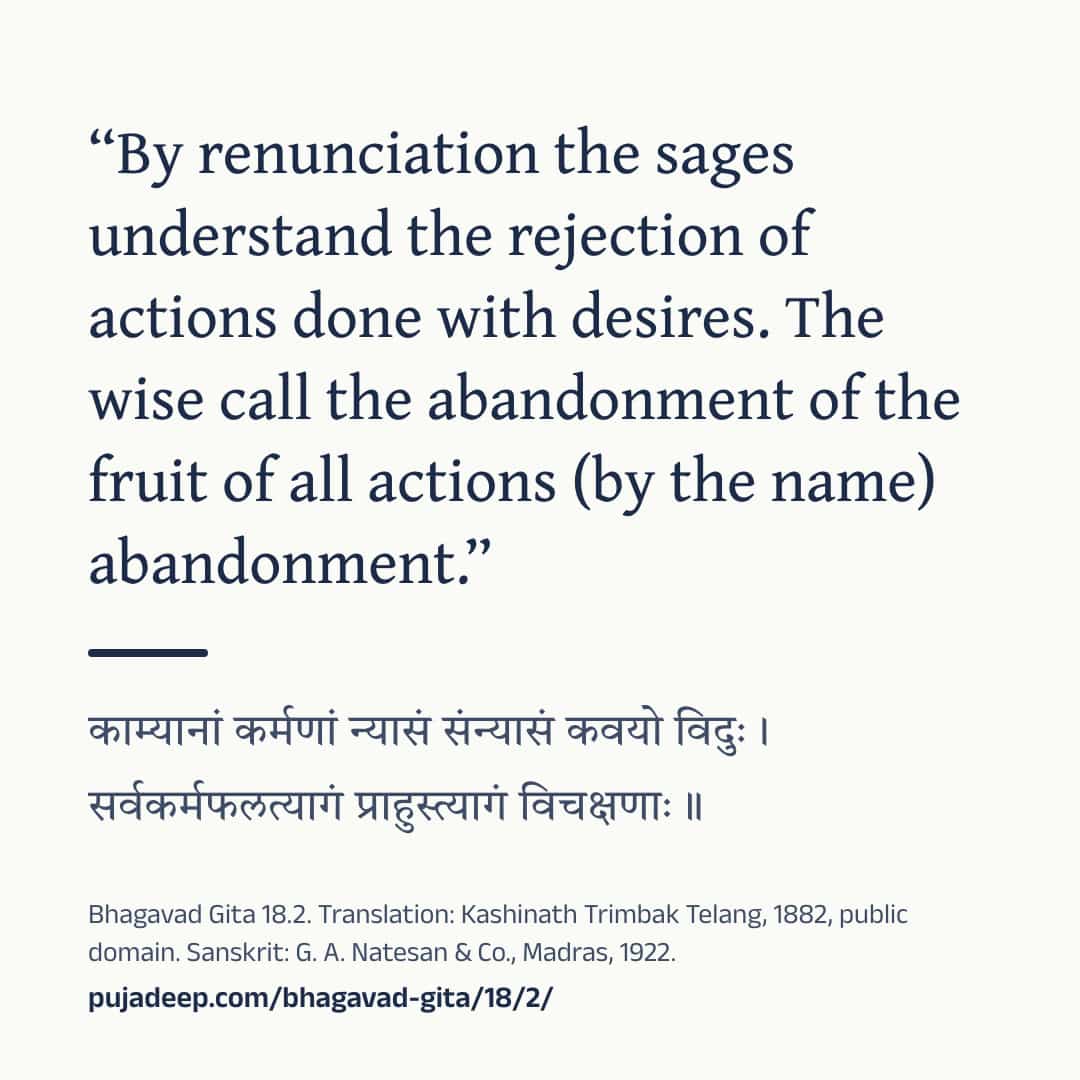
Drawing the picture
See the words
Bhagavad Gita 18.2

काम्यानां कर्मणां न्यासं संन्यासं कवयो विदुः ।
सर्वकर्मफलत्यागं प्राहुस्त्यागं विचक्षणाः ॥

“By renunciation the sages understand the rejection of actions done with desires. The wise call the abandonment of the fruit of all actions (by the name) abandonment.”
(K. T. Telang, The Bhagavadgîtâ (The Sacred Books of the East, vol. VIII, Oxford: Clarendon Press, 1882), p. 121, public domain)

“Sages know as Renunciation the relinquishment of works with desire; the abandonment of the fruit of all actions is called Abandonment by the wise.”
(Annie Besant, The Bhagavad Gîtâ, or The Lord's Song (London: Theosophical Publishing Society, 1895), p. 152, public domain)

“The renunciation of Kâmya actions, the sages understand as Sannyása; the wise declare the abandonment of the fruits of all works as Tyâga.”
(Swami Swarupananda, Srimad-Bhagavad-Gita (Mayavati: Prabuddha Bharata Press, 1909; first printed in Prabuddha Bharata, 1907–1909), p. 320, public domain)

Sanskrit: G. A. Natesan & Co., Madras, 1922.
https://pujadeep.com/bhagavad-gita/18/2/ Nothing is sent from this site. Your own app sends it, to the chat you choose. The picture quotes the translation you chose on this page, with its name and year.
Sanskrit text: The Bhagavad-Gita, or The Lord's Song, with the text in Devanagari and an English translation, 1922. Meanings: written for Pujadeep and checked against the cited edition. Source and changes
Questions families ask
Who speaks Bhagavad Gita 18.2?
Krishna speaks this verse, in chapter 18 (Moksha Sannyasa Yoga).
Where does the Sanskrit text come from?
Sanskrit text: The Bhagavad-Gita, or The Lord's Song, with the text in Devanagari and an English translation, 1922. Meanings: written for Pujadeep and checked against the cited edition. See the source
Is the meaning on this page a translation?
Explanation written for this site from the sources listed here, and checked against the cited edition. It is not a translation and not the only way to read the text. Free to quote with credit.
Source and licence
- Sanskrit text
- The Bhagavad-Gita, or The Lord's Song, with the text in Devanagari and an English translation (Annie Besant, G. A. Natesan & Co., Madras, 1922). Public domain. The Sanskrit on these pages was read from this printing’s page images.
- Translation
- The Bhagavadgîtâ with the Sanatsugâtîya and the Anugîtâ, translated by Kâshinâth Trimbak Telang (The Sacred Books of the East, vol. VIII, ed. F. Max Müller) (Kashinath Trimbak Telang, F. Max Müller, Clarendon Press, Oxford, 1882). Public domain. Shown verbatim, as printed.
- Translation
- The Bhagavad Gîtâ, or The Lord's Song, translated by Annie Besant (Annie Besant, Theosophical Publishing Society, London, 1895). Public domain. Shown verbatim, as printed.
- Translation
- Srimad-Bhagavad-Gita, with Sanskrit Text; Paraphrase with Word-by-word Literal Translation; English Rendering and Comments, Index, &c., by the Swami Swarupananda (Himalayan Series, No. XX) (Swami Swarupananda, The Editors and Publishers, Advaita Ashrama, Mayavati, Prabuddha Bharata Press, Mayavati, Almora, Himalayas, 1909). Public domain. Shown verbatim, as printed.
- Common wording
- In this text, 32 words follow today's common wording, checked against sanskritdocuments.org; Sanskrit Wikisource; Gita Press, Gorakhpur; GRETIL, Göttingen and Bhaktivedanta Book Trust.
- Our explanation
- Explanation written for this site from the sources listed here, and checked against the cited edition. It is not a translation and not the only way to read the text. Free to quote with credit.
- Checked
- Checked against the cited edition, October 15, 2026.
- Updated
- October 25, 2026