Bhagavad Gita 18.13: meaning and translation
Chapter 18: Moksha Sannyasa Yoga. Krishna says
Krishna tells Arjuna to learn from him the five causes of every action, which he says are taught in the Sāṅkhya, the doctrine that ends action.
Click or tap a word for its meaning and its dictionary page.
Text and layers
Text and layers
These choices stay in this browser.
Bhagavad Gita 18.13
पञ्चैतानि महाबाहो कारणानि निबोध मे ।साङ्ख्ये कृतान्ते प्रोक्तानि सिद्धये सर्वकर्मणाम् ॥
Panchaitani mahabaho karanani nibodha meSankhye kritante proktani siddhaye sarvakarmanam
pañcaitāni mahābāho kāraṇāni nibodha me |sāṅkhye kṛtānte proktāni siddhaye sarvakarmaṇām ||
Our explanation Krishna tells Arjuna to learn from him the five causes of every action, which he says are taught in the Sāṅkhya, the doctrine that ends action. The schools read 'Sāṅkhya' here in different ways (see the views).
हिंदी अर्थ कृष्ण अर्जुन से कहते हैं कि वे उनसे हर कर्म की सिद्धि के पाँच कारण जानें, जो, वे कहते हैं, सांख्य में, कर्म का अंत करने वाले सिद्धांत में, बताए गए हैं। यहाँ “सांख्य” को परंपराएँ अलग-अलग ढंग से समझती हैं।
Word by word
Every word, with its dictionary page
Word by word
- पञ्च pañca · five (numeral (neuter), accusative plural) Dictionary: pañcan, Monier-Williams 1899, p. 578, col. 2 “five”
- एतानि etāni · these (pronoun (neuter), accusative plural) Dictionary: etad, Monier-Williams 1899, p. 231, col. 2 “this, this here, here”
- महाबाहो mahābāho · O mighty-armed one (compound (masculine), vocative singular) Dictionary: mahā-bāhu, Monier-Williams 1899, p. 798, col. 1 “long-armed”
- कारणानि kāraṇāni · causes (noun (neuter), accusative plural) Dictionary: 1. kāraṇa, Monier-Williams 1899, p. 274, col. 2 “cause, reason, the cause of anything”
- निबोध nibodha · learn (imperative, 2nd person singular) Dictionary: ni-budh, Monier-Williams 1899, p. 550, col. 2 “to know, understand, consider”
- मे me · from "me" (Krishna) (pronoun, genitive singular) Dictionary: 1. mad, Monier-Williams 1899, p. 777, col. 2 “base of the first pers. pron. in the sg. number (esp. in comp.)”
- साङ्ख्ये sāṅkhye · in the Sāṅkhya (noun (neuter), locative singular) Dictionary: sāṃkhya, Monier-Williams 1899, p. 1199, col. 1 “N. of one of the three great divisions of Hindū philosophy”
- कृतान्ते kṛtānte · in the doctrine that ends action (compound (masculine), locative singular) Dictionary: kṛtānta, Monier-Williams 1899, p. 303, col. 1 “a demonstrated conclusion, dogma”
- प्रोक्तानि proktāni · declared (past participle (neuter), accusative plural) Dictionary: prokta, Monier-Williams 1899, p. 690, col. 2 “called, declared, said”
- सिद्धये siddhaye · for the accomplishment (noun (feminine), dative singular) Dictionary: 2. siddhi, Monier-Williams 1899, p. 1216, col. 2 “accomplishment, performance, fulfilment, complete attainment (of any object), success”
- सर्वकर्मणाम् sarvakarmaṇām · of all actions (compound (neuter), genitive plural) Dictionary: sarva, Monier-Williams 1899, p. 1184, col. 3 “whole, entire, all, every”; karman, Monier-Williams 1899, p. 258, col. 2 “act, action, performance, business”
Old translations
Kashinath Trimbak Telang, 1882. Public domain. Page 123.
Learn from me, O you of mighty arms! these five causes of the completion of all actions, declared in the Sâṅkhya system1.
Footnotes (the translator’s own) - Saṅkara and Madhusûdana say this means Vedânta-sâstra. Srîdhara suggests also the alternative Sâṅkhya-sâstra. Substratum=the body, in which desire, aversion, &c. are manifested; agent=one who egoistically thinks himself the doer of actions; organs=senses of perception, action, &c.; movements=of the vital breaths in the body; deities=the deities which preside over the eye and other senses (as to this cf. Aitareya-upanishad, p. 45; Prasna, pp. 216, 217; Mundaka, p. 314; Aitareya-âranyaka, pp. 88–270; and Max Müller's Hibbert Lectures, p. 204, note). ↩
Compare 3 translations
Kashinath Trimbak Telang, 1882. Public domain. Page 123.
Learn from me, O you of mighty arms! these five causes of the completion of all actions, declared in the Sâṅkhya system1.
Footnotes (the translator’s own) - Saṅkara and Madhusûdana say this means Vedânta-sâstra. Srîdhara suggests also the alternative Sâṅkhya-sâstra. Substratum=the body, in which desire, aversion, &c. are manifested; agent=one who egoistically thinks himself the doer of actions; organs=senses of perception, action, &c.; movements=of the vital breaths in the body; deities=the deities which preside over the eye and other senses (as to this cf. Aitareya-upanishad, p. 45; Prasna, pp. 216, 217; Mundaka, p. 314; Aitareya-âranyaka, pp. 88–270; and Max Müller's Hibbert Lectures, p. 204, note). ↩
You are reading this one
Annie Besant, 1895. Public domain. Page 154.
These five causes, O mighty-armed, learn of Me as declared in the Sânkhya for the accomplishment of all actions—
This sentence goes on in 18.14.
You are reading this one
Swami Swarupananda, 1909 (first printed 1907). Public domain. Page 324.
Learn from Me, O mighty-armed, these five causes for the accomplishment of all works as declared in the wisdom which is the end of all action:—
This sentence goes on in 18.14.
You are reading this one
Cite this verse
The translation: K. T. Telang, The Bhagavadgîtâ (The Sacred Books of the East, vol. VIII, Oxford: Clarendon Press, 1882), p. 123. Bhagavad Gita 18.13.
The translation: Annie Besant, The Bhagavad Gîtâ, or The Lord's Song (London: Theosophical Publishing Society, 1895), p. 154. Bhagavad Gita 18.13.
The translation: Swami Swarupananda, Srimad-Bhagavad-Gita (Mayavati: Prabuddha Bharata Press, 1909; first printed in Prabuddha Bharata, 1907–1909), p. 324. Bhagavad Gita 18.13.
Our explanation: “Bhagavad Gita 18.13: meaning and translation.” Pujadeep. Updated October 25, 2026. https://pujadeep.com/bhagavad-gita/18/13/
Pujadeep’s explanations are free to quote with credit: name Pujadeep and link to the page. How to credit
Classical readings, by school
Each reading is named by its school. None is presented as the only meaning.
What Advaita, Vishishtadvaita and Dvaita teach, in short
Shankara Advaita
Shankara takes 'Sāṅkhya' here to mean the Vedānta (the Upanishads), called 'the end of action' because the knowledge of the Self it gives brings all action to an end.
Source: The Bhagavad-Gita, with the commentary of Sri Sankaracharya, translated by A. Mahadeva Sastri (2nd ed., Mysore: G. T. A. Printing Works, 1901), commentary on 18.13, p. 409. Summarised in our own words; none of its text is reproduced.
Ramanuja Vishishtadvaita
Ramanuja takes 'Sāṅkhya' to mean the reasoning of the Vedic teaching, which holds that the Supreme Self alone is the final author of every act, with the soul, the breath, the senses and the body as his instruments.
Source: Sri Bhagavad-Gita with Sri Ramanujacharya's Visishtadvaita commentary, translated by A. Govindacharya (Madras, 1898), commentary on 18.13, pp. 531–532. Summarised in our own words; none of its text is reproduced.
Share
Show the ways to share
Send one picture or the text to one chat. The picture names its source and the address of this page.
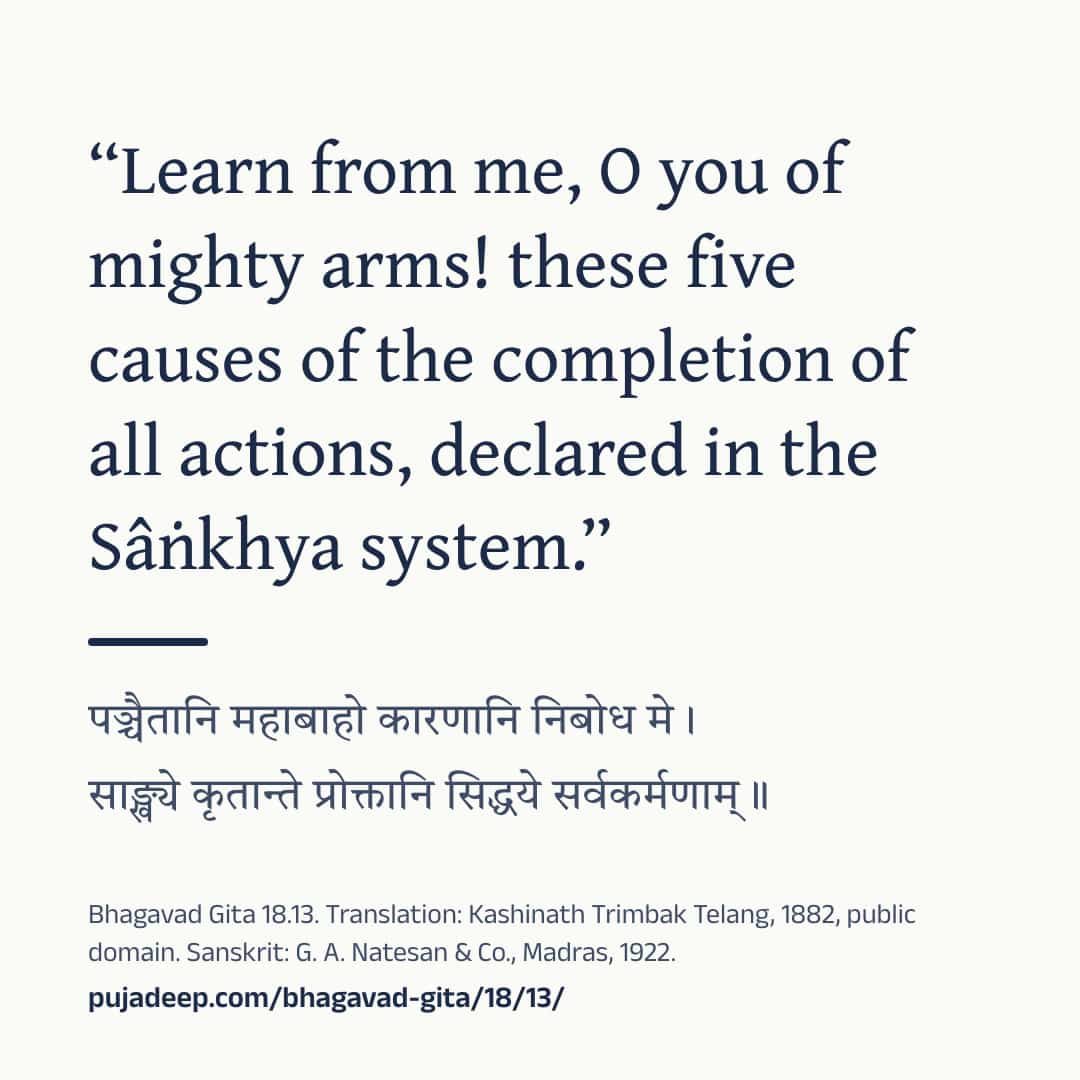
Drawing the picture
See the words
Bhagavad Gita 18.13

पञ्चैतानि महाबाहो कारणानि निबोध मे ।
साङ्ख्ये कृतान्ते प्रोक्तानि सिद्धये सर्वकर्मणाम् ॥

“Learn from me, O you of mighty arms! these five causes of the completion of all actions, declared in the Sâṅkhya system.”
(K. T. Telang, The Bhagavadgîtâ (The Sacred Books of the East, vol. VIII, Oxford: Clarendon Press, 1882), p. 123, public domain)

“These five causes, O mighty-armed, learn of Me as declared in the Sânkhya for the accomplishment of all actions—”
(Annie Besant, The Bhagavad Gîtâ, or The Lord's Song (London: Theosophical Publishing Society, 1895), p. 154, public domain)
This sentence goes on in 18.14.

“Learn from Me, O mighty-armed, these five causes for the accomplishment of all works as declared in the wisdom which is the end of all action:—”
(Swami Swarupananda, Srimad-Bhagavad-Gita (Mayavati: Prabuddha Bharata Press, 1909; first printed in Prabuddha Bharata, 1907–1909), p. 324, public domain)
This sentence goes on in 18.14.

Sanskrit: G. A. Natesan & Co., Madras, 1922.
https://pujadeep.com/bhagavad-gita/18/13/ Nothing is sent from this site. Your own app sends it, to the chat you choose. The picture quotes the translation you chose on this page, with its name and year.
Sanskrit text: The Bhagavad-Gita, or The Lord's Song, with the text in Devanagari and an English translation, 1922. Meanings: written for Pujadeep and checked against the cited edition. Source and changes
Questions families ask
Who speaks Bhagavad Gita 18.13?
Krishna speaks this verse, in chapter 18 (Moksha Sannyasa Yoga).
Where does the Sanskrit text come from?
Sanskrit text: The Bhagavad-Gita, or The Lord's Song, with the text in Devanagari and an English translation, 1922. Meanings: written for Pujadeep and checked against the cited edition. See the source
Is the meaning on this page a translation?
Explanation written for this site from the sources listed here, and checked against the cited edition. It is not a translation and not the only way to read the text. Free to quote with credit.
Source and licence
- Sanskrit text
- The Bhagavad-Gita, or The Lord's Song, with the text in Devanagari and an English translation (Annie Besant, G. A. Natesan & Co., Madras, 1922). Public domain. The Sanskrit on these pages was read from this printing’s page images.
- Translation
- The Bhagavadgîtâ with the Sanatsugâtîya and the Anugîtâ, translated by Kâshinâth Trimbak Telang (The Sacred Books of the East, vol. VIII, ed. F. Max Müller) (Kashinath Trimbak Telang, F. Max Müller, Clarendon Press, Oxford, 1882). Public domain. Shown verbatim, as printed.
- Translation
- The Bhagavad Gîtâ, or The Lord's Song, translated by Annie Besant (Annie Besant, Theosophical Publishing Society, London, 1895). Public domain. Shown verbatim, as printed.
- Translation
- Srimad-Bhagavad-Gita, with Sanskrit Text; Paraphrase with Word-by-word Literal Translation; English Rendering and Comments, Index, &c., by the Swami Swarupananda (Himalayan Series, No. XX) (Swami Swarupananda, The Editors and Publishers, Advaita Ashrama, Mayavati, Prabuddha Bharata Press, Mayavati, Almora, Himalayas, 1909). Public domain. Shown verbatim, as printed.
- Commentary
- The Bhagavad-Gita, with the commentary of Sri Sankaracharya, translated by A. Mahadeva Sastri (2nd ed., Mysore: G. T. A. Printing Works, 1901) (Public-domain scan, University of California Libraries). Summarised in our own words; none of its text is reproduced.
- Commentary
- Sri Bhagavad-Gita with Sri Ramanujacharya's Visishtadvaita commentary, translated by A. Govindacharya (Madras, 1898) (Scan uploaded to archive.org (folkscanomy collection)). Summarised in our own words; none of its text is reproduced.
- Common wording
- In this text, 32 words follow today's common wording, checked against sanskritdocuments.org; Sanskrit Wikisource; Gita Press, Gorakhpur; GRETIL, Göttingen and Bhaktivedanta Book Trust.
- Our explanation
- Explanation written for this site from the sources listed here, and checked against the cited edition. It is not a translation and not the only way to read the text. Free to quote with credit.
- Checked
- Checked against the cited edition, October 15, 2026.
- Updated
- October 25, 2026