Bhagavad Gita 18.27: meaning and translation
Chapter 18: Moksha Sannyasa Yoga. Krishna says
Krishna says that a doer who is full of attachment, who wants the fruit of actions, who is greedy, harmful and impure, and who is moved by joy and grief, is called a doer of the nature of rajas.
Click or tap a word for its meaning and its dictionary page.
Text and layers
Text and layers
These choices stay in this browser.
Bhagavad Gita 18.27
रागी कर्मफलप्रेप्सुर्लुब्धो हिंसात्मकोऽशुचिः ।हर्षशोकान्वितः कर्ता राजसः परिकीर्तितः ॥
Ragi karmaphalaprepsurlubdho hinsatmakoshuchihHarshashokanvitah karta rajasah parikirtitah
rāgī karmaphalaprepsurlubdho hiṃsātmako’śuciḥ |harṣaśokānvitaḥ kartā rājasaḥ parikīrtitaḥ ||
Our explanation Krishna says that a doer who is full of attachment, who wants the fruit of actions, who is greedy, harmful and impure, and who is moved by joy and grief, is called a doer of the nature of rajas.
हिंदी अर्थ कृष्ण कहते हैं कि जो कर्ता रागी है, कर्मफल चाहता है, लोभी, हिंसक और अपवित्र है, और हर्ष-शोक से भरा रहता है, वह राजस कर्ता कहलाता है।
Word by word
Every word, with its dictionary page
Word by word
- रागी rāgī · full of passion (adjective (masculine), nominative singular) Dictionary: rāgin, Monier-Williams 1899, p. 872, col. 2 “impassioned, affectionate, enamoured, passionately fond of or attached to or hankering after (loc. or comp.)”
- कर्मफलप्रेप्सुः karmaphalaprepsuḥ · seeking the fruit of action (compound (masculine), nominative singular) Dictionary: karma-phala, Monier-Williams 1899, p. 259, col. 1 “the fruit or recompense of actions”; prepsu, Monier-Williams 1899, p. 712, col. 3 “wishing to attain, desirous of obtaining, seeking, longing for, aiming at”
- लुब्धः lubdhaḥ · greedy (past participle (masculine), nominative singular) Dictionary: lubdha, Monier-Williams 1899, p. 904, col. 3 “greedy, covetous, avaricious”
- हिंसात्मकः hiṃsātmakaḥ · harmful by nature (compound (masculine), nominative singular) Dictionary: hiṃsā, Monier-Williams 1899, p. 1297, col. 3 “injury, harm (to life or property), hurt, mischief, wrong”; hiṃsātmaka, Monier-Williams 1899, p. 1297, col. 3 “intent on doing harm”
- अशुचिः aśuciḥ · impure (adjective (masculine), nominative singular) Dictionary: a-śuci, Monier-Williams 1899, p. 113, col. 2 “impure, foul”
- हर्षशोकान्वितः harṣaśokānvitaḥ · moved by joy and grief (compound (masculine), nominative singular) Dictionary: harṣa, Monier-Williams 1899, p. 1292, col. 2 “joy, pleasure”; śoka, Monier-Williams 1899, p. 1091, col. 1 “sorrow, affliction, anguish, pain, trouble, grief”; anv-ita, Monier-Williams 1899, p. 47, col. 2 “gone along with; joined, attended, accompanied by, connected with”
- कर्ता kartā · doer (noun (masculine), nominative singular) Dictionary: kartṛ, Monier-Williams 1899, p. 257, col. 3 “one who makes or does or acts or effects, a doer, maker, agent, author”
- राजसः rājasaḥ · of rajas (adjective (masculine), nominative singular) Dictionary: rājasa, Monier-Williams 1899, p. 875, col. 2 “belonging or relating to the quality rajas”
- परिकीर्तितः parikīrtitaḥ · is called (past participle (masculine), nominative singular) Dictionary: pari-kīrtita, Monier-Williams 1899, p. 591, col. 3 “proclaimed, announced, boasted of, said, called”
Old translations
Kashinath Trimbak Telang, 1882. Public domain. Page 124–125.
That agent is called passionate, who is full of affections1, who wishes for the fruit of actions, who is covetous, cruel, and impure, and feels joy and sorrow.
Footnotes (the translator’s own) - I. e. 'for children,' &c., according to Srîdhara; 'for the action,' according to others. ↩
Compare 3 translations
Kashinath Trimbak Telang, 1882. Public domain. Page 124–125.
That agent is called passionate, who is full of affections1, who wishes for the fruit of actions, who is covetous, cruel, and impure, and feels joy and sorrow.
Footnotes (the translator’s own) - I. e. 'for children,' &c., according to Srîdhara; 'for the action,' according to others. ↩
You are reading this one
Annie Besant, 1895. Public domain. Page 157.
Passionate, desiring to obtain the fruit of actions, greedy, harmful, impure, endued with joy and sorrow, such an actor is pronounced râjasic.
You are reading this one
Swami Swarupananda, 1909 (first printed 1907). Public domain. Page 331.
He who is passionate, desiring for the fruits of action, greedy, malignant, impure, easily elated or dejected, such an agent is called Rájasic.
You are reading this one
Cite this verse
The translation: K. T. Telang, The Bhagavadgîtâ (The Sacred Books of the East, vol. VIII, Oxford: Clarendon Press, 1882), pp. 124–125. Bhagavad Gita 18.27.
The translation: Annie Besant, The Bhagavad Gîtâ, or The Lord's Song (London: Theosophical Publishing Society, 1895), p. 157. Bhagavad Gita 18.27.
The translation: Swami Swarupananda, Srimad-Bhagavad-Gita (Mayavati: Prabuddha Bharata Press, 1909; first printed in Prabuddha Bharata, 1907–1909), p. 331. Bhagavad Gita 18.27.
Our explanation: “Bhagavad Gita 18.27: meaning and translation.” Pujadeep. Updated October 25, 2026. https://pujadeep.com/bhagavad-gita/18/27/
Pujadeep’s explanations are free to quote with credit: name Pujadeep and link to the page. How to credit
Classical readings, by school
No readings by school on this verse yet.
Share
Show the ways to share
Send one picture or the text to one chat. The picture names its source and the address of this page.
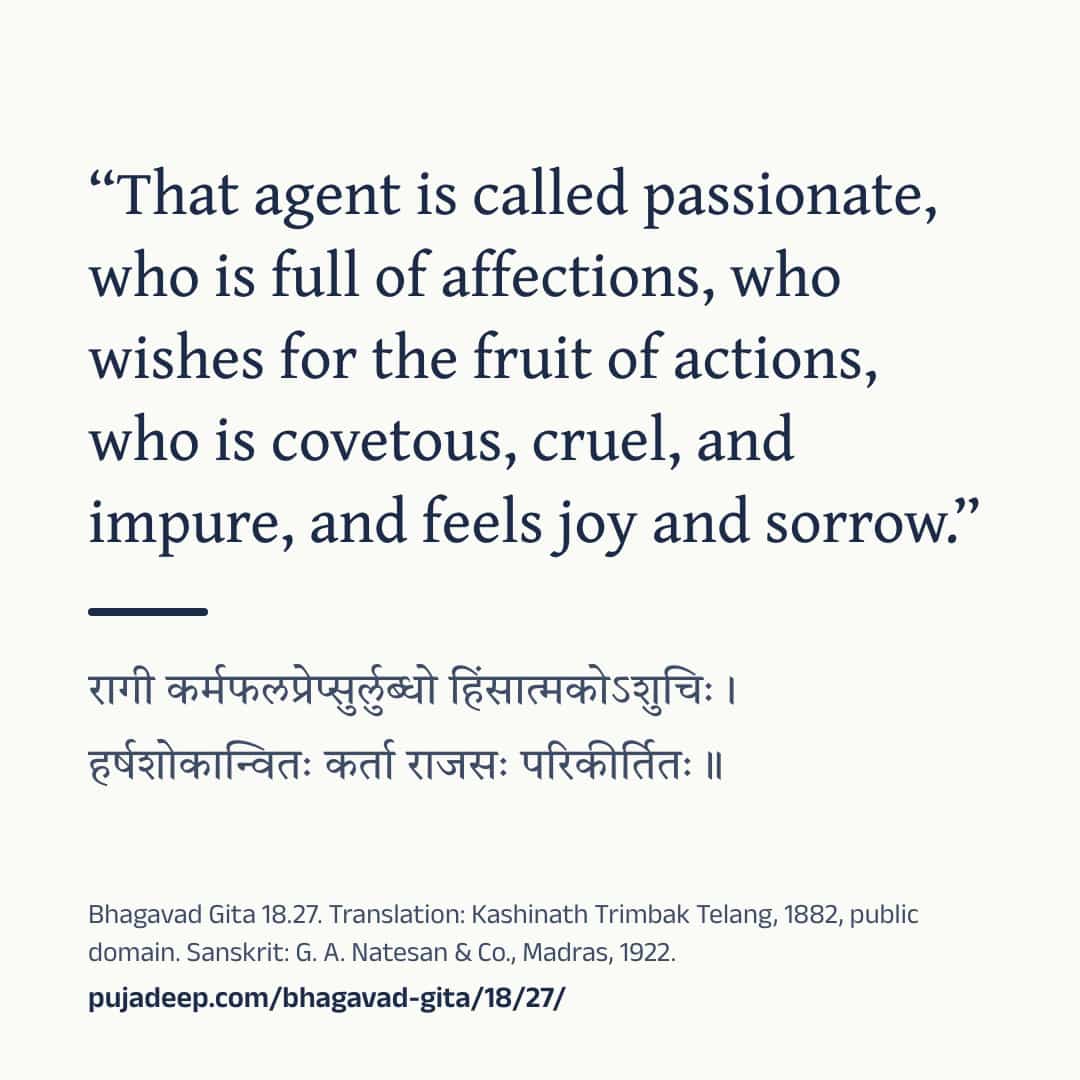
Drawing the picture
See the words
Bhagavad Gita 18.27

रागी कर्मफलप्रेप्सुर्लुब्धो हिंसात्मकोऽशुचिः ।
हर्षशोकान्वितः कर्ता राजसः परिकीर्तितः ॥

“That agent is called passionate, who is full of affections, who wishes for the fruit of actions, who is covetous, cruel, and impure, and feels joy and sorrow.”
(K. T. Telang, The Bhagavadgîtâ (The Sacred Books of the East, vol. VIII, Oxford: Clarendon Press, 1882), pp. 124–125, public domain)

“Passionate, desiring to obtain the fruit of actions, greedy, harmful, impure, endued with joy and sorrow, such an actor is pronounced râjasic.”
(Annie Besant, The Bhagavad Gîtâ, or The Lord's Song (London: Theosophical Publishing Society, 1895), p. 157, public domain)

“He who is passionate, desiring for the fruits of action, greedy, malignant, impure, easily elated or dejected, such an agent is called Rájasic.”
(Swami Swarupananda, Srimad-Bhagavad-Gita (Mayavati: Prabuddha Bharata Press, 1909; first printed in Prabuddha Bharata, 1907–1909), p. 331, public domain)

Sanskrit: G. A. Natesan & Co., Madras, 1922.
https://pujadeep.com/bhagavad-gita/18/27/ Nothing is sent from this site. Your own app sends it, to the chat you choose. The picture quotes the translation you chose on this page, with its name and year.
Sanskrit text: The Bhagavad-Gita, or The Lord's Song, with the text in Devanagari and an English translation, 1922. Meanings: written for Pujadeep and checked against the cited edition. Source and changes
Questions families ask
Who speaks Bhagavad Gita 18.27?
Krishna speaks this verse, in chapter 18 (Moksha Sannyasa Yoga).
Where does the Sanskrit text come from?
Sanskrit text: The Bhagavad-Gita, or The Lord's Song, with the text in Devanagari and an English translation, 1922. Meanings: written for Pujadeep and checked against the cited edition. See the source
Is the meaning on this page a translation?
Explanation written for this site from the sources listed here, and checked against the cited edition. It is not a translation and not the only way to read the text. Free to quote with credit.
Source and licence
- Sanskrit text
- The Bhagavad-Gita, or The Lord's Song, with the text in Devanagari and an English translation (Annie Besant, G. A. Natesan & Co., Madras, 1922). Public domain. The Sanskrit on these pages was read from this printing’s page images.
- Translation
- The Bhagavadgîtâ with the Sanatsugâtîya and the Anugîtâ, translated by Kâshinâth Trimbak Telang (The Sacred Books of the East, vol. VIII, ed. F. Max Müller) (Kashinath Trimbak Telang, F. Max Müller, Clarendon Press, Oxford, 1882). Public domain. Shown verbatim, as printed.
- Translation
- The Bhagavad Gîtâ, or The Lord's Song, translated by Annie Besant (Annie Besant, Theosophical Publishing Society, London, 1895). Public domain. Shown verbatim, as printed.
- Translation
- Srimad-Bhagavad-Gita, with Sanskrit Text; Paraphrase with Word-by-word Literal Translation; English Rendering and Comments, Index, &c., by the Swami Swarupananda (Himalayan Series, No. XX) (Swami Swarupananda, The Editors and Publishers, Advaita Ashrama, Mayavati, Prabuddha Bharata Press, Mayavati, Almora, Himalayas, 1909). Public domain. Shown verbatim, as printed.
- Common wording
- In this text, 32 words follow today's common wording, checked against sanskritdocuments.org; Sanskrit Wikisource; Gita Press, Gorakhpur; GRETIL, Göttingen and Bhaktivedanta Book Trust.
- Our explanation
- Explanation written for this site from the sources listed here, and checked against the cited edition. It is not a translation and not the only way to read the text. Free to quote with credit.
- Checked
- Checked against the cited edition, October 15, 2026.
- Updated
- October 25, 2026