Bhagavad Gita 18.24: meaning and translation
Chapter 18: Moksha Sannyasa Yoga. Krishna says
Krishna says that an action done by one who wants its pleasures, or done with pride (ahaṅkāra), and with great strain, is called action of the nature of rajas.
Click or tap a word for its meaning and its dictionary page.
Text and layers
Text and layers
These choices stay in this browser.
Bhagavad Gita 18.24
यत्तु कामेप्सुना कर्म साहङ्कारेण वा पुनः ।क्रियते बहुलायासं तद्राजसमुदाहृतम् ॥
Yattu kamepsuna karma sahankarena va punahKriyate bahulayasam tadrajasamudahritam
yattu kāmepsunā karma sāhaṅkāreṇa vā punaḥ |kriyate bahulāyāsaṃ tadrājasamudāhṛtam ||
Our explanation Krishna says that an action done by one who wants its pleasures, or done with pride (ahaṅkāra), and with great strain, is called action of the nature of rajas.
हिंदी अर्थ कृष्ण कहते हैं कि जो कर्म भोगों की इच्छा से, या अहंकार के साथ, और बहुत परिश्रम से किया जाता है, वह राजस कहलाता है।
Word by word
Every word, with its dictionary page
Word by word
- यत् yat · which (pronoun (neuter), nominative singular) Dictionary: yad, Monier-Williams 1899, p. 844, col. 2 “who, which, what, whichever, whatever, that”
- तु tu · but (indeclinable) Dictionary: 2. tu, Monier-Williams 1899, p. 449, col. 3 “but”
- कामेप्सुना kāmepsunā · by one who seeks desires (compound (masculine), instrumental singular) Dictionary: kāma, Monier-Williams 1899, p. 271, col. 3 “wish, desire, longing”; īpsu, Monier-Williams 1899, p. 170, col. 2 “striving to obtain; wishing to get or obtain, desirous of (with acc.)”
- कर्म karma · action (noun (neuter), nominative singular) Dictionary: karman, Monier-Williams 1899, p. 258, col. 2 “act, action, performance, business”
- साहङ्कारेण sāhaṅkāreṇa · with ego (compound (masculine), instrumental singular) Dictionary: 7. sa, Monier-Williams 1899, p. 1111, col. 2 “together or along with”; ahaṃ-kāra, Monier-Williams 1899, p. 124, col. 2 “conception of one's individuality, self-consciousness”
- वा vā · or (indeclinable) Dictionary: 1. vā, Monier-Williams 1899, p. 934, col. 2 “ind. or”
- पुनः punaḥ · again (indeclinable) Dictionary: punar, Monier-Williams 1899, p. 633, col. 2 “again, once more”
- क्रियते kriyate · is done (present passive, 3rd person singular) Dictionary: 1. kṛ, Monier-Williams 1899, p. 301, col. 1 “to do, make, perform, accomplish, cause, effect, prepare, undertake”
- बहुलायासम् bahulāyāsam · with much effort (compound (neuter), nominative singular) Dictionary: bahula, Monier-Williams 1899, p. 726, col. 2 “abundant, numerous, many, much”; āyāsa, Monier-Williams 1899, p. 148, col. 2 “effort, exertion (of bodily or mental power), trouble, labour”
- तत् tat · that (pronoun (neuter), nominative singular) Dictionary: tad, Monier-Williams 1899, p. 434, col. 1 “m. he, f. she, n. it, that, this”
- राजसम् rājasam · of rajas (adjective (neuter), nominative singular) Dictionary: rājasa, Monier-Williams 1899, p. 875, col. 2 “belonging or relating to the quality rajas”
- उदाहृतम् udāhṛtam · is called (past participle (neuter), nominative singular) Dictionary: ud-āhṛta, Monier-Williams 1899, p. 185, col. 3 “said, declared, illustrated; called, named, entitled”
Old translations
Kashinath Trimbak Telang, 1882. Public domain. Page 124.
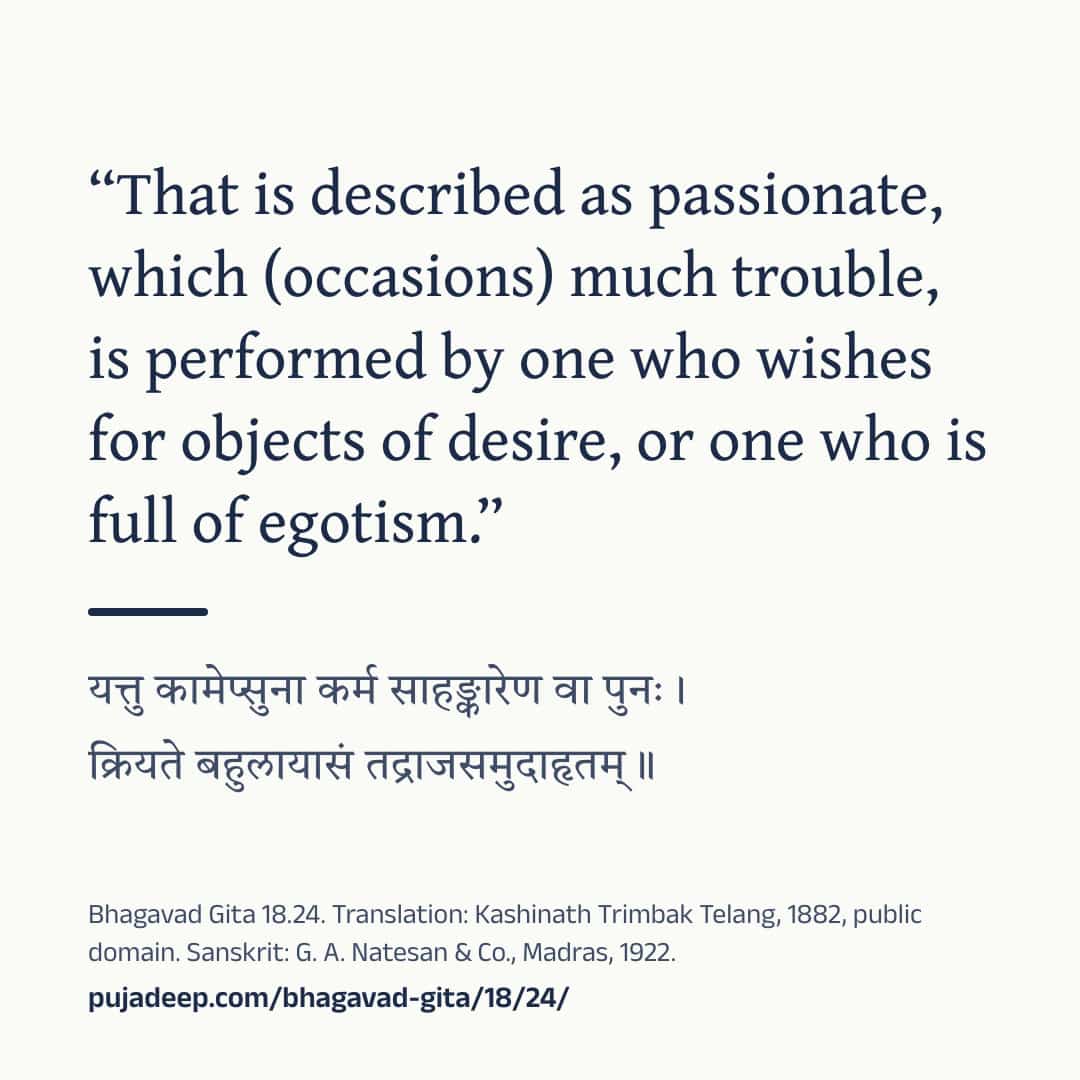
That is described as passionate, which (occasions) much trouble, is performed by one who wishes for objects of desire, or one who is full of egotism1.
Footnotes (the translator’s own) - I. e. 'pride of learning,' &c., Saṅkara; 'egoism,' Râmânuga. ↩
Compare 3 translations
Kashinath Trimbak Telang, 1882. Public domain. Page 124.
That is described as passionate, which (occasions) much trouble, is performed by one who wishes for objects of desire, or one who is full of egotism1.
Footnotes (the translator’s own) - I. e. 'pride of learning,' &c., Saṅkara; 'egoism,' Râmânuga. ↩
You are reading this one
Annie Besant, 1895. Public domain. Page 156–157.
But that action that is done by one longing for desires, or again with egoism, or with much effort, that is declared to be râjasic.
You are reading this one
Swami Swarupananda, 1909 (first printed 1907). Public domain. Page 329.
But the action which is performed desiring desires, or with self-conceit, and with much effort, is declared to be Rájasic.
You are reading this one
Cite this verse
The translation: K. T. Telang, The Bhagavadgîtâ (The Sacred Books of the East, vol. VIII, Oxford: Clarendon Press, 1882), p. 124. Bhagavad Gita 18.24.
The translation: Annie Besant, The Bhagavad Gîtâ, or The Lord's Song (London: Theosophical Publishing Society, 1895), pp. 156–157. Bhagavad Gita 18.24.
The translation: Swami Swarupananda, Srimad-Bhagavad-Gita (Mayavati: Prabuddha Bharata Press, 1909; first printed in Prabuddha Bharata, 1907–1909), p. 329. Bhagavad Gita 18.24.
Our explanation: “Bhagavad Gita 18.24: meaning and translation.” Pujadeep. Updated October 25, 2026. https://pujadeep.com/bhagavad-gita/18/24/
Pujadeep’s explanations are free to quote with credit: name Pujadeep and link to the page. How to credit
Classical readings, by school
No readings by school on this verse yet.
Share
Show the ways to share
Send one picture or the text to one chat. The picture names its source and the address of this page.
Drawing the picture
See the words
Bhagavad Gita 18.24

यत्तु कामेप्सुना कर्म साहङ्कारेण वा पुनः ।
क्रियते बहुलायासं तद्राजसमुदाहृतम् ॥

“That is described as passionate, which (occasions) much trouble, is performed by one who wishes for objects of desire, or one who is full of egotism.”
(K. T. Telang, The Bhagavadgîtâ (The Sacred Books of the East, vol. VIII, Oxford: Clarendon Press, 1882), p. 124, public domain)

“But that action that is done by one longing for desires, or again with egoism, or with much effort, that is declared to be râjasic.”
(Annie Besant, The Bhagavad Gîtâ, or The Lord's Song (London: Theosophical Publishing Society, 1895), pp. 156–157, public domain)

“But the action which is performed desiring desires, or with self-conceit, and with much effort, is declared to be Rájasic.”
(Swami Swarupananda, Srimad-Bhagavad-Gita (Mayavati: Prabuddha Bharata Press, 1909; first printed in Prabuddha Bharata, 1907–1909), p. 329, public domain)

Sanskrit: G. A. Natesan & Co., Madras, 1922.
https://pujadeep.com/bhagavad-gita/18/24/ Nothing is sent from this site. Your own app sends it, to the chat you choose. The picture quotes the translation you chose on this page, with its name and year.
Sanskrit text: The Bhagavad-Gita, or The Lord's Song, with the text in Devanagari and an English translation, 1922. Meanings: written for Pujadeep and checked against the cited edition. Source and changes
Questions families ask
Who speaks Bhagavad Gita 18.24?
Krishna speaks this verse, in chapter 18 (Moksha Sannyasa Yoga).
Where does the Sanskrit text come from?
Sanskrit text: The Bhagavad-Gita, or The Lord's Song, with the text in Devanagari and an English translation, 1922. Meanings: written for Pujadeep and checked against the cited edition. See the source
Is the meaning on this page a translation?
Explanation written for this site from the sources listed here, and checked against the cited edition. It is not a translation and not the only way to read the text. Free to quote with credit.
Source and licence
- Sanskrit text
- The Bhagavad-Gita, or The Lord's Song, with the text in Devanagari and an English translation (Annie Besant, G. A. Natesan & Co., Madras, 1922). Public domain. The Sanskrit on these pages was read from this printing’s page images.
- Translation
- The Bhagavadgîtâ with the Sanatsugâtîya and the Anugîtâ, translated by Kâshinâth Trimbak Telang (The Sacred Books of the East, vol. VIII, ed. F. Max Müller) (Kashinath Trimbak Telang, F. Max Müller, Clarendon Press, Oxford, 1882). Public domain. Shown verbatim, as printed.
- Translation
- The Bhagavad Gîtâ, or The Lord's Song, translated by Annie Besant (Annie Besant, Theosophical Publishing Society, London, 1895). Public domain. Shown verbatim, as printed.
- Translation
- Srimad-Bhagavad-Gita, with Sanskrit Text; Paraphrase with Word-by-word Literal Translation; English Rendering and Comments, Index, &c., by the Swami Swarupananda (Himalayan Series, No. XX) (Swami Swarupananda, The Editors and Publishers, Advaita Ashrama, Mayavati, Prabuddha Bharata Press, Mayavati, Almora, Himalayas, 1909). Public domain. Shown verbatim, as printed.
- Common wording
- In this text, 32 words follow today's common wording, checked against sanskritdocuments.org; Sanskrit Wikisource; Gita Press, Gorakhpur; GRETIL, Göttingen and Bhaktivedanta Book Trust.
- Our explanation
- Explanation written for this site from the sources listed here, and checked against the cited edition. It is not a translation and not the only way to read the text. Free to quote with credit.
- Checked
- Checked against the cited edition, October 15, 2026.
- Updated
- October 25, 2026