Bhagavad Gita 18.29: meaning and translation
Chapter 18: Moksha Sannyasa Yoga. Krishna says
Krishna now turns to understanding (buddhi) and steadiness (dhṛti).
Click or tap a word for its meaning and its dictionary page.
Text and layers
Text and layers
These choices stay in this browser.
Bhagavad Gita 18.29
बुद्धेर्भेदं धृतेश्चैव गुणतस्त्रिविधं शृणु ।प्रोच्यमानमशेषेण पृथक्त्वेन धनञ्जय ॥
Buddherbhedam dhriteshchaiva gunatastrividham shrinuProchyamanamasheshena prithaktvena dhananjaya
buddherbhedaṃ dhṛteścaiva guṇatastrividhaṃ śṛṇu |procyamānamaśeṣeṇa pṛthaktvena dhanañjaya ||
Our explanation Krishna now turns to understanding (buddhi) and steadiness (dhṛti). He asks Arjuna, Dhananjaya, to hear their threefold division by the guṇas, told fully and one by one.
हिंदी अर्थ अब कृष्ण बुद्धि और धृति (धैर्य) की बात करते हैं। वे अर्जुन (धनंजय) से कहते हैं कि गुणों के अनुसार इनके तीन-तीन भेद पूरी तरह और अलग-अलग सुनें।
Word by word
Every word, with its dictionary page
Word by word
- बुद्धेः buddheḥ · of understanding (noun (feminine), genitive singular) Dictionary: buddhi, Monier-Williams 1899, p. 733, col. 3 “intelligence, reason, intellect, mind, discernment, judgment”
- भेदम् bhedam · the division (noun (masculine), accusative singular) Dictionary: bheda, Monier-Williams 1899, p. 766, col. 1 “distinction, difference, kind, sort, species, variety”
- धृतेः dhṛteḥ · of steadiness (noun (feminine), genitive singular) Dictionary: dhṛti, Monier-Williams 1899, p. 519, col. 3 “firmness, constancy, resolution, will, command”
- च ca · and (indeclinable) Dictionary: 2. ca, Monier-Williams 1899, p. 380, col. 1 “and, both, also, moreover, as well as”
- एव eva · also (indeclinable) Dictionary: 1. eva, Monier-Williams 1899, p. 232, col. 2 “just, exactly, very, same, only, even, alone, merely”
- गुणतः guṇataḥ · by the guṇas (indeclinable) Dictionary: guṇa, Monier-Williams 1899, p. 357, col. 1 “(in Sāṃkhya phil.) an ingredient or constituent of Prakṛiti, chief quality of all existing beings”
- त्रिविधम् trividham · threefold (adjective (masculine), accusative singular) Dictionary: tri-vidha, Monier-Williams 1899, p. 460, col. 2 “of 3 kinds, triple, threefold”
- शृणु śṛṇu · hear (imperative, 2nd person singular) Dictionary: 1. śru, Monier-Williams 1899, p. 1100, col. 3 “to hear, listen or attend to anything”
- प्रोच्यमानम् procyamānam · being declared (present passive participle (masculine), accusative singular) Dictionary: pra-vac, Monier-Williams 1899, p. 690, col. 1 “to proclaim, announce, praise, commend, mention, teach, impart, explain”
- अशेषेण aśeṣeṇa · fully (noun (masculine), instrumental singular) Dictionary: a-śeṣa, Monier-Williams 1899, p. 113, col. 3 “without remainder, entire, perfect, all”
- पृथक्त्वेन pṛthaktvena · one by one (noun (neuter), instrumental singular) Dictionary: pṛthak-tva, Monier-Williams 1899, p. 645, col. 3 “singly, one by one”
- धनञ्जय dhanañjaya · O Dhananjaya (Arjuna) (noun (masculine), vocative singular) Dictionary: dhanaṃ-jaya, Monier-Williams 1899, p. 508, col. 2 “N. of Arjuna”
Old translations
Kashinath Trimbak Telang, 1882. Public domain. Page 125.
Now hear, O Dhanañgaya! the threefold division of intelligence1 and courage, according to qualities, which I am about to declare exhaustively and distinctly.
Footnotes (the translator’s own) - The nature of the faculty of understanding; and courage is the firmness of that faculty. ↩
Compare 3 translations
Kashinath Trimbak Telang, 1882. Public domain. Page 125.
Now hear, O Dhanañgaya! the threefold division of intelligence1 and courage, according to qualities, which I am about to declare exhaustively and distinctly.
Footnotes (the translator’s own) - The nature of the faculty of understanding; and courage is the firmness of that faculty. ↩
You are reading this one
Annie Besant, 1895. Public domain. Page 157–158.
The division of Buddhi and of firmness also, threefold according to the qualities, hear thou, as will be declared (by Me) unreservedly and severally, O Dhananjaya.
You are reading this one
Swami Swarupananda, 1909 (first printed 1907). Public domain. Page 331.
Hear thou the triple distinction of intellect and fortitude, according to the Gunas, as I declare them exhaustively and severally, O Dhananjaya.
You are reading this one
Cite this verse
The translation: K. T. Telang, The Bhagavadgîtâ (The Sacred Books of the East, vol. VIII, Oxford: Clarendon Press, 1882), p. 125. Bhagavad Gita 18.29.
The translation: Annie Besant, The Bhagavad Gîtâ, or The Lord's Song (London: Theosophical Publishing Society, 1895), pp. 157–158. Bhagavad Gita 18.29.
The translation: Swami Swarupananda, Srimad-Bhagavad-Gita (Mayavati: Prabuddha Bharata Press, 1909; first printed in Prabuddha Bharata, 1907–1909), p. 331. Bhagavad Gita 18.29.
Our explanation: “Bhagavad Gita 18.29: meaning and translation.” Pujadeep. Updated October 25, 2026. https://pujadeep.com/bhagavad-gita/18/29/
Pujadeep’s explanations are free to quote with credit: name Pujadeep and link to the page. How to credit
Classical readings, by school
No readings by school on this verse yet.
Share
Show the ways to share
Send one picture or the text to one chat. The picture names its source and the address of this page.
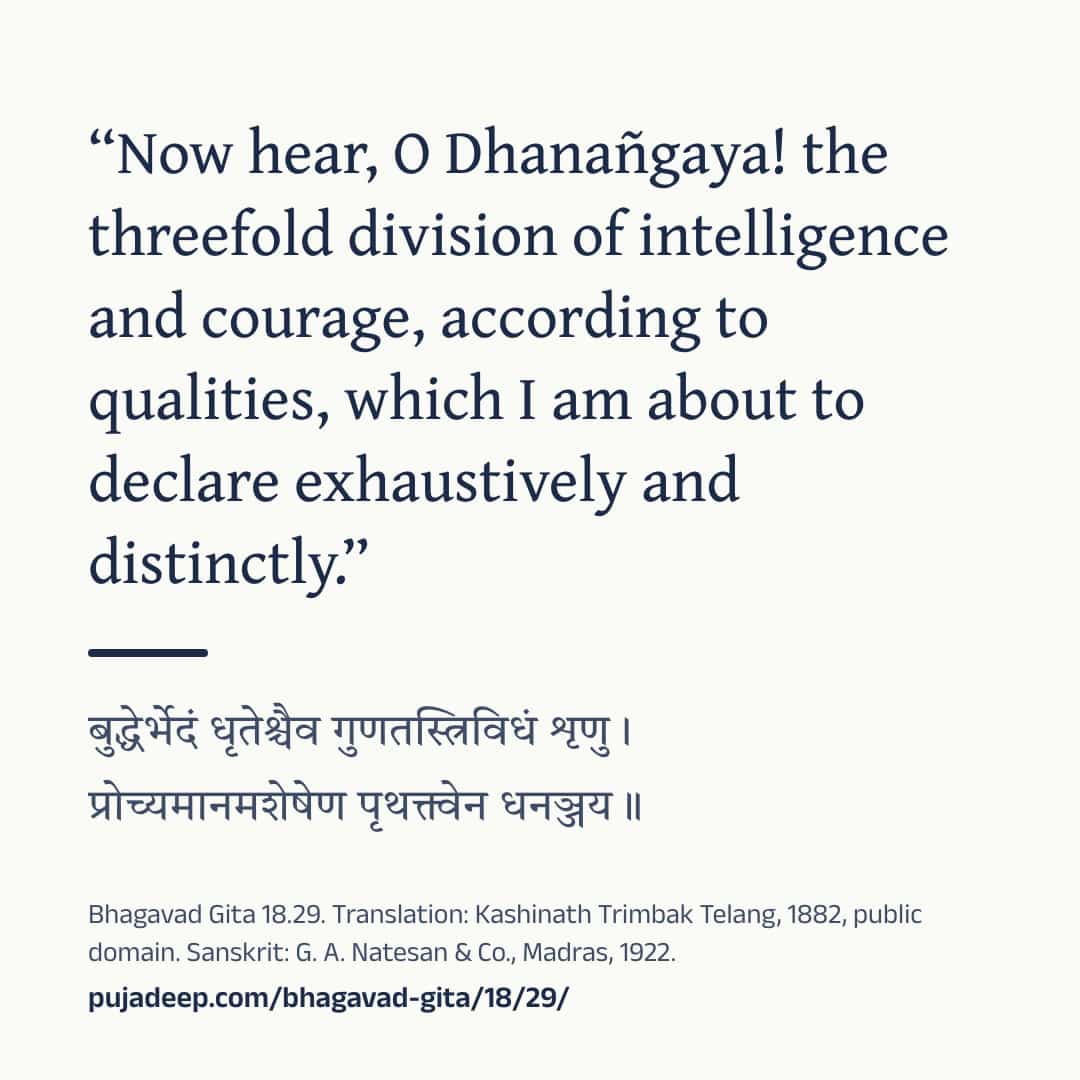
Drawing the picture
See the words
Bhagavad Gita 18.29

बुद्धेर्भेदं धृतेश्चैव गुणतस्त्रिविधं शृणु ।
प्रोच्यमानमशेषेण पृथक्त्वेन धनञ्जय ॥

“Now hear, O Dhanañgaya! the threefold division of intelligence and courage, according to qualities, which I am about to declare exhaustively and distinctly.”
(K. T. Telang, The Bhagavadgîtâ (The Sacred Books of the East, vol. VIII, Oxford: Clarendon Press, 1882), p. 125, public domain)

“The division of Buddhi and of firmness also, threefold according to the qualities, hear thou, as will be declared (by Me) unreservedly and severally, O Dhananjaya.”
(Annie Besant, The Bhagavad Gîtâ, or The Lord's Song (London: Theosophical Publishing Society, 1895), pp. 157–158, public domain)

“Hear thou the triple distinction of intellect and fortitude, according to the Gunas, as I declare them exhaustively and severally, O Dhananjaya.”
(Swami Swarupananda, Srimad-Bhagavad-Gita (Mayavati: Prabuddha Bharata Press, 1909; first printed in Prabuddha Bharata, 1907–1909), p. 331, public domain)

Sanskrit: G. A. Natesan & Co., Madras, 1922.
https://pujadeep.com/bhagavad-gita/18/29/ Nothing is sent from this site. Your own app sends it, to the chat you choose. The picture quotes the translation you chose on this page, with its name and year.
Sanskrit text: The Bhagavad-Gita, or The Lord's Song, with the text in Devanagari and an English translation, 1922. Meanings: written for Pujadeep and checked against the cited edition. Source and changes
Questions families ask
Who speaks Bhagavad Gita 18.29?
Krishna speaks this verse, in chapter 18 (Moksha Sannyasa Yoga).
Where does the Sanskrit text come from?
Sanskrit text: The Bhagavad-Gita, or The Lord's Song, with the text in Devanagari and an English translation, 1922. Meanings: written for Pujadeep and checked against the cited edition. See the source
Is the meaning on this page a translation?
Explanation written for this site from the sources listed here, and checked against the cited edition. It is not a translation and not the only way to read the text. Free to quote with credit.
Source and licence
- Sanskrit text
- The Bhagavad-Gita, or The Lord's Song, with the text in Devanagari and an English translation (Annie Besant, G. A. Natesan & Co., Madras, 1922). Public domain. The Sanskrit on these pages was read from this printing’s page images.
- Translation
- The Bhagavadgîtâ with the Sanatsugâtîya and the Anugîtâ, translated by Kâshinâth Trimbak Telang (The Sacred Books of the East, vol. VIII, ed. F. Max Müller) (Kashinath Trimbak Telang, F. Max Müller, Clarendon Press, Oxford, 1882). Public domain. Shown verbatim, as printed.
- Translation
- The Bhagavad Gîtâ, or The Lord's Song, translated by Annie Besant (Annie Besant, Theosophical Publishing Society, London, 1895). Public domain. Shown verbatim, as printed.
- Translation
- Srimad-Bhagavad-Gita, with Sanskrit Text; Paraphrase with Word-by-word Literal Translation; English Rendering and Comments, Index, &c., by the Swami Swarupananda (Himalayan Series, No. XX) (Swami Swarupananda, The Editors and Publishers, Advaita Ashrama, Mayavati, Prabuddha Bharata Press, Mayavati, Almora, Himalayas, 1909). Public domain. Shown verbatim, as printed.
- Common wording
- In this text, 32 words follow today's common wording, checked against sanskritdocuments.org; Sanskrit Wikisource; Gita Press, Gorakhpur; GRETIL, Göttingen and Bhaktivedanta Book Trust.
- Our explanation
- Explanation written for this site from the sources listed here, and checked against the cited edition. It is not a translation and not the only way to read the text. Free to quote with credit.
- Checked
- Checked against the cited edition, October 15, 2026.
- Updated
- October 25, 2026