Bhagavad Gita 18.34: meaning and translation
Chapter 18: Moksha Sannyasa Yoga. Krishna says
Krishna says that the steadiness by which one holds on to dharma, desire and wealth, wanting their fruit out of attachment, is steadiness of the nature of rajas.
Click or tap a word for its meaning and its dictionary page.
Text and layers
Text and layers
These choices stay in this browser.
Bhagavad Gita 18.34
यया तु धर्मकामार्थान् धृत्या धारयतेऽर्जुन ।प्रसङ्गेन फलाकाङ्क्षी धृतिः सा पार्थ राजसी ॥
Yaya tu dharmakamarthan dhritya dharayaterjunaPrasangena phalakankshi dhritih sa partha rajasi
yayā tu dharmakāmārthān dhṛtyā dhārayate’rjuna |prasaṅgena phalākāṅkṣī dhṛtiḥ sā pārtha rājasī ||
Our explanation Krishna says that the steadiness by which one holds on to dharma, desire and wealth, wanting their fruit out of attachment, is steadiness of the nature of rajas. Telang's note explains these as three of the aims of life, the fourth being liberation.
हिंदी अर्थ कृष्ण कहते हैं कि जिस धृति से व्यक्ति आसक्ति के कारण फल चाहते हुए धर्म, काम और अर्थ को थामे रहता है, वह राजस है। तेलंग की टिप्पणी बताती है कि ये जीवन के चार लक्ष्यों (पुरुषार्थों) में से तीन हैं, चौथा मोक्ष है।
Word by word
Every word, with its dictionary page
Word by word
- यया yayā · by which (pronoun (feminine), instrumental singular) Dictionary: yad, Monier-Williams 1899, p. 844, col. 2 “who, which, what, whichever, whatever, that”
- तु tu · but (indeclinable) Dictionary: 2. tu, Monier-Williams 1899, p. 449, col. 3 “but”
- धर्मकामार्थान् dharmakāmārthān · dharma, pleasure and wealth (compound (masculine), accusative plural) Dictionary: 1. dharma, Monier-Williams 1899, p. 510, col. 3 “usage, practice, customary observance or prescribed conduct, duty”; kāma, Monier-Williams 1899, p. 271, col. 3 “wish, desire, longing”; artha, Monier-Williams 1899, p. 90, col. 3 “substance, wealth, property, opulence, money”
- धृत्या dhṛtyā · by steadiness (noun (feminine), instrumental singular) Dictionary: dhṛti, Monier-Williams 1899, p. 519, col. 3 “firmness, constancy, resolution, will, command”
- धारयते dhārayate · one holds to (causative present, 3rd person singular) Dictionary: dhṛ, Monier-Williams 1899, p. 519, col. 1 “to hold, bear (also = bring forth), carry, maintain, preserve, keep, possess”
- अर्जुन arjuna · O Arjuna (noun (masculine), vocative singular) Dictionary: arjuna, Monier-Williams 1899, p. 90, col. 1 “of the third of the Pāṇḍava princes (who was a son of Indra and Kuntī)”
- प्रसङ्गेन prasaṅgena · through attachment (noun (masculine), instrumental singular) Dictionary: pra-saṅga, Monier-Williams 1899, p. 696, col. 2 “adherence, attachment, inclination or devotion to, indulgence in, fondness for”
- फलाकाङ्क्षी phalākāṅkṣī · wanting the fruit (compound (masculine), nominative singular) Dictionary: phala, Monier-Williams 1899, p. 716, col. 2 “fruit (met.), consequence, effect, result, retribution (good or bad)”; ākāṅkṣin, Monier-Williams 1899, p. 126, col. 3 “ifc. wishing, desirous, hoping, expecting”
- धृतिः dhṛtiḥ · steadiness (noun (feminine), nominative singular) Dictionary: dhṛti, Monier-Williams 1899, p. 519, col. 3 “firmness, constancy, resolution, will, command”
- सा sā · that (pronoun (feminine), nominative singular) Dictionary: tad, Monier-Williams 1899, p. 434, col. 1 “m. he, f. she, n. it, that, this”
- पार्थ pārtha · O son of Pritha (noun (masculine), vocative singular) Dictionary: 2. pārtha, Monier-Williams 1899, p. 621, col. 3 “metron. of Yudhi-shṭhira or Bhīma-sena or Arjuna”
- राजसी rājasī · of rajas (adjective (feminine), nominative singular) Dictionary: rājasa, Monier-Williams 1899, p. 875, col. 2 “belonging or relating to the quality rajas”
1 printing differs
Edition differences. Another printing or text reads this place differently.
- Spelling A digital text reads Same letters. The 1922 edition prints धर्मकामार्थान् धृत्या as two words.
Old translations
Kashinath Trimbak Telang, 1882. Public domain. Page 125–126.
But, O Arguna! that courage is passionate, by which one adheres to piety, lust, and wealth1, and through attachment2 wishes, O son of Prithâ! for the fruit.
Footnotes (the translator’s own) - Three of the aims of mankind, the highest being final emancipation. In the view of the Gîtâ, piety, leading only to heaven, is of doubtful benefit. ↩
- I. e. to the action for attaining them, in the belief that one is the doer of it; the 'fruit' scil. of the action performed with an eye to the three things named. ↩
Compare 3 translations
Kashinath Trimbak Telang, 1882. Public domain. Page 125–126.
But, O Arguna! that courage is passionate, by which one adheres to piety, lust, and wealth1, and through attachment2 wishes, O son of Prithâ! for the fruit.
Footnotes (the translator’s own) - Three of the aims of mankind, the highest being final emancipation. In the view of the Gîtâ, piety, leading only to heaven, is of doubtful benefit. ↩
- I. e. to the action for attaining them, in the belief that one is the doer of it; the 'fruit' scil. of the action performed with an eye to the three things named. ↩
You are reading this one
Annie Besant, 1895. Public domain. Page 159.
The firmness, O Arjuna, by which one holdeth fast Dharma, pleasure and wealth, (and is) from attachment desirous of fruit, that firmness, O Pârtha, is râjasic.
You are reading this one
Swami Swarupananda, 1909 (first printed 1907). Public domain. Page 333–334.
But the fortitude by which one regulates (one's mind) to Dharma, desire and wealth, desirous of the fruit of each from attachment, that fortitude, O Pârtha, is Rájasic.
You are reading this one
Cite this verse
The translation: K. T. Telang, The Bhagavadgîtâ (The Sacred Books of the East, vol. VIII, Oxford: Clarendon Press, 1882), pp. 125–126. Bhagavad Gita 18.34.
The translation: Annie Besant, The Bhagavad Gîtâ, or The Lord's Song (London: Theosophical Publishing Society, 1895), p. 159. Bhagavad Gita 18.34.
The translation: Swami Swarupananda, Srimad-Bhagavad-Gita (Mayavati: Prabuddha Bharata Press, 1909; first printed in Prabuddha Bharata, 1907–1909), pp. 333–334. Bhagavad Gita 18.34.
Our explanation: “Bhagavad Gita 18.34: meaning and translation.” Pujadeep. Updated October 25, 2026. https://pujadeep.com/bhagavad-gita/18/34/
Pujadeep’s explanations are free to quote with credit: name Pujadeep and link to the page. How to credit
Classical readings, by school
No readings by school on this verse yet.
Share
Show the ways to share
Send one picture or the text to one chat. The picture names its source and the address of this page.
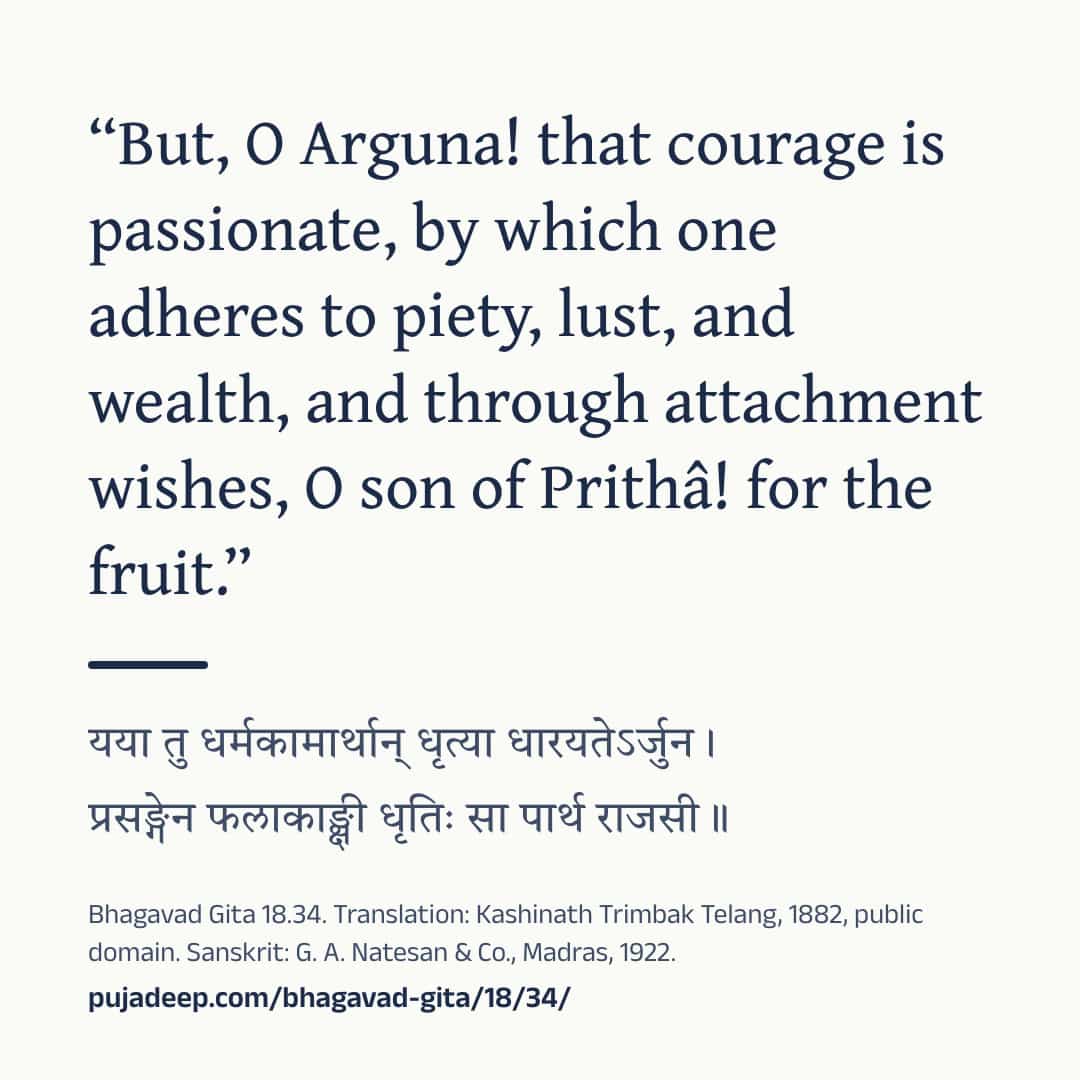
Drawing the picture
See the words
Bhagavad Gita 18.34

यया तु धर्मकामार्थान् धृत्या धारयतेऽर्जुन ।
प्रसङ्गेन फलाकाङ्क्षी धृतिः सा पार्थ राजसी ॥

“But, O Arguna! that courage is passionate, by which one adheres to piety, lust, and wealth, and through attachment wishes, O son of Prithâ! for the fruit.”
(K. T. Telang, The Bhagavadgîtâ (The Sacred Books of the East, vol. VIII, Oxford: Clarendon Press, 1882), pp. 125–126, public domain)

“The firmness, O Arjuna, by which one holdeth fast Dharma, pleasure and wealth, (and is) from attachment desirous of fruit, that firmness, O Pârtha, is râjasic.”
(Annie Besant, The Bhagavad Gîtâ, or The Lord's Song (London: Theosophical Publishing Society, 1895), p. 159, public domain)

“But the fortitude by which one regulates (one's mind) to Dharma, desire and wealth, desirous of the fruit of each from attachment, that fortitude, O Pârtha, is Rájasic.”
(Swami Swarupananda, Srimad-Bhagavad-Gita (Mayavati: Prabuddha Bharata Press, 1909; first printed in Prabuddha Bharata, 1907–1909), pp. 333–334, public domain)

Sanskrit: G. A. Natesan & Co., Madras, 1922.
https://pujadeep.com/bhagavad-gita/18/34/ Nothing is sent from this site. Your own app sends it, to the chat you choose. The picture quotes the translation you chose on this page, with its name and year.
Sanskrit text: The Bhagavad-Gita, or The Lord's Song, with the text in Devanagari and an English translation, 1922. Meanings: written for Pujadeep and checked against the cited edition. Source and changes
Questions families ask
Who speaks Bhagavad Gita 18.34?
Krishna speaks this verse, in chapter 18 (Moksha Sannyasa Yoga).
Where does the Sanskrit text come from?
Sanskrit text: The Bhagavad-Gita, or The Lord's Song, with the text in Devanagari and an English translation, 1922. Meanings: written for Pujadeep and checked against the cited edition. See the source
Is the meaning on this page a translation?
Explanation written for this site from the sources listed here, and checked against the cited edition. It is not a translation and not the only way to read the text. Free to quote with credit.
Source and licence
- Sanskrit text
- The Bhagavad-Gita, or The Lord's Song, with the text in Devanagari and an English translation (Annie Besant, G. A. Natesan & Co., Madras, 1922). Public domain. The Sanskrit on these pages was read from this printing’s page images.
- Translation
- The Bhagavadgîtâ with the Sanatsugâtîya and the Anugîtâ, translated by Kâshinâth Trimbak Telang (The Sacred Books of the East, vol. VIII, ed. F. Max Müller) (Kashinath Trimbak Telang, F. Max Müller, Clarendon Press, Oxford, 1882). Public domain. Shown verbatim, as printed.
- Translation
- The Bhagavad Gîtâ, or The Lord's Song, translated by Annie Besant (Annie Besant, Theosophical Publishing Society, London, 1895). Public domain. Shown verbatim, as printed.
- Translation
- Srimad-Bhagavad-Gita, with Sanskrit Text; Paraphrase with Word-by-word Literal Translation; English Rendering and Comments, Index, &c., by the Swami Swarupananda (Himalayan Series, No. XX) (Swami Swarupananda, The Editors and Publishers, Advaita Ashrama, Mayavati, Prabuddha Bharata Press, Mayavati, Almora, Himalayas, 1909). Public domain. Shown verbatim, as printed.
- Common wording
- In this text, 32 words follow today's common wording, checked against sanskritdocuments.org; Sanskrit Wikisource; Gita Press, Gorakhpur; GRETIL, Göttingen and Bhaktivedanta Book Trust.
- Our explanation
- Explanation written for this site from the sources listed here, and checked against the cited edition. It is not a translation and not the only way to read the text. Free to quote with credit.
- Checked
- Checked against the cited edition, October 15, 2026.
- Updated
- October 25, 2026