Bhagavad Gita 18.46: meaning and translation
Chapter 18: Moksha Sannyasa Yoga. Krishna says
Krishna says that a person reaches perfection by worshipping, through his own work, the one from whom all beings come forth and by whom all this is pervaded.
Click or tap a word for its meaning and its dictionary page.
Text and layers
Text and layers
These choices stay in this browser.
Bhagavad Gita 18.46
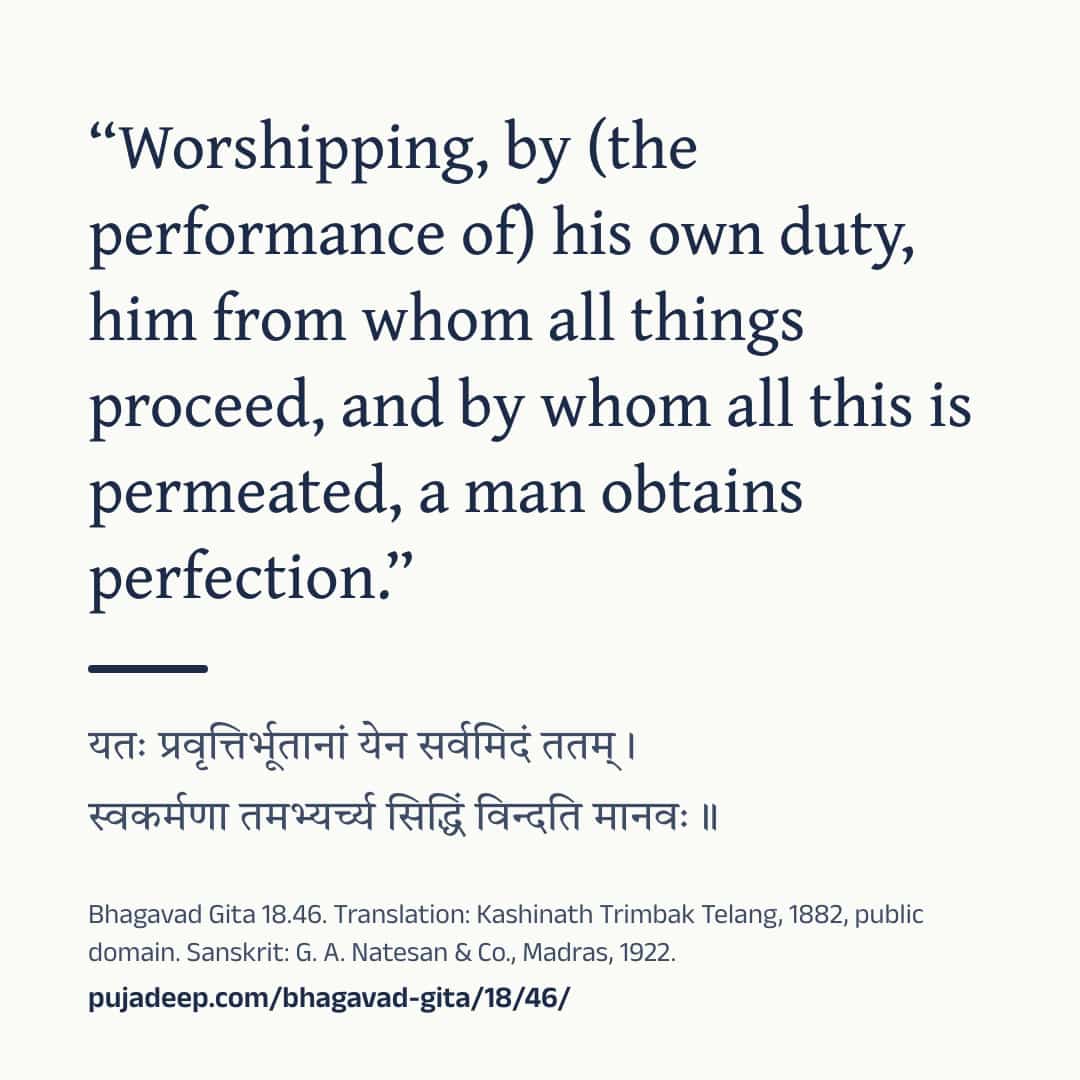
यतः प्रवृत्तिर्भूतानां येन सर्वमिदं ततम् ।स्वकर्मणा तमभ्यर्च्य सिद्धिं विन्दति मानवः ॥
Yatah pravrittirbhutanam yena sarvamidam tatamSvakarmana tamabhyarchya siddhim vindati manavah
yataḥ pravṛttirbhūtānāṃ yena sarvamidaṃ tatam |svakarmaṇā tamabhyarcya siddhiṃ vindati mānavaḥ ||
Our explanation Krishna says that a person reaches perfection by worshipping, through his own work, the one from whom all beings come forth and by whom all this is pervaded. The verse speaks of work done as worship. Readings of these verses differ between schools and teachers, and the wording is the text's, not the view of this library.
हिंदी अर्थ कृष्ण कहते हैं कि जिससे सब प्राणियों की प्रवृत्ति (उत्पत्ति) होती है और जिससे यह सब व्याप्त है, उसकी अपने कर्म से पूजा करके मनुष्य सिद्धि पाता है। यह श्लोक पूजा के रूप में किए गए कर्म की बात करता है। इन श्लोकों को अलग-अलग परंपराएँ और आचार्य अलग ढंग से पढ़ते हैं, और ये शब्द पाठ के हैं, इस पुस्तकालय का मत नहीं।
Word by word
Every word, with its dictionary page
Word by word
- यतः yataḥ · from whom (indeclinable) Dictionary: yatas, Monier-Williams 1899, p. 841, col. 2 “from which or what, whence, whereof, wherefrom”
- प्रवृत्तिः pravṛttiḥ · the coming forth (noun (feminine), nominative singular) Dictionary: pra-vṛtti, Monier-Williams 1899, p. 694, col. 1 “moving onwards, advance, progress; coming forth, appearance, manifestation”
- भूतानाम् bhūtānām · of beings (noun (neuter), genitive plural) Dictionary: bhūta, Monier-Williams 1899, p. 761, col. 3 “that which is or exists, any living being (divine, human, animal, and even vegetable)”
- येन yena · by whom (pronoun (masculine), instrumental singular) Dictionary: yad, Monier-Williams 1899, p. 844, col. 2 “who, which, what, whichever, whatever, that”
- सर्वम् sarvam · all (adjective (neuter), nominative singular) Dictionary: sarva, Monier-Williams 1899, p. 1184, col. 3 “whole, entire, all, every”
- इदम् idam · this (pronoun (neuter), nominative singular) Dictionary: 1. idam, Monier-Williams 1899, p. 165, col. 2 “this, this here, referring to something near the speaker”
- ततम् tatam · is pervaded (past participle (neuter), nominative singular) Dictionary: 2. tata, Monier-Williams 1899, p. 435, col. 1 “extended, stretched, spread, diffused, expanded”
- स्वकर्मणा svakarmaṇā · with his own work (compound (neuter), instrumental singular) Dictionary: 1. sva, Monier-Williams 1899, p. 1275, col. 1 “own, one's own, my own, thy own, his own, her own, our own, their own”; karman, Monier-Williams 1899, p. 258, col. 2 “act, action, performance, business”
- तम् tam · him (pronoun (masculine), accusative singular) Dictionary: tad, Monier-Williams 1899, p. 434, col. 1 “m. he, f. she, n. it, that, this”
- अभ्यर्च्य abhyarcya · worshipping (absolutive (having done)) Dictionary: abhy-arc, Monier-Williams 1899, p. 76, col. 1 “to worship, reverence”
- सिद्धिम् siddhim · perfection (noun (feminine), accusative singular) Dictionary: 2. siddhi, Monier-Williams 1899, p. 1216, col. 2 “final emancipation, perfection”
- विन्दति vindati · finds (present, 3rd person singular) Dictionary: 3. vid, Monier-Williams 1899, p. 964, col. 3 “to find, discover, meet or fall in with, obtain, get, acquire”
- मानवः mānavaḥ · a person (noun (masculine), nominative singular) Dictionary: mānava, Monier-Williams 1899, p. 809, col. 3 “a human being, man”
Old translations
Kashinath Trimbak Telang, 1882. Public domain. Page 127.
Worshipping, by (the performance of) his own duty, him from whom all things proceed, and by whom all this is permeated, a man obtains perfection.
Compare 3 translations
Kashinath Trimbak Telang, 1882. Public domain. Page 127.
Worshipping, by (the performance of) his own duty, him from whom all things proceed, and by whom all this is permeated, a man obtains perfection.
You are reading this one
Annie Besant, 1895. Public domain. Page 161.
THAT, the forth-giver1 of beings, by Whom all This is spread out, by worshipping Him in his own Karma a man winneth perfection.
Footnotes (the translator’s own) - "Pravritti" is taken by some to mean "movement." ↩
You are reading this one
Swami Swarupananda, 1909 (first printed 1907). Public domain. Page 339.
From Whom is the evolution of all beings, by Whom all this is pervaded, worshipping Him with his own duty, a man attains perfection.
You are reading this one
Cite this verse
The translation: K. T. Telang, The Bhagavadgîtâ (The Sacred Books of the East, vol. VIII, Oxford: Clarendon Press, 1882), p. 127. Bhagavad Gita 18.46.
The translation: Annie Besant, The Bhagavad Gîtâ, or The Lord's Song (London: Theosophical Publishing Society, 1895), p. 161. Bhagavad Gita 18.46.
The translation: Swami Swarupananda, Srimad-Bhagavad-Gita (Mayavati: Prabuddha Bharata Press, 1909; first printed in Prabuddha Bharata, 1907–1909), p. 339. Bhagavad Gita 18.46.
Our explanation: “Bhagavad Gita 18.46: meaning and translation.” Pujadeep. Updated October 25, 2026. https://pujadeep.com/bhagavad-gita/18/46/
Pujadeep’s explanations are free to quote with credit: name Pujadeep and link to the page. How to credit
Classical readings, by school
No readings by school on this verse yet.
Share
Show the ways to share
Send one picture or the text to one chat. The picture names its source and the address of this page.
Drawing the picture
See the words
Bhagavad Gita 18.46

यतः प्रवृत्तिर्भूतानां येन सर्वमिदं ततम् ।
स्वकर्मणा तमभ्यर्च्य सिद्धिं विन्दति मानवः ॥

“Worshipping, by (the performance of) his own duty, him from whom all things proceed, and by whom all this is permeated, a man obtains perfection.”
(K. T. Telang, The Bhagavadgîtâ (The Sacred Books of the East, vol. VIII, Oxford: Clarendon Press, 1882), p. 127, public domain)

“THAT, the forth-giver of beings, by Whom all This is spread out, by worshipping Him in his own Karma a man winneth perfection.”
(Annie Besant, The Bhagavad Gîtâ, or The Lord's Song (London: Theosophical Publishing Society, 1895), p. 161, public domain)

“From Whom is the evolution of all beings, by Whom all this is pervaded, worshipping Him with his own duty, a man attains perfection.”
(Swami Swarupananda, Srimad-Bhagavad-Gita (Mayavati: Prabuddha Bharata Press, 1909; first printed in Prabuddha Bharata, 1907–1909), p. 339, public domain)

Sanskrit: G. A. Natesan & Co., Madras, 1922.
https://pujadeep.com/bhagavad-gita/18/46/ Nothing is sent from this site. Your own app sends it, to the chat you choose. The picture quotes the translation you chose on this page, with its name and year.
Sanskrit text: The Bhagavad-Gita, or The Lord's Song, with the text in Devanagari and an English translation, 1922. Meanings: written for Pujadeep and checked against the cited edition. Source and changes
Questions families ask
Who speaks Bhagavad Gita 18.46?
Krishna speaks this verse, in chapter 18 (Moksha Sannyasa Yoga).
Where does the Sanskrit text come from?
Sanskrit text: The Bhagavad-Gita, or The Lord's Song, with the text in Devanagari and an English translation, 1922. Meanings: written for Pujadeep and checked against the cited edition. See the source
Is the meaning on this page a translation?
Explanation written for this site from the sources listed here, and checked against the cited edition. It is not a translation and not the only way to read the text. Free to quote with credit.
Source and licence
- Sanskrit text
- The Bhagavad-Gita, or The Lord's Song, with the text in Devanagari and an English translation (Annie Besant, G. A. Natesan & Co., Madras, 1922). Public domain. The Sanskrit on these pages was read from this printing’s page images.
- Translation
- The Bhagavadgîtâ with the Sanatsugâtîya and the Anugîtâ, translated by Kâshinâth Trimbak Telang (The Sacred Books of the East, vol. VIII, ed. F. Max Müller) (Kashinath Trimbak Telang, F. Max Müller, Clarendon Press, Oxford, 1882). Public domain. Shown verbatim, as printed.
- Translation
- The Bhagavad Gîtâ, or The Lord's Song, translated by Annie Besant (Annie Besant, Theosophical Publishing Society, London, 1895). Public domain. Shown verbatim, as printed.
- Translation
- Srimad-Bhagavad-Gita, with Sanskrit Text; Paraphrase with Word-by-word Literal Translation; English Rendering and Comments, Index, &c., by the Swami Swarupananda (Himalayan Series, No. XX) (Swami Swarupananda, The Editors and Publishers, Advaita Ashrama, Mayavati, Prabuddha Bharata Press, Mayavati, Almora, Himalayas, 1909). Public domain. Shown verbatim, as printed.
- Common wording
- In this text, 32 words follow today's common wording, checked against sanskritdocuments.org; Sanskrit Wikisource; Gita Press, Gorakhpur; GRETIL, Göttingen and Bhaktivedanta Book Trust.
- Our explanation
- Explanation written for this site from the sources listed here, and checked against the cited edition. It is not a translation and not the only way to read the text. Free to quote with credit.
- Checked
- Checked against the cited edition, October 15, 2026.
- Updated
- October 25, 2026