Bhagavad Gita 18.49: meaning and translation
Chapter 18: Moksha Sannyasa Yoga. Krishna says
Krishna says that one whose understanding is unattached everywhere, who has mastered himself and is free of longing, reaches through renunciation (sannyāsa) the highest perfection of freedom from action (naiṣkarmya).
Click or tap a word for its meaning and its dictionary page.
Text and layers
Text and layers
These choices stay in this browser.
Bhagavad Gita 18.49
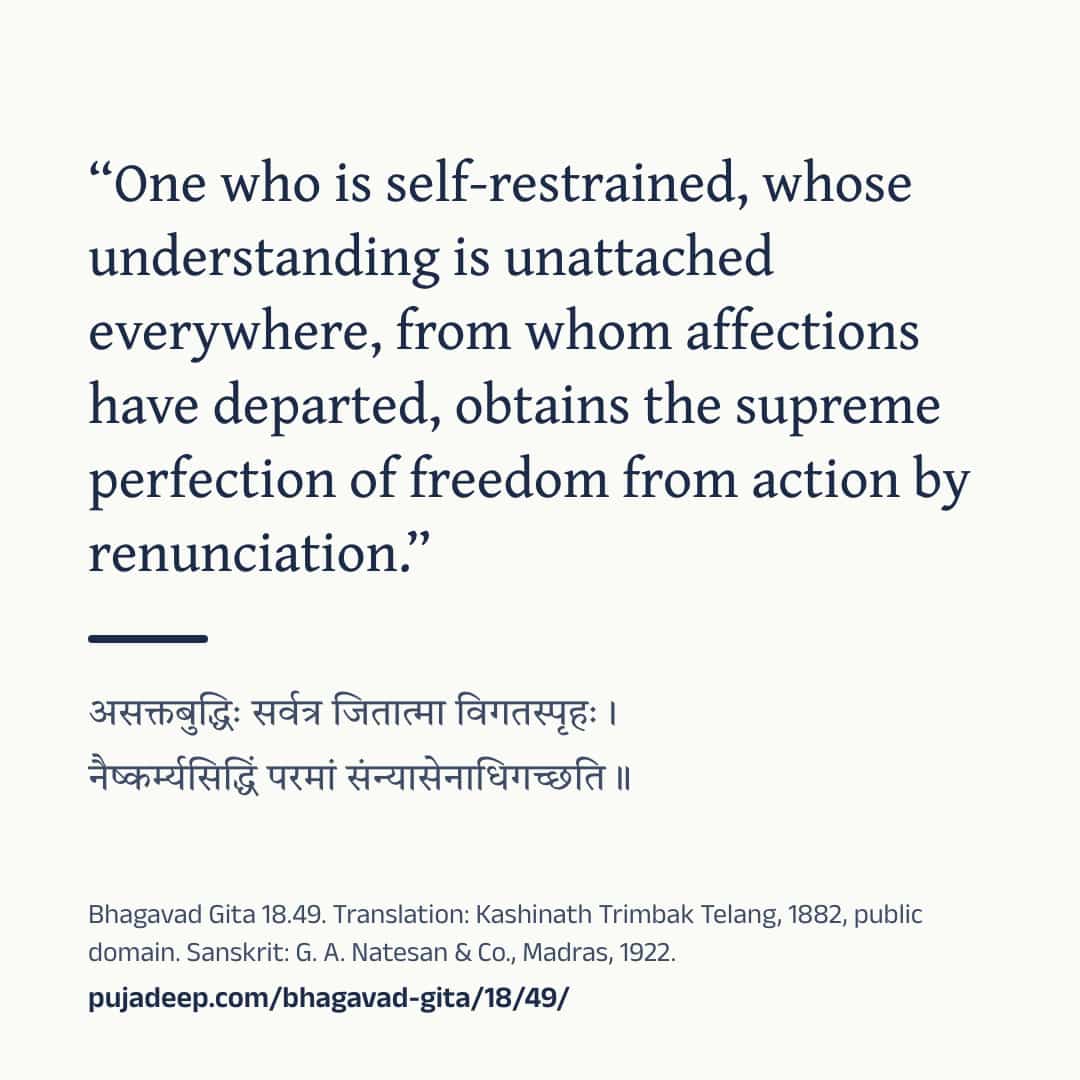
असक्तबुद्धिः सर्वत्र जितात्मा विगतस्पृहः ।नैष्कर्म्यसिद्धिं परमां संन्यासेनाधिगच्छति ॥
Asaktabuddhih sarvatra jitatma vigatasprihahNaishkarmyasiddhim paramam sannyasenadhigachchhati
asaktabuddhiḥ sarvatra jitātmā vigataspṛhaḥ |naiṣkarmyasiddhiṃ paramāṃ saṃnyāsenādhigacchati ||
Our explanation Krishna says that one whose understanding is unattached everywhere, who has mastered himself and is free of longing, reaches through renunciation (sannyāsa) the highest perfection of freedom from action (naiṣkarmya).
हिंदी अर्थ कृष्ण कहते हैं कि जिसकी बुद्धि सब जगह अनासक्त है, जिसने अपने को जीत लिया है और जिसकी कामनाएँ चली गई हैं, वह संन्यास के द्वारा नैष्कर्म्य (कर्म-बंधन से मुक्ति) की परम सिद्धि पाता है।
Word by word
Every word, with its dictionary page
Word by word
- असक्तबुद्धिः asaktabuddhiḥ · whose mind is unattached (compound (masculine), nominative singular) Dictionary: a-sakta, Monier-Williams 1899, p. 118, col. 1 “detached from worldly feelings or passions, unattached or indifferent to (loc.)”; buddhi, Monier-Williams 1899, p. 733, col. 3 “intelligence, reason, intellect, mind, discernment, judgment”
- सर्वत्र sarvatra · everywhere (indeclinable) Dictionary: sarvatra, Monier-Williams 1899, p. 1189, col. 2 “everywhere, in every case, always, at all times”
- जितात्मा jitātmā · self-mastered (compound (masculine), nominative singular) Dictionary: jitātman, Monier-Williams 1899, p. 420, col. 3 “self-subdued”
- विगतस्पृहः vigataspṛhaḥ · free from longing (compound (masculine), nominative singular) Dictionary: vi-gata-spṛha, Monier-Williams 1899, p. 957, col. 1 “devoid of wish or desire, indifferent”
- नैष्कर्म्यसिद्धिम् naiṣkarmyasiddhim · the perfection of freedom from action (compound (feminine), accusative singular) Dictionary: naiṣkarmya, Monier-Williams 1899, p. 570, col. 2 “inactivity, abstinence or exemption from acts and their consequences”; 2. siddhi, Monier-Williams 1899, p. 1216, col. 2 “final emancipation, perfection”
- परमाम् paramām · highest (adjective (feminine), accusative singular) Dictionary: parama, Monier-Williams 1899, p. 588, col. 1 “chief, highest, primary, most prominent or conspicuous; best, most excellent”
- संन्यासेन saṃnyāsena · by renunciation (noun (masculine), instrumental singular) Dictionary: saṃ-nyāsa, Monier-Williams 1899, p. 1148, col. 1 “renunciation of the world, profession of asceticism”
- अधिगच्छति adhigacchati · attains (present, 3rd person singular) Dictionary: adhi-gam, Monier-Williams 1899, p. 20, col. 3 “to meet, find, discover, obtain”
Old translations
Kashinath Trimbak Telang, 1882. Public domain. Page 127.
One who is self-restrained, whose understanding is unattached everywhere, from whom affections have departed, obtains the supreme perfection of freedom from action1 by renunciation.
Footnotes (the translator’s own) - Srîdhara compares p. 65 (V, 13) and distinguishes this from p. 64 (V, 8 seq.) Saṅkara says the perfection here spoken of is emancipation, and it is obtained by true knowledge. ↩
Compare 3 translations
Kashinath Trimbak Telang, 1882. Public domain. Page 127.
One who is self-restrained, whose understanding is unattached everywhere, from whom affections have departed, obtains the supreme perfection of freedom from action1 by renunciation.
Footnotes (the translator’s own) - Srîdhara compares p. 65 (V, 13) and distinguishes this from p. 64 (V, 8 seq.) Saṅkara says the perfection here spoken of is emancipation, and it is obtained by true knowledge. ↩
You are reading this one
Annie Besant, 1895. Public domain. Page 162.
He whose Buddhi is everywhere unattached, the self subdued, dead to desires, he goeth to the supreme perfection of freedom from Karma by Renunciation.
You are reading this one
Swami Swarupananda, 1909 (first printed 1907). Public domain. Page 341.
He whose intellect is unattached everywhere, who has subdued his heart, whose desires have fled, he attains to the supreme perfection, consisting of freedom from action by renunciation.
You are reading this one
Cite this verse
The translation: K. T. Telang, The Bhagavadgîtâ (The Sacred Books of the East, vol. VIII, Oxford: Clarendon Press, 1882), p. 127. Bhagavad Gita 18.49.
The translation: Annie Besant, The Bhagavad Gîtâ, or The Lord's Song (London: Theosophical Publishing Society, 1895), p. 162. Bhagavad Gita 18.49.
The translation: Swami Swarupananda, Srimad-Bhagavad-Gita (Mayavati: Prabuddha Bharata Press, 1909; first printed in Prabuddha Bharata, 1907–1909), p. 341. Bhagavad Gita 18.49.
Our explanation: “Bhagavad Gita 18.49: meaning and translation.” Pujadeep. Updated October 25, 2026. https://pujadeep.com/bhagavad-gita/18/49/
Pujadeep’s explanations are free to quote with credit: name Pujadeep and link to the page. How to credit
Classical readings, by school
No readings by school on this verse yet.
Share
Show the ways to share
Send one picture or the text to one chat. The picture names its source and the address of this page.
Drawing the picture
See the words
Bhagavad Gita 18.49

असक्तबुद्धिः सर्वत्र जितात्मा विगतस्पृहः ।
नैष्कर्म्यसिद्धिं परमां संन्यासेनाधिगच्छति ॥

“One who is self-restrained, whose understanding is unattached everywhere, from whom affections have departed, obtains the supreme perfection of freedom from action by renunciation.”
(K. T. Telang, The Bhagavadgîtâ (The Sacred Books of the East, vol. VIII, Oxford: Clarendon Press, 1882), p. 127, public domain)

“He whose Buddhi is everywhere unattached, the self subdued, dead to desires, he goeth to the supreme perfection of freedom from Karma by Renunciation.”
(Annie Besant, The Bhagavad Gîtâ, or The Lord's Song (London: Theosophical Publishing Society, 1895), p. 162, public domain)

“He whose intellect is unattached everywhere, who has subdued his heart, whose desires have fled, he attains to the supreme perfection, consisting of freedom from action by renunciation.”
(Swami Swarupananda, Srimad-Bhagavad-Gita (Mayavati: Prabuddha Bharata Press, 1909; first printed in Prabuddha Bharata, 1907–1909), p. 341, public domain)

Sanskrit: G. A. Natesan & Co., Madras, 1922.
https://pujadeep.com/bhagavad-gita/18/49/ Nothing is sent from this site. Your own app sends it, to the chat you choose. The picture quotes the translation you chose on this page, with its name and year.
Sanskrit text: The Bhagavad-Gita, or The Lord's Song, with the text in Devanagari and an English translation, 1922. Meanings: written for Pujadeep and checked against the cited edition. Source and changes
Questions families ask
Who speaks Bhagavad Gita 18.49?
Krishna speaks this verse, in chapter 18 (Moksha Sannyasa Yoga).
Where does the Sanskrit text come from?
Sanskrit text: The Bhagavad-Gita, or The Lord's Song, with the text in Devanagari and an English translation, 1922. Meanings: written for Pujadeep and checked against the cited edition. See the source
Is the meaning on this page a translation?
Explanation written for this site from the sources listed here, and checked against the cited edition. It is not a translation and not the only way to read the text. Free to quote with credit.
Source and licence
- Sanskrit text
- The Bhagavad-Gita, or The Lord's Song, with the text in Devanagari and an English translation (Annie Besant, G. A. Natesan & Co., Madras, 1922). Public domain. The Sanskrit on these pages was read from this printing’s page images.
- Translation
- The Bhagavadgîtâ with the Sanatsugâtîya and the Anugîtâ, translated by Kâshinâth Trimbak Telang (The Sacred Books of the East, vol. VIII, ed. F. Max Müller) (Kashinath Trimbak Telang, F. Max Müller, Clarendon Press, Oxford, 1882). Public domain. Shown verbatim, as printed.
- Translation
- The Bhagavad Gîtâ, or The Lord's Song, translated by Annie Besant (Annie Besant, Theosophical Publishing Society, London, 1895). Public domain. Shown verbatim, as printed.
- Translation
- Srimad-Bhagavad-Gita, with Sanskrit Text; Paraphrase with Word-by-word Literal Translation; English Rendering and Comments, Index, &c., by the Swami Swarupananda (Himalayan Series, No. XX) (Swami Swarupananda, The Editors and Publishers, Advaita Ashrama, Mayavati, Prabuddha Bharata Press, Mayavati, Almora, Himalayas, 1909). Public domain. Shown verbatim, as printed.
- Common wording
- In this text, 32 words follow today's common wording, checked against sanskritdocuments.org; Sanskrit Wikisource; Gita Press, Gorakhpur; GRETIL, Göttingen and Bhaktivedanta Book Trust.
- Our explanation
- Explanation written for this site from the sources listed here, and checked against the cited edition. It is not a translation and not the only way to read the text. Free to quote with credit.
- Checked
- Checked against the cited edition, October 15, 2026.
- Updated
- October 25, 2026