Bhagavad Gita 18.57: meaning and translation
Chapter 18: Moksha Sannyasa Yoga. Krishna says
Krishna now speaks to Arjuna directly.
Click or tap a word for its meaning and its dictionary page.
Text and layers
Text and layers
These choices stay in this browser.
Bhagavad Gita 18.57
चेतसा सर्वकर्माणि मयि संन्यस्य मत्परः ।बुद्धियोगमुपाश्रित्य मच्चित्तः सततं भव ॥
Chetasa sarvakarmani mayi sannyasya matparahBuddhiyogamupashritya machchittah satatam bhava
cetasā sarvakarmāṇi mayi saṃnyasya matparaḥ |buddhiyogamupāśritya maccittaḥ satataṃ bhava ||
Our explanation Krishna now speaks to Arjuna directly. He tells him to give up all actions to him in thought, to make him the highest aim, to rely on the yoga of understanding (buddhi-yoga), and to keep his mind always on him.
हिंदी अर्थ अब कृष्ण सीधे अर्जुन से कहते हैं कि वे मन से सब कर्म उन्हें अर्पित करें, उन्हें ही परम लक्ष्य मानें, बुद्धियोग का आश्रय लें और सदा अपना चित्त उनमें लगाए रखें।
Word by word
Every word, with its dictionary page
Word by word
- चेतसा cetasā · in mind (noun (neuter), instrumental singular) Dictionary: cetas, Monier-Williams 1899, p. 398, col. 1 “consciousness, intelligence, thinking soul, heart, mind”
- सर्वकर्माणि sarvakarmāṇi · all actions (compound (neuter), accusative plural) Dictionary: sarva, Monier-Williams 1899, p. 1184, col. 3 “whole, entire, all, every”; karman, Monier-Williams 1899, p. 258, col. 2 “act, action, performance, business”
- मयि mayi · to "me" (Krishna) (pronoun, locative singular) Dictionary: 1. mad, Monier-Williams 1899, p. 777, col. 2 “base of the first pers. pron. in the sg. number (esp. in comp.)”
- संन्यस्य saṃnyasya · having given over (absolutive (having done)) Dictionary: saṃ-ny-as, Monier-Williams 1899, p. 1148, col. 1 “to lay aside, give up, abandon, resign”
- मत्परः matparaḥ · with "me" (Krishna) as the goal (compound (masculine), nominative singular) Dictionary: mat-para, Monier-Williams 1899, p. 777, col. 2 “devoted to me”
- बुद्धियोगम् buddhiyogam · the yoga of understanding (compound (masculine), accusative singular) Dictionary: buddhi-yoga, Monier-Williams 1899, p. 734, col. 1 “devotion of the intellect, intellectual union with the Supreme Spirit”
- उपाश्रित्य upāśritya · relying on (absolutive (having done)) Dictionary: upā-śri, Monier-Williams 1899, p. 214, col. 3 “to take refuge or have recourse to”
- मच्चित्तः maccittaḥ · with mind on "me" (Krishna) (compound (masculine), nominative singular) Dictionary: mac-citta, Monier-Williams 1899, p. 777, col. 2 “having the mind (fixed) on me, thinking of me”
- सततम् satatam · always (indeclinable) Dictionary: sa-tata, Monier-Williams 1899, p. 1138, col. 1 “constantly, always, ever”
- भव bhava · be (imperative, 2nd person singular) Dictionary: 1. bhū, Monier-Williams 1899, p. 760, col. 2 “to become, be”
Old translations
Kashinath Trimbak Telang, 1882. Public domain. Page 128.
Dedicating in thought1 all actions to me, be constantly given up to me, (placing) your thoughts on me, through recourse to mental abstraction.
Footnotes (the translator’s own) - Cf. p. 55. ↩
Compare 3 translations
Kashinath Trimbak Telang, 1882. Public domain. Page 128.
Dedicating in thought1 all actions to me, be constantly given up to me, (placing) your thoughts on me, through recourse to mental abstraction.
Footnotes (the translator’s own) - Cf. p. 55. ↩
You are reading this one
Annie Besant, 1895. Public domain. Page 163.
Abandoning mentally all works in Me, I thy chief Good, resorting to Buddhi-Yoga, have thy thought ever on Me.
You are reading this one
Swami Swarupananda, 1909 (first printed 1907). Public domain. Page 345.
Resigning mentally all deeds in Me, having Me as the highest goal, resorting to Buddhi Yoga do thou ever fix thy mind on Me.
You are reading this one
Cite this verse
The translation: K. T. Telang, The Bhagavadgîtâ (The Sacred Books of the East, vol. VIII, Oxford: Clarendon Press, 1882), p. 128. Bhagavad Gita 18.57.
The translation: Annie Besant, The Bhagavad Gîtâ, or The Lord's Song (London: Theosophical Publishing Society, 1895), p. 163. Bhagavad Gita 18.57.
The translation: Swami Swarupananda, Srimad-Bhagavad-Gita (Mayavati: Prabuddha Bharata Press, 1909; first printed in Prabuddha Bharata, 1907–1909), p. 345. Bhagavad Gita 18.57.
Our explanation: “Bhagavad Gita 18.57: meaning and translation.” Pujadeep. Updated October 25, 2026. https://pujadeep.com/bhagavad-gita/18/57/
Pujadeep’s explanations are free to quote with credit: name Pujadeep and link to the page. How to credit
Classical readings, by school
No readings by school on this verse yet.
Share
Show the ways to share
Send one picture or the text to one chat. The picture names its source and the address of this page.
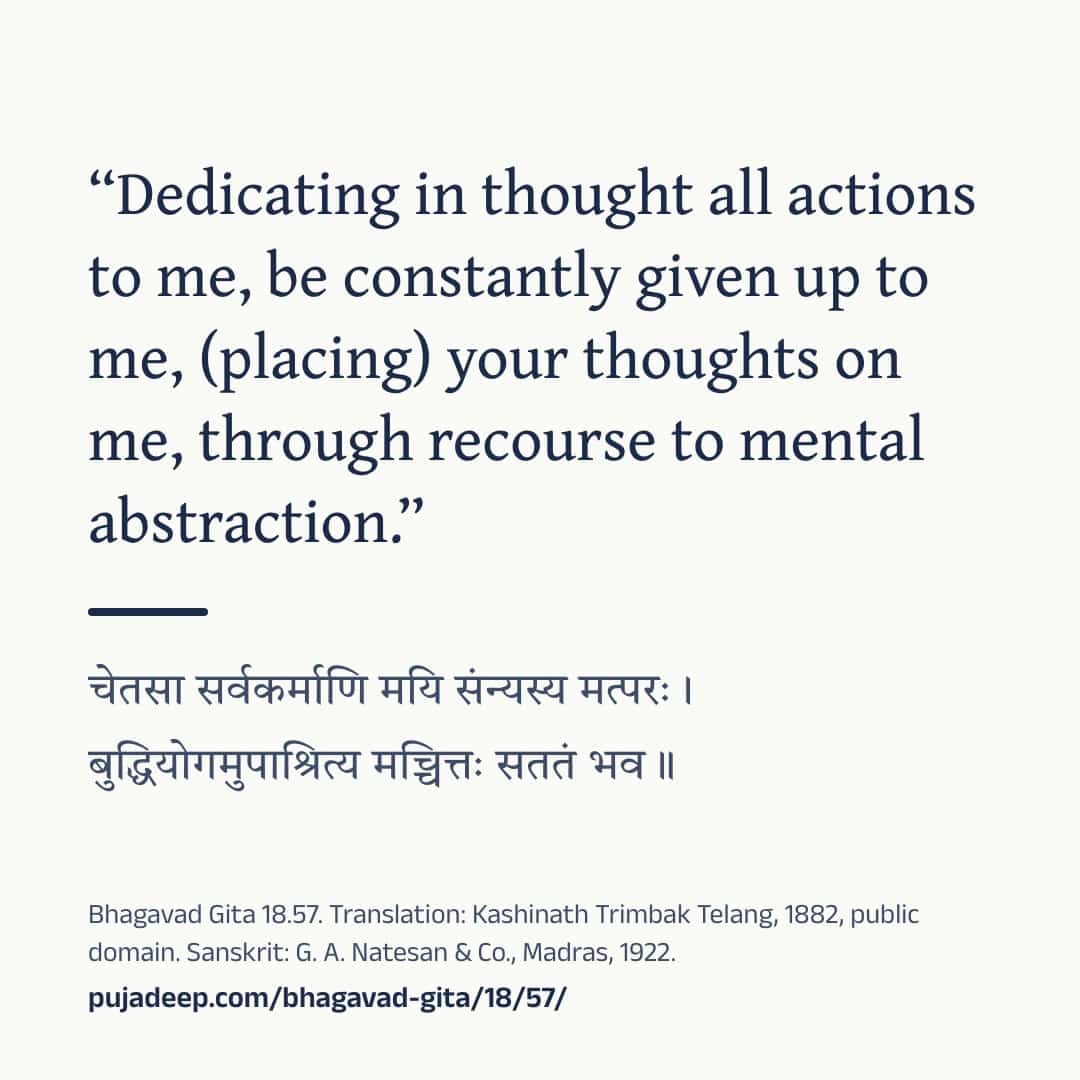
Drawing the picture
See the words
Bhagavad Gita 18.57

चेतसा सर्वकर्माणि मयि संन्यस्य मत्परः ।
बुद्धियोगमुपाश्रित्य मच्चित्तः सततं भव ॥

“Dedicating in thought all actions to me, be constantly given up to me, (placing) your thoughts on me, through recourse to mental abstraction.”
(K. T. Telang, The Bhagavadgîtâ (The Sacred Books of the East, vol. VIII, Oxford: Clarendon Press, 1882), p. 128, public domain)

“Abandoning mentally all works in Me, I thy chief Good, resorting to Buddhi-Yoga, have thy thought ever on Me.”
(Annie Besant, The Bhagavad Gîtâ, or The Lord's Song (London: Theosophical Publishing Society, 1895), p. 163, public domain)

“Resigning mentally all deeds in Me, having Me as the highest goal, resorting to Buddhi Yoga do thou ever fix thy mind on Me.”
(Swami Swarupananda, Srimad-Bhagavad-Gita (Mayavati: Prabuddha Bharata Press, 1909; first printed in Prabuddha Bharata, 1907–1909), p. 345, public domain)

Sanskrit: G. A. Natesan & Co., Madras, 1922.
https://pujadeep.com/bhagavad-gita/18/57/ Nothing is sent from this site. Your own app sends it, to the chat you choose. The picture quotes the translation you chose on this page, with its name and year.
Sanskrit text: The Bhagavad-Gita, or The Lord's Song, with the text in Devanagari and an English translation, 1922. Meanings: written for Pujadeep and checked against the cited edition. Source and changes
Questions families ask
Who speaks Bhagavad Gita 18.57?
Krishna speaks this verse, in chapter 18 (Moksha Sannyasa Yoga).
Where does the Sanskrit text come from?
Sanskrit text: The Bhagavad-Gita, or The Lord's Song, with the text in Devanagari and an English translation, 1922. Meanings: written for Pujadeep and checked against the cited edition. See the source
Is the meaning on this page a translation?
Explanation written for this site from the sources listed here, and checked against the cited edition. It is not a translation and not the only way to read the text. Free to quote with credit.
Source and licence
- Sanskrit text
- The Bhagavad-Gita, or The Lord's Song, with the text in Devanagari and an English translation (Annie Besant, G. A. Natesan & Co., Madras, 1922). Public domain. The Sanskrit on these pages was read from this printing’s page images.
- Translation
- The Bhagavadgîtâ with the Sanatsugâtîya and the Anugîtâ, translated by Kâshinâth Trimbak Telang (The Sacred Books of the East, vol. VIII, ed. F. Max Müller) (Kashinath Trimbak Telang, F. Max Müller, Clarendon Press, Oxford, 1882). Public domain. Shown verbatim, as printed.
- Translation
- The Bhagavad Gîtâ, or The Lord's Song, translated by Annie Besant (Annie Besant, Theosophical Publishing Society, London, 1895). Public domain. Shown verbatim, as printed.
- Translation
- Srimad-Bhagavad-Gita, with Sanskrit Text; Paraphrase with Word-by-word Literal Translation; English Rendering and Comments, Index, &c., by the Swami Swarupananda (Himalayan Series, No. XX) (Swami Swarupananda, The Editors and Publishers, Advaita Ashrama, Mayavati, Prabuddha Bharata Press, Mayavati, Almora, Himalayas, 1909). Public domain. Shown verbatim, as printed.
- Common wording
- In this text, 32 words follow today's common wording, checked against sanskritdocuments.org; Sanskrit Wikisource; Gita Press, Gorakhpur; GRETIL, Göttingen and Bhaktivedanta Book Trust.
- Our explanation
- Explanation written for this site from the sources listed here, and checked against the cited edition. It is not a translation and not the only way to read the text. Free to quote with credit.
- Checked
- Checked against the cited edition, October 15, 2026.
- Updated
- October 25, 2026