Bhagavad Gita 18.66: meaning and translation
Chapter 18: Moksha Sannyasa Yoga. Krishna says
Krishna says: give up all dharmas and come to him alone for refuge; he will free Arjuna from all sins; do not grieve.
Click or tap a word for its meaning and its dictionary page.
Text and layers
Text and layers
These choices stay in this browser.
Bhagavad Gita 18.66
सर्वधर्मान्परित्यज्य मामेकं शरणं व्रज ।अहं त्वा सर्वपापेभ्यो मोक्षयिष्यामि मा शुचः ॥
Sarvadharmanparityajya mamekam sharanam vrajaAham tva sarvapapebhyo mokshayishyami ma shuchah
sarvadharmānparityajya māmekaṃ śaraṇaṃ vraja |ahaṃ tvā sarvapāpebhyo mokṣayiṣyāmi mā śucaḥ ||
Our explanation Krishna says: give up all dharmas and come to him alone for refuge; he will free Arjuna from all sins; do not grieve. The verse is short and much discussed. Telang renders 'all dharmas' as 'all duties' and notes 'of caste or order'; Besant keeps 'all Dharmas'. Shankara reads it as the renunciation of all works in the knowledge of the one Self; Ramanuja reads it as doing every means as worship while giving up fruit and doership, or as giving up the rites of atonement. Madhva reads it as giving up the fruit of one's duties, and every duty not done for the Lord, and taking refuge in him. None of these readings is given here as the meaning; all three are shown in the views.
हिंदी अर्थ कृष्ण कहते हैं कि अर्जुन सब धर्मों को छोड़कर केवल उनकी शरण में आएँ; वे अर्जुन को सब पापों से मुक्त करेंगे; शोक न करें। यह श्लोक छोटा है और इस पर बहुत विचार हुआ है। तेलंग “सब धर्मों” का अनुवाद “all duties” करते हैं और टिप्पणी में “वर्ण या आश्रम के” लिखते हैं; बेसेंट “Dharmas” शब्द रखती हैं। शंकराचार्य इसे एक आत्मा के ज्ञान में सब कर्मों का संन्यास मानते हैं; रामानुजाचार्य इसे हर साधन को पूजा के रूप में, फल और कर्तापन छोड़कर, करना, या प्रायश्चित्त-कर्मों को छोड़ना मानते हैं। मध्वाचार्य इसे अपने कर्तव्यों का फल छोड़ना, और भगवान के लिए न किए गए हर कर्म को छोड़कर उनकी शरण लेना मानते हैं। यहाँ इनमें से किसी एक को सही नहीं ठहराया गया; तीनों मत नीचे दिए गए हैं।
Word by word
Every word, with its dictionary page
Word by word
- सर्वधर्मान् sarvadharmān · all dharmas, all duties (compound (masculine), accusative plural) Dictionary: sarva, Monier-Williams 1899, p. 1184, col. 3 “whole, entire, all, every”; 1. dharma, Monier-Williams 1899, p. 510, col. 3 “usage, practice, customary observance or prescribed conduct, duty”
- परित्यज्य parityajya · giving up (absolutive (having done)) Dictionary: pari-tyaj, Monier-Williams 1899, p. 595, col. 2 “to leave, quit, abandon, give up, reject, disregard, not heed”
- माम् mām · to "me" (Krishna) (pronoun, accusative singular) Dictionary: 1. mad, Monier-Williams 1899, p. 777, col. 2 “base of the first pers. pron. in the sg. number (esp. in comp.)”
- एकम् ekam · alone (adjective (masculine), accusative singular) Dictionary: eka, Monier-Williams 1899, p. 227, col. 3 “one”
- शरणम् śaraṇam · refuge (noun (neuter), accusative singular) Dictionary: 2. śaraṇa, Monier-Williams 1899, p. 1057, col. 1 “refuge, protection”
- व्रज vraja · go (imperative, 2nd person singular) Dictionary: vraj, Monier-Williams 1899, p. 1041, col. 3 “to go, walk, proceed, travel, wander, move”
- अहम् aham · "I" (Krishna) (pronoun, nominative singular) Dictionary: aham, Monier-Williams 1899, p. 124, col. 2 “nom. sg. ‘I,’”
- त्वा tvā · you (pronoun, accusative singular) Dictionary: 2. tva, Monier-Williams 1899, p. 463, col. 2 “base of the 2nd personal pron.”
- सर्वपापेभ्यः sarvapāpebhyaḥ · from all sins (compound (neuter), ablative plural) Dictionary: sarva, Monier-Williams 1899, p. 1184, col. 3 “whole, entire, all, every”; pāpa, Monier-Williams 1899, p. 618, col. 2 “sin, vice, crime, guilt”
- मोक्षयिष्यामि mokṣayiṣyāmi · will set free (causative future, 1st person singular) Dictionary: 2. muc, Monier-Williams 1899, p. 820, col. 3 “to set free, liberate, absolve from (abl.)”
- मा mā · do not (indeclinable) Dictionary: 1. mā, Monier-Williams 1899, p. 804, col. 1 “a particle of prohibition or negation”
- शुचः śucaḥ · grieve (aorist (with mā: do not), 2nd person singular) Dictionary: 1. śuc, Monier-Williams 1899, p. 1081, col. 1 “be sorrowful or afflicted, grieve, mourn at or for”
Old translations
Kashinath Trimbak Telang, 1882. Public domain. Page 129.
Forsaking all duties1, come to me as (your) sole refuge. I will release you from all sins. Be not grieved.
Footnotes (the translator’s own) - Of caste or order, such as Agnihotra and so forth. ↩
Compare 3 translations
Kashinath Trimbak Telang, 1882. Public domain. Page 129.
Forsaking all duties1, come to me as (your) sole refuge. I will release you from all sins. Be not grieved.
Footnotes (the translator’s own) - Of caste or order, such as Agnihotra and so forth. ↩
You are reading this one
Annie Besant, 1895. Public domain. Page 165.
Renouncing all Dharmas, come unto Me alone for shelter; sorrow not, I will liberate thee from all sins.
You are reading this one
Swami Swarupananda, 1909 (first printed 1907). Public domain. Page 348.
Relinquishing all Dharmas, take refuge in Me alone; I will liberate thee from all sins; grieve not.
You are reading this one
Cite this verse
The translation: K. T. Telang, The Bhagavadgîtâ (The Sacred Books of the East, vol. VIII, Oxford: Clarendon Press, 1882), p. 129. Bhagavad Gita 18.66.
The translation: Annie Besant, The Bhagavad Gîtâ, or The Lord's Song (London: Theosophical Publishing Society, 1895), p. 165. Bhagavad Gita 18.66.
The translation: Swami Swarupananda, Srimad-Bhagavad-Gita (Mayavati: Prabuddha Bharata Press, 1909; first printed in Prabuddha Bharata, 1907–1909), p. 348. Bhagavad Gita 18.66.
Our explanation: “Bhagavad Gita 18.66: meaning and translation.” Pujadeep. Updated October 25, 2026. https://pujadeep.com/bhagavad-gita/18/66/
Pujadeep’s explanations are free to quote with credit: name Pujadeep and link to the page. How to credit
Classical readings, by school
Each reading is named by its school. None is presented as the only meaning.
What Advaita, Vishishtadvaita and Dvaita teach, in short
Shankara Advaita
Shankara says 'all dharmas' includes adharma too, because the verse teaches freedom from all action (naiṣkarmya): it means renouncing all works. To take the Lord alone as refuge is to know that one's own Self is that Lord and that there is nothing else; then the Lord frees the seeker from the bonds of both dharma and adharma by showing himself as the seeker's own Self. In a long discussion that follows, he argues that knowledge of the Self alone, not works and not works joined with knowledge, is the means to the highest good.
Source: The Bhagavad-Gita, with the commentary of Sri Sankaracharya, translated by A. Mahadeva Sastri (2nd ed., Mysore: G. T. A. Printing Works, 1901), commentary on 18.66, pp. 453–455 (the discussion runs to p. 473). Summarised in our own words; none of its text is reproduced.
Ramanuja Vishishtadvaita
Ramanuja says 'all dharmas' are the means to liberation taught in the Gita: karma-yoga, jñāna-yoga and bhakti-yoga. To 'give them up' is to practise them as worship of the Lord while giving up their fruit, the sense of owning the act and the sense of being its doer, as 18.4–18.11 taught; to take him as refuge is to see him as the doer, the one worshipped, the goal and the means. He gives a second reading: Arjuna feared that his past sins barred him from bhakti-yoga, so Krishna tells him to give up the many rites of atonement and take refuge in him alone, and he will remove those sins. The translator's note (p. 563) adds that the school counts the verse among its three 'mysteries' (rahasyas), and that beside the usual reading, bhakti, which Ramanuja gives here, it is read as teaching prapatti, surrender.
Source: Sri Bhagavad-Gita with Sri Ramanujacharya's Visishtadvaita commentary, translated by A. Govindacharya (Madras, 1898), commentary on 18.66, pp. 563–565. Summarised in our own words; none of its text is reproduced.
Madhva Dvaita
Madhva says the verse cannot mean giving up all duties outright, since the whole teaching ends by urging Arjuna to fight. 'Giving up all dharmas' means two things: giving up the fruit of the duties one does, and giving up every duty not done for the Lord's pleasure. Going to him alone for refuge is śaraṇāgati, surrender to Vishnu, which he describes as knowing the Lord's supremacy, setting the mind on him, loving him above all, offering everything to him, trusting that he protects, and always remembering that one belongs to him. Sins gathered over beginningless time stand in the way, but the Lord promises to free Arjuna from their effects.
Source: The Bhagavad-Gita: translation and commentaries in English according to Sri Madhwacharya's Bhashyas, by S. Subba Rau (Madras, 1906), commentary on 18.66, pp. 313–314 (leaves n311–n312). Summarised in our own words; none of its text is reproduced.
This verse is on our page of well-known Gita verses, by theme
Share
Show the ways to share
Send one picture or the text to one chat. The picture names its source and the address of this page.
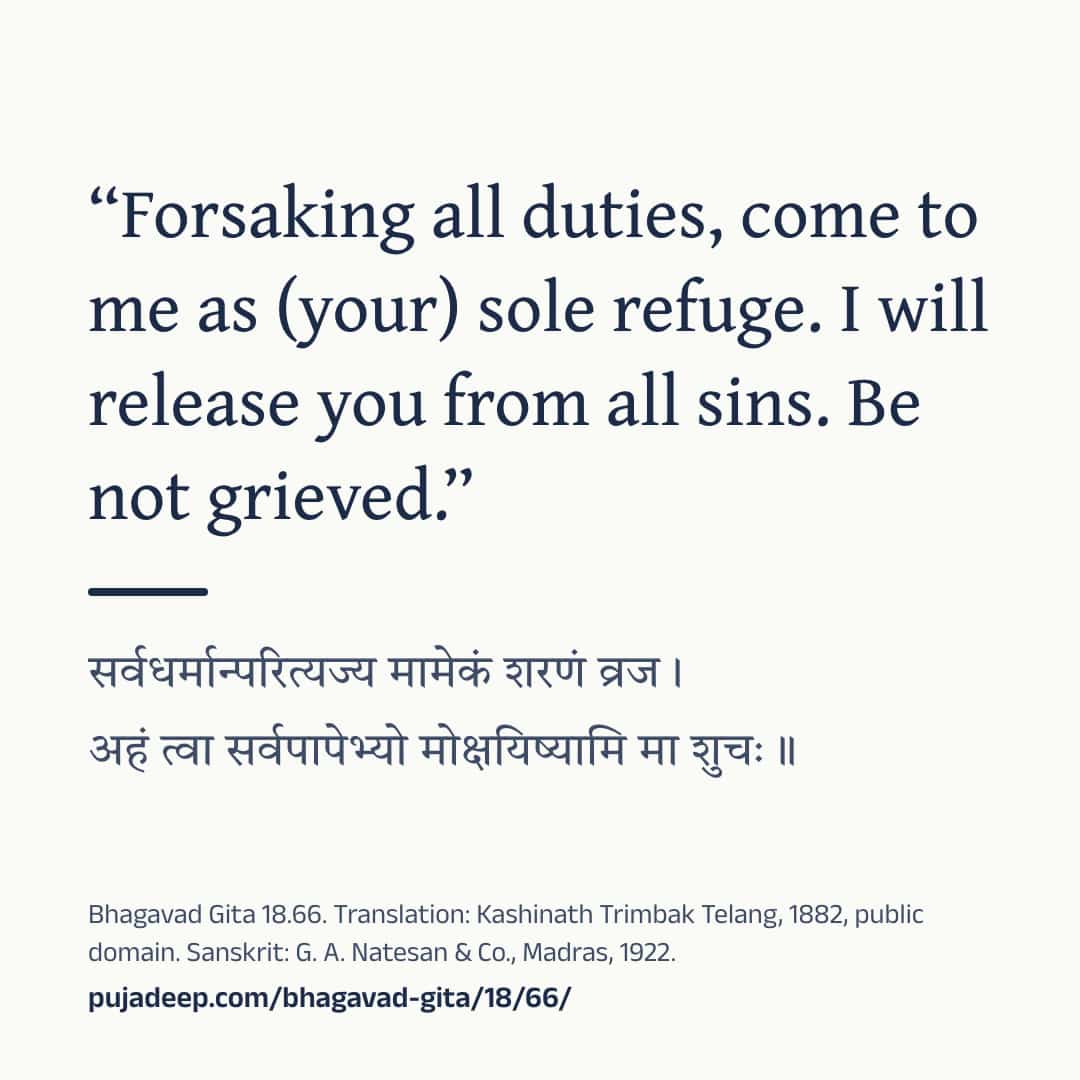
Drawing the picture
See the words
Bhagavad Gita 18.66

सर्वधर्मान्परित्यज्य मामेकं शरणं व्रज ।
अहं त्वा सर्वपापेभ्यो मोक्षयिष्यामि मा शुचः ॥

“Forsaking all duties, come to me as (your) sole refuge. I will release you from all sins. Be not grieved.”
(K. T. Telang, The Bhagavadgîtâ (The Sacred Books of the East, vol. VIII, Oxford: Clarendon Press, 1882), p. 129, public domain)

“Renouncing all Dharmas, come unto Me alone for shelter; sorrow not, I will liberate thee from all sins.”
(Annie Besant, The Bhagavad Gîtâ, or The Lord's Song (London: Theosophical Publishing Society, 1895), p. 165, public domain)

“Relinquishing all Dharmas, take refuge in Me alone; I will liberate thee from all sins; grieve not.”
(Swami Swarupananda, Srimad-Bhagavad-Gita (Mayavati: Prabuddha Bharata Press, 1909; first printed in Prabuddha Bharata, 1907–1909), p. 348, public domain)

Sanskrit: G. A. Natesan & Co., Madras, 1922.
https://pujadeep.com/bhagavad-gita/18/66/ Nothing is sent from this site. Your own app sends it, to the chat you choose. The picture quotes the translation you chose on this page, with its name and year.
Sanskrit text: The Bhagavad-Gita, or The Lord's Song, with the text in Devanagari and an English translation, 1922. Meanings: written for Pujadeep and checked against the cited edition. Source and changes
Questions families ask
Who speaks Bhagavad Gita 18.66?
Krishna speaks this verse, in chapter 18 (Moksha Sannyasa Yoga).
Where does the Sanskrit text come from?
Sanskrit text: The Bhagavad-Gita, or The Lord's Song, with the text in Devanagari and an English translation, 1922. Meanings: written for Pujadeep and checked against the cited edition. See the source
Is the meaning on this page a translation?
Explanation written for this site from the sources listed here, and checked against the cited edition. It is not a translation and not the only way to read the text. Free to quote with credit.
Source and licence
- Sanskrit text
- The Bhagavad-Gita, or The Lord's Song, with the text in Devanagari and an English translation (Annie Besant, G. A. Natesan & Co., Madras, 1922). Public domain. The Sanskrit on these pages was read from this printing’s page images.
- Translation
- The Bhagavadgîtâ with the Sanatsugâtîya and the Anugîtâ, translated by Kâshinâth Trimbak Telang (The Sacred Books of the East, vol. VIII, ed. F. Max Müller) (Kashinath Trimbak Telang, F. Max Müller, Clarendon Press, Oxford, 1882). Public domain. Shown verbatim, as printed.
- Translation
- The Bhagavad Gîtâ, or The Lord's Song, translated by Annie Besant (Annie Besant, Theosophical Publishing Society, London, 1895). Public domain. Shown verbatim, as printed.
- Translation
- Srimad-Bhagavad-Gita, with Sanskrit Text; Paraphrase with Word-by-word Literal Translation; English Rendering and Comments, Index, &c., by the Swami Swarupananda (Himalayan Series, No. XX) (Swami Swarupananda, The Editors and Publishers, Advaita Ashrama, Mayavati, Prabuddha Bharata Press, Mayavati, Almora, Himalayas, 1909). Public domain. Shown verbatim, as printed.
- Commentary
- The Bhagavad-Gita, with the commentary of Sri Sankaracharya, translated by A. Mahadeva Sastri (2nd ed., Mysore: G. T. A. Printing Works, 1901) (Public-domain scan, University of California Libraries). Summarised in our own words; none of its text is reproduced.
- Commentary
- Sri Bhagavad-Gita with Sri Ramanujacharya's Visishtadvaita commentary, translated by A. Govindacharya (Madras, 1898) (Scan uploaded to archive.org (folkscanomy collection)). Summarised in our own words; none of its text is reproduced.
- Commentary
- The Bhagavad-Gita: translation and commentaries in English according to Sri Madhwacharya's Bhashyas, by S. Subba Rau (Madras, 1906) (Scan uploaded to archive.org (folkscanomy collection)). Summarised in our own words; none of its text is reproduced.
- Common wording
- In this text, 32 words follow today's common wording, checked against sanskritdocuments.org; Sanskrit Wikisource; Gita Press, Gorakhpur; GRETIL, Göttingen and Bhaktivedanta Book Trust.
- Our explanation
- Explanation written for this site from the sources listed here, and checked against the cited edition. It is not a translation and not the only way to read the text. Free to quote with credit.
- Checked
- Checked against the cited edition, October 15, 2026.
- Updated
- October 25, 2026