Bhagavad Gita 18.72: meaning and translation
Chapter 18: Moksha Sannyasa Yoga. Krishna says
Krishna asks Arjuna, son of Pritha, whether he has heard this with a focused mind, and whether his confusion born of ignorance has been destroyed.
Click or tap a word for its meaning and its dictionary page.
Text and layers
Text and layers
These choices stay in this browser.
Bhagavad Gita 18.72
कच्चिदेतच्छ्रुतं पार्थ त्वयैकाग्रेण चेतसा ।कच्चिदज्ञानसम्मोहः प्रनष्टस्ते धनञ्जय ॥
Kachchidetachchhrutam partha tvayaikagrena chetasaKachchidajnanasammohah pranashtaste dhananjaya
kaccidetacchrutaṃ pārtha tvayaikāgreṇa cetasā |kaccidajñānasammohaḥ pranaṣṭaste dhanañjaya ||
Our explanation Krishna asks Arjuna, son of Pritha, whether he has heard this with a focused mind, and whether his confusion born of ignorance has been destroyed.
हिंदी अर्थ कृष्ण अर्जुन (पार्थ) से पूछते हैं कि क्या उन्होंने यह एकाग्र मन से सुना, और क्या अज्ञान से उत्पन्न उनका मोह नष्ट हो गया।
Word by word
Every word, with its dictionary page
Word by word
- कच्चित् kaccit · "I hope" that (indeclinable) Dictionary: 2. kad, Monier-Williams 1899, p. 247, col. 3 “kaccid may be translated by ‘I hope that;’”
- एतत् etat · this (pronoun (neuter), nominative singular) Dictionary: etad, Monier-Williams 1899, p. 231, col. 2 “this, this here, here”
- श्रुतम् śrutam · has been heard (past participle (neuter), nominative singular) Dictionary: śruta, Monier-Williams 1899, p. 1101, col. 1 “heard, listened to, heard about or of, taught”
- पार्थ pārtha · O son of Pritha (noun (masculine), vocative singular) Dictionary: 2. pārtha, Monier-Williams 1899, p. 621, col. 3 “metron. of Yudhi-shṭhira or Bhīma-sena or Arjuna”
- त्वया tvayā · by you (pronoun, instrumental singular) Dictionary: 2. tva, Monier-Williams 1899, p. 463, col. 2 “base of the 2nd personal pron.”
- एकाग्रेण ekāgreṇa · one-pointed (adjective (neuter), instrumental singular) Dictionary: ekāgra, Monier-Williams 1899, p. 230, col. 1 “one-pointed, having one point, fixing one's attention upon one point or object, closely attentive”
- चेतसा cetasā · with a mind (noun (neuter), instrumental singular) Dictionary: cetas, Monier-Williams 1899, p. 398, col. 1 “consciousness, intelligence, thinking soul, heart, mind”
- कच्चित् kaccit · "I hope" that (indeclinable) Dictionary: 2. kad, Monier-Williams 1899, p. 247, col. 3 “kaccid may be translated by ‘I hope that;’”
- अज्ञानसम्मोहः ajñānasammohaḥ · the confusion of ignorance (compound (masculine), nominative singular) Dictionary: a-jñāna, Monier-Williams 1899, p. 10, col. 3 “non-cognizance; ignorance”; sam-moha, Monier-Williams 1899, p. 1181, col. 1 “stupefaction, bewilderment, confusion, insensibility, unconsciousness, ignorance, folly, illusion of mind”
- प्रनष्टः pranaṣṭaḥ · has been destroyed (past participle (masculine), nominative singular) Dictionary: pra-naṣṭa, Monier-Williams 1899, p. 659, col. 3 “lost, disappeared, vanished, ceased, gone, perished, destroyed, annihilated”
- ते te · your (pronoun, genitive singular) Dictionary: 2. tva, Monier-Williams 1899, p. 463, col. 2 “base of the 2nd personal pron.”
- धनञ्जय dhanañjaya · O Dhananjaya (Arjuna) (noun (masculine), vocative singular) Dictionary: dhanaṃ-jaya, Monier-Williams 1899, p. 508, col. 2 “N. of Arjuna”
2 printings differ
Edition differences. Another printing or text reads this place differently.
- The printed edition reads: कच्चिदेतच्छ्रुतं पार्थ त्वयैकाग्रेण चेतसा ।
कच्चिदज्ञानसम्मोहः प्रणष्टस्ते धनञ्जय ॥ - Spelling The 1922 Madras printing reads: कच्चिदज्ञानसम्मोहः प्रणष्टस्ते धनञ्जय The 1922 base printing (leaf n270) writes the retroflex ण (प्रणष्टः). Retroflexion after र does not apply here: Pāṇini 8.4.36 (naśeḥ ṣāntasya) blocks it when naś ends in ṣ, and Monier-Williams (p. 659, col. 3) calls pra-ṇashṭa 'wrongly written'. Under decision 14 the display follows प्रनष्टः, printed by Gita Press (p. 201) and read in sanskritdocuments.org, GRETIL and Sanskrit Wikisource. Same word. A dot printed before प्र in this line is a speck and is not transcribed.
Old translations
Kashinath Trimbak Telang, 1882. Public domain. Page 130.
Have you listened to this, O son of Prithâ! with a mind (fixed) on (this) one point only? Has your delusion (caused) by ignorance been destroyed, O Dhanañgaya?
Compare 3 translations
Kashinath Trimbak Telang, 1882. Public domain. Page 130.
Have you listened to this, O son of Prithâ! with a mind (fixed) on (this) one point only? Has your delusion (caused) by ignorance been destroyed, O Dhanañgaya?
You are reading this one
Annie Besant, 1895. Public domain. Page 166.
I hope this is heard, O son of Pritha, with one-pointed intelligence. Is thy delusion, caused by unwisdom, destroyed, O Dhananjaya?
You are reading this one
Swami Swarupananda, 1909 (first printed 1907). Public domain. Page 352.
Has this been heard by thee, O Pártha with an attentive mind? Has the delusion of thy ignorance been destroyed, O Dhananjaya?
You are reading this one
Cite this verse
The translation: K. T. Telang, The Bhagavadgîtâ (The Sacred Books of the East, vol. VIII, Oxford: Clarendon Press, 1882), p. 130. Bhagavad Gita 18.72.
The translation: Annie Besant, The Bhagavad Gîtâ, or The Lord's Song (London: Theosophical Publishing Society, 1895), p. 166. Bhagavad Gita 18.72.
The translation: Swami Swarupananda, Srimad-Bhagavad-Gita (Mayavati: Prabuddha Bharata Press, 1909; first printed in Prabuddha Bharata, 1907–1909), p. 352. Bhagavad Gita 18.72.
Our explanation: “Bhagavad Gita 18.72: meaning and translation.” Pujadeep. Updated October 25, 2026. https://pujadeep.com/bhagavad-gita/18/72/
Pujadeep’s explanations are free to quote with credit: name Pujadeep and link to the page. How to credit
Classical readings, by school
No readings by school on this verse yet.
Share
Show the ways to share
Send one picture or the text to one chat. The picture names its source and the address of this page.
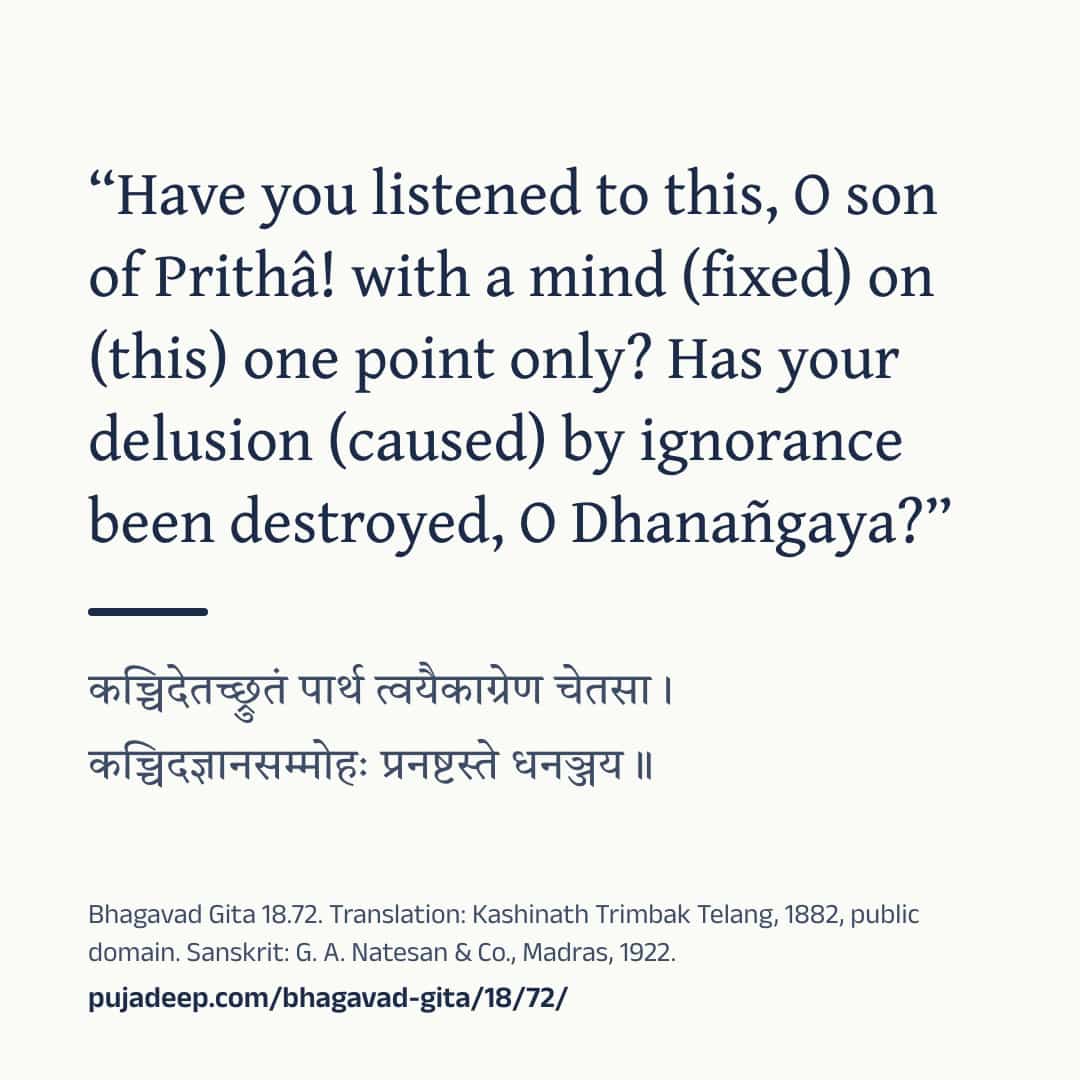
Drawing the picture
See the words
Bhagavad Gita 18.72

कच्चिदेतच्छ्रुतं पार्थ त्वयैकाग्रेण चेतसा ।
कच्चिदज्ञानसम्मोहः प्रनष्टस्ते धनञ्जय ॥

“Have you listened to this, O son of Prithâ! with a mind (fixed) on (this) one point only? Has your delusion (caused) by ignorance been destroyed, O Dhanañgaya?”
(K. T. Telang, The Bhagavadgîtâ (The Sacred Books of the East, vol. VIII, Oxford: Clarendon Press, 1882), p. 130, public domain)

“I hope this is heard, O son of Pritha, with one-pointed intelligence. Is thy delusion, caused by unwisdom, destroyed, O Dhananjaya?”
(Annie Besant, The Bhagavad Gîtâ, or The Lord's Song (London: Theosophical Publishing Society, 1895), p. 166, public domain)

“Has this been heard by thee, O Pártha with an attentive mind? Has the delusion of thy ignorance been destroyed, O Dhananjaya?”
(Swami Swarupananda, Srimad-Bhagavad-Gita (Mayavati: Prabuddha Bharata Press, 1909; first printed in Prabuddha Bharata, 1907–1909), p. 352, public domain)

Sanskrit: G. A. Natesan & Co., Madras, 1922.
https://pujadeep.com/bhagavad-gita/18/72/ Nothing is sent from this site. Your own app sends it, to the chat you choose. The picture quotes the translation you chose on this page, with its name and year.
Sanskrit text: The Bhagavad-Gita, or The Lord's Song, with the text in Devanagari and an English translation, 1922. Meanings: written for Pujadeep and checked against the cited edition. Source and changes
Questions families ask
Who speaks Bhagavad Gita 18.72?
Krishna speaks this verse, in chapter 18 (Moksha Sannyasa Yoga).
Where does the Sanskrit text come from?
Sanskrit text: The Bhagavad-Gita, or The Lord's Song, with the text in Devanagari and an English translation, 1922. Meanings: written for Pujadeep and checked against the cited edition. See the source
Is the meaning on this page a translation?
Explanation written for this site from the sources listed here, and checked against the cited edition. It is not a translation and not the only way to read the text. Free to quote with credit.
Source and licence
- Sanskrit text
- The Bhagavad-Gita, or The Lord's Song, with the text in Devanagari and an English translation (Annie Besant, G. A. Natesan & Co., Madras, 1922). Public domain. The Sanskrit on these pages was read from this printing’s page images.
- Translation
- The Bhagavadgîtâ with the Sanatsugâtîya and the Anugîtâ, translated by Kâshinâth Trimbak Telang (The Sacred Books of the East, vol. VIII, ed. F. Max Müller) (Kashinath Trimbak Telang, F. Max Müller, Clarendon Press, Oxford, 1882). Public domain. Shown verbatim, as printed.
- Translation
- The Bhagavad Gîtâ, or The Lord's Song, translated by Annie Besant (Annie Besant, Theosophical Publishing Society, London, 1895). Public domain. Shown verbatim, as printed.
- Translation
- Srimad-Bhagavad-Gita, with Sanskrit Text; Paraphrase with Word-by-word Literal Translation; English Rendering and Comments, Index, &c., by the Swami Swarupananda (Himalayan Series, No. XX) (Swami Swarupananda, The Editors and Publishers, Advaita Ashrama, Mayavati, Prabuddha Bharata Press, Mayavati, Almora, Himalayas, 1909). Public domain. Shown verbatim, as printed.
- Common wording
- In this text, 32 words follow today's common wording, checked against sanskritdocuments.org; Sanskrit Wikisource; Gita Press, Gorakhpur; GRETIL, Göttingen and Bhaktivedanta Book Trust.
- Our explanation
- Explanation written for this site from the sources listed here, and checked against the cited edition. It is not a translation and not the only way to read the text. Free to quote with credit.
- Checked
- Checked against the cited edition, October 15, 2026.
- Updated
- October 25, 2026