Bhagavad Gita 18.74: meaning and translation
Chapter 18: Moksha Sannyasa Yoga. Sanjaya says
Sanjaya speaks to King Dhritarashtra.
Click or tap a word for its meaning and its dictionary page.
Text and layers
Text and layers
These choices stay in this browser.
Bhagavad Gita 18.74
सञ्जय उवाच ।
इत्यहं वासुदेवस्य पार्थस्य च महात्मनः ।संवादमिममश्रौषमद्भुतं रोमहर्षणम् ॥
Ityaham vasudevasya parthasya cha mahatmanahSanvadamimamashraushamadbhutam romaharshanam
ityahaṃ vāsudevasya pārthasya ca mahātmanaḥ |saṃvādamimamaśrauṣamadbhutaṃ romaharṣaṇam ||
Our explanation Sanjaya speaks to King Dhritarashtra. He says that he heard this wonderful dialogue between Vasudeva (Krishna) and the great-souled Partha (Arjuna), and that it made his hair stand on end.
हिंदी अर्थ संजय राजा धृतराष्ट्र से कहते हैं। वे कहते हैं कि उन्होंने वासुदेव (कृष्ण) और महात्मा पार्थ (अर्जुन) का यह अद्भुत संवाद सुना, जिससे उनके रोंगटे खड़े हो गए।
Word by word
Every word, with its dictionary page
Word by word
- इति iti · thus (indeclinable) Dictionary: 2. iti, Monier-Williams 1899, p. 165, col. 1 “in this manner, thus”
- अहम् aham · "I" (Sanjaya) (pronoun, nominative singular) Dictionary: aham, Monier-Williams 1899, p. 124, col. 2 “nom. sg. ‘I,’”
- वासुदेवस्य vāsudevasya · of Vasudeva (Krishna) (noun (masculine), genitive singular) Dictionary: vāsudeva, Monier-Williams 1899, p. 948, col. 2 “(fr. vasu-d°) patr. of Kṛishṇa”
- पार्थस्य pārthasya · of the son of Pritha (Arjuna) (noun (masculine), genitive singular) Dictionary: 2. pārtha, Monier-Williams 1899, p. 621, col. 3 “metron. of Yudhi-shṭhira or Bhīma-sena or Arjuna”
- च ca · and (indeclinable) Dictionary: 2. ca, Monier-Williams 1899, p. 380, col. 1 “and, both, also, moreover, as well as”
- महात्मनः mahātmanaḥ · the great-souled (compound (masculine), genitive singular) Dictionary: mahātman, Monier-Williams 1899, p. 796, col. 1 “‘high-souled,’ magnanimous, having a gr° or noble nature, high-minded, noble”
- संवादम् saṃvādam · dialogue (noun (masculine), accusative singular) Dictionary: saṃ-vāda, Monier-Williams 1899, p. 1114, col. 2 “speaking together, conversation, colloquy with”
- इमम् imam · this (pronoun (masculine), accusative singular) Dictionary: 1. idam, Monier-Williams 1899, p. 165, col. 2 “this, this here, referring to something near the speaker”
- अश्रौषम् aśrauṣam · "I heard" (aorist, 1st person singular) Dictionary: 1. śru, Monier-Williams 1899, p. 1100, col. 3 “to hear, listen or attend to anything”
- अद्भुतम् adbhutam · wonderful (adjective (masculine), accusative singular) Dictionary: adbhuta, Monier-Williams 1899, p. 19, col. 1 “supernatural, wonderful, marvellous”
- रोमहर्षणम् romaharṣaṇam · making the hair stand on end (compound (masculine), accusative singular) Dictionary: 1. roman, Monier-Williams 1899, p. 889, col. 3 “the hair on the body of men and animals”; roma-harṣaṇa, Monier-Williams 1899, p. 889, col. 3 “causing the h° to bristle or stand erect (through excessive joy or terror)”
Old translations
Kashinath Trimbak Telang, 1882. Public domain. Page 130.
Sañgaya said:
Thus did I hear this dialogue between Vâsudeva and the high-minded son of Prithâ, (a dialogue) wonderful and causing the hair to stand on end.
Compare 3 translations
Kashinath Trimbak Telang, 1882. Public domain. Page 130.
Sañgaya said:
Thus did I hear this dialogue between Vâsudeva and the high-minded son of Prithâ, (a dialogue) wonderful and causing the hair to stand on end.
You are reading this one
Annie Besant, 1895. Public domain. Page 167.
Sanjaya said:
I heard this marvellous dialogue of Vâsudeva and the great-souled Pârtha, causing my hair to stand on end;
This sentence goes on in 18.75.
You are reading this one
Swami Swarupananda, 1909 (first printed 1907). Public domain. Page 353.
Sanjaya said:
Thus have I heard this wonderful dialogue between Vâsudeva and the high-souled Pârtha, causing my hair to stand on end.
You are reading this one
Cite this verse
The translation: K. T. Telang, The Bhagavadgîtâ (The Sacred Books of the East, vol. VIII, Oxford: Clarendon Press, 1882), p. 130. Bhagavad Gita 18.74.
The translation: Annie Besant, The Bhagavad Gîtâ, or The Lord's Song (London: Theosophical Publishing Society, 1895), p. 167. Bhagavad Gita 18.74.
The translation: Swami Swarupananda, Srimad-Bhagavad-Gita (Mayavati: Prabuddha Bharata Press, 1909; first printed in Prabuddha Bharata, 1907–1909), p. 353. Bhagavad Gita 18.74.
Our explanation: “Bhagavad Gita 18.74: meaning and translation.” Pujadeep. Updated October 25, 2026. https://pujadeep.com/bhagavad-gita/18/74/
Pujadeep’s explanations are free to quote with credit: name Pujadeep and link to the page. How to credit
Classical readings, by school
No readings by school on this verse yet.
Share
Show the ways to share
Send one picture or the text to one chat. The picture names its source and the address of this page.
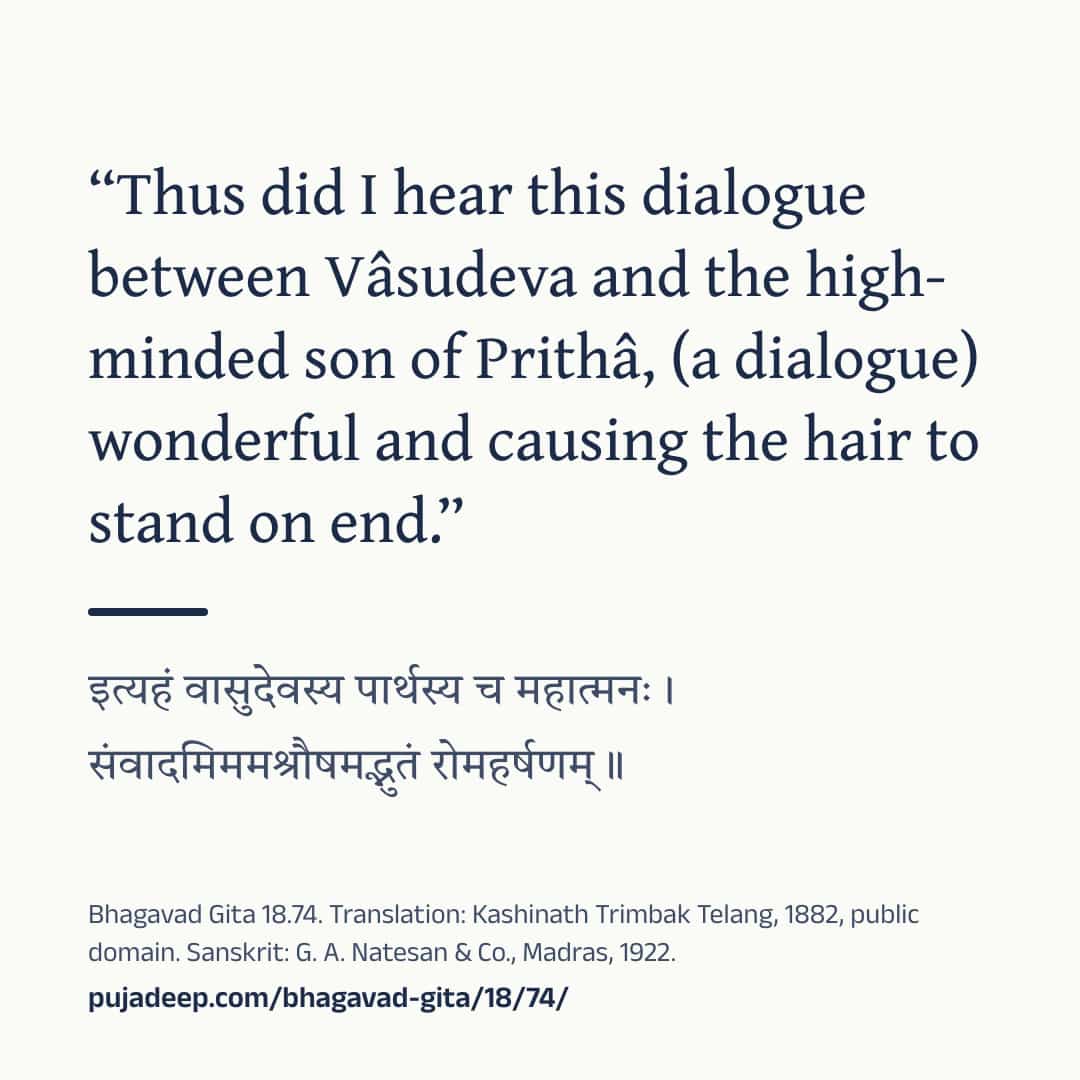
Drawing the picture
See the words
Bhagavad Gita 18.74

इत्यहं वासुदेवस्य पार्थस्य च महात्मनः ।
संवादमिममश्रौषमद्भुतं रोमहर्षणम् ॥

“Thus did I hear this dialogue between Vâsudeva and the high-minded son of Prithâ, (a dialogue) wonderful and causing the hair to stand on end.”
(K. T. Telang, The Bhagavadgîtâ (The Sacred Books of the East, vol. VIII, Oxford: Clarendon Press, 1882), p. 130, public domain)

“I heard this marvellous dialogue of Vâsudeva and the great-souled Pârtha, causing my hair to stand on end;”
(Annie Besant, The Bhagavad Gîtâ, or The Lord's Song (London: Theosophical Publishing Society, 1895), p. 167, public domain)
This sentence goes on in 18.75.

“Thus have I heard this wonderful dialogue between Vâsudeva and the high-souled Pârtha, causing my hair to stand on end.”
(Swami Swarupananda, Srimad-Bhagavad-Gita (Mayavati: Prabuddha Bharata Press, 1909; first printed in Prabuddha Bharata, 1907–1909), p. 353, public domain)

Sanskrit: G. A. Natesan & Co., Madras, 1922.
https://pujadeep.com/bhagavad-gita/18/74/ Nothing is sent from this site. Your own app sends it, to the chat you choose. The picture quotes the translation you chose on this page, with its name and year.
Sanskrit text: The Bhagavad-Gita, or The Lord's Song, with the text in Devanagari and an English translation, 1922. Meanings: written for Pujadeep and checked against the cited edition. Source and changes
Questions families ask
Who speaks Bhagavad Gita 18.74?
Sanjaya speaks this verse, in chapter 18 (Moksha Sannyasa Yoga).
Where does the Sanskrit text come from?
Sanskrit text: The Bhagavad-Gita, or The Lord's Song, with the text in Devanagari and an English translation, 1922. Meanings: written for Pujadeep and checked against the cited edition. See the source
Is the meaning on this page a translation?
Explanation written for this site from the sources listed here, and checked against the cited edition. It is not a translation and not the only way to read the text. Free to quote with credit.
Source and licence
- Sanskrit text
- The Bhagavad-Gita, or The Lord's Song, with the text in Devanagari and an English translation (Annie Besant, G. A. Natesan & Co., Madras, 1922). Public domain. The Sanskrit on these pages was read from this printing’s page images.
- Translation
- The Bhagavadgîtâ with the Sanatsugâtîya and the Anugîtâ, translated by Kâshinâth Trimbak Telang (The Sacred Books of the East, vol. VIII, ed. F. Max Müller) (Kashinath Trimbak Telang, F. Max Müller, Clarendon Press, Oxford, 1882). Public domain. Shown verbatim, as printed.
- Translation
- The Bhagavad Gîtâ, or The Lord's Song, translated by Annie Besant (Annie Besant, Theosophical Publishing Society, London, 1895). Public domain. Shown verbatim, as printed.
- Translation
- Srimad-Bhagavad-Gita, with Sanskrit Text; Paraphrase with Word-by-word Literal Translation; English Rendering and Comments, Index, &c., by the Swami Swarupananda (Himalayan Series, No. XX) (Swami Swarupananda, The Editors and Publishers, Advaita Ashrama, Mayavati, Prabuddha Bharata Press, Mayavati, Almora, Himalayas, 1909). Public domain. Shown verbatim, as printed.
- Common wording
- In this text, 32 words follow today's common wording, checked against sanskritdocuments.org; Sanskrit Wikisource; Gita Press, Gorakhpur; GRETIL, Göttingen and Bhaktivedanta Book Trust.
- Our explanation
- Explanation written for this site from the sources listed here, and checked against the cited edition. It is not a translation and not the only way to read the text. Free to quote with credit.
- Checked
- Checked against the cited edition, October 15, 2026.
- Updated
- October 25, 2026