Bhagavad Gita 18.68: meaning and translation
Chapter 18: Moksha Sannyasa Yoga. Krishna says
The text says, in Krishna's words, that whoever, with the highest devotion to him, teaches this supreme secret to his devotees will come to him, without doubt.
Click or tap a word for its meaning and its dictionary page.
Text and layers
Text and layers
These choices stay in this browser.
Bhagavad Gita 18.68
य इदं परमं गुह्यं मद्भक्तेष्वभिधास्यति ।भक्तिं मयि परां कृत्वा मामेवैष्यत्यसंशयः ॥
Ya idam paramam guhyam madbhakteshvabhidhasyatiBhaktim mayi param kritva mamevaishyatyasanshayah
ya idaṃ paramaṃ guhyaṃ madbhakteṣvabhidhāsyati |bhaktiṃ mayi parāṃ kṛtvā māmevaiṣyatyasaṃśayaḥ ||
Our explanation The text says, in Krishna's words, that whoever, with the highest devotion to him, teaches this supreme secret to his devotees will come to him, without doubt. This is the Gita's own claim about teaching it.
हिंदी अर्थ यह श्लोक कृष्ण के शब्दों में कहता है कि जो उनकी परा भक्ति करते हुए यह परम रहस्य उनके भक्तों को बताएगा, वह निःसंदेह उन्हीं को पाएगा। यह गीता को सिखाने के बारे में स्वयं गीता का कथन है।
The text’s own words about its benefits, not a promise from Pujadeep.
Word by word
Every word, with its dictionary page
Word by word
- यः yaḥ · who (pronoun (masculine), nominative singular) Dictionary: yad, Monier-Williams 1899, p. 844, col. 2 “who, which, what, whichever, whatever, that”
- इदम् idam · this (pronoun (neuter), accusative singular) Dictionary: 1. idam, Monier-Williams 1899, p. 165, col. 2 “this, this here, referring to something near the speaker”
- परमम् paramam · highest (adjective (neuter), accusative singular) Dictionary: parama, Monier-Williams 1899, p. 588, col. 1 “chief, highest, primary, most prominent or conspicuous; best, most excellent”
- गुह्यम् guhyam · secret (noun (neuter), accusative singular) Dictionary: guhya, Monier-Williams 1899, p. 360, col. 3 “a secret, mystery”
- मद्भक्तेषु madbhakteṣu · among "my" (Krishna's) devotees (compound (masculine), locative plural) Dictionary: mad-bhakta, Monier-Williams 1899, p. 777, col. 2 “devoted to me”
- अभिधास्यति abhidhāsyati · will tell (future, 3rd person singular) Dictionary: 1. abhi-dhā, Monier-Williams 1899, p. 63, col. 2 “to set forth, explain, tell, speak to, address, say, name”
- भक्तिम् bhaktim · devotion (noun (feminine), accusative singular) Dictionary: bhakti, Monier-Williams 1899, p. 743, col. 2 “attachment, devotion, fondness for, devotion to”
- मयि mayi · to "me" (Krishna) (pronoun, locative singular) Dictionary: 1. mad, Monier-Williams 1899, p. 777, col. 2 “base of the first pers. pron. in the sg. number (esp. in comp.)”
- पराम् parām · highest (adjective (feminine), accusative singular) Dictionary: 1. para, Monier-Williams 1899, p. 586, col. 1 “best or worst, highest, supreme, chief”
- कृत्वा kṛtvā · having made (absolutive (having done)) Dictionary: 1. kṛ, Monier-Williams 1899, p. 301, col. 1 “to do, make, perform, accomplish, cause, effect, prepare, undertake”
- माम् mām · to "me" (Krishna) (pronoun, accusative singular) Dictionary: 1. mad, Monier-Williams 1899, p. 777, col. 2 “base of the first pers. pron. in the sg. number (esp. in comp.)”
- एव eva · indeed (indeclinable) Dictionary: 1. eva, Monier-Williams 1899, p. 232, col. 2 “just, exactly, very, same, only, even, alone, merely”
- एष्यति eṣyati · will come (future, 3rd person singular) Dictionary: 5. i, Monier-Williams 1899, p. 163, col. 3
- असंशयः asaṃśayaḥ · without doubt (literally 'no doubt') (noun (masculine), nominative singular) Dictionary: a-saṃśaya, Monier-Williams 1899, p. 117, col. 3 “absence of doubt, certainty”
4 printings differ
Edition differences. Another printing or text reads this place differently.
- The printed edition reads: य इदं परमं गुह्यं मद्भक्तेष्वभिधास्यति ।
भक्तिं मयि परां कृत्वा मामेवैष्यत्यसंशयम् ॥ - Word The 1922 Madras printing reads: भक्तिं मयि परां कृत्वा मामेवैष्यत्यसंशयम् The 1922 base printing (leaf n269) reads असंशयम् ('without doubt', said of the outcome). Under decision 14 the display follows the common wording असंशयः ('no doubt'; Shankara: 'there is no doubt about this'), printed by Gita Press (p. 200) and read in sanskritdocuments.org, GRETIL and Sanskrit Wikisource. Telang ('freed from (all) doubts') follows असंशयः; Besant 1895 ('there is no doubt thereof') follows असंशयम्, with a footnote giving the other reading.
- Word Today's text from Gita Press, Gorakhpur reads: य इमं परमं गुह्यं मद्भक्तेष्वभिधास्यति Today's text from Gita Press (p. 200) reads इमं ('this', masculine, with the secret); sanskritdocuments.org and GRETIL read इदं with the 1922 edition. The popular texts disagree, so the printing's reading stays (decision 14).
- Word Today's text from Sanskrit Wikisource reads: य इमं परमं गुह्यं मद्भक्तेष्वभिधास्यति Sanskrit Wikisource (the Gita Supersite's text) reads इमं, like Gita Press.
Old translations
Kashinath Trimbak Telang, 1882. Public domain. Page 129.
He who, with the highest devotion1 to me, will proclaim this supreme mystery among my devotees, will come to me, freed from (all) doubts.
Footnotes (the translator’s own) - I. e. belief that in disseminating it, he is serving me. Cf. Kathopanishad, p. 120. ↩
Compare 3 translations
Kashinath Trimbak Telang, 1882. Public domain. Page 129.
He who, with the highest devotion1 to me, will proclaim this supreme mystery among my devotees, will come to me, freed from (all) doubts.
Footnotes (the translator’s own) - I. e. belief that in disseminating it, he is serving me. Cf. Kathopanishad, p. 120. ↩
You are reading this one
Annie Besant, 1895. Public domain. Page 165.
He who shall declare this Supreme Secret among My devotees, having shown this supreme devotion for Me, verily he shall come to Me; there is no doubt thereof1.
Footnotes (the translator’s own) - Some read "asanshaya," which would be "being freed from doubts." ↩
You are reading this one
Swami Swarupananda, 1909 (first printed 1907). Public domain. Page 350.
He who with supreme devotion to Me will teach this deeply profound philosophy to My devotees, shall doubtless come to Me.
You are reading this one
Cite this verse
The translation: K. T. Telang, The Bhagavadgîtâ (The Sacred Books of the East, vol. VIII, Oxford: Clarendon Press, 1882), p. 129. Bhagavad Gita 18.68.
The translation: Annie Besant, The Bhagavad Gîtâ, or The Lord's Song (London: Theosophical Publishing Society, 1895), p. 165. Bhagavad Gita 18.68.
The translation: Swami Swarupananda, Srimad-Bhagavad-Gita (Mayavati: Prabuddha Bharata Press, 1909; first printed in Prabuddha Bharata, 1907–1909), p. 350. Bhagavad Gita 18.68.
Our explanation: “Bhagavad Gita 18.68: meaning and translation.” Pujadeep. Updated October 25, 2026. https://pujadeep.com/bhagavad-gita/18/68/
Pujadeep’s explanations are free to quote with credit: name Pujadeep and link to the page. How to credit
Classical readings, by school
No readings by school on this verse yet.
Share
Show the ways to share
Send one picture or the text to one chat. The picture names its source and the address of this page.
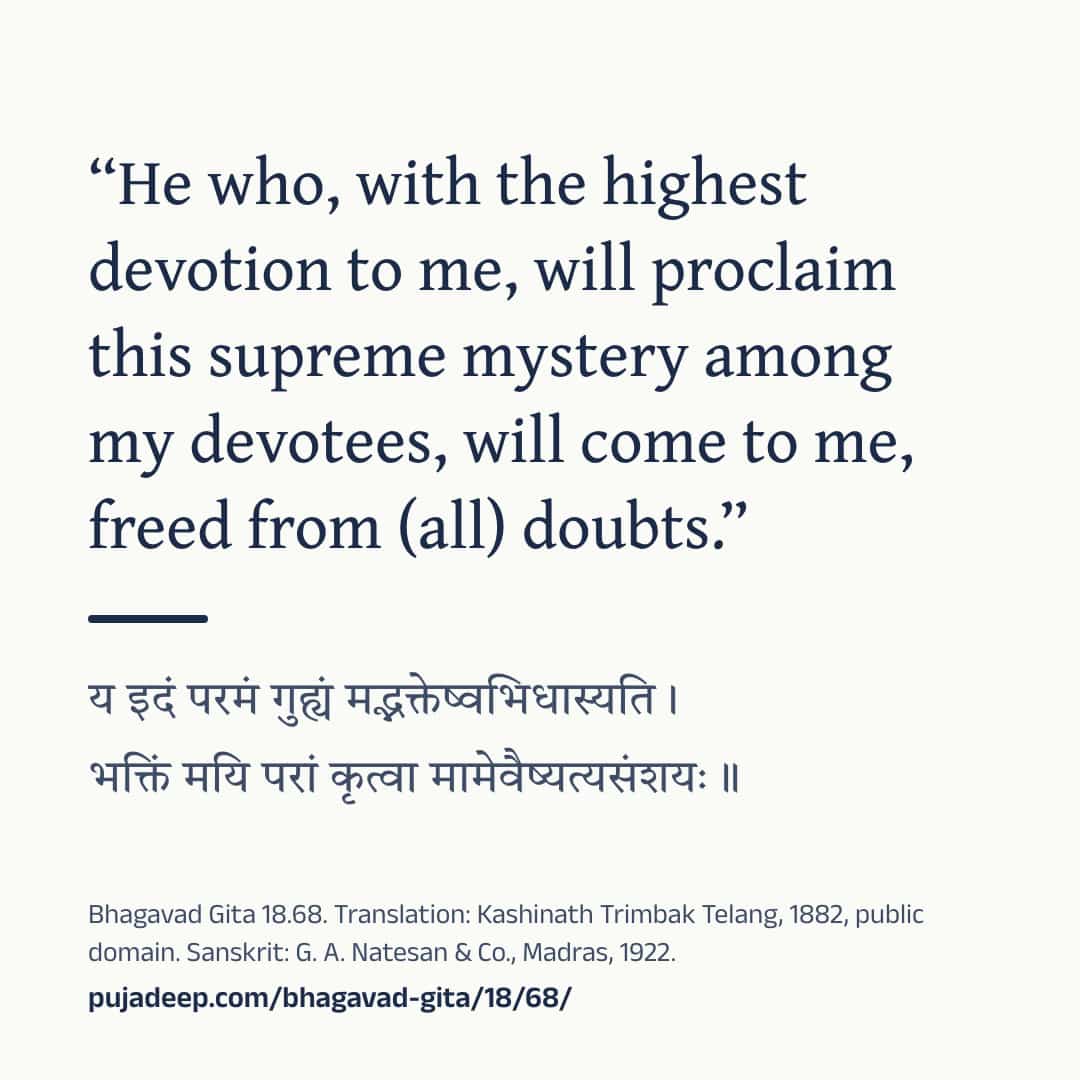
Drawing the picture
See the words
Bhagavad Gita 18.68

य इदं परमं गुह्यं मद्भक्तेष्वभिधास्यति ।
भक्तिं मयि परां कृत्वा मामेवैष्यत्यसंशयः ॥

“He who, with the highest devotion to me, will proclaim this supreme mystery among my devotees, will come to me, freed from (all) doubts.”
(K. T. Telang, The Bhagavadgîtâ (The Sacred Books of the East, vol. VIII, Oxford: Clarendon Press, 1882), p. 129, public domain)

“He who shall declare this Supreme Secret among My devotees, having shown this supreme devotion for Me, verily he shall come to Me; there is no doubt thereof.”
(Annie Besant, The Bhagavad Gîtâ, or The Lord's Song (London: Theosophical Publishing Society, 1895), p. 165, public domain)

“He who with supreme devotion to Me will teach this deeply profound philosophy to My devotees, shall doubtless come to Me.”
(Swami Swarupananda, Srimad-Bhagavad-Gita (Mayavati: Prabuddha Bharata Press, 1909; first printed in Prabuddha Bharata, 1907–1909), p. 350, public domain)

Sanskrit: G. A. Natesan & Co., Madras, 1922.
https://pujadeep.com/bhagavad-gita/18/68/ Nothing is sent from this site. Your own app sends it, to the chat you choose. The picture quotes the translation you chose on this page, with its name and year.
Sanskrit text: The Bhagavad-Gita, or The Lord's Song, with the text in Devanagari and an English translation, 1922. Meanings: written for Pujadeep and checked against the cited edition. Source and changes
Questions families ask
Who speaks Bhagavad Gita 18.68?
Krishna speaks this verse, in chapter 18 (Moksha Sannyasa Yoga).
Where does the Sanskrit text come from?
Sanskrit text: The Bhagavad-Gita, or The Lord's Song, with the text in Devanagari and an English translation, 1922. Meanings: written for Pujadeep and checked against the cited edition. See the source
Is the meaning on this page a translation?
Explanation written for this site from the sources listed here, and checked against the cited edition. It is not a translation and not the only way to read the text. Free to quote with credit.
Source and licence
- Sanskrit text
- The Bhagavad-Gita, or The Lord's Song, with the text in Devanagari and an English translation (Annie Besant, G. A. Natesan & Co., Madras, 1922). Public domain. The Sanskrit on these pages was read from this printing’s page images.
- Translation
- The Bhagavadgîtâ with the Sanatsugâtîya and the Anugîtâ, translated by Kâshinâth Trimbak Telang (The Sacred Books of the East, vol. VIII, ed. F. Max Müller) (Kashinath Trimbak Telang, F. Max Müller, Clarendon Press, Oxford, 1882). Public domain. Shown verbatim, as printed.
- Translation
- The Bhagavad Gîtâ, or The Lord's Song, translated by Annie Besant (Annie Besant, Theosophical Publishing Society, London, 1895). Public domain. Shown verbatim, as printed.
- Translation
- Srimad-Bhagavad-Gita, with Sanskrit Text; Paraphrase with Word-by-word Literal Translation; English Rendering and Comments, Index, &c., by the Swami Swarupananda (Himalayan Series, No. XX) (Swami Swarupananda, The Editors and Publishers, Advaita Ashrama, Mayavati, Prabuddha Bharata Press, Mayavati, Almora, Himalayas, 1909). Public domain. Shown verbatim, as printed.
- Common wording
- In this text, 32 words follow today's common wording, checked against sanskritdocuments.org; Sanskrit Wikisource; Gita Press, Gorakhpur; GRETIL, Göttingen and Bhaktivedanta Book Trust.
- Our explanation
- Explanation written for this site from the sources listed here, and checked against the cited edition. It is not a translation and not the only way to read the text. Free to quote with credit.
- Checked
- Checked against the cited edition, October 15, 2026.
- Updated
- October 25, 2026