Bhagavad Gita 18.61: meaning and translation
Chapter 18: Moksha Sannyasa Yoga. Krishna says
Krishna tells Arjuna that the Lord (Īśvara) dwells in the heart of all beings and, by his māyā, turns them all as if they were mounted on a machine.
Click or tap a word for its meaning and its dictionary page.
Text and layers
Text and layers
These choices stay in this browser.
Bhagavad Gita 18.61
ईश्वरः सर्वभूतानां हृद्देशेऽर्जुन तिष्ठति ।भ्रामयन्सर्वभूतानि यन्त्रारूढानि मायया ॥
Ishvarah sarvabhutanam hriddesherjuna tishthatiBhramayansarvabhutani yantrarudhani mayaya
īśvaraḥ sarvabhūtānāṃ hṛddeśe’rjuna tiṣṭhati |bhrāmayansarvabhūtāni yantrārūḍhāni māyayā ||
Our explanation Krishna tells Arjuna that the Lord (Īśvara) dwells in the heart of all beings and, by his māyā, turns them all as if they were mounted on a machine. Besant renders the machine as a potter's wheel; Shankara compares wooden dolls on a machine.
हिंदी अर्थ कृष्ण अर्जुन से कहते हैं कि ईश्वर सब प्राणियों के हृदय में रहते हैं और अपनी माया से उन सबको ऐसे घुमाते हैं मानो वे किसी यंत्र पर चढ़े हों। बेसेंट यंत्र को कुम्हार का चाक लिखती हैं; शंकराचार्य यंत्र पर रखी लकड़ी की कठपुतलियों की उपमा देते हैं।
Word by word
Every word, with its dictionary page
Word by word
- ईश्वरः īśvaraḥ · the Lord (noun (masculine), nominative singular) Dictionary: īśvara, Monier-Williams 1899, p. 171, col. 1 “God; the Supreme Being”
- सर्वभूतानाम् sarvabhūtānām · of all beings (compound (neuter), genitive plural) Dictionary: sarva, Monier-Williams 1899, p. 1184, col. 3 “whole, entire, all, every”; bhūta, Monier-Williams 1899, p. 761, col. 3 “that which is or exists, any living being (divine, human, animal, and even vegetable)”
- हृद्देशे hṛddeśe · in the region of the heart (compound (masculine), locative singular) Dictionary: hṛd, Monier-Williams 1899, p. 1302, col. 2 “the heart (as the seat of feelings and emotions)”; deśa, Monier-Williams 1899, p. 496, col. 2 “point, region, spot, place, part, portion”
- अर्जुन arjuna · O Arjuna (noun (masculine), vocative singular) Dictionary: arjuna, Monier-Williams 1899, p. 90, col. 1 “of the third of the Pāṇḍava princes (who was a son of Indra and Kuntī)”
- तिष्ठति tiṣṭhati · dwells (present, 3rd person singular) Dictionary: 1. sthā, Monier-Williams 1899, p. 1262, col. 2 “to stand, stand firmly, station one's self”
- भ्रामयन् bhrāmayan · making them turn (causative present participle (masculine), nominative singular) Dictionary: bhram, Monier-Williams 1899, p. 769, col. 2 “to cause to move or turn round or revolve”
- सर्वभूतानि sarvabhūtāni · all beings (compound (neuter), accusative plural) Dictionary: sarva, Monier-Williams 1899, p. 1184, col. 3 “whole, entire, all, every”; bhūta, Monier-Williams 1899, p. 761, col. 3 “that which is or exists, any living being (divine, human, animal, and even vegetable)”
- यन्त्रारूढानि yantrārūḍhāni · as if mounted on a machine (compound (neuter), accusative plural) Dictionary: yantra, Monier-Williams 1899, p. 845, col. 3 “any instrument or apparatus, mechanical contrivance, engine, machine, implement, appliance”; ā-rūḍha, Monier-Williams 1899, p. 151, col. 1 “mounted, ascended, bestridden (as a horse &c.)”
- मायया māyayā · by his māyā (noun (feminine), instrumental singular) Dictionary: māyā, Monier-Williams 1899, p. 811, col. 1 “art, wisdom, extraordinary or supernatural power”
Old translations
Kashinath Trimbak Telang, 1882. Public domain. Page 129.
The lord, O Arguna! is seated in the region of the heart1 of all beings, turning round all beings (as though) mounted on a machine, by his delusion.
Footnotes (the translator’s own) - Svetâsvatara-upanishad, pp. 333–345; Kathopanishad, p. 157. ↩
Compare 3 translations
Kashinath Trimbak Telang, 1882. Public domain. Page 129.
The lord, O Arguna! is seated in the region of the heart1 of all beings, turning round all beings (as though) mounted on a machine, by his delusion.
Footnotes (the translator’s own) - Svetâsvatara-upanishad, pp. 333–345; Kathopanishad, p. 157. ↩
You are reading this one
Annie Besant, 1895. Public domain. Page 164.
Îshvara dwelleth in the hearts of all beings, O Arjuna, by His Mâyâ1 causing all beings to revolve, as though mounted on a potter's wheel.
Footnotes (the translator’s own) - Illusive power. ↩
You are reading this one
Swami Swarupananda, 1909 (first printed 1907). Public domain. Page 346.
The Lord, O Arjuna, dwells in the hearts of all beings, causing all beings, by His Máyá, to revolve, (as if) mounted on a machine.
You are reading this one
Cite this verse
The translation: K. T. Telang, The Bhagavadgîtâ (The Sacred Books of the East, vol. VIII, Oxford: Clarendon Press, 1882), p. 129. Bhagavad Gita 18.61.
The translation: Annie Besant, The Bhagavad Gîtâ, or The Lord's Song (London: Theosophical Publishing Society, 1895), p. 164. Bhagavad Gita 18.61.
The translation: Swami Swarupananda, Srimad-Bhagavad-Gita (Mayavati: Prabuddha Bharata Press, 1909; first printed in Prabuddha Bharata, 1907–1909), p. 346. Bhagavad Gita 18.61.
Our explanation: “Bhagavad Gita 18.61: meaning and translation.” Pujadeep. Updated October 25, 2026. https://pujadeep.com/bhagavad-gita/18/61/
Pujadeep’s explanations are free to quote with credit: name Pujadeep and link to the page. How to credit
Classical readings, by school
No readings by school on this verse yet.
Share
Show the ways to share
Send one picture or the text to one chat. The picture names its source and the address of this page.
Drawing the picture
See the words
Bhagavad Gita 18.61

ईश्वरः सर्वभूतानां हृद्देशेऽर्जुन तिष्ठति ।
भ्रामयन्सर्वभूतानि यन्त्रारूढानि मायया ॥

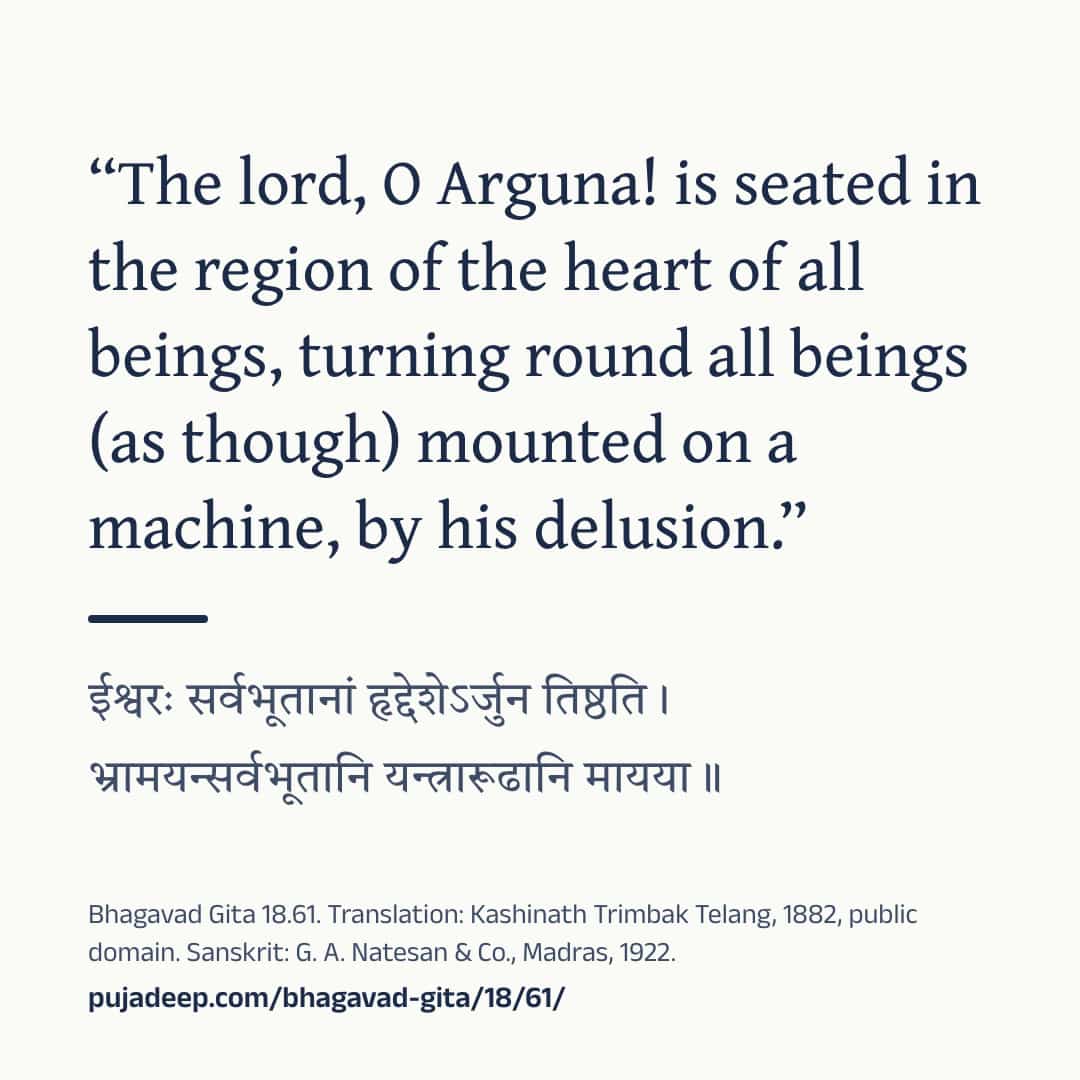
“The lord, O Arguna! is seated in the region of the heart of all beings, turning round all beings (as though) mounted on a machine, by his delusion.”
(K. T. Telang, The Bhagavadgîtâ (The Sacred Books of the East, vol. VIII, Oxford: Clarendon Press, 1882), p. 129, public domain)

“Îshvara dwelleth in the hearts of all beings, O Arjuna, by His Mâyâ causing all beings to revolve, as though mounted on a potter's wheel.”
(Annie Besant, The Bhagavad Gîtâ, or The Lord's Song (London: Theosophical Publishing Society, 1895), p. 164, public domain)

“The Lord, O Arjuna, dwells in the hearts of all beings, causing all beings, by His Máyá, to revolve, (as if) mounted on a machine.”
(Swami Swarupananda, Srimad-Bhagavad-Gita (Mayavati: Prabuddha Bharata Press, 1909; first printed in Prabuddha Bharata, 1907–1909), p. 346, public domain)

Sanskrit: G. A. Natesan & Co., Madras, 1922.
https://pujadeep.com/bhagavad-gita/18/61/ Nothing is sent from this site. Your own app sends it, to the chat you choose. The picture quotes the translation you chose on this page, with its name and year.
Sanskrit text: The Bhagavad-Gita, or The Lord's Song, with the text in Devanagari and an English translation, 1922. Meanings: written for Pujadeep and checked against the cited edition. Source and changes
Questions families ask
Who speaks Bhagavad Gita 18.61?
Krishna speaks this verse, in chapter 18 (Moksha Sannyasa Yoga).
Where does the Sanskrit text come from?
Sanskrit text: The Bhagavad-Gita, or The Lord's Song, with the text in Devanagari and an English translation, 1922. Meanings: written for Pujadeep and checked against the cited edition. See the source
Is the meaning on this page a translation?
Explanation written for this site from the sources listed here, and checked against the cited edition. It is not a translation and not the only way to read the text. Free to quote with credit.
Source and licence
- Sanskrit text
- The Bhagavad-Gita, or The Lord's Song, with the text in Devanagari and an English translation (Annie Besant, G. A. Natesan & Co., Madras, 1922). Public domain. The Sanskrit on these pages was read from this printing’s page images.
- Translation
- The Bhagavadgîtâ with the Sanatsugâtîya and the Anugîtâ, translated by Kâshinâth Trimbak Telang (The Sacred Books of the East, vol. VIII, ed. F. Max Müller) (Kashinath Trimbak Telang, F. Max Müller, Clarendon Press, Oxford, 1882). Public domain. Shown verbatim, as printed.
- Translation
- The Bhagavad Gîtâ, or The Lord's Song, translated by Annie Besant (Annie Besant, Theosophical Publishing Society, London, 1895). Public domain. Shown verbatim, as printed.
- Translation
- Srimad-Bhagavad-Gita, with Sanskrit Text; Paraphrase with Word-by-word Literal Translation; English Rendering and Comments, Index, &c., by the Swami Swarupananda (Himalayan Series, No. XX) (Swami Swarupananda, The Editors and Publishers, Advaita Ashrama, Mayavati, Prabuddha Bharata Press, Mayavati, Almora, Himalayas, 1909). Public domain. Shown verbatim, as printed.
- Common wording
- In this text, 32 words follow today's common wording, checked against sanskritdocuments.org; Sanskrit Wikisource; Gita Press, Gorakhpur; GRETIL, Göttingen and Bhaktivedanta Book Trust.
- Our explanation
- Explanation written for this site from the sources listed here, and checked against the cited edition. It is not a translation and not the only way to read the text. Free to quote with credit.
- Checked
- Checked against the cited edition, October 15, 2026.
- Updated
- October 25, 2026