Bhagavad Gita 18.71: meaning and translation
Chapter 18: Moksha Sannyasa Yoga. Krishna says
The text says, in Krishna's words, that even a person who only listens to it, with faith and without fault-finding, is set free and reaches the happy worlds of those who do good.
Click or tap a word for its meaning and its dictionary page.
Text and layers
Text and layers
These choices stay in this browser.
Bhagavad Gita 18.71
श्रद्धावाननसूयश्च शृणुयादपि यो नरः ।सोऽपि मुक्तः शुभांल्लोकान्प्राप्नुयात्पुण्यकर्मणाम् ॥
Shraddhavananasuyashcha shrinuyadapi yo narahSopi muktah shubhanllokanprapnuyatpunyakarmanam
śraddhāvānanasūyaśca śṛṇuyādapi yo naraḥ |so’pi muktaḥ śubhāṃllokānprāpnuyātpuṇyakarmaṇām ||
Our explanation The text says, in Krishna's words, that even a person who only listens to it, with faith and without fault-finding, is set free and reaches the happy worlds of those who do good. This is the Gita's own claim about hearing it.
हिंदी अर्थ यह श्लोक कृष्ण के शब्दों में कहता है कि जो व्यक्ति श्रद्धा से और दोष निकाले बिना इसे केवल सुनता भी है, वह भी मुक्त होकर पुण्य करने वालों के शुभ लोकों को पाता है। यह गीता को सुनने के बारे में गीता का अपना कथन है।
The text’s own words about its benefits, not a promise from Pujadeep.
Word by word
Every word, with its dictionary page
Word by word
- श्रद्धावान् śraddhāvān · full of faith (adjective (masculine), nominative singular) Dictionary: śraddhā-vat, Monier-Williams 1899, p. 1095, col. 3; śraddhā, Monier-Williams 1899, p. 1095, col. 3 “faith, trust, confidence, trustfulness, faithfulness, belief in”
- अनसूयः anasūyaḥ · without fault-finding (adjective (masculine), nominative singular) Dictionary: an-asūya, Monier-Williams 1899, p. 27, col. 2 “not spiteful, not envious”
- च ca · and (indeclinable) Dictionary: 2. ca, Monier-Williams 1899, p. 380, col. 1 “and, both, also, moreover, as well as”
- शृणुयात् śṛṇuyāt · should hear (optative, 3rd person singular) Dictionary: 1. śru, Monier-Williams 1899, p. 1100, col. 3 “to hear, listen or attend to anything”
- अपि api · even (indeclinable) Dictionary: api, Monier-Williams 1899, p. 55, col. 1 “in the sense of even, also, very”
- यः yaḥ · who (pronoun (masculine), nominative singular) Dictionary: yad, Monier-Williams 1899, p. 844, col. 2 “who, which, what, whichever, whatever, that”
- नरः naraḥ · a person (noun (masculine), nominative singular) Dictionary: nara, Monier-Williams 1899, p. 528, col. 3 “a man, a male, a person (pl. men, people)”
- सः saḥ · he (pronoun (masculine), nominative singular) Dictionary: tad, Monier-Williams 1899, p. 434, col. 1 “m. he, f. she, n. it, that, this”
- अपि api · also (indeclinable) Dictionary: api, Monier-Williams 1899, p. 55, col. 1 “in the sense of even, also, very”
- मुक्तः muktaḥ · freed (past participle (masculine), nominative singular) Dictionary: mukta, Monier-Williams 1899, p. 820, col. 3 “liberated, delivered, emancipated (esp. from sin or worldly existence)”
- शुभान् śubhān · auspicious, happy (adjective (masculine), accusative plural) Dictionary: śubha, Monier-Williams 1899, p. 1083, col. 2 “auspicious, fortunate, prosperous”
- लोकान् lokān · worlds (noun (masculine), accusative plural) Dictionary: loka, Monier-Williams 1899, p. 906, col. 1 “the wide space or world”
- प्राप्नुयात् prāpnuyāt · would reach (optative, 3rd person singular) Dictionary: prāp, Monier-Williams 1899, p. 707, col. 2 “to attain to, reach, arrive at, meet with, find”
- पुण्यकर्मणाम् puṇyakarmaṇām · of those of good deeds (compound (masculine), genitive plural) Dictionary: puṇya-karman, Monier-Williams 1899, p. 632, col. 1 “acting right, virtuous, pious”
1 printing differs
Edition differences. Another printing or text reads this place differently.
- Spelling A digital text reads Same word. The e-text writes the nasal of शुभाँल्लोकान् with a candrabindu; the 1922 edition writes anusvara (शुभांल्लोकान्).
Old translations
Kashinath Trimbak Telang, 1882. Public domain. Page 130.
And the man, also, who with faith and without carping will listen (to this), will be freed (from sin), and attain to the holy regions of those who perform pious acts1.
Footnotes (the translator’s own) - Cf. p. 72. ↩
Compare 3 translations
Kashinath Trimbak Telang, 1882. Public domain. Page 130.
And the man, also, who with faith and without carping will listen (to this), will be freed (from sin), and attain to the holy regions of those who perform pious acts1.
Footnotes (the translator’s own) - Cf. p. 72. ↩
You are reading this one
Annie Besant, 1895. Public domain. Page 166.
The man also who, full of faith, heareth it unreviling, he indeed, liberated, shall obtain the spotless worlds of the righteous.
You are reading this one
Swami Swarupananda, 1909 (first printed 1907). Public domain. Page 351.
And even that man who hears this, full of Shraddhâ and free from malice, he too, liberated, shall attain to the happy worlds of those of righteous deeds.
You are reading this one
Cite this verse
The translation: K. T. Telang, The Bhagavadgîtâ (The Sacred Books of the East, vol. VIII, Oxford: Clarendon Press, 1882), p. 130. Bhagavad Gita 18.71.
The translation: Annie Besant, The Bhagavad Gîtâ, or The Lord's Song (London: Theosophical Publishing Society, 1895), p. 166. Bhagavad Gita 18.71.
The translation: Swami Swarupananda, Srimad-Bhagavad-Gita (Mayavati: Prabuddha Bharata Press, 1909; first printed in Prabuddha Bharata, 1907–1909), p. 351. Bhagavad Gita 18.71.
Our explanation: “Bhagavad Gita 18.71: meaning and translation.” Pujadeep. Updated October 25, 2026. https://pujadeep.com/bhagavad-gita/18/71/
Pujadeep’s explanations are free to quote with credit: name Pujadeep and link to the page. How to credit
Classical readings, by school
No readings by school on this verse yet.
Share
Show the ways to share
Send one picture or the text to one chat. The picture names its source and the address of this page.
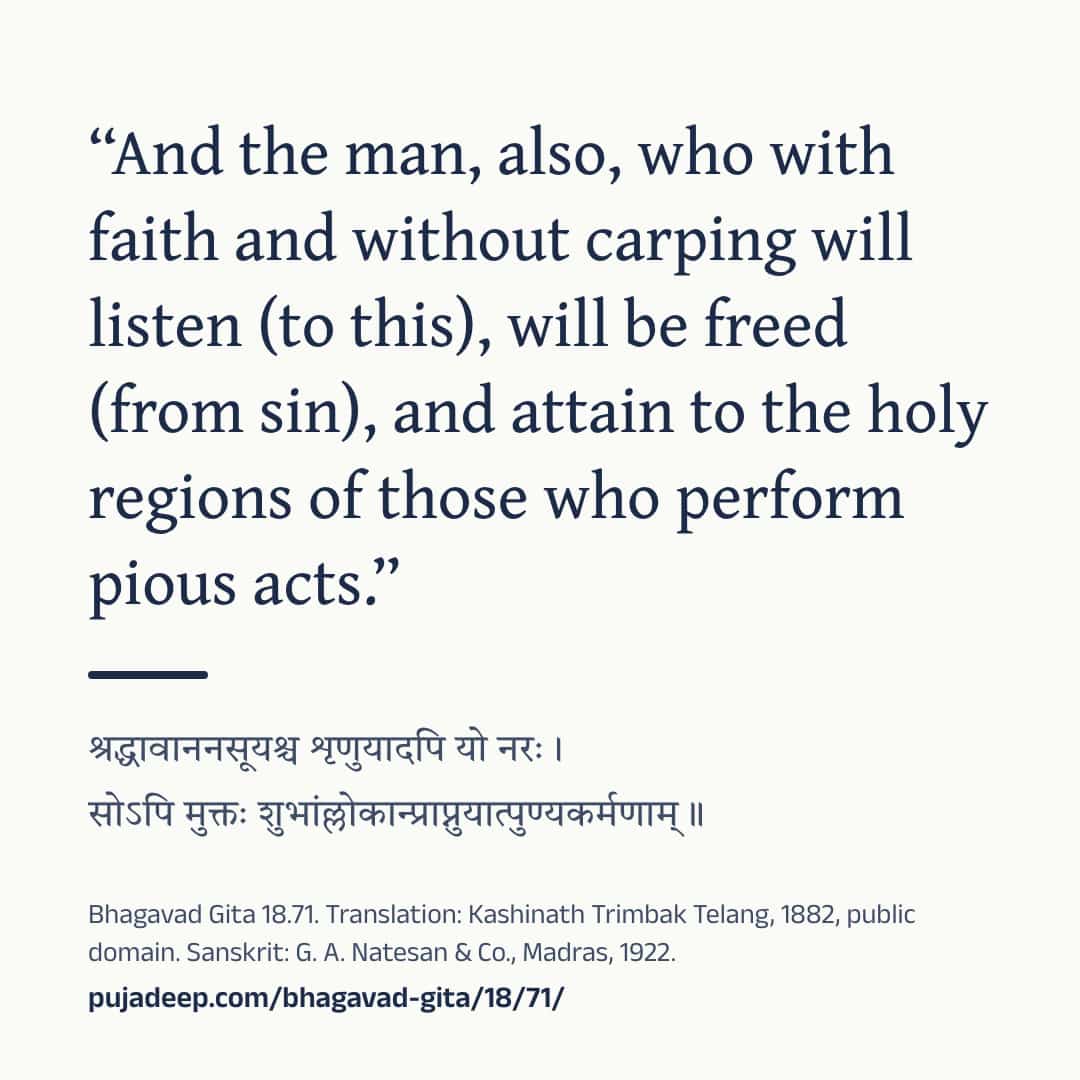
Drawing the picture
See the words
Bhagavad Gita 18.71

श्रद्धावाननसूयश्च शृणुयादपि यो नरः ।
सोऽपि मुक्तः शुभांल्लोकान्प्राप्नुयात्पुण्यकर्मणाम् ॥

“And the man, also, who with faith and without carping will listen (to this), will be freed (from sin), and attain to the holy regions of those who perform pious acts.”
(K. T. Telang, The Bhagavadgîtâ (The Sacred Books of the East, vol. VIII, Oxford: Clarendon Press, 1882), p. 130, public domain)

“The man also who, full of faith, heareth it unreviling, he indeed, liberated, shall obtain the spotless worlds of the righteous.”
(Annie Besant, The Bhagavad Gîtâ, or The Lord's Song (London: Theosophical Publishing Society, 1895), p. 166, public domain)

“And even that man who hears this, full of Shraddhâ and free from malice, he too, liberated, shall attain to the happy worlds of those of righteous deeds.”
(Swami Swarupananda, Srimad-Bhagavad-Gita (Mayavati: Prabuddha Bharata Press, 1909; first printed in Prabuddha Bharata, 1907–1909), p. 351, public domain)

Sanskrit: G. A. Natesan & Co., Madras, 1922.
https://pujadeep.com/bhagavad-gita/18/71/ Nothing is sent from this site. Your own app sends it, to the chat you choose. The picture quotes the translation you chose on this page, with its name and year.
Sanskrit text: The Bhagavad-Gita, or The Lord's Song, with the text in Devanagari and an English translation, 1922. Meanings: written for Pujadeep and checked against the cited edition. Source and changes
Questions families ask
Who speaks Bhagavad Gita 18.71?
Krishna speaks this verse, in chapter 18 (Moksha Sannyasa Yoga).
Where does the Sanskrit text come from?
Sanskrit text: The Bhagavad-Gita, or The Lord's Song, with the text in Devanagari and an English translation, 1922. Meanings: written for Pujadeep and checked against the cited edition. See the source
Is the meaning on this page a translation?
Explanation written for this site from the sources listed here, and checked against the cited edition. It is not a translation and not the only way to read the text. Free to quote with credit.
Source and licence
- Sanskrit text
- The Bhagavad-Gita, or The Lord's Song, with the text in Devanagari and an English translation (Annie Besant, G. A. Natesan & Co., Madras, 1922). Public domain. The Sanskrit on these pages was read from this printing’s page images.
- Translation
- The Bhagavadgîtâ with the Sanatsugâtîya and the Anugîtâ, translated by Kâshinâth Trimbak Telang (The Sacred Books of the East, vol. VIII, ed. F. Max Müller) (Kashinath Trimbak Telang, F. Max Müller, Clarendon Press, Oxford, 1882). Public domain. Shown verbatim, as printed.
- Translation
- The Bhagavad Gîtâ, or The Lord's Song, translated by Annie Besant (Annie Besant, Theosophical Publishing Society, London, 1895). Public domain. Shown verbatim, as printed.
- Translation
- Srimad-Bhagavad-Gita, with Sanskrit Text; Paraphrase with Word-by-word Literal Translation; English Rendering and Comments, Index, &c., by the Swami Swarupananda (Himalayan Series, No. XX) (Swami Swarupananda, The Editors and Publishers, Advaita Ashrama, Mayavati, Prabuddha Bharata Press, Mayavati, Almora, Himalayas, 1909). Public domain. Shown verbatim, as printed.
- Common wording
- In this text, 32 words follow today's common wording, checked against sanskritdocuments.org; Sanskrit Wikisource; Gita Press, Gorakhpur; GRETIL, Göttingen and Bhaktivedanta Book Trust.
- Our explanation
- Explanation written for this site from the sources listed here, and checked against the cited edition. It is not a translation and not the only way to read the text. Free to quote with credit.
- Checked
- Checked against the cited edition, October 15, 2026.
- Updated
- October 25, 2026