Bhagavad Gita 18.75: meaning and translation
Chapter 18: Moksha Sannyasa Yoga. Sanjaya says
Sanjaya says that by the grace of Vyasa he heard this supreme and secret yoga directly from Krishna, the lord of yoga, as Krishna spoke it himself.
Click or tap a word for its meaning and its dictionary page.
Text and layers
Text and layers
These choices stay in this browser.
Bhagavad Gita 18.75
व्यासप्रसादाच्छ्रुतवानेतद् गुह्यमहं परम् ।योगं योगेश्वरात्कृष्णात्साक्षात्कथयतः स्वयम् ॥
Vyasaprasadachchhrutavanetad guhyamaham paramYogam yogeshvaratkrishnatsakshatkathayatah svayam
vyāsaprasādācchrutavānetad guhyamahaṃ param |yogaṃ yogeśvarātkṛṣṇātsākṣātkathayataḥ svayam ||
Our explanation Sanjaya says that by the grace of Vyasa he heard this supreme and secret yoga directly from Krishna, the lord of yoga, as Krishna spoke it himself. Both commentators explain that Vyasa had given Sanjaya divine sight (Sastri p. 478; Govindacharya p. 570).
हिंदी अर्थ संजय कहते हैं कि व्यास की कृपा से उन्होंने यह परम गुप्त योग सीधे योगेश्वर कृष्ण से सुना, जैसा कृष्ण ने स्वयं कहा। दोनों टीकाकार बताते हैं कि व्यास ने संजय को दिव्य दृष्टि दी थी (शास्त्री पृ. 478; गोविंदाचार्य पृ. 570)।
Word by word
Every word, with its dictionary page
Word by word
- व्यासप्रसादात् vyāsaprasādāt · by the grace of Vyasa (compound (masculine), ablative singular) Dictionary: vy-āsa, Monier-Williams 1899, p. 1035, col. 2 “N. of a celebrated mythical sage and author”; pra-sāda, Monier-Williams 1899, p. 697, col. 1 “graciousness, kindness, kind behaviour, favour, aid”
- श्रुतवान् śrutavān · have heard (past active participle (masculine), nominative singular) Dictionary: 1. śru, Monier-Williams 1899, p. 1100, col. 3 “to hear, listen or attend to anything”; śruta, Monier-Williams 1899, p. 1101, col. 1 “heard, listened to, heard about or of, taught”
- एतत् etat · this (pronoun (neuter), accusative singular) Dictionary: etad, Monier-Williams 1899, p. 231, col. 2 “this, this here, here”
- गुह्यम् guhyam · secret (noun (neuter), accusative singular) Dictionary: guhya, Monier-Williams 1899, p. 360, col. 3 “a secret, mystery”
- अहम् aham · "I" (Sanjaya) (pronoun, nominative singular) Dictionary: aham, Monier-Williams 1899, p. 124, col. 2 “nom. sg. ‘I,’”
- परम् param · highest (adjective (neuter), accusative singular) Dictionary: 1. para, Monier-Williams 1899, p. 586, col. 1 “best or worst, highest, supreme, chief”
- योगम् yogam · yoga (noun (masculine), accusative singular) Dictionary: yoga, Monier-Williams 1899, p. 856, col. 3 “application or concentration of the thoughts, abstract contemplation, meditation”
- योगेश्वरात् yogeśvarāt · from the lord of yoga (compound (masculine), ablative singular) Dictionary: yogeśvara, Monier-Williams 1899, p. 857, col. 3 “a master or adept in the Yoga”
- कृष्णात् kṛṣṇāt · from Krishna (noun (masculine), ablative singular) Dictionary: 1. kṛṣṇa, Monier-Williams 1899, p. 306, col. 2 “N. of a celebrated Avatār of the god Vishṇu, or sometimes identified with Vishṇu himself”
- साक्षात् sākṣāt · directly (indeclinable) Dictionary: sākṣāt, Monier-Williams 1899, p. 1198, col. 1 “in person, in bodily form, personally, visibly, really, actually”
- कथयतः kathayataḥ · as he spoke (present participle (masculine), ablative singular) Dictionary: kath, Monier-Williams 1899, p. 247, col. 1 “to tell, relate, narrate, report, inform, speak about, declare”
- स्वयम् svayam · himself (indeclinable) Dictionary: svayam, Monier-Williams 1899, p. 1278, col. 2 “self, one's self”
1 printing differs
Edition differences. Another printing or text reads this place differently.
- Spelling A digital text reads Same letters. The 1922 edition prints एतद् गुह्यम् as two words.
Old translations
Kashinath Trimbak Telang, 1882. Public domain. Page 130.
By the favour of Vyâsa, I heard this highest mystery, (this) devotion1, from Krishna himself, the lord of the possessors of mystic power, who proclaimed it in person.
Footnotes (the translator’s own) - The work is so called, as it refers to devotion. ↩
Compare 3 translations
Kashinath Trimbak Telang, 1882. Public domain. Page 130.
By the favour of Vyâsa, I heard this highest mystery, (this) devotion1, from Krishna himself, the lord of the possessors of mystic power, who proclaimed it in person.
Footnotes (the translator’s own) - The work is so called, as it refers to devotion. ↩
You are reading this one
Annie Besant, 1895. Public domain. Page 167.
By the favour of Vyâsa I listened to this Supreme Secret, Yoga from the Lord of Yoga, Krishna Himself speaking in my presence.
This sentence begins in 18.74.
You are reading this one
Swami Swarupananda, 1909 (first printed 1907). Public domain. Page 353.
Through the grace of Vyâsa have I heard this supreme and most profound Yoga, direct from Krishna, the Lord of Yoga, Himself declaring it.
You are reading this one
Cite this verse
The translation: K. T. Telang, The Bhagavadgîtâ (The Sacred Books of the East, vol. VIII, Oxford: Clarendon Press, 1882), p. 130. Bhagavad Gita 18.75.
The translation: Annie Besant, The Bhagavad Gîtâ, or The Lord's Song (London: Theosophical Publishing Society, 1895), p. 167. Bhagavad Gita 18.75.
The translation: Swami Swarupananda, Srimad-Bhagavad-Gita (Mayavati: Prabuddha Bharata Press, 1909; first printed in Prabuddha Bharata, 1907–1909), p. 353. Bhagavad Gita 18.75.
Our explanation: “Bhagavad Gita 18.75: meaning and translation.” Pujadeep. Updated October 25, 2026. https://pujadeep.com/bhagavad-gita/18/75/
Pujadeep’s explanations are free to quote with credit: name Pujadeep and link to the page. How to credit
Classical readings, by school
No readings by school on this verse yet.
Share
Show the ways to share
Send one picture or the text to one chat. The picture names its source and the address of this page.
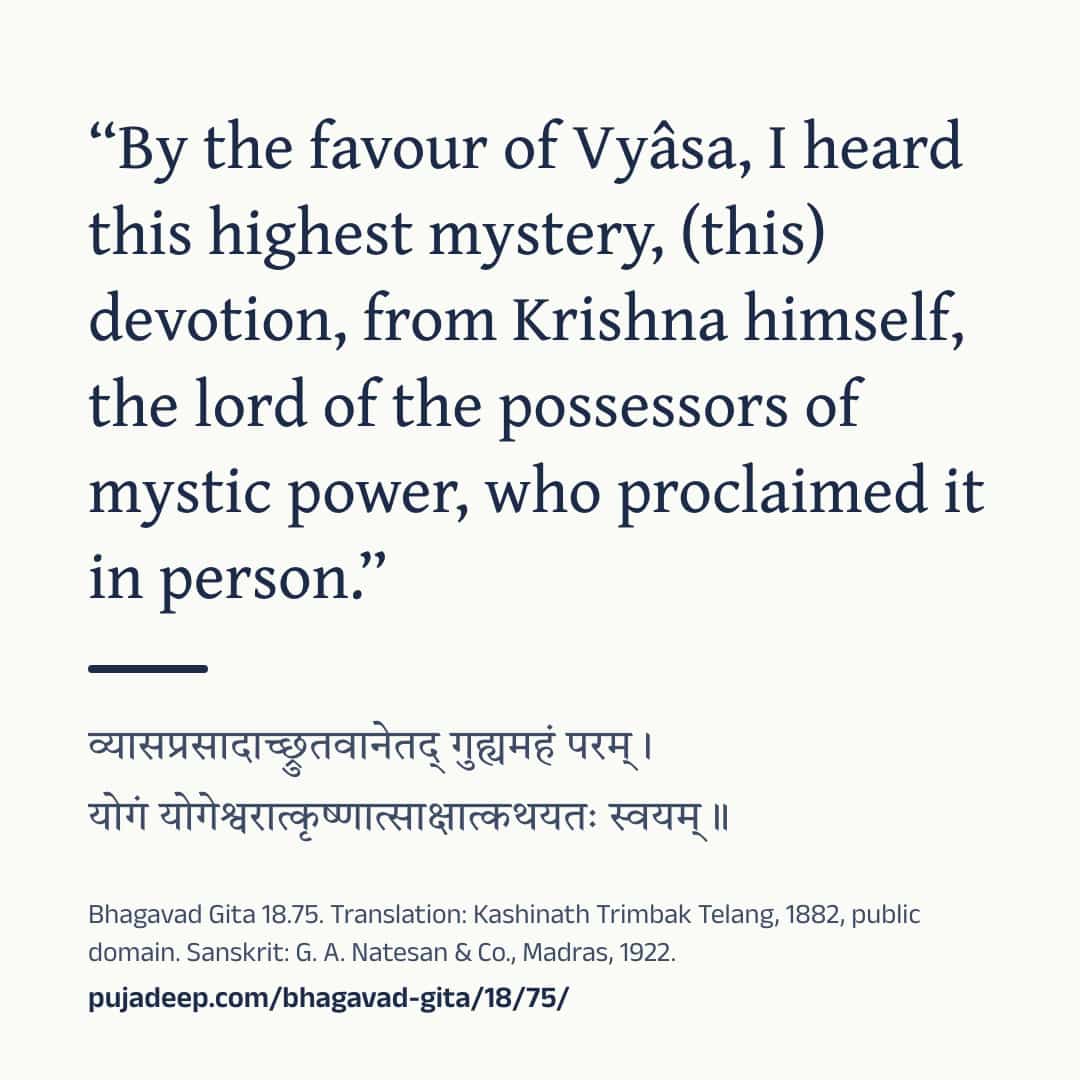
Drawing the picture
See the words
Bhagavad Gita 18.75

व्यासप्रसादाच्छ्रुतवानेतद् गुह्यमहं परम् ।
योगं योगेश्वरात्कृष्णात्साक्षात्कथयतः स्वयम् ॥

“By the favour of Vyâsa, I heard this highest mystery, (this) devotion, from Krishna himself, the lord of the possessors of mystic power, who proclaimed it in person.”
(K. T. Telang, The Bhagavadgîtâ (The Sacred Books of the East, vol. VIII, Oxford: Clarendon Press, 1882), p. 130, public domain)

“By the favour of Vyâsa I listened to this Supreme Secret, Yoga from the Lord of Yoga, Krishna Himself speaking in my presence.”
(Annie Besant, The Bhagavad Gîtâ, or The Lord's Song (London: Theosophical Publishing Society, 1895), p. 167, public domain)
This sentence begins in 18.74.

“Through the grace of Vyâsa have I heard this supreme and most profound Yoga, direct from Krishna, the Lord of Yoga, Himself declaring it.”
(Swami Swarupananda, Srimad-Bhagavad-Gita (Mayavati: Prabuddha Bharata Press, 1909; first printed in Prabuddha Bharata, 1907–1909), p. 353, public domain)

Sanskrit: G. A. Natesan & Co., Madras, 1922.
https://pujadeep.com/bhagavad-gita/18/75/ Nothing is sent from this site. Your own app sends it, to the chat you choose. The picture quotes the translation you chose on this page, with its name and year.
Sanskrit text: The Bhagavad-Gita, or The Lord's Song, with the text in Devanagari and an English translation, 1922. Meanings: written for Pujadeep and checked against the cited edition. Source and changes
Questions families ask
Who speaks Bhagavad Gita 18.75?
Sanjaya speaks this verse, in chapter 18 (Moksha Sannyasa Yoga).
Where does the Sanskrit text come from?
Sanskrit text: The Bhagavad-Gita, or The Lord's Song, with the text in Devanagari and an English translation, 1922. Meanings: written for Pujadeep and checked against the cited edition. See the source
Is the meaning on this page a translation?
Explanation written for this site from the sources listed here, and checked against the cited edition. It is not a translation and not the only way to read the text. Free to quote with credit.
Source and licence
- Sanskrit text
- The Bhagavad-Gita, or The Lord's Song, with the text in Devanagari and an English translation (Annie Besant, G. A. Natesan & Co., Madras, 1922). Public domain. The Sanskrit on these pages was read from this printing’s page images.
- Translation
- The Bhagavadgîtâ with the Sanatsugâtîya and the Anugîtâ, translated by Kâshinâth Trimbak Telang (The Sacred Books of the East, vol. VIII, ed. F. Max Müller) (Kashinath Trimbak Telang, F. Max Müller, Clarendon Press, Oxford, 1882). Public domain. Shown verbatim, as printed.
- Translation
- The Bhagavad Gîtâ, or The Lord's Song, translated by Annie Besant (Annie Besant, Theosophical Publishing Society, London, 1895). Public domain. Shown verbatim, as printed.
- Translation
- Srimad-Bhagavad-Gita, with Sanskrit Text; Paraphrase with Word-by-word Literal Translation; English Rendering and Comments, Index, &c., by the Swami Swarupananda (Himalayan Series, No. XX) (Swami Swarupananda, The Editors and Publishers, Advaita Ashrama, Mayavati, Prabuddha Bharata Press, Mayavati, Almora, Himalayas, 1909). Public domain. Shown verbatim, as printed.
- Common wording
- In this text, 32 words follow today's common wording, checked against sanskritdocuments.org; Sanskrit Wikisource; Gita Press, Gorakhpur; GRETIL, Göttingen and Bhaktivedanta Book Trust.
- Our explanation
- Explanation written for this site from the sources listed here, and checked against the cited edition. It is not a translation and not the only way to read the text. Free to quote with credit.
- Checked
- Checked against the cited edition, October 15, 2026.
- Updated
- October 25, 2026