Bhagavad Gita 18.77: meaning and translation
Chapter 18: Moksha Sannyasa Yoga. Sanjaya says
Sanjaya says that as he remembers again and again that most wonderful form of Hari, his wonder is great and he rejoices again and again.
Click or tap a word for its meaning and its dictionary page.
Text and layers
Text and layers
These choices stay in this browser.
Bhagavad Gita 18.77
तच्च संस्मृत्य संस्मृत्य रूपमत्यद्भुतं हरेः ।विस्मयो मे महान् राजन् हृष्यामि च पुनः पुनः ॥
Tachcha sansmritya sansmritya rupamatyadbhutam harehVismayo me mahan rajan hrishyami cha punah punah
tacca saṃsmṛtya saṃsmṛtya rūpamatyadbhutaṃ hareḥ |vismayo me mahān rājan hṛṣyāmi ca punaḥ punaḥ ||
Our explanation Sanjaya says that as he remembers again and again that most wonderful form of Hari, his wonder is great and he rejoices again and again. Shankara and Ramanuja both take the form to be the universal form of chapter 11.
हिंदी अर्थ संजय कहते हैं कि हरि के उस अत्यंत अद्भुत रूप को बार-बार याद करके उन्हें बड़ा विस्मय होता है और वे बार-बार हर्षित होते हैं। शंकराचार्य और रामानुजाचार्य दोनों इस रूप को अध्याय 11 का विश्वरूप मानते हैं।
Word by word
Every word, with its dictionary page
Word by word
- तत् tat · that (pronoun (neuter), accusative singular) Dictionary: tad, Monier-Williams 1899, p. 434, col. 1 “m. he, f. she, n. it, that, this”
- च ca · and (indeclinable) Dictionary: 2. ca, Monier-Williams 1899, p. 380, col. 1 “and, both, also, moreover, as well as”
- संस्मृत्य saṃsmṛtya · remembering (absolutive (having done)) Dictionary: saṃ-smṛ, Monier-Williams 1899, p. 1122, col. 2 “to remember fully, recollect (acc.; rarely gen.)”
- संस्मृत्य saṃsmṛtya · again and again (absolutive (having done)) Dictionary: saṃ-smṛ, Monier-Williams 1899, p. 1122, col. 2 “to remember fully, recollect (acc.; rarely gen.)”
- रूपम् rūpam · form (noun (neuter), accusative singular) Dictionary: rūpa, Monier-Williams 1899, p. 885, col. 3 “any outward appearance or phenomenon or colour (often pl.), form, shape, figure”
- अत्यद्भुतम् atyadbhutam · most wonderful (adjective (neuter), accusative singular) Dictionary: ati, Monier-Williams 1899, p. 12, col. 2 “excessively, too; exceedingly, very”; adbhuta, Monier-Williams 1899, p. 19, col. 1 “supernatural, wonderful, marvellous”
- हरेः hareḥ · of Hari (Krishna) (noun (masculine), genitive singular) Dictionary: 2. hari, Monier-Williams 1899, p. 1289, col. 3 “(esp.) N. of Vishṇu-Kṛishṇa”
- विस्मयः vismayaḥ · wonder (noun (masculine), nominative singular) Dictionary: 1. vi-smaya, Monier-Williams 1899, p. 1002, col. 2 “wonder, surprise, amazement, bewilderment, perplexity”
- मे me · "my" (Sanjaya's) (pronoun, genitive singular) Dictionary: 1. mad, Monier-Williams 1899, p. 777, col. 2 “base of the first pers. pron. in the sg. number (esp. in comp.)”
- महान् mahān · great (adjective (masculine), nominative singular) Dictionary: mahat, Monier-Williams 1899, p. 794, col. 2 “great (in space, time, quantity or degree)”
- राजन् rājan · O king (noun (masculine), vocative singular) Dictionary: 1. rājan, Monier-Williams 1899, p. 874, col. 3 “a king, sovereign, prince, chief”
- हृष्यामि hṛṣyāmi · "I rejoice" (present, 1st person singular) Dictionary: hṛṣ, Monier-Williams 1899, p. 1303, col. 2 “to thrill with rapture, rejoice, exult, be glad or pleased”
- च ca · and (indeclinable) Dictionary: 2. ca, Monier-Williams 1899, p. 380, col. 1 “and, both, also, moreover, as well as”
- पुनः punaḥ · again (indeclinable) Dictionary: punar, Monier-Williams 1899, p. 633, col. 2 “again, once more”
- पुनः punaḥ · and again (indeclinable) Dictionary: punar, Monier-Williams 1899, p. 633, col. 2 “again, once more”
1 printing differs
Edition differences. Another printing or text reads this place differently.
- Spelling A digital text reads Same letters. The 1922 edition prints राजन् हृष्यामि as two words.
Old translations
Kashinath Trimbak Telang, 1882. Public domain. Page 130–131.
And remembering and (again) remembering that excessively wonderful form of Hari also, great is my amazement, O king! and I rejoice over and over again.
Compare 3 translations
Kashinath Trimbak Telang, 1882. Public domain. Page 130–131.
And remembering and (again) remembering that excessively wonderful form of Hari also, great is my amazement, O king! and I rejoice over and over again.
You are reading this one
Annie Besant, 1895. Public domain. Page 167.
And remembering, remembering, that most marvellous form of Hari, great is my wonder, O King. I rejoice, again and again.
You are reading this one
Swami Swarupananda, 1909 (first printed 1907). Public domain. Page 354.
And as I remember and remember the most wonderful Form of Hari, great is my wonder, O King; and I rejoice again and again.
You are reading this one
Cite this verse
The translation: K. T. Telang, The Bhagavadgîtâ (The Sacred Books of the East, vol. VIII, Oxford: Clarendon Press, 1882), pp. 130–131. Bhagavad Gita 18.77.
The translation: Annie Besant, The Bhagavad Gîtâ, or The Lord's Song (London: Theosophical Publishing Society, 1895), p. 167. Bhagavad Gita 18.77.
The translation: Swami Swarupananda, Srimad-Bhagavad-Gita (Mayavati: Prabuddha Bharata Press, 1909; first printed in Prabuddha Bharata, 1907–1909), p. 354. Bhagavad Gita 18.77.
Our explanation: “Bhagavad Gita 18.77: meaning and translation.” Pujadeep. Updated October 25, 2026. https://pujadeep.com/bhagavad-gita/18/77/
Pujadeep’s explanations are free to quote with credit: name Pujadeep and link to the page. How to credit
Classical readings, by school
No readings by school on this verse yet.
Share
Show the ways to share
Send one picture or the text to one chat. The picture names its source and the address of this page.
Drawing the picture
See the words
Bhagavad Gita 18.77

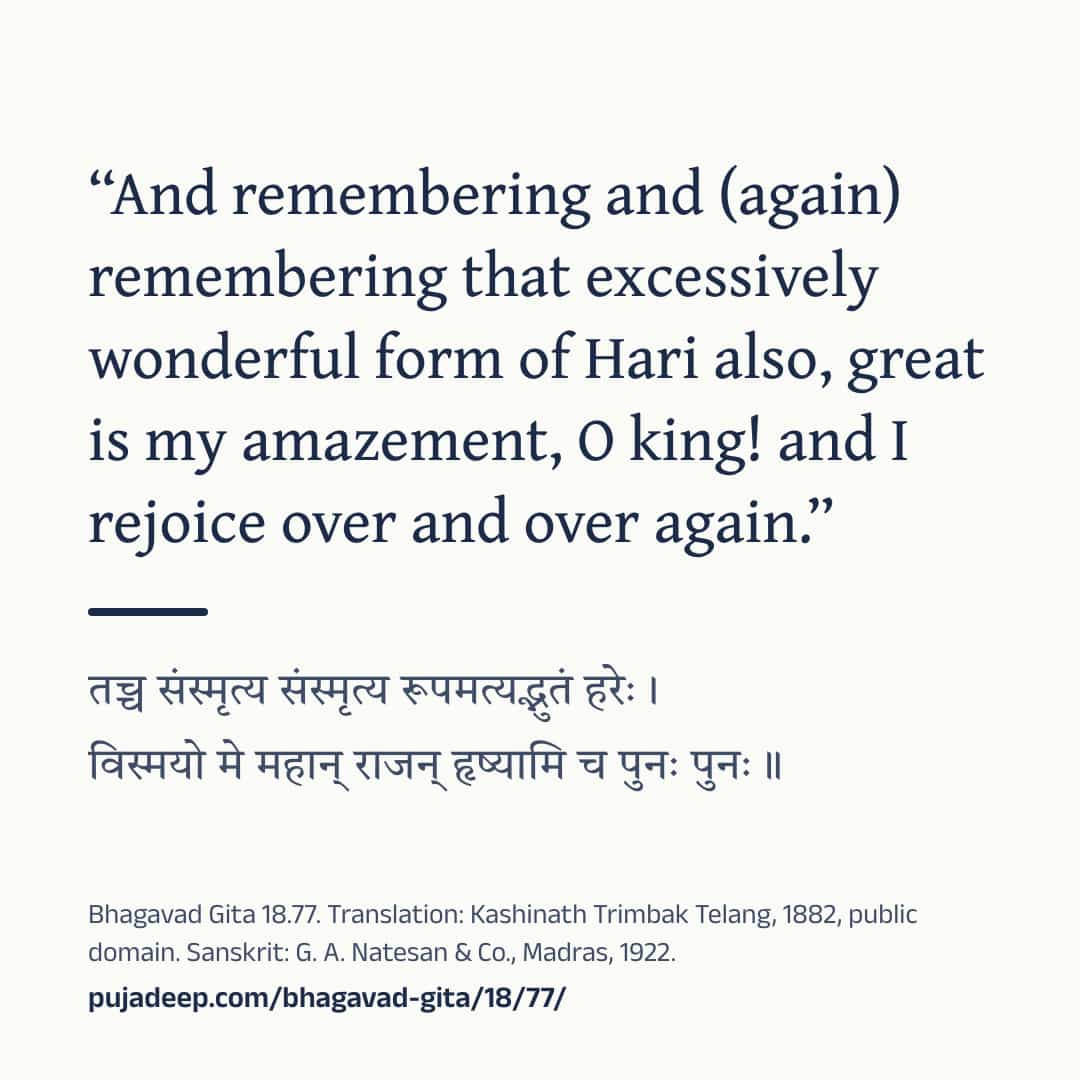
तच्च संस्मृत्य संस्मृत्य रूपमत्यद्भुतं हरेः ।
विस्मयो मे महान् राजन् हृष्यामि च पुनः पुनः ॥

“And remembering and (again) remembering that excessively wonderful form of Hari also, great is my amazement, O king! and I rejoice over and over again.”
(K. T. Telang, The Bhagavadgîtâ (The Sacred Books of the East, vol. VIII, Oxford: Clarendon Press, 1882), pp. 130–131, public domain)

“And remembering, remembering, that most marvellous form of Hari, great is my wonder, O King. I rejoice, again and again.”
(Annie Besant, The Bhagavad Gîtâ, or The Lord's Song (London: Theosophical Publishing Society, 1895), p. 167, public domain)

“And as I remember and remember the most wonderful Form of Hari, great is my wonder, O King; and I rejoice again and again.”
(Swami Swarupananda, Srimad-Bhagavad-Gita (Mayavati: Prabuddha Bharata Press, 1909; first printed in Prabuddha Bharata, 1907–1909), p. 354, public domain)

Sanskrit: G. A. Natesan & Co., Madras, 1922.
https://pujadeep.com/bhagavad-gita/18/77/ Nothing is sent from this site. Your own app sends it, to the chat you choose. The picture quotes the translation you chose on this page, with its name and year.
Sanskrit text: The Bhagavad-Gita, or The Lord's Song, with the text in Devanagari and an English translation, 1922. Meanings: written for Pujadeep and checked against the cited edition. Source and changes
Questions families ask
Who speaks Bhagavad Gita 18.77?
Sanjaya speaks this verse, in chapter 18 (Moksha Sannyasa Yoga).
Where does the Sanskrit text come from?
Sanskrit text: The Bhagavad-Gita, or The Lord's Song, with the text in Devanagari and an English translation, 1922. Meanings: written for Pujadeep and checked against the cited edition. See the source
Is the meaning on this page a translation?
Explanation written for this site from the sources listed here, and checked against the cited edition. It is not a translation and not the only way to read the text. Free to quote with credit.
Source and licence
- Sanskrit text
- The Bhagavad-Gita, or The Lord's Song, with the text in Devanagari and an English translation (Annie Besant, G. A. Natesan & Co., Madras, 1922). Public domain. The Sanskrit on these pages was read from this printing’s page images.
- Translation
- The Bhagavadgîtâ with the Sanatsugâtîya and the Anugîtâ, translated by Kâshinâth Trimbak Telang (The Sacred Books of the East, vol. VIII, ed. F. Max Müller) (Kashinath Trimbak Telang, F. Max Müller, Clarendon Press, Oxford, 1882). Public domain. Shown verbatim, as printed.
- Translation
- The Bhagavad Gîtâ, or The Lord's Song, translated by Annie Besant (Annie Besant, Theosophical Publishing Society, London, 1895). Public domain. Shown verbatim, as printed.
- Translation
- Srimad-Bhagavad-Gita, with Sanskrit Text; Paraphrase with Word-by-word Literal Translation; English Rendering and Comments, Index, &c., by the Swami Swarupananda (Himalayan Series, No. XX) (Swami Swarupananda, The Editors and Publishers, Advaita Ashrama, Mayavati, Prabuddha Bharata Press, Mayavati, Almora, Himalayas, 1909). Public domain. Shown verbatim, as printed.
- Common wording
- In this text, 32 words follow today's common wording, checked against sanskritdocuments.org; Sanskrit Wikisource; Gita Press, Gorakhpur; GRETIL, Göttingen and Bhaktivedanta Book Trust.
- Our explanation
- Explanation written for this site from the sources listed here, and checked against the cited edition. It is not a translation and not the only way to read the text. Free to quote with credit.
- Checked
- Checked against the cited edition, October 15, 2026.
- Updated
- October 25, 2026