Bhagavad Gita 18.67: meaning and translation
Chapter 18: Moksha Sannyasa Yoga. Krishna says
Krishna says this teaching is never to be told to one without austerity, without devotion, to one who does not wish to listen (or, as Telang has it, does not serve a teacher), or to one who speaks ill of him.
Click or tap a word for its meaning and its dictionary page.
Text and layers
Text and layers
These choices stay in this browser.
Bhagavad Gita 18.67
इदं ते नातपस्काय नाभक्ताय कदाचन ।न चाशुश्रूषवे वाच्यं न च मां योऽभ्यसूयति ॥
Idam te natapaskaya nabhaktaya kadachanaNa chashushrushave vachyam na cha mam yobhyasuyati
idaṃ te nātapaskāya nābhaktāya kadācana |na cāśuśrūṣave vācyaṃ na ca māṃ yo’bhyasūyati ||
Our explanation Krishna says this teaching is never to be told to one without austerity, without devotion, to one who does not wish to listen (or, as Telang has it, does not serve a teacher), or to one who speaks ill of him. Telang's note says that for Shankara these conditions go together; in Sastri's translation (p. 474) Shankara allows the teaching to one with austerity or with understanding who is also devoted and serves the teacher, and never to one who finds fault with the Lord.
हिंदी अर्थ कृष्ण कहते हैं कि यह उपदेश कभी उस व्यक्ति को नहीं बताना चाहिए जो तपरहित है, भक्तिरहित है, जो सुनना नहीं चाहता (तेलंग के अनुसार, जो गुरु की सेवा नहीं करता), या जो उनकी निंदा करता है। तेलंग की टिप्पणी कहती है कि शंकराचार्य के अनुसार ये शर्तें एक साथ लागू होती हैं; शास्त्री के अनुवाद (पृ. 474) में शंकराचार्य यह उपदेश उसे देने की बात कहते हैं जिसमें तप या समझ हो और जो साथ ही भक्त हो और गुरु की सेवा करे, पर ईश्वर में दोष निकालने वाले को कभी नहीं।
Word by word
Every word, with its dictionary page
Word by word
- इदम् idam · this (pronoun (neuter), nominative singular) Dictionary: 1. idam, Monier-Williams 1899, p. 165, col. 2 “this, this here, referring to something near the speaker”
- ते te · by you (pronoun, genitive singular) Dictionary: 2. tva, Monier-Williams 1899, p. 463, col. 2 “base of the 2nd personal pron.”
- न na · not (indeclinable) Dictionary: 2. na, Monier-Williams 1899, p. 523, col. 1 “not, no, nor, neither”
- अतपस्काय atapaskāya · to one without austerity (adjective (masculine), dative singular) Dictionary: a-tapaska, Monier-Williams 1899, p. 12, col. 1 “one who neglects tapas or the practice of ascetic austerities”
- न na · not (indeclinable) Dictionary: 2. na, Monier-Williams 1899, p. 523, col. 1 “not, no, nor, neither”
- अभक्ताय abhaktāya · to one without devotion (adjective (masculine), dative singular) Dictionary: a-bhakta, Monier-Williams 1899, p. 60, col. 3 “not attached to, detached, unconnected with”
- कदाचन kadācana · ever (indeclinable) Dictionary: kadā, Monier-Williams 1899, p. 248, col. 1 “at some time, one day”; cana, Monier-Williams 1899, p. 386, col. 2 “and not, also not, even not, not even”
- न na · not (indeclinable) Dictionary: 2. na, Monier-Williams 1899, p. 523, col. 1 “not, no, nor, neither”
- च ca · and (indeclinable) Dictionary: 2. ca, Monier-Williams 1899, p. 380, col. 1 “and, both, also, moreover, as well as”
- अशुश्रूषवे aśuśrūṣave · to one who does not wish to listen (adjective (masculine), dative singular) Dictionary: a-śuśrūṣu, Monier-Williams 1899, p. 113, col. 3 “not desirous of hearing or learning”
- वाच्यम् vācyam · is to be told (gerundive (to be done) (neuter), nominative singular) Dictionary: 2. vācya, Monier-Williams 1899, p. 937, col. 2 “to be spoken or said or told or announced or communicated”
- न na · not (indeclinable) Dictionary: 2. na, Monier-Williams 1899, p. 523, col. 1 “not, no, nor, neither”
- च ca · and (indeclinable) Dictionary: 2. ca, Monier-Williams 1899, p. 380, col. 1 “and, both, also, moreover, as well as”
- माम् mām · "me" (Krishna) (pronoun, accusative singular) Dictionary: 1. mad, Monier-Williams 1899, p. 777, col. 2 “base of the first pers. pron. in the sg. number (esp. in comp.)”
- यः yaḥ · who (pronoun (masculine), nominative singular) Dictionary: yad, Monier-Williams 1899, p. 844, col. 2 “who, which, what, whichever, whatever, that”
- अभ्यसूयति abhyasūyati · finds fault with (present, 3rd person singular) Dictionary: abhy-asūya, Monier-Williams 1899, p. 77, col. 1 “to show indignation, be indignant at”
Old translations
Kashinath Trimbak Telang, 1882. Public domain. Page 129.
This1 you should never declare to one who performs no penance2, who is not a devotee3, nor to one who does not wait on (some preceptor)4, nor yet to one who calumniates me.
Footnotes (the translator’s own) Compare 3 translations
Kashinath Trimbak Telang, 1882. Public domain. Page 129.
This1 you should never declare to one who performs no penance2, who is not a devotee3, nor to one who does not wait on (some preceptor)4, nor yet to one who calumniates me.
Footnotes (the translator’s own) You are reading this one
Annie Besant, 1895. Public domain. Page 165.
This is not to be ever spoken by thee to anyone who is without religious austerities, nor (to one who) is not devoted, nor as well (to one) who desireth not to listen, nor yet to him who speaketh evil of Me.
You are reading this one
Swami Swarupananda, 1909 (first printed 1907). Public domain. Page 349.
This is never to be spoken by thee to one who is devoid of austerities, nor to one who does not render service, nor to one who cavils at Me.
You are reading this one
Cite this verse
The translation: K. T. Telang, The Bhagavadgîtâ (The Sacred Books of the East, vol. VIII, Oxford: Clarendon Press, 1882), p. 129. Bhagavad Gita 18.67.
The translation: Annie Besant, The Bhagavad Gîtâ, or The Lord's Song (London: Theosophical Publishing Society, 1895), p. 165. Bhagavad Gita 18.67.
The translation: Swami Swarupananda, Srimad-Bhagavad-Gita (Mayavati: Prabuddha Bharata Press, 1909; first printed in Prabuddha Bharata, 1907–1909), p. 349. Bhagavad Gita 18.67.
Our explanation: “Bhagavad Gita 18.67: meaning and translation.” Pujadeep. Updated October 25, 2026. https://pujadeep.com/bhagavad-gita/18/67/
Pujadeep’s explanations are free to quote with credit: name Pujadeep and link to the page. How to credit
Classical readings, by school
No readings by school on this verse yet.
Share
Show the ways to share
Send one picture or the text to one chat. The picture names its source and the address of this page.
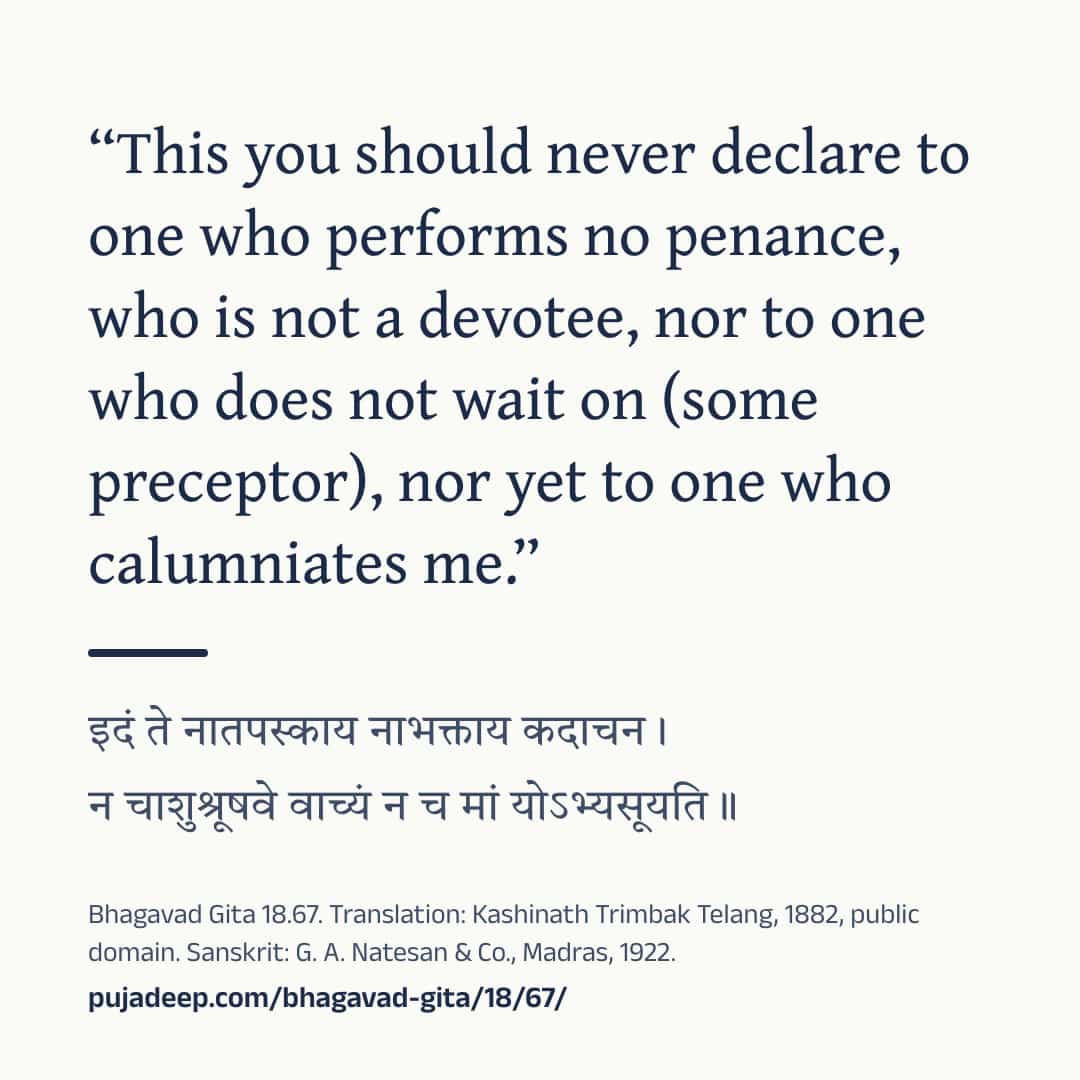
Drawing the picture
See the words
Bhagavad Gita 18.67

इदं ते नातपस्काय नाभक्ताय कदाचन ।
न चाशुश्रूषवे वाच्यं न च मां योऽभ्यसूयति ॥

“This you should never declare to one who performs no penance, who is not a devotee, nor to one who does not wait on (some preceptor), nor yet to one who calumniates me.”
(K. T. Telang, The Bhagavadgîtâ (The Sacred Books of the East, vol. VIII, Oxford: Clarendon Press, 1882), p. 129, public domain)

“This is not to be ever spoken by thee to anyone who is without religious austerities, nor (to one who) is not devoted, nor as well (to one) who desireth not to listen, nor yet to him who speaketh evil of Me.”
(Annie Besant, The Bhagavad Gîtâ, or The Lord's Song (London: Theosophical Publishing Society, 1895), p. 165, public domain)

“This is never to be spoken by thee to one who is devoid of austerities, nor to one who does not render service, nor to one who cavils at Me.”
(Swami Swarupananda, Srimad-Bhagavad-Gita (Mayavati: Prabuddha Bharata Press, 1909; first printed in Prabuddha Bharata, 1907–1909), p. 349, public domain)

Sanskrit: G. A. Natesan & Co., Madras, 1922.
https://pujadeep.com/bhagavad-gita/18/67/ Nothing is sent from this site. Your own app sends it, to the chat you choose. The picture quotes the translation you chose on this page, with its name and year.
Sanskrit text: The Bhagavad-Gita, or The Lord's Song, with the text in Devanagari and an English translation, 1922. Meanings: written for Pujadeep and checked against the cited edition. Source and changes
Questions families ask
Who speaks Bhagavad Gita 18.67?
Krishna speaks this verse, in chapter 18 (Moksha Sannyasa Yoga).
Where does the Sanskrit text come from?
Sanskrit text: The Bhagavad-Gita, or The Lord's Song, with the text in Devanagari and an English translation, 1922. Meanings: written for Pujadeep and checked against the cited edition. See the source
Is the meaning on this page a translation?
Explanation written for this site from the sources listed here, and checked against the cited edition. It is not a translation and not the only way to read the text. Free to quote with credit.
Source and licence
- Sanskrit text
- The Bhagavad-Gita, or The Lord's Song, with the text in Devanagari and an English translation (Annie Besant, G. A. Natesan & Co., Madras, 1922). Public domain. The Sanskrit on these pages was read from this printing’s page images.
- Translation
- The Bhagavadgîtâ with the Sanatsugâtîya and the Anugîtâ, translated by Kâshinâth Trimbak Telang (The Sacred Books of the East, vol. VIII, ed. F. Max Müller) (Kashinath Trimbak Telang, F. Max Müller, Clarendon Press, Oxford, 1882). Public domain. Shown verbatim, as printed.
- Translation
- The Bhagavad Gîtâ, or The Lord's Song, translated by Annie Besant (Annie Besant, Theosophical Publishing Society, London, 1895). Public domain. Shown verbatim, as printed.
- Translation
- Srimad-Bhagavad-Gita, with Sanskrit Text; Paraphrase with Word-by-word Literal Translation; English Rendering and Comments, Index, &c., by the Swami Swarupananda (Himalayan Series, No. XX) (Swami Swarupananda, The Editors and Publishers, Advaita Ashrama, Mayavati, Prabuddha Bharata Press, Mayavati, Almora, Himalayas, 1909). Public domain. Shown verbatim, as printed.
- Common wording
- In this text, 32 words follow today's common wording, checked against sanskritdocuments.org; Sanskrit Wikisource; Gita Press, Gorakhpur; GRETIL, Göttingen and Bhaktivedanta Book Trust.
- Our explanation
- Explanation written for this site from the sources listed here, and checked against the cited edition. It is not a translation and not the only way to read the text. Free to quote with credit.
- Checked
- Checked against the cited edition, October 15, 2026.
- Updated
- October 25, 2026