Bhagavad Gita 18.65: meaning and translation
Chapter 18: Moksha Sannyasa Yoga. Krishna says
Krishna tells Arjuna to fix his mind on him, to be devoted to him, to worship him and to bow to him; so, he says, Arjuna will come to him.
Click or tap a word for its meaning and its dictionary page.
Text and layers
Text and layers
These choices stay in this browser.
Bhagavad Gita 18.65
मन्मना भव मद्भक्तो मद्याजी मां नमस्कुरु ।मामेवैष्यसि सत्यं ते प्रतिजाने प्रियोऽसि मे ॥
Manmana bhava madbhakto madyaji mam namaskuruMamevaishyasi satyam te pratijane priyosi me
manmanā bhava madbhakto madyājī māṃ namaskuru |māmevaiṣyasi satyaṃ te pratijāne priyo’si me ||
Our explanation Krishna tells Arjuna to fix his mind on him, to be devoted to him, to worship him and to bow to him; so, he says, Arjuna will come to him. He gives this as a true promise, because Arjuna is dear to him. The first half repeats 9.34.
हिंदी अर्थ कृष्ण अर्जुन से कहते हैं कि वे अपना मन उनमें लगाएँ, उनके भक्त बनें, उनकी पूजा करें और उन्हें नमस्कार करें; वे कहते हैं कि ऐसा करके अर्जुन उन्हीं को पाएँगे। वे इसे सच्ची प्रतिज्ञा के रूप में कहते हैं, क्योंकि अर्जुन उन्हें प्रिय हैं। पहली पंक्ति 9.34 की पंक्ति ही है।
Word by word
Every word, with its dictionary page
Word by word
- मन्मनाः manmanāḥ · with mind on "me" (Krishna) (compound (masculine), nominative singular) Dictionary: 1. mad, Monier-Williams 1899, p. 777, col. 2 “base of the first pers. pron. in the sg. number (esp. in comp.)”; manas, Monier-Williams 1899, p. 783, col. 3 “mind (in its widest sense as applied to all the mental powers)”
- भव bhava · be (imperative, 2nd person singular) Dictionary: 1. bhū, Monier-Williams 1899, p. 760, col. 2 “to become, be”
- मद्भक्तः madbhaktaḥ · devoted to "me" (Krishna) (compound (masculine), nominative singular) Dictionary: mad-bhakta, Monier-Williams 1899, p. 777, col. 2 “devoted to me”
- मद्याजी madyājī · worshipping "me" (Krishna) (compound (masculine), nominative singular) Dictionary: 1. mad, Monier-Williams 1899, p. 777, col. 2 “base of the first pers. pron. in the sg. number (esp. in comp.)”; yājin, Monier-Williams 1899, p. 850, col. 3 “(mostly ifc.) worshipping, sacrificing, a sacrificer”
- माम् mām · to "me" (Krishna) (pronoun, accusative singular) Dictionary: 1. mad, Monier-Williams 1899, p. 777, col. 2 “base of the first pers. pron. in the sg. number (esp. in comp.)”
- नमस्कुरु namaskuru · bow (imperative, 2nd person singular) Dictionary: namas, Monier-Williams 1899, p. 528, col. 1 “bow, obeisance, reverential salutation, adoration”; 1. kṛ, Monier-Williams 1899, p. 301, col. 1 “to do, make, perform, accomplish, cause, effect, prepare, undertake”
- माम् mām · "me" (Krishna) (pronoun, accusative singular) Dictionary: 1. mad, Monier-Williams 1899, p. 777, col. 2 “base of the first pers. pron. in the sg. number (esp. in comp.)”
- एव eva · indeed (indeclinable) Dictionary: 1. eva, Monier-Williams 1899, p. 232, col. 2 “just, exactly, very, same, only, even, alone, merely”
- एष्यसि eṣyasi · you will come (future, 2nd person singular) Dictionary: 5. i, Monier-Williams 1899, p. 163, col. 3
- सत्यम् satyam · truly (noun (neuter), accusative singular) Dictionary: satya, Monier-Williams 1899, p. 1135, col. 3 “true, real, actual, genuine, sincere, honest, truthful”
- ते te · to you (pronoun, dative singular) Dictionary: 2. tva, Monier-Williams 1899, p. 463, col. 2 “base of the 2nd personal pron.”
- प्रतिजाने pratijāne · "I promise" (present, 1st person singular) Dictionary: prati-jñā, Monier-Williams 1899, p. 665, col. 3 “to promise”
- प्रियः priyaḥ · dear (adjective (masculine), nominative singular) Dictionary: priya, Monier-Williams 1899, p. 710, col. 1 “beloved, dear to (gen., loc., dat. or comp.), liked, favourite”
- असि asi · you are (present, 2nd person singular) Dictionary: 1. as, Monier-Williams 1899, p. 117, col. 2 “to be, live, exist, be present”
- मे me · to "me" (Krishna) (pronoun, genitive singular) Dictionary: 1. mad, Monier-Williams 1899, p. 777, col. 2 “base of the first pers. pron. in the sg. number (esp. in comp.)”
Old translations
Kashinath Trimbak Telang, 1882. Public domain. Page 129.
On me (place) your mind, become my devotee, sacrifice to me, reverence me, you will certainly come to me. I declare to you truly, you are dear to me.
Compare 3 translations
Kashinath Trimbak Telang, 1882. Public domain. Page 129.
On me (place) your mind, become my devotee, sacrifice to me, reverence me, you will certainly come to me. I declare to you truly, you are dear to me.
You are reading this one
Annie Besant, 1895. Public domain. Page 165.
(Place) thy Manas on Me, be My devotee, sacrifice to Me, prostrate thyself before Me, thou shalt come even to Me. I pledge thee My troth; thou art dear to Me.
You are reading this one
Swami Swarupananda, 1909 (first printed 1907). Public domain. Page 348.
Occupy thy mind with Me, be devoted to Me, sacrifice to Me, bow down to Me. Thou shalt reach Myself; truly do I promise unto thee, (for) thou art dear to Me.
You are reading this one
Cite this verse
The translation: K. T. Telang, The Bhagavadgîtâ (The Sacred Books of the East, vol. VIII, Oxford: Clarendon Press, 1882), p. 129. Bhagavad Gita 18.65.
The translation: Annie Besant, The Bhagavad Gîtâ, or The Lord's Song (London: Theosophical Publishing Society, 1895), p. 165. Bhagavad Gita 18.65.
The translation: Swami Swarupananda, Srimad-Bhagavad-Gita (Mayavati: Prabuddha Bharata Press, 1909; first printed in Prabuddha Bharata, 1907–1909), p. 348. Bhagavad Gita 18.65.
Our explanation: “Bhagavad Gita 18.65: meaning and translation.” Pujadeep. Updated October 25, 2026. https://pujadeep.com/bhagavad-gita/18/65/
Pujadeep’s explanations are free to quote with credit: name Pujadeep and link to the page. How to credit
Classical readings, by school
No readings by school on this verse yet.
Share
Show the ways to share
Send one picture or the text to one chat. The picture names its source and the address of this page.
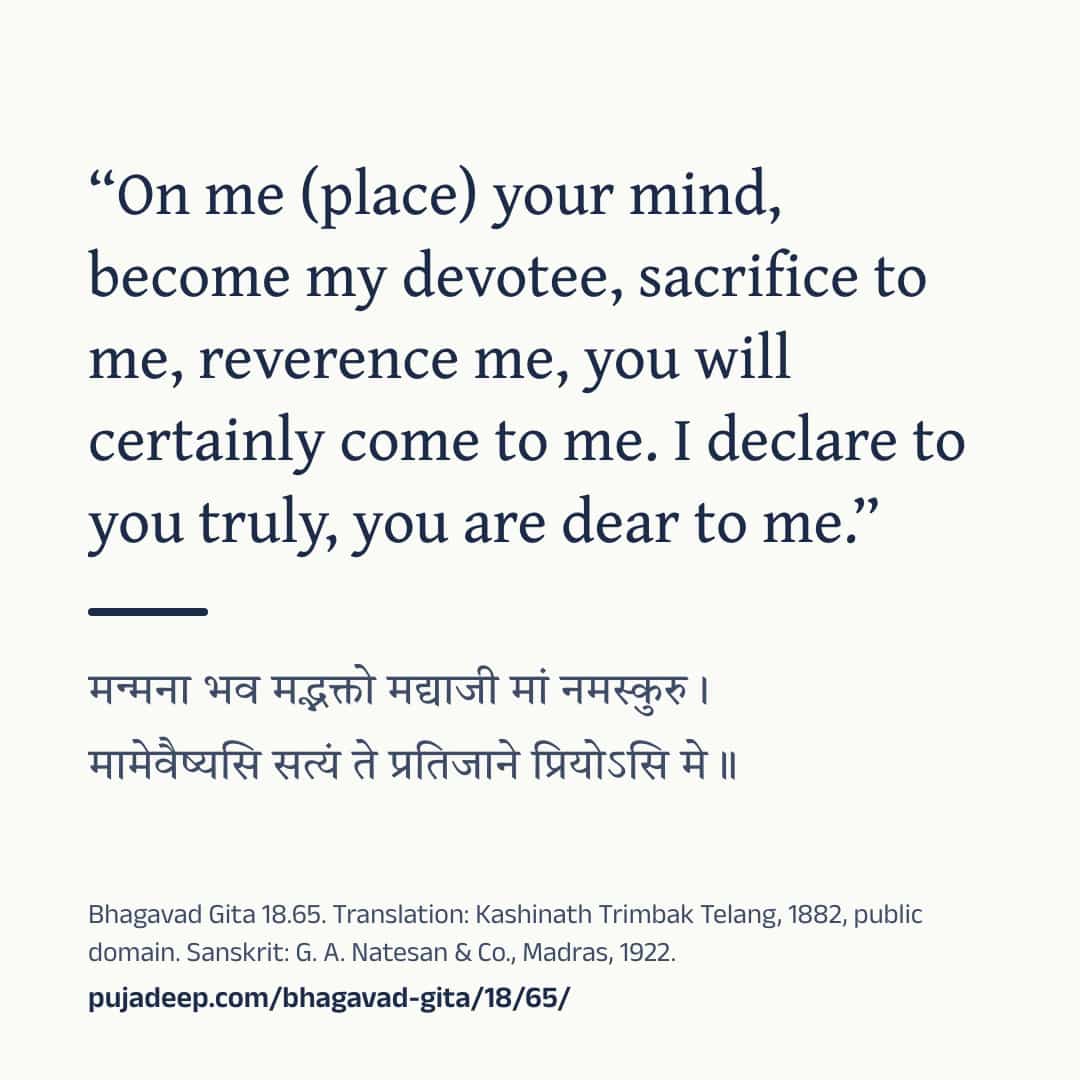
Drawing the picture
See the words
Bhagavad Gita 18.65

मन्मना भव मद्भक्तो मद्याजी मां नमस्कुरु ।
मामेवैष्यसि सत्यं ते प्रतिजाने प्रियोऽसि मे ॥

“On me (place) your mind, become my devotee, sacrifice to me, reverence me, you will certainly come to me. I declare to you truly, you are dear to me.”
(K. T. Telang, The Bhagavadgîtâ (The Sacred Books of the East, vol. VIII, Oxford: Clarendon Press, 1882), p. 129, public domain)

“(Place) thy Manas on Me, be My devotee, sacrifice to Me, prostrate thyself before Me, thou shalt come even to Me. I pledge thee My troth; thou art dear to Me.”
(Annie Besant, The Bhagavad Gîtâ, or The Lord's Song (London: Theosophical Publishing Society, 1895), p. 165, public domain)

“Occupy thy mind with Me, be devoted to Me, sacrifice to Me, bow down to Me. Thou shalt reach Myself; truly do I promise unto thee, (for) thou art dear to Me.”
(Swami Swarupananda, Srimad-Bhagavad-Gita (Mayavati: Prabuddha Bharata Press, 1909; first printed in Prabuddha Bharata, 1907–1909), p. 348, public domain)

Sanskrit: G. A. Natesan & Co., Madras, 1922.
https://pujadeep.com/bhagavad-gita/18/65/ Nothing is sent from this site. Your own app sends it, to the chat you choose. The picture quotes the translation you chose on this page, with its name and year.
Sanskrit text: The Bhagavad-Gita, or The Lord's Song, with the text in Devanagari and an English translation, 1922. Meanings: written for Pujadeep and checked against the cited edition. Source and changes
Questions families ask
Who speaks Bhagavad Gita 18.65?
Krishna speaks this verse, in chapter 18 (Moksha Sannyasa Yoga).
Where does the Sanskrit text come from?
Sanskrit text: The Bhagavad-Gita, or The Lord's Song, with the text in Devanagari and an English translation, 1922. Meanings: written for Pujadeep and checked against the cited edition. See the source
Is the meaning on this page a translation?
Explanation written for this site from the sources listed here, and checked against the cited edition. It is not a translation and not the only way to read the text. Free to quote with credit.
Source and licence
- Sanskrit text
- The Bhagavad-Gita, or The Lord's Song, with the text in Devanagari and an English translation (Annie Besant, G. A. Natesan & Co., Madras, 1922). Public domain. The Sanskrit on these pages was read from this printing’s page images.
- Translation
- The Bhagavadgîtâ with the Sanatsugâtîya and the Anugîtâ, translated by Kâshinâth Trimbak Telang (The Sacred Books of the East, vol. VIII, ed. F. Max Müller) (Kashinath Trimbak Telang, F. Max Müller, Clarendon Press, Oxford, 1882). Public domain. Shown verbatim, as printed.
- Translation
- The Bhagavad Gîtâ, or The Lord's Song, translated by Annie Besant (Annie Besant, Theosophical Publishing Society, London, 1895). Public domain. Shown verbatim, as printed.
- Translation
- Srimad-Bhagavad-Gita, with Sanskrit Text; Paraphrase with Word-by-word Literal Translation; English Rendering and Comments, Index, &c., by the Swami Swarupananda (Himalayan Series, No. XX) (Swami Swarupananda, The Editors and Publishers, Advaita Ashrama, Mayavati, Prabuddha Bharata Press, Mayavati, Almora, Himalayas, 1909). Public domain. Shown verbatim, as printed.
- Common wording
- In this text, 32 words follow today's common wording, checked against sanskritdocuments.org; Sanskrit Wikisource; Gita Press, Gorakhpur; GRETIL, Göttingen and Bhaktivedanta Book Trust.
- Our explanation
- Explanation written for this site from the sources listed here, and checked against the cited edition. It is not a translation and not the only way to read the text. Free to quote with credit.
- Checked
- Checked against the cited edition, October 15, 2026.
- Updated
- October 25, 2026