Bhagavad Gita 18.60: meaning and translation
Chapter 18: Moksha Sannyasa Yoga. Krishna says
Krishna tells Arjuna, son of Kunti, that he is bound by his own work, born of his nature; what he does not wish to do out of confusion, he will do even against his will.
Click or tap a word for its meaning and its dictionary page.
Text and layers
Text and layers
These choices stay in this browser.
Bhagavad Gita 18.60
स्वभावजेन कौन्तेय निबद्धः स्वेन कर्मणा ।कर्तुं नेच्छसि यन्मोहात्करिष्यस्यवशोऽपि तत् ॥
Svabhavajena kaunteya nibaddhah svena karmanaKartum nechchhasi yanmohatkarishyasyavashopi tat
svabhāvajena kaunteya nibaddhaḥ svena karmaṇā |kartuṃ necchasi yanmohātkariṣyasyavaśo’pi tat ||
Our explanation Krishna tells Arjuna, son of Kunti, that he is bound by his own work, born of his nature; what he does not wish to do out of confusion, he will do even against his will.
हिंदी अर्थ कृष्ण अर्जुन (कौन्तेय) से कहते हैं कि वे अपने स्वभाव से उत्पन्न अपने कर्म से बँधे हैं; जो वे मोह के कारण नहीं करना चाहते, वह विवश होकर भी करेंगे।
Word by word
Every word, with its dictionary page
Word by word
- स्वभावजेन svabhāvajena · born of your nature (compound (neuter), instrumental singular) Dictionary: sva-bhāva, Monier-Williams 1899, p. 1276, col. 1 “innate or inherent disposition, nature”; 2. ja, Monier-Williams 1899, p. 407, col. 3 “ifc. born or descended from, produced or caused by”
- कौन्तेय kaunteya · O son of Kunti (noun (masculine), vocative singular) Dictionary: kaunteya, Monier-Williams 1899, p. 316, col. 2 “metron. fr. Kuntī, N. of Yudhishṭhira, Bhīma-sena, and Arjuna”
- निबद्धः nibaddhaḥ · bound (past participle (masculine), nominative singular) Dictionary: ni-baddha, Monier-Williams 1899, p. 550, col. 1 “bound, fettered, chained, tied or fastened to”
- स्वेन svena · by your own (pronoun (neuter), instrumental singular) Dictionary: 1. sva, Monier-Williams 1899, p. 1275, col. 1 “own, one's own, my own, thy own, his own, her own, our own, their own”
- कर्मणा karmaṇā · work (noun (neuter), instrumental singular) Dictionary: karman, Monier-Williams 1899, p. 258, col. 2 “act, action, performance, business”
- कर्तुम् kartum · to do (infinitive (to do)) Dictionary: 1. kṛ, Monier-Williams 1899, p. 301, col. 1 “to do, make, perform, accomplish, cause, effect, prepare, undertake”
- न na · not (indeclinable) Dictionary: 2. na, Monier-Williams 1899, p. 523, col. 1 “not, no, nor, neither”
- इच्छसि icchasi · you wish (present, 2nd person singular) Dictionary: 3. iṣ, Monier-Williams 1899, p. 169, col. 1 “to desire, wish, long for, request”
- यत् yat · which (pronoun (neuter), accusative singular) Dictionary: yad, Monier-Williams 1899, p. 844, col. 2 “who, which, what, whichever, whatever, that”
- मोहात् mohāt · out of delusion (noun (masculine), ablative singular) Dictionary: moha, Monier-Williams 1899, p. 836, col. 1 “loss of consciousness, bewilderment, perplexity, distraction, infatuation, delusion, error, folly”
- करिष्यसि kariṣyasi · you will do (future, 2nd person singular) Dictionary: 1. kṛ, Monier-Williams 1899, p. 301, col. 1 “to do, make, perform, accomplish, cause, effect, prepare, undertake”
- अवशः avaśaḥ · against your will (adjective (masculine), nominative singular) Dictionary: a-vaśa, Monier-Williams 1899, p. 104, col. 1 “not having one's own free will, doing something against one's desire or unwillingly”
- अपि api · even (indeclinable) Dictionary: api, Monier-Williams 1899, p. 55, col. 1 “in the sense of even, also, very”
- तत् tat · that (pronoun (neuter), accusative singular) Dictionary: tad, Monier-Williams 1899, p. 434, col. 1 “m. he, f. she, n. it, that, this”
Old translations
Kashinath Trimbak Telang, 1882. Public domain. Page 128–129.
That, O son of Kuntî! which through delusion you do not wish to do, you will do involuntarily, tied down by your own duty, flowing from your nature.
Compare 3 translations
Kashinath Trimbak Telang, 1882. Public domain. Page 128–129.
That, O son of Kuntî! which through delusion you do not wish to do, you will do involuntarily, tied down by your own duty, flowing from your nature.
You are reading this one
Annie Besant, 1895. Public domain. Page 164.
O son of Kuntî, bound by thine own Karma arising from thine own nature, that which from delusion thou desirest not to do, that even involuntarily thou wilt perform.
You are reading this one
Swami Swarupananda, 1909 (first printed 1907). Public domain. Page 346.
Fettered, O son of Kunti, by thy own Karma, born of thy own nature, what thou, from delusion, desirest not to do, thou shalt have to do in spite of thyself.
You are reading this one
Cite this verse
The translation: K. T. Telang, The Bhagavadgîtâ (The Sacred Books of the East, vol. VIII, Oxford: Clarendon Press, 1882), pp. 128–129. Bhagavad Gita 18.60.
The translation: Annie Besant, The Bhagavad Gîtâ, or The Lord's Song (London: Theosophical Publishing Society, 1895), p. 164. Bhagavad Gita 18.60.
The translation: Swami Swarupananda, Srimad-Bhagavad-Gita (Mayavati: Prabuddha Bharata Press, 1909; first printed in Prabuddha Bharata, 1907–1909), p. 346. Bhagavad Gita 18.60.
Our explanation: “Bhagavad Gita 18.60: meaning and translation.” Pujadeep. Updated October 25, 2026. https://pujadeep.com/bhagavad-gita/18/60/
Pujadeep’s explanations are free to quote with credit: name Pujadeep and link to the page. How to credit
Classical readings, by school
No readings by school on this verse yet.
Share
Show the ways to share
Send one picture or the text to one chat. The picture names its source and the address of this page.
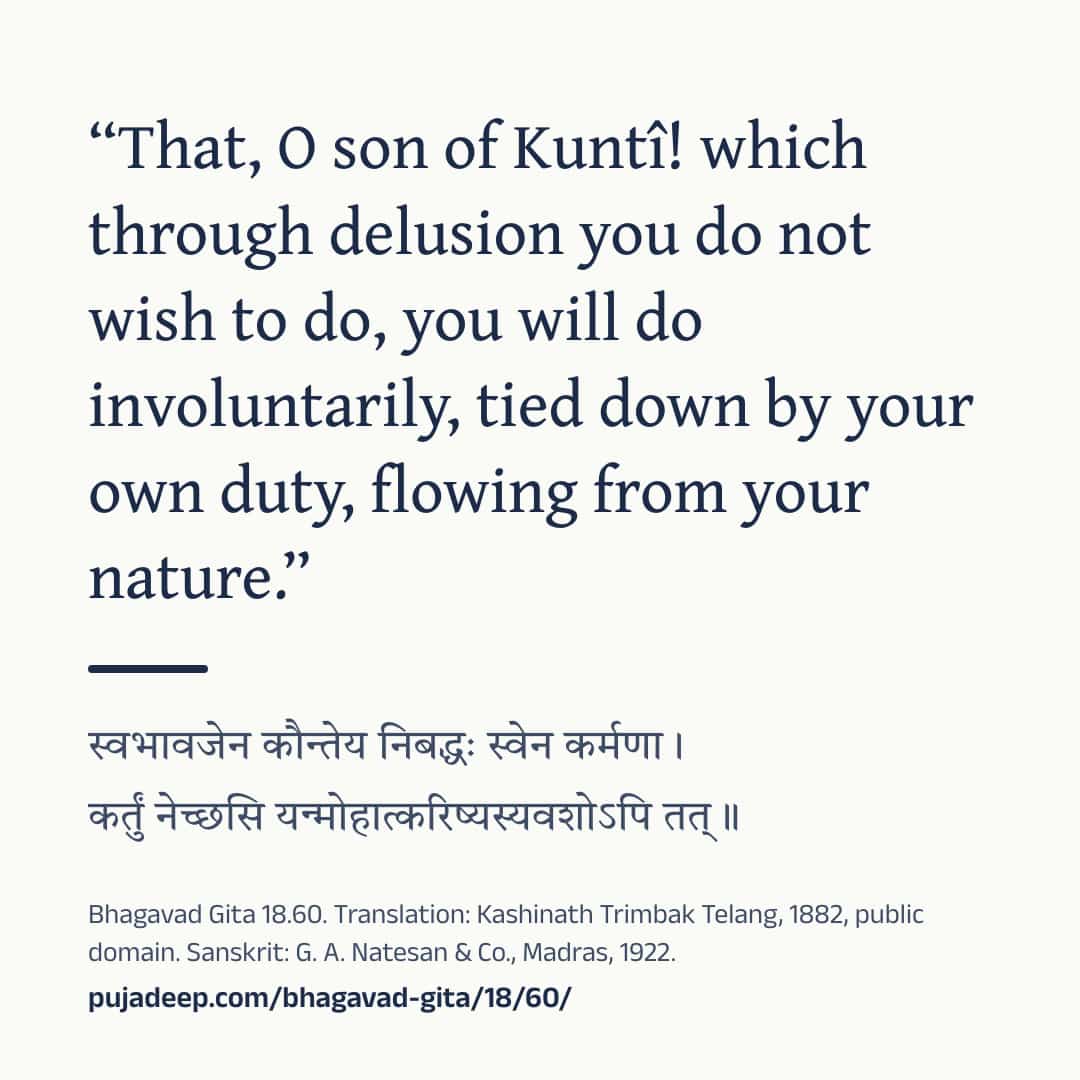
Drawing the picture
See the words
Bhagavad Gita 18.60

स्वभावजेन कौन्तेय निबद्धः स्वेन कर्मणा ।
कर्तुं नेच्छसि यन्मोहात्करिष्यस्यवशोऽपि तत् ॥

“That, O son of Kuntî! which through delusion you do not wish to do, you will do involuntarily, tied down by your own duty, flowing from your nature.”
(K. T. Telang, The Bhagavadgîtâ (The Sacred Books of the East, vol. VIII, Oxford: Clarendon Press, 1882), pp. 128–129, public domain)

“O son of Kuntî, bound by thine own Karma arising from thine own nature, that which from delusion thou desirest not to do, that even involuntarily thou wilt perform.”
(Annie Besant, The Bhagavad Gîtâ, or The Lord's Song (London: Theosophical Publishing Society, 1895), p. 164, public domain)

“Fettered, O son of Kunti, by thy own Karma, born of thy own nature, what thou, from delusion, desirest not to do, thou shalt have to do in spite of thyself.”
(Swami Swarupananda, Srimad-Bhagavad-Gita (Mayavati: Prabuddha Bharata Press, 1909; first printed in Prabuddha Bharata, 1907–1909), p. 346, public domain)

Sanskrit: G. A. Natesan & Co., Madras, 1922.
https://pujadeep.com/bhagavad-gita/18/60/ Nothing is sent from this site. Your own app sends it, to the chat you choose. The picture quotes the translation you chose on this page, with its name and year.
Sanskrit text: The Bhagavad-Gita, or The Lord's Song, with the text in Devanagari and an English translation, 1922. Meanings: written for Pujadeep and checked against the cited edition. Source and changes
Questions families ask
Who speaks Bhagavad Gita 18.60?
Krishna speaks this verse, in chapter 18 (Moksha Sannyasa Yoga).
Where does the Sanskrit text come from?
Sanskrit text: The Bhagavad-Gita, or The Lord's Song, with the text in Devanagari and an English translation, 1922. Meanings: written for Pujadeep and checked against the cited edition. See the source
Is the meaning on this page a translation?
Explanation written for this site from the sources listed here, and checked against the cited edition. It is not a translation and not the only way to read the text. Free to quote with credit.
Source and licence
- Sanskrit text
- The Bhagavad-Gita, or The Lord's Song, with the text in Devanagari and an English translation (Annie Besant, G. A. Natesan & Co., Madras, 1922). Public domain. The Sanskrit on these pages was read from this printing’s page images.
- Translation
- The Bhagavadgîtâ with the Sanatsugâtîya and the Anugîtâ, translated by Kâshinâth Trimbak Telang (The Sacred Books of the East, vol. VIII, ed. F. Max Müller) (Kashinath Trimbak Telang, F. Max Müller, Clarendon Press, Oxford, 1882). Public domain. Shown verbatim, as printed.
- Translation
- The Bhagavad Gîtâ, or The Lord's Song, translated by Annie Besant (Annie Besant, Theosophical Publishing Society, London, 1895). Public domain. Shown verbatim, as printed.
- Translation
- Srimad-Bhagavad-Gita, with Sanskrit Text; Paraphrase with Word-by-word Literal Translation; English Rendering and Comments, Index, &c., by the Swami Swarupananda (Himalayan Series, No. XX) (Swami Swarupananda, The Editors and Publishers, Advaita Ashrama, Mayavati, Prabuddha Bharata Press, Mayavati, Almora, Himalayas, 1909). Public domain. Shown verbatim, as printed.
- Common wording
- In this text, 32 words follow today's common wording, checked against sanskritdocuments.org; Sanskrit Wikisource; Gita Press, Gorakhpur; GRETIL, Göttingen and Bhaktivedanta Book Trust.
- Our explanation
- Explanation written for this site from the sources listed here, and checked against the cited edition. It is not a translation and not the only way to read the text. Free to quote with credit.
- Checked
- Checked against the cited edition, October 15, 2026.
- Updated
- October 25, 2026