Bhagavad Gita 18.51: meaning and translation
Chapter 18: Moksha Sannyasa Yoga. Krishna says
Krishna begins a description that runs to verse 53.
Click or tap a word for its meaning and its dictionary page.
Text and layers
Text and layers
These choices stay in this browser.
Bhagavad Gita 18.51
बुद्ध्या विशुद्धया युक्तो धृत्याऽऽत्मानं नियम्य च ।शब्दादीन्विषयांस्त्यक्त्वा रागद्वेषौ व्युदस्य च ॥
Buddhya vishuddhaya yukto dhrityatmanam niyamya chaShabdadinvishayanstyaktva ragadveshau vyudasya cha
buddhyā viśuddhayā yukto dhṛtyā’’tmānaṃ niyamya ca |śabdādīnviṣayāṃstyaktvā rāgadveṣau vyudasya ca ||
Our explanation Krishna begins a description that runs to verse 53. Such a person is joined to a pure understanding, controls himself with steadiness, sets aside sound and the other objects of the senses, and puts away liking and dislike.
हिंदी अर्थ कृष्ण एक वर्णन आरंभ करते हैं जो श्लोक 53 तक चलता है। ऐसा व्यक्ति शुद्ध बुद्धि से युक्त होता है, धृति से अपने को वश में रखता है, शब्द आदि विषयों को छोड़ देता है और राग-द्वेष को दूर कर देता है।
Word by word
Every word, with its dictionary page
Word by word
- बुद्ध्या buddhyā · with an understanding (noun (feminine), instrumental singular) Dictionary: buddhi, Monier-Williams 1899, p. 733, col. 3 “intelligence, reason, intellect, mind, discernment, judgment”
- विशुद्धया viśuddhayā · purified (past participle (feminine), instrumental singular) Dictionary: vi-śuddha, Monier-Williams 1899, p. 991, col. 2 “completely cleansed or purified (also in a ritual sense), clean, clear, pure”
- युक्तः yuktaḥ · joined, endowed (past participle (masculine), nominative singular) Dictionary: yukta, Monier-Williams 1899, p. 853, col. 2 “furnished or endowed or filled or supplied or provided with”
- धृत्या dhṛtyā · by steadiness (noun (feminine), instrumental singular) Dictionary: dhṛti, Monier-Williams 1899, p. 519, col. 3 “firmness, constancy, resolution, will, command”
- आत्मानम् ātmānam · oneself (noun (masculine), accusative singular) Dictionary: ātman, Monier-Williams 1899, p. 135, col. 1 “is used as reflexive pronoun for all three persons and all three genders”
- नियम्य niyamya · having controlled (absolutive (having done)) Dictionary: ni-yam, Monier-Williams 1899, p. 552, col. 1 “to hold in, keep down, restrain, control, govern, regulate”
- च ca · and (indeclinable) Dictionary: 2. ca, Monier-Williams 1899, p. 380, col. 1 “and, both, also, moreover, as well as”
- शब्दादीन् śabdādīn · sound and the rest (compound (masculine), accusative plural) Dictionary: śabda, Monier-Williams 1899, p. 1052, col. 2 “sound, noise, voice, tone, note”; 1. ādi, Monier-Williams 1899, p. 136, col. 3 “ifc. beginning with, et cætera, and so on”
- विषयान् viṣayān · objects of the senses (noun (masculine), accusative plural) Dictionary: viṣaya, Monier-Williams 1899, p. 997, col. 1 “an object of sense”
- त्यक्त्वा tyaktvā · having given up (absolutive (having done)) Dictionary: 1. tyaj, Monier-Williams 1899, p. 456, col. 3 “to leave, abandon, quit”
- रागद्वेषौ rāgadveṣau · liking and hatred (compound (masculine), accusative dual) Dictionary: rāga, Monier-Williams 1899, p. 872, col. 1 “any feeling or passion, (esp.) love, affection or sympathy for”; dveṣa, Monier-Williams 1899, p. 507, col. 1 “hatred, dislike, repugnance, enmity”
- व्युदस्य vyudasya · having cast off (absolutive (having done)) Dictionary: vy-ud-as, Monier-Williams 1899, p. 1040, col. 2 “to cast off, reject, give up, abandon”
- च ca · and (indeclinable) Dictionary: 2. ca, Monier-Williams 1899, p. 380, col. 1 “and, both, also, moreover, as well as”
1 printing differs
Edition differences. Another printing or text reads this place differently.
- Spelling A digital text reads Same words. The 1922 edition marks the merged long vowel with a double avagraha (धृत्याऽऽत्मानं); this e-text does not.
Old translations
Kashinath Trimbak Telang, 1882. Public domain. Page 127–128.
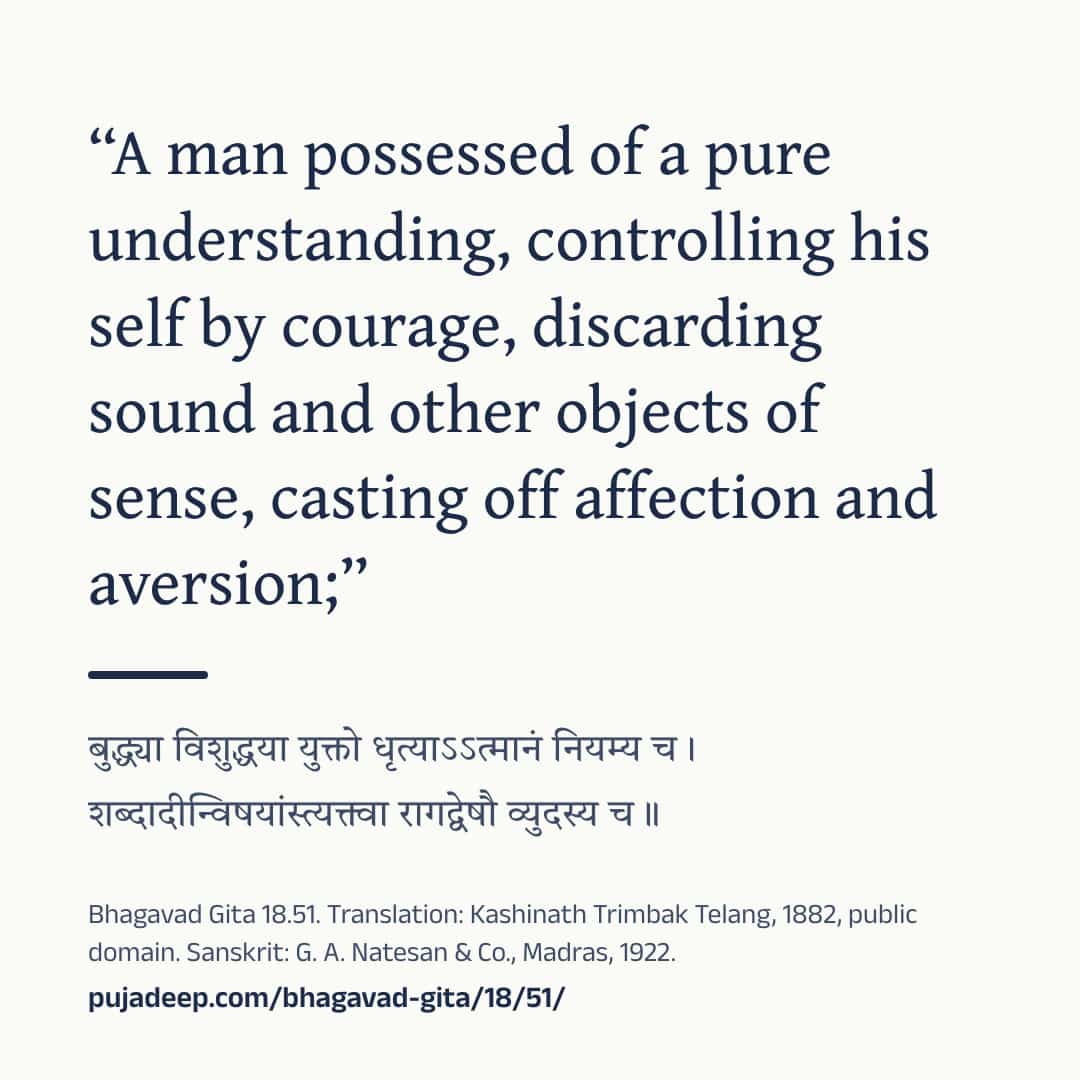
A man possessed of a pure understanding, controlling his self by courage, discarding sound and other objects of sense, casting off affection and aversion;
This sentence goes on in 18.52.
Compare 3 translations
Kashinath Trimbak Telang, 1882. Public domain. Page 127–128.
A man possessed of a pure understanding, controlling his self by courage, discarding sound and other objects of sense, casting off affection and aversion;
This sentence goes on in 18.52.
You are reading this one
Annie Besant, 1895. Public domain. Page 162.
United to Buddhi purified, controlling the self by firmness, having renounced sound and the other objects of the senses, having laid aside passion and hatred,
This sentence goes on in 18.52.
You are reading this one
Swami Swarupananda, 1909 (first printed 1907). Public domain. Page 342.
Endued with a pure intellect; subduing the body and the senses with fortitude; relinquishing sound and such other sense-objects; abandoning attraction and hatred;
This sentence goes on in 18.52.
You are reading this one
Cite this verse
The translation: K. T. Telang, The Bhagavadgîtâ (The Sacred Books of the East, vol. VIII, Oxford: Clarendon Press, 1882), pp. 127–128. Bhagavad Gita 18.51.
The translation: Annie Besant, The Bhagavad Gîtâ, or The Lord's Song (London: Theosophical Publishing Society, 1895), p. 162. Bhagavad Gita 18.51.
The translation: Swami Swarupananda, Srimad-Bhagavad-Gita (Mayavati: Prabuddha Bharata Press, 1909; first printed in Prabuddha Bharata, 1907–1909), p. 342. Bhagavad Gita 18.51.
Our explanation: “Bhagavad Gita 18.51: meaning and translation.” Pujadeep. Updated October 25, 2026. https://pujadeep.com/bhagavad-gita/18/51/
Pujadeep’s explanations are free to quote with credit: name Pujadeep and link to the page. How to credit
Classical readings, by school
No readings by school on this verse yet.
Share
Show the ways to share
Send one picture or the text to one chat. The picture names its source and the address of this page.
Drawing the picture
See the words
Bhagavad Gita 18.51

बुद्ध्या विशुद्धया युक्तो धृत्याऽऽत्मानं नियम्य च ।
शब्दादीन्विषयांस्त्यक्त्वा रागद्वेषौ व्युदस्य च ॥

“A man possessed of a pure understanding, controlling his self by courage, discarding sound and other objects of sense, casting off affection and aversion;”
(K. T. Telang, The Bhagavadgîtâ (The Sacred Books of the East, vol. VIII, Oxford: Clarendon Press, 1882), pp. 127–128, public domain)
This sentence goes on in 18.52.

“United to Buddhi purified, controlling the self by firmness, having renounced sound and the other objects of the senses, having laid aside passion and hatred,”
(Annie Besant, The Bhagavad Gîtâ, or The Lord's Song (London: Theosophical Publishing Society, 1895), p. 162, public domain)
This sentence goes on in 18.52.

“Endued with a pure intellect; subduing the body and the senses with fortitude; relinquishing sound and such other sense-objects; abandoning attraction and hatred;”
(Swami Swarupananda, Srimad-Bhagavad-Gita (Mayavati: Prabuddha Bharata Press, 1909; first printed in Prabuddha Bharata, 1907–1909), p. 342, public domain)
This sentence goes on in 18.52.

Sanskrit: G. A. Natesan & Co., Madras, 1922.
https://pujadeep.com/bhagavad-gita/18/51/ Nothing is sent from this site. Your own app sends it, to the chat you choose. The picture quotes the translation you chose on this page, with its name and year.
Sanskrit text: The Bhagavad-Gita, or The Lord's Song, with the text in Devanagari and an English translation, 1922. Meanings: written for Pujadeep and checked against the cited edition. Source and changes
Questions families ask
Who speaks Bhagavad Gita 18.51?
Krishna speaks this verse, in chapter 18 (Moksha Sannyasa Yoga).
Where does the Sanskrit text come from?
Sanskrit text: The Bhagavad-Gita, or The Lord's Song, with the text in Devanagari and an English translation, 1922. Meanings: written for Pujadeep and checked against the cited edition. See the source
Is the meaning on this page a translation?
Explanation written for this site from the sources listed here, and checked against the cited edition. It is not a translation and not the only way to read the text. Free to quote with credit.
Source and licence
- Sanskrit text
- The Bhagavad-Gita, or The Lord's Song, with the text in Devanagari and an English translation (Annie Besant, G. A. Natesan & Co., Madras, 1922). Public domain. The Sanskrit on these pages was read from this printing’s page images.
- Translation
- The Bhagavadgîtâ with the Sanatsugâtîya and the Anugîtâ, translated by Kâshinâth Trimbak Telang (The Sacred Books of the East, vol. VIII, ed. F. Max Müller) (Kashinath Trimbak Telang, F. Max Müller, Clarendon Press, Oxford, 1882). Public domain. Shown verbatim, as printed.
- Translation
- The Bhagavad Gîtâ, or The Lord's Song, translated by Annie Besant (Annie Besant, Theosophical Publishing Society, London, 1895). Public domain. Shown verbatim, as printed.
- Translation
- Srimad-Bhagavad-Gita, with Sanskrit Text; Paraphrase with Word-by-word Literal Translation; English Rendering and Comments, Index, &c., by the Swami Swarupananda (Himalayan Series, No. XX) (Swami Swarupananda, The Editors and Publishers, Advaita Ashrama, Mayavati, Prabuddha Bharata Press, Mayavati, Almora, Himalayas, 1909). Public domain. Shown verbatim, as printed.
- Common wording
- In this text, 32 words follow today's common wording, checked against sanskritdocuments.org; Sanskrit Wikisource; Gita Press, Gorakhpur; GRETIL, Göttingen and Bhaktivedanta Book Trust.
- Our explanation
- Explanation written for this site from the sources listed here, and checked against the cited edition. It is not a translation and not the only way to read the text. Free to quote with credit.
- Checked
- Checked against the cited edition, October 15, 2026.
- Updated
- October 25, 2026